Key Takeaways
- A practical MOQ for a custom growler is often 3,000-5,000 pcs, with 30-45 days standard lead time after sample approval.
- For stainless steel growlers, 18/8 steel and 0.6-0.8 mm wall thickness usually give better durability than bargain 0.4 mm builds.
- Ask for AQL 2.5/4.0 inspection, REACH documentation, and closure leak testing before you approve a production run.
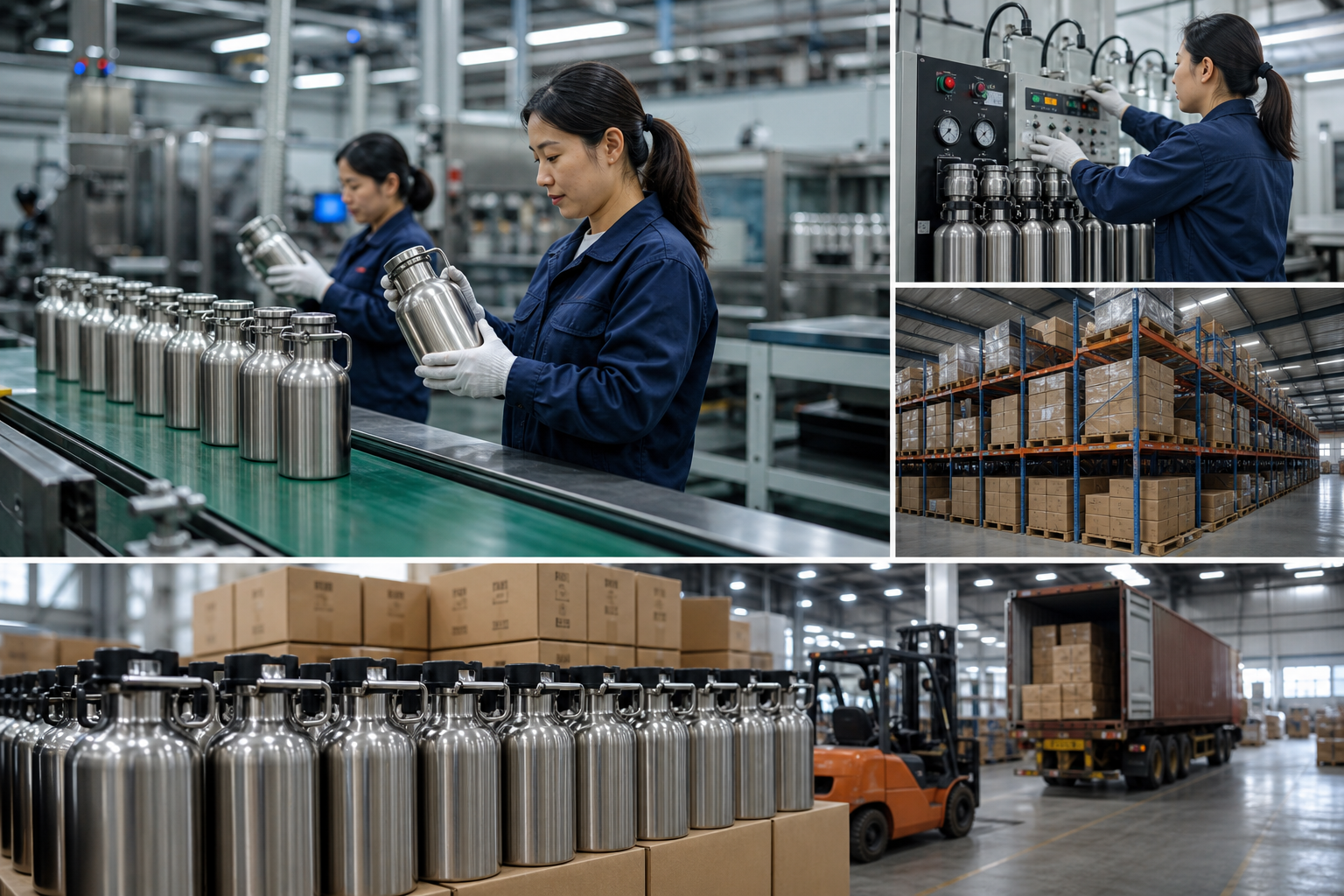
- A strong beer growler manufacturer in Zhejiang should show monthly output, decoration limits, and packaging options before quoting price.
If you are buying from a beer growler manufacturer, the job is not picking a shiny sample. It is matching capacity, cost, compliance, and decoration to the way you sell. A 64 oz stainless growler can look fine on a desk and still fail in the field if the cap leaks, the powder coat chips, or the wall gauge is too thin for repeated transport. We have seen a 0.4 mm wall pass the photo test and fail after a drop test at the line.
We build drinkware in Zhejiang, China, and the buyers who do well ask the plain questions first: What is the MOQ? What is the gauge? Is the finish REACH-compliant? Can you hold a 45-day lead time at 30,000 units/month? This is the wrong question to leave for the last email. The math does not work once the PO lands with a typo on the cap color or the carton count. If you are sourcing custom drinkware for retail, hospitality, or distributor programs, you need a supplier who knows the product and the shipment. QC pulled the sample, checked the threads, and caught the mismatch before we ran 5,000 pieces.
What a growler buyer actually buys
Most first-time buyers think they are buying a container. They are not. You are buying a system: bottle body, finish, closure, decoration, carton, and the factory’s ability to run the same result 5,000 or 50,000 times without the line drifting. We check neck threads with a go/no-go gauge at 0.1 mm. That is why a beer growler manufacturer should be treated like a production partner, not a catalog vendor.
A standard stainless steel custom growler for beer is usually 32 oz or 64 oz. The 64 oz version is the common retail format in the U.S. and parts of Europe, while the 32 oz size fits airline-friendly travel sets and premium gift programs better. We see buyers push for one size for everything, and that is the wrong question to ask. If you are building a custom drinkware line, decide early whether the growler is for taproom resale, distributor drinkware, seasonal promotion, or e-commerce. The use case drives the finish, cap type, and packout.
For a brewery, a customized growler often needs a wide mouth for filling and cleaning. For a canteen distributor or canteen supplier handling mixed drinkware programs, the priority may be SKU efficiency, not just one item. We have seen this go sideways when a buyer wanted six cap styles on a 3,000-piece order, then complained about lead time. That is where a canteen manufacturer mindset helps: keep parts standard where possible, customize only where the margin supports it.
Common buyer decision points
- Capacity: 16 oz, 32 oz, or 64 oz
- Material: 304 stainless steel, 316 for special corrosion needs
- Closure: screw cap, swing-top, or tethered cap
- Decoration: silkscreen, laser engraving, UV print, powder coat
Material and wall gauge matter
Do not let anyone sell you on appearance alone. A growler can feel heavy and still be wrong. Material grade, wall thickness, rim construction, weld quality, and the closure interface decide whether the bottle holds up in the field. For stainless growlers, 304 steel is the default. It stands up to beer, coffee, and water, and it is the spec we run for a canteen custom or custom drinkware program with normal retail expectations.
Wall thickness is where factories in China separate real production from cheap sourcing. For a 64 oz stainless growler, 0.6 mm is a workable baseline, 0.7-0.8 mm is the safer call for premium positioning, and 0.4-0.5 mm is what shows up when the buyer pushed the target too far. We had one PO with “0.6mm” typed as “0.06mm”; QC pulled the sample, and the buyer flagged the dent after one drop test from 80 cm. The math does not work when gauge gets cut first.
If your program includes a canteen customizable or customized canteen line with different capacities, keep the steel spec the same across SKUs. That keeps the tooling set and the QC checklist tighter. A good canteen factory will tell you when a decorative finish is easier to run than a structural change. We run that call every week on the line, and it saves money.
Practical spec target: 304 stainless steel, 0.7 mm wall thickness, polished interior, and a leak-tested closure with 100% final inspection on the first 500 units.
For promotional items, a canteen promotional budget may tempt you toward the cheapest build. Do not do that unless the item is truly disposable. Buyers who want to stay with the same canteen vendor for two or three seasons should pay for durability up front. The gap between a $3.40 FOB unit and a $4.10 FOB unit is often the gap between a repeat order and a complaint.
Decoration choices that hold up
Decoration is where custom drinkware either looks like a real brand or like a rushed private-label job. For a beer growler manufacturer, the right method comes down to artwork, order size, and the finish on the bottle. One-color silkscreen is still the lowest-cost choice for simple logos at 3,000 pcs and up. Laser engraving gives a permanent clean mark, but it does not work when the buyer needs strong brand color. UV print handles finer detail; it needs a surface that can hold the ink, and we tell buyers up front that the wear profile is different from laser or silk.
Powder coating sells well because it hides small forming marks and gives a better hand feel. It changes the decoration plan. If the logo is 12 mm wide and the coat has a rough texture, the mark can disappear on the shelf. We have seen this go sideways. A customized growler sample should be checked under the same lighting as the retail photo spec, with the same 5000K light on the bench. Buyers sometimes approve one sample, then flag the bulk run because the logo sits lower or reads duller. That is usually an approval issue, not a line problem.
For canteen manufacturers and canteen distributors offering broader lines, we run the pricing in three tiers:
- Entry: one-color print, standard carton
- Mid-range: laser logo, matte powder coat
- Premium: full-wrap print, gift box, spare gasket
If you sell through Amazon or direct-to-consumer, the packout changes fast. FNSKU labeling, suffocation warning bags, and a drop-test-ready carton are all part of the job. We ship this every week. A solid beer growler manufacturer should quote decoration and packaging as separate line items, because a vague unit price hides the real cost and the math does not work.
MOQ, price, and lead time
This is where buyers save or lose real money. For a typical custom growler project, the MOQ is often 3,000 pcs for a single color and can rise to 5,000 pcs if you need special molds, multi-step printing, or custom caps. A realistic FOB China price for a 64 oz 304 stainless growler usually lands around USD 3.40-6.80 depending on wall thickness, coating, and packaging. On the line, a 1.0 mm shell and a 2.0 mm shell do not cost the same. If someone offers you a premium-looking item for USD 2.20 FOB, the math does not work and the factory is cutting somewhere you have not noticed yet.
Lead time is usually 30-45 days after sample approval and deposit. If the factory in Zhejiang is already running a 30,000 units/month line, they may still ask for a longer lead time in peak season because decoration and packing bottlenecks matter more than shell forming. QC pulled the sample, then found a carton mark mismatch, and that alone pushed dispatch by 4 days. That is normal shop-floor behavior, not an excuse. Ask for a production calendar, not a promise.
For canteen customized programs and distributor canteen orders, pricing becomes cleaner when you standardize:
- Same body shape across colors
- Same cap across capacities
- Same carton across SKUs
That is how a canteen supplier keeps your unit cost under control. We have seen a buyer push back on a 500-piece color split, then save 8-12 percent once the line ran one cap and one carton spec. It also makes reorder timing easier for canteen distributors and distributor growler programs that need stable margin over multiple seasons.
Do not accept a quote without clarifying Incoterms. FOB Ningbo or FOB Shanghai are common for Zhejiang exports. If you need DDP, expect the logistics cost, duties, and brokerage to change the economics fast. We once caught a PO typo that turned FOB into DDP on paper, and the buyer flagged it before the shipment left the warehouse. This is the right question to ask before you compare prices.
Quality checks before shipment
Quality control is not a certificate on a wall. It is what the buyer can verify before the container closes. For custom drinkware, ask the factory to set inspection points by defect class: critical, major, minor. On our line, we run AQL 2.5 for major defects and AQL 4.0 for minor defects, with leak points, sharp edges, coating adhesion, and logo position checked one by one. The buyer flagged a 2 mm logo shift once; the math did not work, and we reprinted the run.
A beer growler manufacturer in China should do a leak test, cap torque test, and finish adhesion check before packing. If the product has a vacuum wall, add thermal retention testing and a condensation check. For stainless steel items, ask for material confirmation and migration paperwork when the destination market requires it. REACH for Europe is a basic request, and ASTM-style performance references are common in the U.S. buyer mindset, even when the exact test method varies by product. QC pulled the sample at 18 kg pressure and found one cap thread issue before it left the workshop.
Here is what experienced buyers should request before shipping:
- Pre-production sample signed off in writing
- Golden sample retained by both sides
- In-line inspection after first 1,000 units
- Final random inspection before carton sealing
If you are buying from a canteen factory that also serves canteen manufacturers and canteen vendors across categories, ask how they keep coating colors and print setups separate. We have seen this go sideways: black dust inside a white-coated custom canteen, and the buyer had to sort 3,200 units by hand. One typo on a PO, one wrong ink tray, and the whole shipment slows down.
When a growler becomes a broader program
Most buyers start with one custom growler SKU and end up with a line. We see it every season. If you are a brand owner, distributor, or retailer with Q4 demand, the first order works, then the buyer flags the next need: matching canteen customizable items, travel tumblers, or a custom canteen line for office water. A supplier who only quotes one item will slow you down when the PO lands with 3 SKUs instead of 1.
This is where factory logic matters more than the product name. A canteen manufacturer that also runs custom drinkware in multiple shapes can keep artwork aligned across the line. The best canteen distributors do not chase random SKUs. They build a product family with one color system, one logo rule, and carton sizes that fit the same pallet pattern. QC pulled the sample at 2 mm off-center once; that kind of miss is small, but it shows up on repeat orders.
For example, you can structure a line like this:
- Beer growler: 64 oz, matte powder coat, laser logo
- Custom canteen: 500 ml, carabiner cap, screen print
- Customizable growler: same body, multiple lid colors
That cuts sampling time and makes reorder quoting faster. It also keeps the sales script clean. One buyer once sent a PO with “640z” typed as “64ozs”; we caught it before production, but that typo would have broken the carton label run. In Zhejiang, factories that run this way usually hold repeat quality better than shops jumping between unrelated categories all week.
If you want one supplier relationship to last past one buying season, build the program as a system. The math works. A line with shared caps, shared artwork rules, and shared packaging beats one-off buying every time.
Get a quote for your growler program
Send your target capacity, MOQ, artwork, and destination market. We will tell you what is realistic, what is risky, and what it should cost FOB China.
Frequently asked questions
What is a reasonable MOQ for a custom beer growler?
For a standard 64 oz stainless custom growler, a practical MOQ is usually 3,000 pcs per design and color. If you need a custom cap, special carton, or multi-step decoration, 5,000 pcs is more realistic. For smaller pilot runs, some China factories in Zhejiang can do 1,000-2,000 pcs, but the unit price will rise fast, often by 15%-30%. A serious beer growler manufacturer should tell you the MOQ by process, not hide it in one vague quote.
What price should I expect FOB China?
For a 64 oz 304 stainless growler, FOB China pricing often falls around USD 3.40-6.80 per unit. The lower end usually means simpler print, thinner gauge, and basic packaging. If you want 0.7-0.8 mm wall thickness, matte powder coating, and a premium carton, expect the price to move upward. In Zhejiang, logistics to Ningbo or Shanghai is usually straightforward, but your final landed cost depends on carton size, palletization, and destination duties.
How do I know the growler will not leak?
Ask for a 100% leak test on the first production batch and clear sampling rules afterward. A proper beer growler manufacturer should test the closure, gasket fit, and torque consistency. For screw caps, request cap torque values in writing. For swing-top styles, ask for gasket compression checks. In practice, a good factory will also keep a golden sample and use AQL 2.5 for major defects. Never approve a run without written leak-test results.
Can I use one supplier for canteens and growlers?
Yes, if the factory has real drinkware tooling and not just a trading-house catalog. A capable canteen factory can often handle custom canteen, customized canteen, and growler programs if the materials and decoration lines are set up properly. The advantage is consistency: the same color codes, the same artwork control, and easier reorder management. For distributor drinkware programs, one supplier can reduce freight complexity and improve margin control, especially if monthly output is above 20,000 units.
What compliance documents should I ask for?
For Europe, ask about REACH and any relevant food-contact declarations. For the U.S., ask for material specs, migration-related support, and packaging compliance if you are shipping retail units. If the product is stainless steel, confirm 304 or 316 material and request test records for coating adhesion and leak performance. A dependable beer growler manufacturer in China should also be able to provide factory audit documents such as BSCI or ISO evidence if your retailer or distributor requires them.