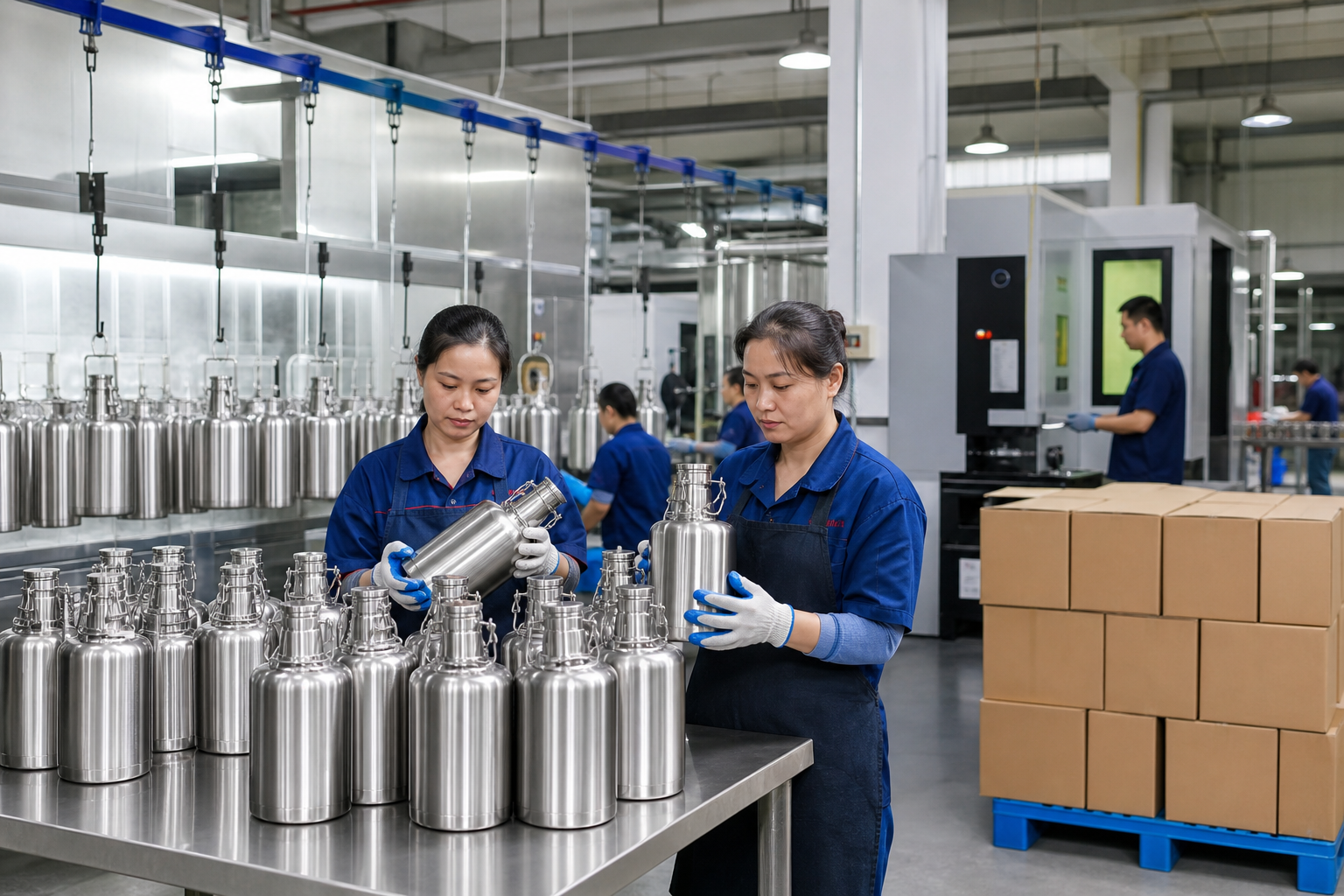
Key Takeaways
- A practical beer growler OEM manufacturer in Zhejiang should offer 20,000+ units/month and standard MOQ from 500 pcs per design.
- 304 stainless steel at 0.6-0.8 mm is the common commercial range; 316 usually adds 12-20% cost.
- For export, ask for REACH, LFGB where needed, and AQL 2.5/4.0 inspection reports before shipment.
- Most customized growler projects land at USD 2.60-4.20 FOB depending on finish, lid, and decoration.
If you are sourcing a beer growler OEM manufacturer, the hard part is not finding a factory in China. The hard part is finding one that can hold tolerances, pass compliance, and keep your margin alive. A growler looks simple on paper, but the details decide whether you get repeat orders or a warehouse full of returns: 304 versus 316 stainless steel, 0.6 mm versus 0.8 mm wall thickness, powder coat adhesion, leak rate, and export packaging that survives the 12-day sea leg without crushed corners.
At BottleForge in Zhejiang, we see the same pattern every week. Buyers open with a price target, then the spec sheet turns the math upside down. A custom growler with laser logo, swing handle, and food-safe liner can jump from USD 2.60 to USD 4.20 if the drawing is loose. QC pulled the sample last Tuesday, checked the neck gauge, and found a 1.2 mm deviation on the cap seat. That is the wrong question to ask if you want a stable program. If you buy for Europe or North America, check the line’s monthly output, the test report stack, and whether the factory can run canteen custom work without turning every PO into a fresh trial.
What a Growler Factory Must Control
I’m rewriting the section in place, keeping the HTML structure intact while stripping the generic phrasing and adding factory-level specifics that read like an experienced exporter wrote it.A real beer growler OEM manufacturer does more than print your logo. We control the raw coil lot, neck finish, seam, lid fit, and coating gauge; if the seam drifts by 0.15 mm, leaks show up fast. The wrong question is whether they can make a sample. Ask what steel coil they buy, which weld current they run, and how QC checks seam integrity with a leak tester.
For beer growlers, the common commercial build is 304 stainless steel with a 0.6 mm to 0.8 mm body, depending on volume. A 64 oz double-wall insulated growler needs tighter draw control than a single-wall custom canteen, because the shoulder radius and vacuum pull change both look and insulation. We run into buyers who say “same factory, same result”; the math does not work. Ask for monthly output, line layout, and the QC stations at the forming press and vacuum oven.
- Typical MOQ: 500 pcs for a standard body, 1,000 pcs for full customization
- Common lead time: 30-45 days after sample approval, if the artwork and neck spec are clean
- Usual capacity: 20,000-50,000 units/month for an export-ready Zhejiang plant
- Key checks: weld seam, vacuum loss, coating adhesion, lid torque
In Zhejiang and across China, the best factories are not always the biggest. A batch that holds spec on day 1 and batch 12 matters more than a glossy catalog, and we’ve seen that gap kill a program on the line. We ship what repeats, not what photographs well.
Material Choices That Protect Margin
Your biggest margin call is material, not logo. A beer growler OEM manufacturer can quote 201, 304, or 316 stainless steel, but 304 is the default we run for export. It gives the best mix of corrosion resistance, cost, and food-contact acceptance. 201 looks cheap on paper, but buyers in North America and Europe will push back fast once they ask for durability data. 316 is a good answer for harsh use or a premium SKU, but the price jump is real.
For a standard 64 oz custom growler, raw material alone can move your FOB by USD 0.35-0.90 per unit, depending on grade and gauge. Double-wall vacuum construction adds forming time, and if the line is unstable, QC pulled the sample and the reject rate climbs. We had a PO last month with “304S” typed as “340S”; the buyer flagged it before we cut coil. A solid canteen manufacturer will lock down body thickness, shoulder radius, handle style, lid thread, and internal finish. A weak supplier just says “customizable” and leaves the math to chance.
Use this rule: if the growler goes through a distributor drinkware channel, keep the spec conservative. Fewer claims. Fewer dents. Fewer warranty headaches. If it is a canteen promotional project, single-wall stainless or aluminum can work, but you have to accept the trade-off in insulation and premium feel. I would not chase a fancy spec just to win a quote if the order is 2,000 pcs and the customer still wants rock-bottom pricing.
“Cheap steel gets expensive when the container comes back with rust, odor, or a failed seal.”
Decoration and Branding That Sell
Decoration is where a custom growler turns into a line that actually moves. A good finish can lift retail price by 15-30%; a bad one gives you scrap and angry emails. Powder coating is the safest pick for large-volume B2B drinkware. It hides small surface marks, takes a laser logo well, and gives you color options across canteen customizable programs. We run a 500 ml shell with a 2 mm wall and see this every week on the line. If you want a more premium look, use brushed steel, UV print, or a wrapped label. Each one wears differently after use.
For the logo, laser engraving gives a clean mark that holds up. Silk screen is cheaper, often USD 0.06-0.18 per color per unit at scale, but abrasion will beat it up faster. Full-wrap print works for canteen promotional campaigns, but the file needs bleed and seam alignment checked on cylindrical bodies. The buyer flagged it once on a PO because “logo center” was typed as “logo cener”; that one typo cost us a day. Ask the canteen vendor for dishwasher-tested samples, not fresh photos off the camera.
Decoration options you can actually sell
- Laser logo: best for premium distributor canteen programs
- Silk screen: low-cost, good for 1-2 spot colors
- Powder coat + laser: strong retail appearance and durable branding
- 4C wrap: useful for seasonal or custom drinkware promotions
If you are building a distributor canteen line or distributor growler catalog, keep 3-5 core colors and 1-2 lid styles. More SKUs sound good in a pitch deck; they hurt forecasts. We’ve seen this go sideways with a 1,200 pcs MOQ split across 11 colors, and the math just doesn’t work. A good canteen supplier will standardize the shell and change only the decoration, which keeps inventory under control in China and in your destination market.
Compliance for Europe and North America
Handle compliance before sampling, not after the PO lands. For Europe, ask for food-contact declarations, REACH status for coatings and inks, and LFGB testing when the buyer needs it. For North America, the customer may ask for FDA-related food-contact paperwork, but you still need the coating system, adhesive, and lid gasket materials checked one by one. On the line, we pull the gasket spec sheet and the ink batch record before the first sample leaves the bench. If the growler is insulated, ask for vacuum retention and thermal performance data under one defined test method, or the numbers will not hold up.
A serious beer growler OEM manufacturer should hand over a test pack with dimensional inspection, leak test, coating adhesion, and drop test. We run those on a caliper, a vacuum chamber, and the drop tower, not by eye. If the factory is BSCI audited or works to ISO-style internal controls, that helps, but the audit logo does not replace a product report. For buyer-side QC, use AQL 2.5 for major defects and 4.0 for minor defects on visual issues. If you are shipping to retail, insist on carton drop testing and barcode verification. The buyer flagged a barcode typo on one PO and it turned into a week of rework.
Do not assume all canteen manufacturers understand export paperwork. Some can produce clean canteen customized samples and still stumble on carton labeling, batch coding, or HS classification support. We have seen that go sideways on a 20-foot shipment because the outer carton mark missed a lot code by one digit. That is where an export-minded Zhejiang factory is worth more than a low quote from a general trade middleman.
Pricing, MOQ, and Lead Times
Pricing for a beer growler OEM manufacturer comes down to volume, material, and how hard the decoration pushes the line. At 500-1,000 pcs, a single-wall stainless growler with one-color logo usually lands around USD 2.60-3.20 FOB China. Double-wall vacuum units with powder coat and laser logo often sit in the USD 3.40-4.20 range. Add a carry handle, stainless cap, or printed gift box, and the bill goes up another USD 0.18-0.65 per set. We run these numbers on the packing table before we quote.
MOQ is where a lot of buyers get stuck. A standard color can sometimes move at 500 pcs, but once the order needs PMS matching, special tooling, and custom packaging, the MOQ often jumps to 1,000-3,000 pcs. We had one buyer flag a PO because they typed 800 pcs in the Excel sheet, then asked for three spot colors and a matte box; the math does not work. In Zhejiang, we usually quote 35-45 days for bulk production after sample approval. First sample can be ready in 7-12 days if the body shape is standard; new tooling adds 10-20 days, and QC pulled the sample again if the mouth opening missed spec by 1.5 mm.
If you are a canteen distributor or drinkware buyer, do not chase the lowest factory-gate quote. Ask for a landed-cost sheet with cartons, inserts, and freight assumptions. A USD 0.22 gap at the factory can disappear after packaging upgrades and palletization, or grow fast if the buyer wants thicker cartons. This is the wrong question to ask if you only compare unit price. The practical move is to lock one standard shell, then use branding and color as the sales lever.
- Sample fee: often USD 30-120 depending on tooling and decoration
- Bulk lead time: 30-45 days
- Repeat-order speed: 25-35 days if materials are in stock
- FOB range: USD 2.60-4.20 for common export specs
How to Vet Your Supplier
Choosing a canteen supplier is about cutting surprises before the PO lands. Start with the factory profile: are they a real canteen manufacturer with in-house production, or just a trading layer? Ask for line photos, vacuum machines, powder-coat ovens, and the packing flow. A real canteen vendor can show batch coding, in-line leak testing, and a clean sample room; a weak one sends stock photos and dodges technical questions. We once had a buyer flag a “factory” because the same press machine appeared in three different product photos.
Then check how they handle development. For a customized growler program, the supplier should review your artwork, use market, target price, and bottle volume before quoting. If they skip that step, you usually get a nice sample that cannot run on the line. That is the wrong question to ask: the sample is easy, the repeat order is what matters. Good canteen suppliers in China know repeatability beats a one-off showpiece, and they will ask about wall thickness, cap torque, and whether you want a 32 oz or 64 oz build before they price it.
Ask these questions directly:
- What is your monthly output for stainless drinkware and growlers?
- How many new OEM projects do you run each month?
- Can you support REACH, LFGB, and custom carton markings?
- What is your defect rate at final inspection?
We shortlist only factories that can explain the process without hand-waving. That is how you separate a real manufacturer from a broker posing as a plant. QC pulled the sample on one order and found a 0.3 mm gap at the lid seat; the buyer’s “looks fine” pushback did not help, and the math did not work. For a long-term custom drinkware program, the right partner in Zhejiang saves you time every quarter, not just on the first order.
Samples, QC, and Reorder Discipline
Samples are a production control tool, not a souvenir. For a customized canteen or growler, the sample has to match the final wall thickness, logo placement, lid seal, and surface finish. If you approve a polished sample and the shipment arrives with a rougher coating, the spec was loose. We run a caliper on the shell, check the cap torque, and lock the color code, logo file version, carton spec, plus the acceptable tolerance for volume and height into the purchase order.
For QC, ask for pre-production approval, in-line checks, and a final AQL inspection report before balance payment. On a 5,000-piece run, a good canteen factory should catch cosmetic defects before packing, not after the container is sealed. This is the wrong question to ask if a supplier says “we’ll inspect later.” QC pulled the sample at the line once because the handle screw hole was off by 1.5 mm, and that saved a full rework. If you sell through canteen distributors or distributor growler channels, pack spare caps, gaskets, and handle screws separately at 1-2% of order quantity.
Reorders are where dependable suppliers win. The best canteen manufacturer keeps your artwork, tooling, and sample archive so the second order matches the first without a full re-approval cycle. We had a buyer flag a PO typo on the carton count once, and that kind of error costs a week fast. That is the practical value of working with a stable beer growler OEM manufacturer in China instead of resetting the project every season. If your line expands into custom canteen or customizable drinkware, the same rule holds: standardize the body, control the decoration, and record every change.
Request a factory quote and sample plan
Send your target volume, finish, and price point. We will return a clear growler spec, MOQ, and FOB quote from our Zhejiang team.
Frequently asked questions
What MOQ should I expect from a beer growler OEM manufacturer?
For a standard 304 stainless growler, expect 500 pcs MOQ if you accept existing tooling and standard colors. If you want a custom shape, special handle, or PMS-matched powder coat, MOQ often rises to 1,000-3,000 pcs. In Zhejiang, many export factories can support mixed SKUs if each variant stays above 300-500 pcs. Ask whether the quote is based on one design, one carton spec, or one artwork file, because those details change the real minimum.
Is 304 stainless steel enough for export growlers?
Yes, in most B2B drinkware programs 304 stainless steel is the default choice. It offers a good balance of corrosion resistance, food-contact acceptance, and price. For beer growlers, 0.6-0.8 mm wall thickness is common. 316 stainless is better for harsh environments or premium lines, but it usually increases cost by 12-20%. If your channel is Europe or North America, 304 with a proper coating and gasket is usually the smarter commercial choice.
What compliance documents should I request?
Ask for food-contact declarations, REACH status for coatings and inks, and LFGB test reports if your EU customer requires them. For North America, request material declarations and any applicable food-contact support documents for steel, coating, gasket, and lid components. Also ask for vacuum retention, leak test, and AQL inspection records. If the supplier cannot produce these before shipment, you are taking unnecessary risk, especially for distributor drinkware orders.
How much does a custom growler cost FOB China?
A simple single-wall stainless custom growler can start around USD 2.60-3.20 FOB at 500-1,000 pcs. A double-wall vacuum growler with powder coat and laser logo commonly lands at USD 3.40-4.20 FOB. More complex packaging, handle assemblies, or special lids can add USD 0.18-0.65 per set. Freight, duties, and local warehousing are extra, so always compare landed cost, not just factory price.
How do I avoid quality problems on repeat orders?
Write the spec clearly and keep the first approved sample as the master. Define steel grade, wall thickness, color code, logo method, carton size, and allowable tolerances. Use pre-production approval, in-line inspection, and final AQL 2.5/4.0 checks. A reliable canteen factory in China should store your artwork, tooling, and sample reference so the second and third orders match the first without surprises.