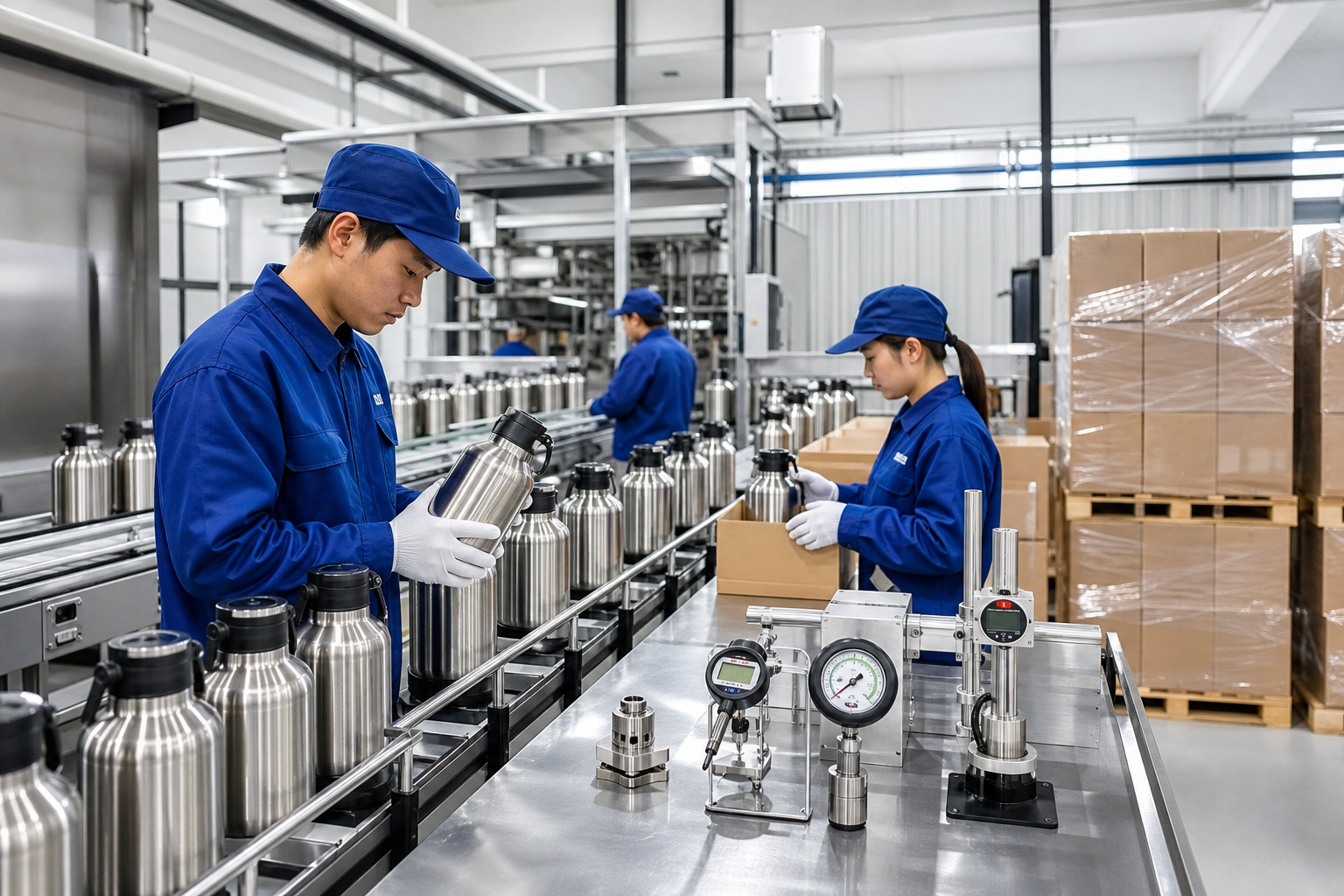
Key Takeaways
- Most beer growler private label projects start at 1,000–3,000 units MOQ, with 25–35 days lead time after sample approval.
- 304 stainless steel growlers usually use 0.5–0.7 mm wall thickness; 18/8 grade is the standard request for custom drinkware.
- Expect FOB China prices around USD 2.80–6.50 per unit depending on size, coating, and decoration.
- AQL 2.5 for critical defects is a practical inspection target for canteen distributor programs and retail-ready orders.
If you are sourcing beer growler private label products, the real job is not picking a shape. It is controlling leak rate, decoration quality, compliance, and landed cost before you commit to 2,000 or 5,000 units. We had a buyer flag a cap thread typo on a PO once, and that one line would have sent the whole run sideways. A growler can look clean on a mockup and still fail in transit, sweat at the wrong time, or get bounced by a retail buyer because the cap finish or print registration is off by 1.5 mm.
We build custom drinkware in Zhejiang, China, and the same rule applies to beer growlers, stainless flasks, and custom canteen programs: lock the specs early or pay later in rework and chargebacks. QC pulled the sample at the line and measured wall thickness at 0.8 mm, then checked the coating adhesion before release. A serious canteen manufacturer should give you wall thickness, coating method, MOQ, lead time, and test data, not vague promises. For private label, that is the difference between a SKU that ships clean and dead inventory on a warehouse rack.
What private label buyers really buy
When you buy a beer growler private label program, you are not buying a container. You are buying a repeatable SKU that has to survive filling, sealing, warehouse stacking, and real customer use. The spec needs to spell out metal grade, volume tolerance, lid torque, coating thickness, logo wear, carton strength, and the exact leak and drop test. QC pulled one sample with a torque wrench and found the cap drifting after 18 turns. That is the kind of miss that kills a launch.
For most B2B buyers, the fast-moving format is a 64 oz stainless growler with a brushed or powder-coated body. A China factory will usually quote by volume, decoration, and closure type. If you want a canteen customizable line for outdoor retail, ask for a 304 stainless body, a PP or stainless lid, and a gasket that passes hot-water leak testing at 70–90°C. We ship plenty of these, and the buyer usually pushes back on price until the carton fails a 1.2 m drop. Skip those details and you are not sourcing customizable drinkware. You are buying a problem.
A practical procurement brief should include:
- Capacity: 32 oz, 64 oz, or 128 oz
- Material: 304 stainless or glass-lined interior if specified
- Decoration: silk screen, laser, or full-wrap UV print
- MOQ: usually 1,000–3,000 pcs per color
- Lead time: 25–35 days after sample approval
If you are also planning a canteen promotional line, use the same standard. A canteen supplier that cannot state wall thickness in millimeters is not ready for distributor drinkware programs. We have seen a 0.2 mm gap turn into a leak claim on the first 500 pcs. The math does not work.
Material choices that affect margin
Material choice decides your defect rate, not just your unit cost. For a private label growler, 304 stainless is the safest default. It resists corrosion, survives repeated washing, and gives you a better shot at passing REACH buyer checks in Europe and North America. We had one buyer flag a 201 grade sample after a 72-hour salt test, and the math stopped there. If your customer is a distributor canteen buyer selling outdoor, gym, or brewery retail, 304 stainless is easier to move than a cheaper metal with vague alloy content.
Most beer growler private label orders sit in a cost band where 0.1 mm matters. That tiny shift in wall thickness changes weight, freight, and hand feel. Our line usually runs 0.5–0.7 mm for a quality stainless growler. Go thinner and dents show up in transit. Go thicker and you pay more to ship the same bottle. This is the wrong question to ask if you only look at factory price; a 12-day freight difference can erase the saving fast.
Glass growlers bring higher breakage risk in carton handling, but premium branding can still carry the order. Stainless gives you durability and fewer claims. For custom canteen or customized growler programs, ask for material certificates, salt spray targets if coated, and whether the body is one-piece drawn or welded. QC pulled the sample on a welded neck once and found a 0.3 mm seam mark under bright light. In Zhejiang, plenty of factories can make both, but not every canteen vendor keeps the same finish across all lots.
Price is visible on the quote. Cost of failure shows up later in chargebacks, returns, and lost reorders.
Decoration that survives shipping
Decoration is where a lot of private label orders go off the rails. The mockup looks fine on a screen, then the carton takes two extra handlings and the logo shifts 1.5 mm or starts flaking at the edge. If you want custom drinkware that sells, the decoration has to match the line we run, not someone’s taste board. For a beer growler private label order, the usual picks are silk screen, laser engraving, heat transfer, and powder coating with one-color logo.
Silk screen works for a clean logo and low unit cost. Laser engraving gives you permanent branding on stainless, and it holds up better after 12 days in transit than a weak topcoat. UV print can carry more colors, but the surface prep has to be tight. We ask the canteen factory what ink system they use, then we check whether the logo passes alcohol rub and dishwasher rub tests. If they dodge that question, the buyer flagged it for a reason.
Typical decoration economics look like this:
- Laser engraving: USD 0.20–0.45 per unit
- 1-color silk screen: USD 0.08–0.18 per unit
- 3-color print: USD 0.20–0.60 per unit
For canteen distributors, keep one decoration method across your custom canteen line, your custom growler line, and the bundle SKUs. That cuts prepress mistakes and keeps inventory from turning into a mess. We ran a 5,000-piece test last season, and the PO had “stainless” typed as “stainess” on the draft; QC pulled the sample, fixed the art, and saved a reprint. In Zhejiang, factories can run all three methods on the same floor, but ask for a print sample and a signed color target. The math doesn’t work if you skip that step.
MOQs, lead times, and pricing
If you want a real private label quote, start with quantity. We run the line by batch, not by wishful thinking. For most beer growler private label projects, MOQ starts at 1,000 pcs for one design and one color, and 3,000 pcs if you want multiple finishes or mixed lid options. Some canteen manufacturers in Zhejiang will take 500 pcs, but the unit price can jump 18% to 30% because setup cost gets spread too thin. On the shop floor, we check the 1.2 mm wall spec before we talk price.
FOB China prices for a standard 64 oz stainless growler usually land between USD 2.80 and USD 6.50 depending on body thickness, powder coating, lid type, and logo method. Add packaging and you may be at USD 3.10 to USD 7.20 before freight. If you are a canteen distributor selling into retail, that range matters because your margin is often 2.2x to 2.8x landed cost, not 5x fantasy math. We had a buyer push back on a $0.18 powder-coat upgrade last quarter, then the carton failed a 3-corner drop test and the math got worse.
Lead time is usually 25–35 days after sample approval and deposit. Add 5–7 days for sample making and another 20–35 days for ocean freight to North America or Europe, depending on port and season. A serious canteen vendor should also quote spare parts separately: gaskets, caps, and cartons. That is how you protect repeat orders and avoid a dead SKU because one cap supplier missed a batch. QC pulled the sample against a 28 mm thread gauge before we released the mold.
One practical note from Zhejiang: if you need both beer growler private label and a matching canteen promotional run, combining them in one production schedule can reduce setup loss by 8% to 12%. This is the wrong question to ask if you are only chasing the lowest unit price. The better move is to share the screen frame, keep the same pack spec, and let the line run once instead of twice.
Compliance and testing buyers should request
Compliance is not a box to tick. It is what keeps a PO from getting blocked at the port or rejected by a chain buyer. For custom drinkware sold into Europe and North America, ask for REACH declarations, food-contact statements, and a plain answer on the coatings and inks. If the growler is stainless, ask whether the body or lid has any restricted substances in the surface finish. We had one buyer flag a lid print because the supplier wrote “decorative paint” on the report. That kind of wording kills confidence fast.
A supplier should show an inspection plan with AQL, not just say “we check everything.” For most distributor drinkware orders, AQL 2.5 for major defects and 4.0 for minor defects is a sensible starting point. If the cap design is new, or this is your first run, push for 100% leak testing. We run a simple water-fill and invert check at the line, then QC pulled the sample again after packing. Drop testing at 1.0 m onto a hard surface is a common benchmark, and carton compression matters when you ship palletized goods to Amazon FBA or a retail DC. The math does not work if the outer carton crushes in transit.
If you need custom canteen or customized growler programs for the EU market, ask for traceability by lot number and carton mark. A lot code like “2406-3B” is enough to trace one run back to the filling line and the lid lot. In Zhejiang, plenty of factories already handle this well, but I still ask for sample reports before the order. We once caught a PO typo where the buyer wrote “5000 pcs” on the art file and “5500 pcs” on the PO; that mismatch would have caused a mess at packing. A canteen supplier that sends test data the same day understands export reality. If they stall, they are passing the liability back to you.
For branded retailer programs, request this set in writing:
- REACH declaration or equivalent material statement
- Food-contact compliance document
- Drop test report
- Leak test procedure
- AQL inspection standard in writing
How to choose the right factory
The best canteen manufacturer is not the one with the prettiest website. It is the one that can show process control, not just product photos. A real factory should tell you monthly output, sample turnaround, and in-line inspection ratio without hesitation. In Hangzhou, we run over 500,000 units per month across custom drinkware lines, and that matters when a distributor asks for 12 days ship-out on one PO and the next PO lands with a 7-day gap.
When you audit a potential canteen manufacturer or canteen distributor partner, ask direct questions. Do they own coating or printing in-house? Do they use incoming material inspection? Can they do color matching to Pantone? Do they keep spare lids and gaskets? If they outsource every step, your schedule gets shaky. For beer growler private label orders, the factory has to treat packaging, decoration, and closure as one setup. We once saw a buyer flag a PO typo on the lid size—38 mm printed as 36 mm—and the line had to stop for half a shift.
One practical filter is responsiveness. A capable canteen suppliers team should send a revised drawing within 24 hours and a physical sample within 7–10 days for standard items. If replies drag during sampling, production will drag too. Check whether they already handle canteen distributors, distributor drinkware accounts, or custom canteen retail packs. That experience shows up in carton labels, barcode placement, and fewer headaches at the warehouse. QC pulled the sample with a caliper on one job, found a 1.2 mm gap at the gasket seat, and we fixed it before mass run. Slow answer, slow line.
Look for these signals:
- Clear engineering drawings with dimensions and wall thickness
- OEM and ODM experience in Zhejiang or wider China
- QC photos with measurement tools, not just beauty shots
- Documented export packaging standards for 12-piece inner cartons
Start your private label growler project
Send us your target size, finish, and MOQ. We will quote from Zhejiang with clear specs, sample timing, and export-ready packaging.
Frequently asked questions
What is the usual MOQ for beer growler private label orders?
For standard stainless growlers, MOQ is usually 1,000 units per design and color. If you want multiple lid colors, special coating, or mixed sizes, 3,000 units is more realistic. Some Zhejiang factories can do 500 units, but unit price often rises 18% to 30%. For distributor drinkware programs, it is smarter to consolidate SKUs and keep one decoration method. That reduces setup waste and helps you stay inside a workable FOB range, usually USD 2.80 to USD 6.50 depending on spec.
Which material is better for custom growler sourcing?
304 stainless is the safest default for a custom growler. It is durable, export-friendly, and easier to position for Europe and North America. A practical wall thickness is 0.5–0.7 mm. That gives a good balance between dent resistance and freight weight. Glass can look premium, but breakage risk is higher in transit. If you are building a canteen customized or customizable drinkware line, ask for material certificates and coating details before you approve samples.
How long does production take in China?
For a beer growler private label order, typical production takes 25–35 days after sample approval and deposit. Sample making usually needs 5–7 days. If you are sourcing from Zhejiang or another China export hub, add 20–35 days for ocean freight to the US or EU, depending on destination and season. If you need printed cartons, spare lids, or extra testing, budget another 3–5 days. Do not promise retail launch dates before confirming these timings.
What compliance documents should I request?
Ask for REACH declaration, food-contact statement, and written AQL inspection standard. If the growler has coatings, inks, or special lids, request material details for each component. For first orders, insist on leak testing and drop test evidence. If you sell through Amazon FBA or major retail chains, carton and barcode requirements matter too. A good canteen supplier in China should provide traceability by lot number and sample reports without delay.
Can I match my growler with a custom canteen line?
Yes, and it is often smart if you sell through the same channel. You can align finish, logo placement, and packaging across a beer growler private label SKU and a custom canteen line to simplify replenishment. Many distributors do this to build a coherent assortment. Keep the decoration method consistent, and if possible use the same carton spec and barcode logic. That reduces errors in warehouse handling and makes your branded collection easier to manage across retail and e-commerce.