Key Takeaways
- A practical beer growler private labeling MOQ is usually 500 pcs per SKU, with 1,000 pcs giving better unit pricing.
- 304 stainless with a 0.7 mm body and silicone gasket is safer for freight and daily use than thin, decorative builds.
- Laser engraving or one-color silk screen is the most durable branding choice for 1,000+ wash cycles.
- A Zhejiang factory with 80,000 units per month can usually ship samples in 7-10 days and mass production in 25-35 days.
If you are buying beer growler private labeling for a taproom, retail chain, or distributor program, the job is not printing a logo. It is building a product that survives freight, cleans easily, seals tight, and still looks premium after 50 wash cycles. A cheap sample can hide weak welds, thin walls, or a cap that leaks once the carton gets cold and damp. We have seen that go sideways on the line.
Serious buyers treat growlers like custom drinkware, not giveaway merch. In Zhejiang, the better factories talk in units per month, not vague promises. A workable run often starts at 500 pcs per SKU, with 25-35 day lead times after approval. QC pulled the sample with a pinhole at the neck weld last month; that is the kind of defect that kills a distributor program fast.
What Buyers Are Really Paying For
When you source a custom growler, you are not just buying a container. You are paying for leak control, shelf appeal, carton fit, and whether the same result holds on the next order. Buyers who chase unit price miss the cost driver: 3% cartons rejected at packing, bent caps, and artwork that looks clean on a screen but breaks on the line.
For beer growler private labeling, the real question is simple: will this item sell in your channel at your target margin? A taproom can take a heavier bottle and a premium finish. A distributor growler sold through retail needs a lower landed cost, a stable 12-bottle carton count, and a label area that stays clean when condensation hits. We saw a buyer flag a 78 mm label panel because their artwork crossed the seam. The math doesn't work if the panel is wrong. If you also buy custom drinkware outside beer, the same rule applies to a custom canteen or a canteen customized line. We need to know the end user and the shipping route, not just the logo.
Do not start with decoration. Start with use case, carton size, and defect tolerance.
That is what separates a one-off canteen promotional item from a serious canteen manufacturer program. A strong canteen supplier or canteen vendor should give you the pass rate, the packaging spec, and the defect definition before they quote artwork. QC pulled the sample, checked the cap torque, and found a 1.5 mm gap on the seal ring. If they cannot show that, you are not comparing factories. You are comparing guesses.
Choose The Right Growler Build
The first call is material and build. For most private-label beer growlers, 304 stainless steel stays the default because it keeps cost in line and passes food-contact checks without drama. A 64 oz single-wall growler with a 0.6-0.8 mm body is a common spec for brewery merch and promo orders. We run that line often. If the buyer wants a premium feel, a double-wall insulated version with a 0.4 mm inner and outer shell holds temperature better, but it adds weight and the math moves fast on freight.
Cap design matters more than first-time buyers expect. A threaded stainless cap with a silicone gasket is the safer export pick. Swing-top closures look good on a shelf, but they need tighter process control and better leak testing; we’ve seen that go sideways when the buyer flagged a tiny seal line at QC. If the program is for cold-fill beer, carbonated drinks, or outdoor use, ask for a seal test after assembly, not just a visual check. A 1-meter drop test and a 24-hour inverted leak test are basic. No drama.
For buyers building a broader line, the same logic applies to a canteen custom program. A customizable canteen, customized canteen, or customizable growler can share the same factory rules on wall thickness, gasket quality, and finish control. The best canteen manufacturers do not just offer shapes; they hold repeatability on the line. That is the real question. If you want a canteen distributor program, you need the same item to reorder six months later with no color drift and no cap mismatch, and we check that against the PO before production starts.
Branding Methods That Hold Up
Beer growler private labeling lives or dies on decoration. We have seen a logo peel after 3 wash cycles, and the buyer flagged the whole order. On stainless growlers, laser engraving is the hard-wearing option because it does not rely on ink adhesion. If you need brand color, one-color silk screen or pad print works, but the surface has to be clean and the care note needs to be clear from day one.
Powder coating gives more visual choices. We run matte black, satin white, or a custom Pantone match, then add a laser mark or a small print panel. That setup fits premium retail and brewery gift sets. The catch is setup time and a higher MOQ, since color consistency has to stay within spec. A 0.3 mm shade shift sounds small on paper; on the line, it gets picked up fast. A canteen customized in two colors or a custom growler with wrap decoration costs more than a plain brushed body with one laser logo. The math does not lie.
- Laser engraving: best durability, low color impact.
- Silk screen: good for bold logos, needs controlled curing.
- Powder coat plus laser: strongest premium look, higher setup cost.
If you also source canteen promotional items, keep the decoration system simple. A canteen factory, canteen supplier, or canteen vendors network that can run one repeatable method is usually worth more than a factory offering five flashy options with weak color control. QC pulled the sample, checked the print edge under a 10x loupe, and the simple route won.
MOQ, Price, And Lead Time
In China, private-label growler pricing comes down to three levers: 1.0 mm or 0.8 mm body thickness, decoration method, and pack-out. A basic 64 oz 304 stainless growler from a Zhejiang factory usually lands at USD 3.20-5.80 FOB. Single wall sits at the low end; double wall, laser engraving, and color coating push it up. Custom cartons, inserts, and barcode labels add another USD 0.35-0.90 per unit. We once caught a buyer PO that said “barcode lables” and the line still ran, but the carton artwork had to be fixed before QC pulled the sample.
MOQ is where projects stall. A canteen manufacturer or canteen factory will usually quote 500 pcs per artwork or per color for a standard growler. If you want three finish colors, the math jumps fast: 1,000 pcs total or more. Some factories can split at 300 pcs each for a simpler canteen customizable order, but only when the print setup and packing line stay clean. The buyer says “just mix the colors”; we’ve seen that go sideways on the line when the carton count and label rolls do not match.
Capacity tells you whether the supplier can keep up after launch. A Zhejiang plant running 80,000 units per month can take repeat orders without redoing fixtures every time. Samples usually take 7-10 days. Mass production runs 25-35 days after sample approval and deposit. If your beer growler order is tied to a brewery launch, seasonal promo, or distributor rollout, those extra 10 days of delay hurt margin more than a USD 0.20 FOB swing. We ship on that schedule all the time, and a 2 mm print shift is enough to send a batch back to the pad printer.
Compliance And Quality Checks
For Europe and North America, ask for proof before you talk price. We ship better when the buyer asks for material declarations, food-contact statements, and test reports tied to the exact SKU. For EU-bound orders, REACH coverage is the baseline. For retail accounts, LFGB papers usually come up as well. For the US market, buyers ask for FDA food-contact support, plus factory records showing the same bottle passes from sample to shipment.
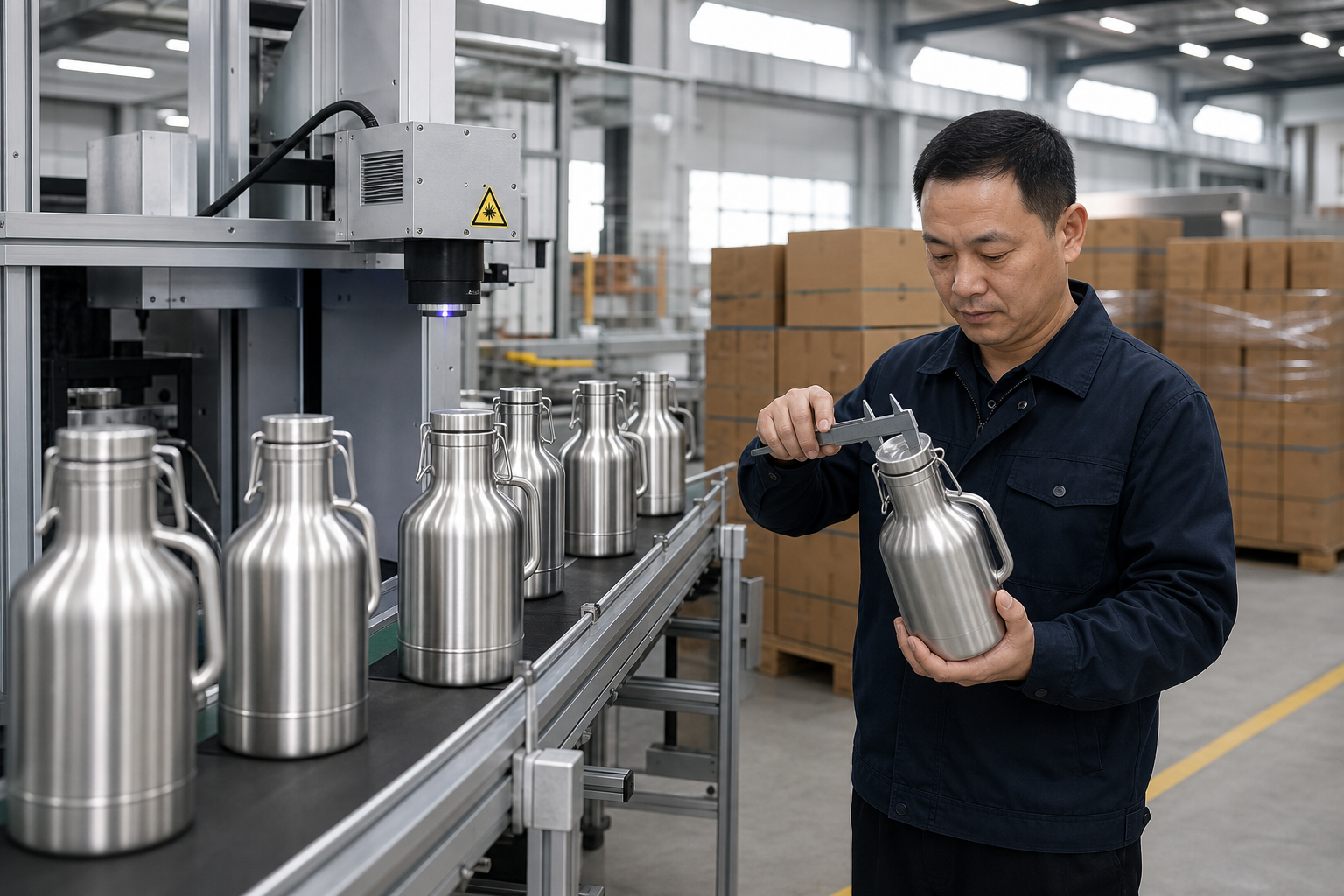
QC needs numbers, not good intentions. AQL 2.5 for major defects and 4.0 for minor defects is a solid starting point for most custom drinkware runs. On our line, that means checking logo position, cap fit, carton crush, and finish defects by lot, with calipers and a torque tester in hand. We had one buyer flag a 1.5 mm logo shift on a PO, and the whole batch got held. If a canteen supplier cannot explain defect classes, the growler order will go the same way.
In Zhejiang, the stronger factories will show BSCI or ISO 9001 without a fight, but that is not the whole story. You still need a pre-shipment report, carton photos, and one clear acceptance standard. QC pulled the sample before loading on a 12-day job once, and the buyer was happy because the packed cartons matched the approved sample, not the first photo set. That is how you keep a beer growler private labeling program clean when the order moves from sample to bulk.
Packaging For Retail And E-Commerce
Packaging is part of the product, not an afterthought. A growler for retail needs a clean shelf face; a growler going to Amazon or a DTC warehouse needs drop protection and barcode discipline. If your channel uses FNSKU labels, we apply them at the factory before the cartons are sealed. For wholesale, bulk master cartons with inner dividers cut packing cost. On one PO last month, the buyer flagged a barcode typo at 2 a.m., and we had to stop the line before loading.
For a standard 64 oz stainless growler, the common pack-out is 6 pcs or 12 pcs per master carton, depending on height and finish. A 5-ply export carton is the floor for long-haul freight; 3-ply sounds cheap until you see crushed corners after a 12-day ocean move versus an 18-day route with extra handoffs. If the cap ships separate, keep it in a sealed bag with the bottle so QC does not find mixed components at final count. We run a carton drop test from 76 cm, and coated finishes need a rub test on the printed surface before release.
This is where distributor drinkware planning pulls its weight. A canteen distributor who already handles custom canteen or customized drinkware lines knows carton count, barcode placement, and unit presentation affect sell-through. The same logic applies to beer growler private labeling: if the carton fails, the product feels cheap. That is the wrong question to ask if someone says, "Can we save 8 cents on the box?" We have seen that go sideways. Keep the spec stable, keep the label system simple, and make the factory pack the way your warehouse receives it.
Start your custom growler program with a real spec
Send your target size, finish, logo method, and market. We will match the right factory setup, MOQ, and packaging for China export.
Frequently asked questions
What is a realistic MOQ for beer growler private labeling?
For most China factories, 500 pcs per SKU is the practical starting point for beer growler private labeling. If you want multiple colors, special coating, or printed gift boxes, 1,000 pcs total usually gives better pricing and smoother setup. A small Zhejiang factory may still accept 300 pcs for a simple laser logo, but the unit cost rises fast. Expect sample lead time of 7-10 days and bulk lead time of 25-35 days after approval. If your launch is tied to a brewery opening or seasonal promotion, lock the artwork first and avoid changing the cap or carton spec after sampling.
Is 304 stainless steel enough for a beer growler?
Yes, 304 stainless is the standard for most private-label growlers because it handles food contact, corrosion resistance, and export requirements well. For a 64 oz growler, a 0.6-0.8 mm wall is common in single-wall builds, while double-wall premium versions use thinner inner and outer shells but cost more. If you are targeting colder retention or outdoor use, ask for a silicone gasket and a leak test on every batch. 316 stainless is usually unnecessary unless you have a niche spec or a very aggressive cleaning environment, and it will push the price up without changing most retail outcomes.
Which decoration method lasts longest on a custom growler?
Laser engraving is the most durable option for a custom growler because it does not rely on ink or adhesion. It is the safest choice if the bottle will be washed frequently, handled by multiple users, or sold through a distributor channel where appearance must stay consistent. One-color silk screen is still useful for bold branding, but it needs controlled curing and a smooth surface. Powder coating with laser marking gives you the strongest premium look, but the setup cost is higher. For most B2B buyers, the best balance is a brushed 304 body with a clean laser logo and a tested cap seal.
How should I package growlers for Amazon or wholesale?
For Amazon, you should plan around barcode placement, individual protection, and carton strength. Many buyers use FNSKU labels on the unit box and then pack 6 or 12 units per master carton, depending on weight and size. A 5-ply export carton is the floor, not the ceiling, if you want to survive long-haul freight. For wholesale, inner dividers reduce dent risk and keep the finish clean. Ask the factory to confirm carton drop test results and to photograph the packed goods before shipment. That simple step saves you from receiving a pallet of cracked boxes and mixed labels.
Can I bundle growlers with canteen custom programs?
Yes, and many distributors do. If you already manage canteen custom, canteen customizable, or canteen customized programs, you can often add a growler SKU in the same factory relationship and keep decoration, carton specs, and quality expectations aligned. That is useful for a canteen distributor or canteen supplier who wants one export flow instead of three separate vendors. The key is not to force the same mold or same packaging onto different products. Keep the artwork system, QC standard, and reorder logic consistent, then let each item have the right wall thickness, lid type, and carton count.