Key Takeaways
- Most beer growler promotional orders land at 500-3,000 pcs MOQ, with 30-45 days production in Zhejiang factories.
- A 64 oz stainless custom growler usually uses 18/8 stainless, 0.5-0.7 mm wall thickness, and a leak-tested cap.
- Decoration choice changes cost fast: one-color silk screen may add USD 0.12-0.35, laser engraving often adds USD 0.20-0.60.
- For Europe and North America, ask for REACH, LFGB where needed, and AQL 2.5/4.0 inspection before booking FOB.
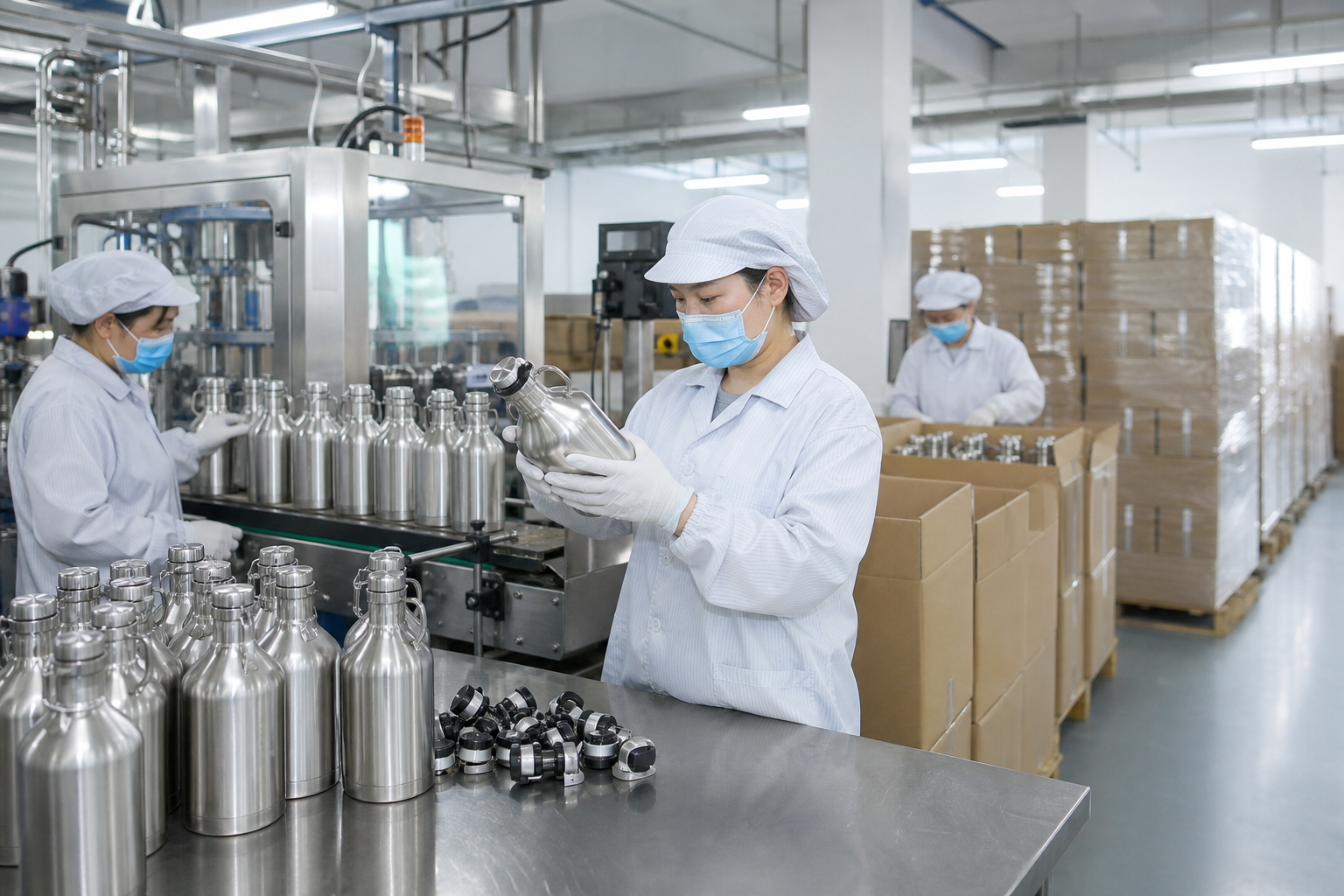
If you are buying beer growler promotional items for a brewery, distributor, or retail program, the hard part is not finding a bottle shape. The hard part is getting a product that pours cleanly, survives transit, prints well, and still lands inside your target cost. In Zhejiang, we see sample-room wins all the time, then the first 500 pcs hit the carton drop test and the buyer flags a leak at the cap. That is the real check.
Start with use case, not artwork. A 64 oz stainless growler for taproom sales needs a different wall thickness, closure, and outer carton than a 32 oz glass growler for gift sets, and the math changes fast. On one run, QC pulled the sample at 1.2 mm instead of the agreed 1.5 mm, and the PO had a typo on the lid spec; small errors, big headaches. If you also source canteen custom programs, your canteen manufacturer should speak in numbers like gasket size, leak rate, MOQ, and decoration cost, not sales talk.
Start with the end use
Before you ask for prices, pin down the use case. A beer growler promotional item sold over a taproom bar sees different abuse than one packed for a distributor drop or handed out at a trade show. If the buyer takes it home, twists the lid 20 times a week, and wants cold hold, stainless is the safer call. If the brief is a short campaign and the budget is tight, glass can work, but the carton count rises and breakage follows.
We use these numbers on the line:
- 32 oz for lightweight gifting and retail bundles
- 64 oz for beer and brewery programs; this is the most common promotional size
- 0.5-0.7 mm wall thickness for stainless bodies
- 500 pcs MOQ for simple decoration from a capable canteen factory in Zhejiang
Think like a distributor canteen buyer, even if you are ordering growlers. The order only works when the product, carton, and brand story fit the channel. We had a buyer flag a PO that called for retail boxes but bulk pallet shipping; the math does not work. A canteen supplier that knows custom drinkware should tell you straight whether the item is for shelf display, kitted promos, or plain giveaway packing.
Choose material by channel and margin
Material sets the first impression and the landed cost. For beer growler promotional runs, stainless steel is the line we run when the buyer wants fewer dents, better insulation, and a cleaner premium look. The usual build is 304 or 18/8 stainless on the inner wall, with a powder-coated or brushed shell. On a recent 1,000 pcs order, QC pulled the sample after a 1.2 mm wall check, and the imprint still held after a drop test, so for outdoor events stainless is usually the safer bet for fewer claims and better print life.
Glass still makes sense for bar shelves and brewery retail. It reads familiar, and a simple customized drinkware layout can look sharp on it. The math changes fast, though. Glass needs thicker cartons, dividers, and tighter pallet planning, and a 2.3% breakage rate on arrival is enough to wipe out the margin. We have seen this go sideways when a buyer tried to save on cartons, then the buyer flagged chipped rims on day one. For export cartons, that is the wrong question to ask.
Typical pricing from a China factory changes quickly with decoration:
- Plain stainless growler: about USD 2.80-4.20 FOB at 1,000 pcs
- Powder coat + logo: about USD 3.30-5.10 FOB
- Glass growler with one-color print: about USD 1.20-2.40 FOB, but higher shipping and breakage cost
If your buyer wants a canteen customizable line across multiple SKUs, keep the cap system shared and reuse cartons where the size allows. We ship that way when the MOQ is tight, and it keeps tooling from eating the margin. A canteen manufacturer in China does not need a new lid drawing for every colorway. Keep the SKU base simple, then add decoration where it actually sells.
Decoration decides whether it sells
Good decoration makes a promotional growler look planned. Bad decoration makes it look like leftover stock. For a beer growler promotional run, the decoration method has to fit the brand budget and the way the bottle gets handled. We run a lot of these on 304 stainless, and the first question is usually whether the buyer wants low cost or long wear. One-color silk screen is cheap and works for brewery logos, but repeated washing can chip it. Laser engraving on stainless gives a cleaner look and holds up better on matte or brushed finishes.
Use this as a shop-floor guide:
- Silk screen: best for simple logos, USD 0.12-0.35 added cost
- Laser engraving: premium, durable, USD 0.20-0.60 added cost
- UV print: good for more colors, but check abrasion resistance
- Embossed or debossed panels: stronger brand presence, higher tooling cost
If you also source a custom canteen or customizable canteen program, ask whether the factory keeps decoration files standardized across SKUs. We had a buyer flag a PO typo on carton labels once, and it turned into two days of rework because the art file was not locked. A real canteen vendor should line up art placement, color tolerance, and packing marks without making every order a fresh test. In Zhejiang, some factories run customized canteen and custom growler jobs on the same print line, which helps when you reorder 5,000 pcs and want the same logo position back.
Do not approve artwork from a PDF alone. Ask for a real sample, because print size on a 64 oz cylinder often looks 10-15% smaller once the bottle curves. QC pulled the sample with a ruler at 1 mm tolerance, and that was the number that settled the argument.
Check lid, seal, and leak performance
The cap is where a promotional growler either feels premium or turns into a complaint. Beer closures take a beating: open, wash, carry, repeat. On stainless growlers, we run a screw cap with a silicone gasket. On glass, swing-top closures show up often, but they add parts and the hinge quality has to be right.
When we work with canteen manufacturers in China, we ask for leak testing under pressure and inverted holding. QC pulled the sample on one run and found a slow seep at the threads after 30 minutes, which is the kind of miss that shows up in the field later. For export programs, we recommend:
- 100% leak test for the first production batch if the design is new
- AQL 2.5 for major defects and AQL 4.0 for minor defects on repeat orders
- 48-hour gasket compression check if the cap includes silicone parts
Do not ignore mouth size. A wider opening is easier to clean, but it can cut thermal performance and raise splash risk. We had a buyer flag a 60 mm mouth on a 64 oz growler because the lid family would not match the rest of the line, and the math did not work for spare parts. If the growler sits inside a broader custom drinkware line, keep the lid family consistent across SKUs where you can. That helps a canteen supplier ship replacements faster, which matters for canteen distributors and distributor drinkware channels that want quick replenishment.
For beer use, ask whether the closure is rated for carbonation retention or only liquid containment. A lot of promo pieces pass transport testing but are not built to hold pressure like a sealed keg transfer vessel. Be direct with the buyer. If the PO says "carbonated beer storage" but the sample is only tested for water, we stop there and reset the spec.
Know the compliance documents
If you ship beer growler promotional products to Europe or North America, the paperwork carries the same weight as the finish. A wrong test report can stop customs cold, and we have seen a missing declaration turn a 12-day rollout into an 18-day wait. Ask for material declarations and traceability on the main parts. For contact safety, stainless and coatings need the right market test, not a generic file.
For most buyers, the checklist is simple:
- REACH for EU chemical compliance
- LFGB when your customer wants stricter food-contact documentation
- FDA food-contact declaration for U.S. market programs
- ISO 9001 from the factory, plus a real internal QC process
When you audit a canteen factory in Zhejiang or anywhere else in China, ask how they track coating batches and gasket material lots. We run this check with batch cards, a label printer, and a simple incoming log; if the supplier cannot pull that file in 10 minutes, the system is weak. Sample retention should sit for at least 12 months. If they cannot show it, you are buying on hope, and that is the wrong question to ask.
For heavier retail programs, ask for carton drop-test data and humidity storage conditions. A custom growler with a powder-coated exterior can still fail if the carton scuffs the finish during a 40-hour sea leg, and QC pulled the sample for rub marks more than once on our line. Good factories in Zhejiang will point to the weak spot before you ask. That usually saves one production round and one angry buyer email.
Price, MOQ, and lead time reality
Most buyers ask for a quote first. The real cost sits in MOQ, decoration, tooling, and freight. For a standard beer growler promotional order from a Chinese factory, 500 pcs MOQ is a normal start for stock shapes. If you need a new mold, custom cap, or special carton, plan on 1,000 pcs. A Zhejiang plant we run can push 80,000-150,000 units per month across drinkware lines, but your PO still has to fit the line changeover and print slot. Last month the buyer flagged a 2 mm cap mismatch before we ran the order, and that saved a headache.
Typical lead times are straightforward:
- Sample lead time: 5-10 days
- Mass production: 30-45 days after sample approval
- Ocean freight booking buffer: 7-14 days depending on port congestion
FOB pricing is the cleanest way to compare suppliers because it strips out freight noise. If a canteen manufacturer gives you a number that looks too low, check the fine print: one carton size, one print color, standard cap, no testing, no export-ready packing. We’ve seen this go sideways when a buyer assumed AQL 2.5 was included and it wasn’t. A good canteen vendor will break out the base unit, the decoration surcharge, and the carton spec separately. Then you can compare canteen promotional and beer growler promotional orders on the same sheet.
For repeat orders, ask whether tooling charges are one-time or spread across a volume threshold. The math does not work if you treat the first run like the reorder price. On one job, the PO typo said “stainless steel 3040” instead of 304, and QC pulled the sample before the line started. That kind of mistake is cheap to fix early. Many custom drinkware projects in China only turn healthy on reorder, not on the first run.
Build a sourcing process that scales
A clean sourcing process is the difference between a one-off PO and a program that keeps moving. Start with a brief that covers size, material, logo method, cap style, carton target, and the compliance market. Then send the same spec sheet to every canteen supplier or canteen distributor. If they cannot quote the same spec, the math does not work. We had a buyer flag a typo on a PO once—“5000ml” instead of “500ml”—and the line caught it before tooling.
A practical workflow looks like this:
- Confirm target volume, usually 500, 1,000, or 3,000 pcs
- Approve material and finish on a physical sample
- Lock artwork, placement, and PMS or Pantone tolerance
- Review pre-production sample and carton drop-test photos
- Authorize production, then inspect against AQL before shipment
If you run a broader portfolio such as custom canteen, customizable drinkware, and customized canteen items, ask the factory to keep one QA template. That is how we ship repeat orders without rebuilding the paperwork every time. The factories that stay tight on documents usually beat the ones that only look good in photos. We saw one job slide because the buyer wanted 12 mm logo placement on one run and 8 mm on the next; QC pulled the sample and the issue stopped there.
If your buyer plans marketplace resale, check FNSKU labeling, polybagging, and master carton markings before you confirm the order. A canteen promotional item sold in retail is a logistics unit, not just a bottle. Treat it that way and your reorder rate will improve. We had a 1,200 pcs Amazon order held up because the master carton mark was off by one line. Small mistake. Big delay.
Request a quote with your exact spec
Send size, logo method, target market, and MOQ. We will quote a beer growler promotional program with clear FOB pricing and testing options.
Frequently asked questions
What is a realistic MOQ for beer growler promotional orders?
For stock shapes with simple logo work, 500 pcs is realistic in many Zhejiang factories. If you want a new mold, special cap, or custom carton, plan for 1,000 pcs or more. Some large canteen manufacturers can support lower trial orders, but the unit price usually jumps 15-30%. For repeat programs, 3,000 pcs often gives a much better FOB rate and more stable production scheduling.
Should I choose stainless or glass for a custom growler?
Choose stainless if the product will be shipped long distance, handled in stores, or used outdoors. A 64 oz stainless growler typically uses 304 or 18/8 steel with 0.5-0.7 mm wall thickness and better impact resistance. Choose glass if you want a lower unit price and a classic look, but expect higher breakage risk and heavier freight. For most beer growler promotional programs, stainless is the safer commercial choice.
What tests should I ask for before shipping?
Ask for leak testing, carton drop testing, and material compliance documents. For EU-bound orders, request REACH and often LFGB if your customer needs stricter food-contact proof. For U.S. programs, ask for FDA food-contact declarations. On the QC side, AQL 2.5 for major defects and AQL 4.0 for minor defects is a reasonable baseline. If the design is new, I would want 100% leak testing on the first batch.
How much does logo decoration add to unit cost?
A one-color silk screen on a stainless custom growler often adds about USD 0.12-0.35 per piece at production scale. Laser engraving usually adds USD 0.20-0.60 depending on logo size and surface finish. UV print can be higher if you need several colors. If you are buying customized drinkware in multiple SKUs, consolidate decoration methods to keep setup fees down and reduce color variation across the order.
How long does a custom order take from sample to shipment?
A normal timeline is 5-10 days for samples and 30-45 days for mass production after sample approval. Add another 7-14 days if you are booking ocean freight from China, depending on port congestion and your destination. A reliable canteen factory in Zhejiang should give you a production calendar before you pay the deposit, not after. If they cannot, the schedule is not under control.