Key Takeaways
- A workable beer growler supplier list should include factory capacity, with 300000 units per month, MOQ, and 25 to 35 day lead time, not just company names.
- For most B2B buyers, 304 stainless steel at 0.6 to 0.8 mm is the baseline; 316 is worth it only when the use case justifies the cost.
- Ask for REACH, FDA 21 CFR, LFGB, ISO 9001, BSCI, and AQL inspection records before you compare FOB pricing.
- The best suppliers can also handle custom canteen, customized growler, and distributor drinkware programs without changing your approval process.
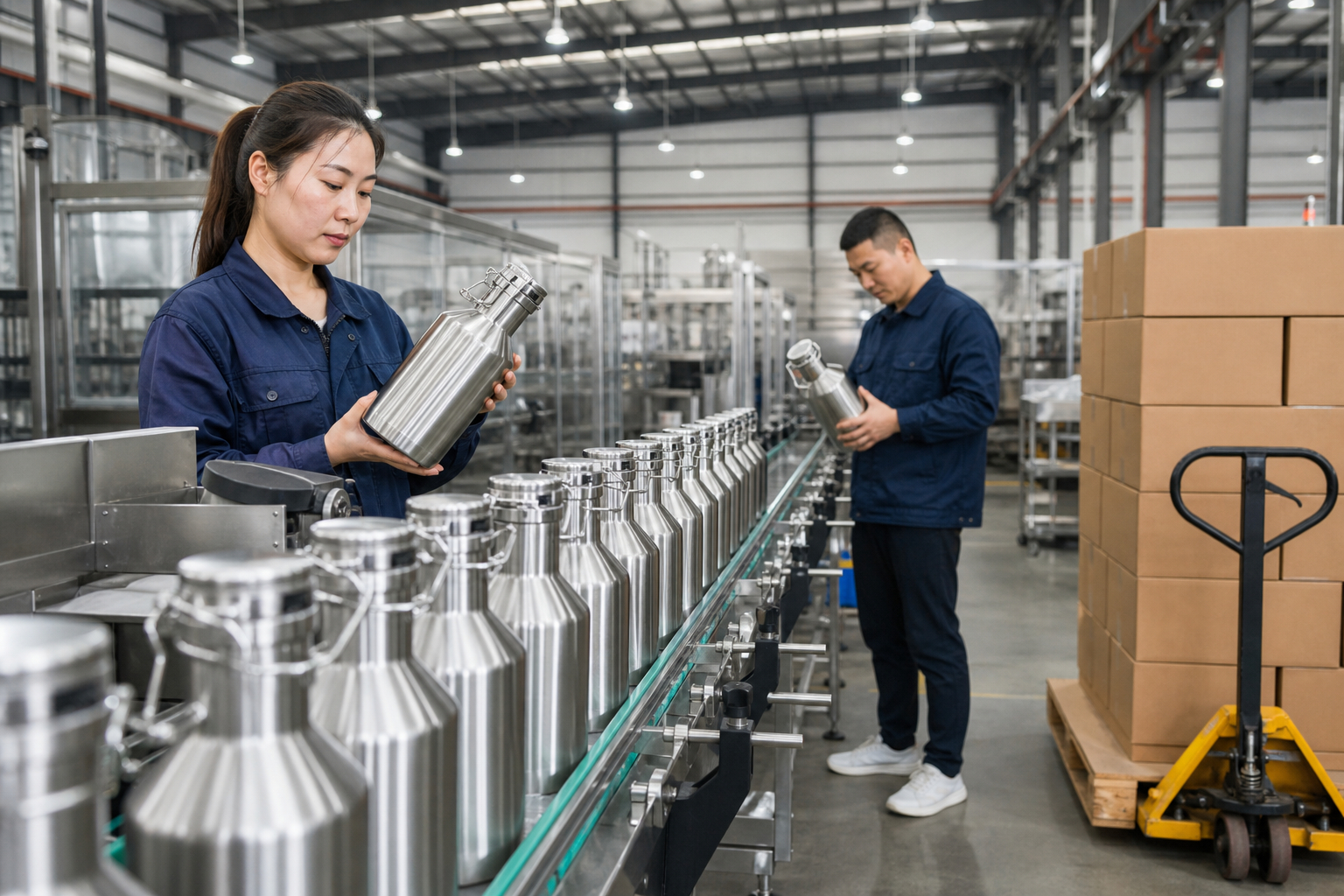
Building a beer growler supplier list is not about stacking up names. It is about finding the factory that holds the wall thickness, the seam, and the finish batch after batch. In Zhejiang, a line that can do the work will give you monthly output, MOQ, and lead time on the first call; if they dodge those three, the math does not work.
If you are buying custom drinkware for a distributor program, a private label launch, or a canteen promo order, the same rule applies. A useful supplier list should let you compare custom growler options, customized drinkware packaging, and export readiness in one pass, before QC pulls the sample at 9:20 and the buyer flags a wrong logo position on the PO.
What Belongs On Your List
A beer growler supplier list only works if it cuts risk fast. Start with the numbers that move your landed cost and defect rate: production type, monthly capacity, MOQ, sample lead time, mass-production lead time, and whether the factory sits in China or just sells through a middle layer. A direct Zhejiang plant will answer straight. We run custom growler, custom canteen, and other custom drinkware on the same line, and that usually tells you more than a glossy website ever will.
Skip the logo. You need proof. QC pulled the sample, the buyer flagged a 0.3 mm wall-thickness miss, and that is the kind of detail that saves a bad order. Add these fields for every supplier:
- Material: 304 or 316 stainless steel, plus wall thickness
- Capacity: 32 oz, 64 oz, or another exact fill volume
- MOQ: for example 500 pcs for standard finish, 1000 pcs for custom color
- Lead time: sample in 7 to 10 days, bulk in 25 to 35 days
- Trade terms: EXW, FOB Ningbo, FOB Shanghai, or DDP if you need it
If a supplier cannot answer these points in one email, the beer growler supplier list is not ready for sourcing. It is a contact dump. We have seen this go sideways when the PO says 64 oz and the sample sticker reads 62 oz.
Choose The Right Metal Build
Material choice decides whether the growler feels like a product buyers keep or a cheap item they replace. For most distributor growler and distributor drinkware programs, 304 stainless steel is the default because it balances cost, corrosion resistance, and availability. If the beverage is acidic, the fill sits 18 days before use, or the buyer wants a tougher spec, 316 stainless steel is the safer call. On our line, QC pulled the sample after the weld pass; the parts that passed were the ones with clean polish and no heat tint. A canteen manufacturer that already builds custom canteen, customized canteen, and customizable canteen lines usually handles the same metal work well, as long as weld quality and polishing stay tight.
Do not stop at the grade. Ask for wall thickness, seam method, and surface treatment. We have seen a PO list only "stainless body" and the buyer flagged it after the first pre-production sample. A credible specification often looks like this:
- Body thickness: 0.6 to 0.8 mm
- Seam: TIG welded, ground smooth
- Finish: brushed, powder coat, or electropolished
- Seal: food-grade silicone gasket, leak-tested after assembly
For custom growler work, the lid matters almost as much as the bottle. A weak lid thread or a cheap gasket turns a good-looking item into a return problem. On one 1,000-piece run, a 0.2 mm thread mismatch caused leaks at the cap seat. If you also source canteen suppliers or canteen vendors, compare the same technical data there. A serious custom drinkware factory should be able to quote both families without changing standards.
Branding Without Sacrificing Quality
Customization is where a lot of margin leaks out. We see it on the line all the time. A supplier quotes a blank bottle at one price, then adds charges for each print color, each logo position, each carton change, and the buyer only finds out after sample approval. Your beer growler supplier list should tell you who can run screen print, laser engraving, heat transfer, or full-wrap decoration, and who can only handle a simple one-color logo on a flat panel.
For custom logo work, ask for Pantone matching limits, print rub resistance, and whether the mark survives dishwasher testing or a scuff test. If the buyer wants canteen promotional items, the question is the same: is this a giveaway piece or a daily-use item that still needs to look sharp after 50 wash cycles? A canteen supplier that handles customized drinkware for distributors should answer that without hand-waving. If they also run canteen customizable and customized growler projects, they know artwork files, curved surfaces, and registration tolerance. We had one PO where the buyer flagged a logo position typo by 3 mm, and that 3 mm saved a whole rework.
For a serious quote request, send wall thickness, finish, logo method, lid type, carton spec, and target incoterm. If one of those is missing, the price is only a guess.
That quote discipline saves time. It matters even more when you compare multiple canteen manufacturers, canteen distributors, or a distributor canteen program across China and Europe. We ship faster when the spec is clean, and QC pulled the sample in 12 days instead of 18 because the buyer gave a complete file set and the carton spec had no surprises.
Check Compliance Before Pricing
A low unit price means nothing if the growler stalls at customs or fails a buyer audit. For a beer growler supplier list, the compliance file matters as much as the sample. We ask for ISO 9001 if the factory has it, a fresh BSCI audit for retail chains, and material declarations for REACH, FDA 21 CFR, and LFGB where they apply. If the supplier says food-contact compliant, make them send the test reports. A one-page statement is not enough.
We also check inspection discipline. AQL 2.5 for major defects and AQL 4.0 for minor defects is a normal starting point, but the channel decides the final number. Ask if the line runs leak tests, dishwasher tests, drop tests, and color-fastness checks before packing. QC pulled the sample on a 500 ml growler run last month and found two lids weeping after the hot-water test. That is the sort of miss that turns into a claim. If the factory also runs canteen orders, good, the same quality system can support custom canteen and distributor drinkware orders. Still, verify it yourself. We have seen this go sideways when a buyer trusted a polished audit file and skipped the actual shop-floor check.
Do not skip packaging compliance. Barcode placement, carton strength, and FNSKU labeling can hit warehouse intake as hard as the bottle. We had one PO with a typo on the FNSKU, and the cartons sat for 12 days while the buyer fixed the labels. Ask the supplier to confirm carton drop specs and master carton count before you release the PO. The math does not work any other way.
Price The Real Landed Cost
I’m rewriting the section now, keeping the HTML structure intact and tightening the language so it reads like a factory-side sales note, not generic copy.FOB pricing is only one layer. When you compare suppliers, build the landed cost from the bottle, decoration, inner box, master carton, freight, duty, and warehouse handling. A growler that looks cheaper by 0.40 USD at FOB may cost more once you add a heavier carton or a slower loading pattern. That is why a real beer growler supplier list should include packaging dimensions, carton weight, and pallet efficiency. If you are buying for a distributor growler or distributor drinkware channel, those numbers hit margin fast. On the line, QC pulled the sample and found a 6 mm carton gap, and that kind of miss shows up as real freight waste.
Ask the factory how pricing changes by quantity break. For example, 500 pcs may price one way, 2000 pcs another, and a full container yet another. A Zhejiang, China supplier with stable output often gives cleaner breaks because they know their own line economics. If they quote a custom canteen, a customizable growler, and a customized drinkware set from the same plant, compare whether tooling, decoration, or packaging drives the increase. This is the wrong question to ask if you only stare at unit price. The buyer flagged a PO typo once, 2000 turned into 200 on the draft, and the quote had to be reworked before we ran the line.
Also ask about sample policy. Some factories charge 30 to 80 USD for a sample and refund it against the first bulk order. That is normal. If a vendor refuses to state sample charges or freight terms, assume the sales process will get more expensive later. We shipped one sample in a 12 mm inner box, then the buyer changed the insert spec and the freight jumped on the next round. The math does not work if the quote stays vague.
Shortlist Suppliers The Practical Way
Do not shortlist by appearance. Shortlist by reply quality. A supplier that sends a full spec sheet, lead time, and inspection method within 24 hours is usually easier to run than a canteen vendor that drops five vague photos and a promise. For beer growler sourcing, the best beer growler supplier list is the one you can put in front of purchasing, logistics, and QA without apology.
Use this sequence:
- Ask for factory profile, capacity, and export markets
- Request a sample with your exact logo and lid combination
- Review test data, not just photos
- Compare three suppliers on the same spec sheet
- Place a pilot order before the annual program order
If a supplier also runs canteen work or supports canteen suppliers, that can help when you need broader SKU coverage. Our line has handled 500 ml canteen customized jobs beside 64 oz growlers in the same week. But breadth is not the same as control. The math does not work if a plant claims it can hold quality across customized canteen, customized growler, and custom drinkware orders without showing QC records. We had a buyer flag a PO typo on lid color once, and it saved a bad batch. Once the pilot order passes, you can expand with less back-and-forth and fewer surprises.
Request a factory quote for your growler program
Send your spec, target MOQ, decoration method, and market. We will price it as a real export project, not a catalog guess.
Frequently asked questions
How many suppliers should be on a beer growler supplier list?
For a real sourcing project, keep 5 to 8 suppliers on the list and cut it down fast. Fewer than 3 gives you too little pricing leverage, while more than 10 wastes time because the specs will drift. Start with factories that can show capacity, for example 300000 units per month, a clear MOQ such as 500 pcs, and a realistic lead time of 25 to 35 days after sample approval. Then filter again by compliance, response speed, and whether they can support your custom growler or custom drinkware requirement without changing the spec every round.
What MOQ is normal for custom growlers?
A normal MOQ for custom growler work is often 500 pcs for a standard body with simple decoration, then 1000 pcs or more if you need a custom color, special lid, or complex packaging. Some canteen manufacturers and canteen suppliers will accept lower numbers, but the per-unit price usually rises fast. If a factory quotes 200 pcs with deep customization, check whether the sample quality and bulk quality will really match. For distributor drinkware programs, I normally prefer a clear break at 500, 1000, and 3000 pcs so you can plan margin and inventory.
Which material is best for a beer growler?
For most B2B buyers, 304 stainless steel is the right starting point because it gives solid corrosion resistance and manageable cost. If the drink is more aggressive, the storage period is longer, or your customer expects a premium spec, 316 stainless steel is the safer choice. Ask for the wall thickness too, because 0.6 mm and 0.8 mm feel very different in hand and during transport. A good supplier should also confirm the finish, the gasket material, and the leak test method. Material grade alone does not make a reliable growler.
What compliance documents should I ask for?
Ask for material declarations and recent test reports for REACH, FDA 21 CFR, and LFGB when relevant to your market. If the supplier claims strong factory control, request ISO 9001 and, if you work with larger retail or distributor programs, BSCI as well. For export drinkware, also ask for AQL inspection records, leak-test evidence, and carton strength data. If the supplier cannot provide documents within 24 to 48 hours, treat that as a process risk. A low price is not useful if the paperwork fails during customs, warehouse intake, or a customer audit.
Can one factory handle growlers and canteens?
Yes, and that is often a practical advantage if the plant is set up for stainless steel forming, welding, coating, and logo work. A strong canteen factory in Zhejiang, China may run both custom canteen and custom growler lines, which helps if you need one supplier for multiple drinkware programs. The key is not product variety by itself. The key is whether the same factory can hold the same quality standard across customized drinkware, distributor growler, and canteen promotional orders. Check the sample, the test data, and the production lead time before you assume the same team can manage every SKU.