Key Takeaways
- Typical MOQ for a custom growler from a Zhejiang factory starts at 1,000–3,000 pcs, with 35–45 days lead time after sample approval.
- A proper beer growler lid needs a silicone gasket and leak test; 100% air-pressure or water inversion checks are common on export orders.
- Powder coating is usually 60–80 μm thick; thin paint below 40 μm chips faster in distribution and retail handling.
- For EU and US shipments, ask for REACH, LFGB where needed, and BSCI/ISO 9001 documentation before you confirm FOB pricing.
If you are comparing beer growler suppliers, you are already past the browsing stage. You need a container that ships safely, survives 200+ open-close cycles, and still carries a clean logo after transit. A weak hinge, a gasket cut 0.2 mm off spec, or a coating that scuffs in a carton turns one custom growler order into returns and complaints. In Zhejiang, we run this as a line problem, not a photo contest. QC pulled the sample, checked the seal, and the bad parts showed up fast.
The supplier should give you hard numbers: MOQ, lead time, wall thickness, finish options, and test standards. If you also buy canteen custom programs or other custom drinkware, the same discipline applies. A growler has to manage pressure, sealing, and a heavier impact load, so this is the wrong question to ask if the only comparison is price. For European and North American buyers, ask for the report before you commit to a canteen manufacturer, canteen supplier, or beer growler suppliers with polished photos and no proof. We have seen a PO typo send 3,000 pcs into two split shipments, and the math does not work when that happens.
What a growler supplier must prove
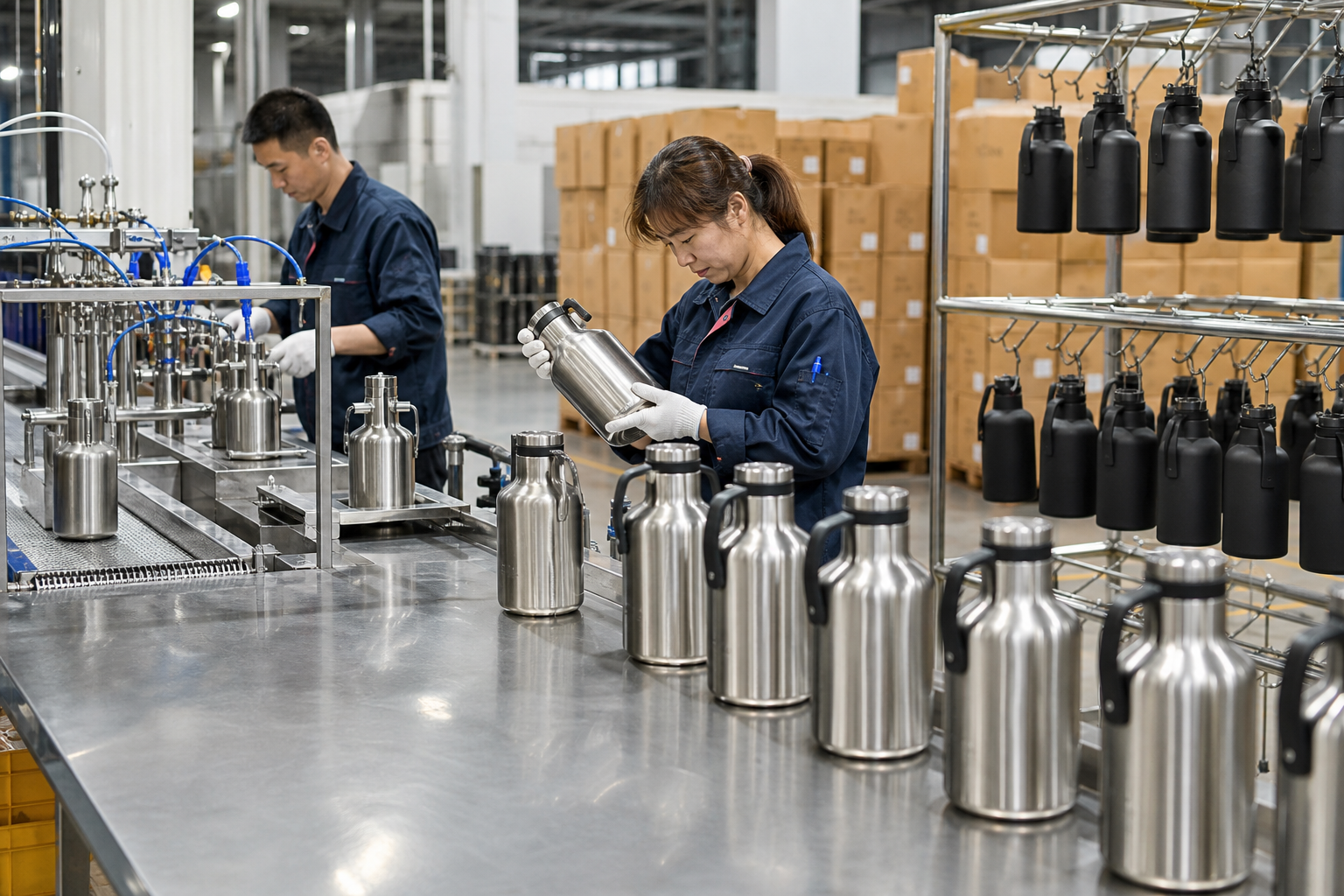
When you shortlist beer growler suppliers, skip the polished photos for a minute and ask for proof. A real factory shows capacity, process control, and test records. Here in Hangzhou, a serious canteen factory or canteen manufacturer usually runs separate lines for stainless body forming, TIG welding, coating, and packing. That matters because a custom growler is a sealed transport container with branding on top, and the line has to hold both.
Start with production capacity. If a supplier can only make 20,000 units per month, that may work for a regional launch, but it will strain a distributor drinkware program that needs replenishment every six weeks. We run 300,000+ units per month across drinkware categories, and that scale only helps if QC stays tight. Ask for AQL 2.5 on appearance and AQL 1.5 for functional defects on export retail orders. QC pulled the sample on one 500 ml lot because the lid torque slipped at 18 N·m; the buyer flagged it before shipment, which saved a return.
- MOQ: 1,000–3,000 pcs per SKU is normal for custom drinkware.
- Lead time: 35–45 days after sample approval.
- Documents: BSCI, ISO 9001, REACH, and material declarations.
- Testing: leak test, drop test, coating adhesion, odor check.
A canteen supplier that hides these basics is not the supplier you want for a distributor canteen program, and the same rule applies to growlers. If the factory cannot explain weld seam thickness, gasket material, and finishing method, keep looking. We once saw a PO with “304 stainles” typed wrong, and that tiny miss told us the buyer had not checked the spec sheet line by line. The math does not work when the paperwork is loose.
Choose the right growler construction
Most buyers start with capacity, but construction decides how the custom growler behaves on the shelf and in transit. A beer growler for retail usually sits in the 32 oz, 64 oz, or 128 oz range. For North America, 64 oz still moves best; we ship a lot of that size because it fits standard case packs. In Europe, 1L and 1.5L formats work better for bar programs and gift sets. Pick the size from shelf space, carton count, and how the customer will carry it home. If the buyer says “make it bigger,” I ask for the carton loading plan first. The math has to work.
Material choice is where a lot of canteen distributors go wrong. Stainless steel 304 is the standard for beverage contact because it holds up on corrosion and cost. For a premium customized growler, 18/8 stainless with a 0.5 mm to 0.7 mm wall is normal. We checked a sample at 0.38 mm once, and QC pulled it because the body rang too thin and dented on the bench test. Push it under 0.4 mm and the cup feels cheap; go over 0.8 mm and weight and cost climb fast. If you want a canteen customizable design with matte powder coat, ask for coating thickness in microns, not just “premium finish.”
Lid style and gasket quality
For beer, the lid matters more than the body graphics. A screw lid with a silicone gasket is common for a custom canteen or customized canteen used for cold beverages, but a flip-top or swing-top style fits craft beer merchandising better. Ask for gasket hardness around 50–60 Shore A and confirm the supplier can pass inversion leak tests for at least 30 seconds. We had a buyer flag a PO once because “growler” was typed as “grower” on the spec sheet; that kind of slip tells you the paperwork is loose, and loose paperwork usually means loose sealing control too. A canteen vendor that cannot hold the seal is not ready for distributor growler programs.
Practical rule: if the lid cannot pass a 1-meter drop test with no leakage or deformation, you are buying packaging risk, not drinkware.
Branding methods that survive shipping
Branding on a custom growler has to survive carton rub, pallet stacking, and the way a buyer tosses samples onto a metal table. If you only need a logo for a photo, almost any canteen promotional supplier can print it. If the goal is a customized growler that still looks clean after 3,000 miles in transit, the decoration method matters. For powder-coated stainless, silkscreen gives better color fill and lower cost. Laser engraving is the cleaner pick for premium distributor drinkware programs.
On a powder-coated body, a good laser mark does not peel because it cuts through the top layer. Silkscreen can still work, but we always ask for adhesion testing and a hand-wash check, because we have seen ink fail after 40 wash cycles. If your buyer chain includes retailers, bars, or e-commerce packs, the finish affects returns fast. A canteen customized with a soft-touch coating looks good on the sample bench, but once the line picks up scuffs in packing, the perceived value drops.
- Silkscreen: best for 1–3 spot colors and lower unit cost.
- Laser engraving: best for premium, durable branding.
- UV printing: useful for complex graphics, but confirm abrasion resistance.
Ask your canteen manufacturer for decoration tolerances and artwork setup fees. One buyer once sent a PO with the logo size typed as 35mm instead of 25mm, and that typo would have changed the whole run. A good factory in China will tell you where each method works best and when a custom drinkware design needs simplification. That kind of straight answer saves money. The math does not work otherwise.
Compliance for US and EU markets
If your beer growler suppliers cannot talk compliance, they are not export-ready. For North America, ask for safe material declarations and proof that coatings, seals, and inks are suitable for food-contact use. For the EU, REACH is the starting point, and LFGB may be requested on some food-contact programs. On one shipment last quarter, the buyer flagged a missing carton declaration before booking. We had to fix it at the line.
Do not treat compliance like a checkbox. Ask what the supplier tests in-house and what goes to a third-party lab. A Zhejiang canteen factory should be able to show metal composition for 304 stainless, silicone declarations, and a coating input summary. If the order is a canteen personalized gift item, the same rules still apply. Promo wording does not change the legal risk. The math does not work any other way.
For Amazon or big-box channels, carton labeling matters too. FNSKU placement, barcode print quality, master carton counts, and inner box protection all affect receiving speed. We once saw a PO with a typo on the inner carton count, and QC pulled the sample before the goods left. A customized drinkware order can fail at the warehouse even when the bottle passes inspection. Request packed samples before mass production.
Useful document set to request:
- REACH declaration and material safety summary
- ISO 9001 and BSCI audit copies if available
- Food-contact statement for stainless and silicone parts
- Test report for leak, drop, and coating adhesion
- Carton packing spec with gross weight and dimensions
Pricing, MOQ, and buying terms
Good pricing is not just the unit price. It is landed risk, packing risk, and the rework bill if the line slips. A basic custom growler from a China factory may start around USD 2.80 to 4.20 FOB for a plain stainless model at higher volume, while a powder-coated version with logo work can move into the USD 4.50 to 7.50 range depending on size and finish. We’ve seen a 500 ml 304 stainless growler come through with 0.4 mm wall thickness on one quote and 0.5 mm on another; the cheap one looked fine on paper, then QC pulled the sample and found the coating scratched at the lid shoulder. Special lids, gift boxes, and multi-color printing push it higher. If a canteen supplier quotes far below that range, ask what got cut: wall thickness, coating thickness, or inspection steps.
MOQ usually depends on decoration and color. Plain stock shapes can be flexible, but a canteen customizable program with a new color often needs 1,000 pcs per color and 3,000 pcs total. That is workable if you track sell-through by account and color code the PO correctly. For a smaller distributor canteen order, it can be too much unless the factory allows mixed SKUs in the same production window. We had one buyer flag a typo on the PO—“1,000” entered as “100”—and the line held the order for two days while we rechecked the carton plan.
FOB Zhejiang or Ningbo is common for export. If you are comparing canteen suppliers, ask whether the quote includes inner boxes, carton dividers, and master carton labeling. A quote that leaves out packaging is not cheaper once breakage starts; we ship enough busted samples to know that. Ask about sample charges too. Many factories refund sample fees on bulk orders above 3,000 pcs, but not always. One job went sideways because the buyer assumed the sample fee covered freight; it did not, and the math did not work.
What to negotiate:
- Tooling fee, if any, for custom lids or molded parts
- Sample lead time: usually 7–12 days for decorated samples
- Mass production lead time: 35–45 days
- Payment terms: 30% deposit, 70% before shipment is common
Working with a Zhejiang factory
There is a reason importers keep sourcing in Zhejiang and the nearby belt around Ningbo, Shaoxing, and Taizhou: the supply chain is dense. Stainless coils, powder coating, screen printing, cartons, and freight booking sit within 30 to 80 km of each other, so a missing PO line can be fixed before lunch. That does not make every canteen factory equal. It just means the line moves faster. If you are buying custom drinkware and custom growler items in the same season, a Zhejiang factory can combine production better than a scattered trading setup. We have seen that shave 12 days off a mixed order. The math is simple.
Still, you need to qualify the factory like an engineer. Ask for live production photos with date stamps, not old catalog images. Request a video of the leak test line. QC pulled the sample at 9:20 a.m. and the buyer flagged a 2 mm cap gap on the first round; that is the kind of detail you want to see. Confirm whether the factory owns the coating line or outsources it. A canteen vendor that runs its own coating and assembly has fewer color shifts. If they also sell canteen promotional items, that is fine for range building, but only when the same QC sheet applies to every SKU. If they cannot answer that plainly, stop there.
Visit if you can, or pay for a third-party inspection before balance payment. A standard inspection should cover quantity, appearance, functional test, packaging, and carton drop condition. We run a drop tester at 60 cm and check the outer carton corners after the third fall; that catches the weak packing fast. For export orders, a pre-shipment inspection with AQL sampling is cheap insurance. The wrong question is whether inspection offends the supplier. The right question is whether the supplier can pass it. The best beer growler suppliers do not resist that request, and the factories that welcome inspection usually have less to hide.
How to place a safer first order
Your first order should be boring. That is the goal. We run the line that way for new buyers. Do not start with five colors, three lid styles, and a custom sleeve unless you already trust the factory. Start with one or two SKUs, one branding method, and one carton spec. If the supplier also makes canteens for other shapes, ask whether they can share lids, gaskets, or packing inserts. Shared parts cut cost and make reorders cleaner.
Before you approve, lock down five points in writing:
- Capacity and dimensions, measured in mm and ounces or liters
- Stainless grade, wall thickness, and coating thickness
- Decoration method, logo size, and color codes
- Leak test standard and AQL level
- Carton pack count, master carton size, and labels
If you handle canteen custom, canteen customized, or customizable drinkware programs, use the same checklist for every SKU. We had a buyer flag a PO typo once—12 oz printed as 21 oz—and QC pulled the sample before packing. That kind of mistake costs a week. A distributor who keeps this tight is doing the right job. The factory in Hangzhou or elsewhere in Zhejiang should be able to support repeat orders without changing your product by accident. Consistency beats a lower sample price when your customer comes back eight months later and wants the same lid fit, same logo size, same carton mark.
For a new launch, ask for a production sample, a golden sample, and a packed sample. The golden sample stays on file and sets the standard. If the supplier cannot keep those three pieces separate, they are not ready for scalable beer growler suppliers work. We ship safer orders when the buyer signs off on the packed sample too; a carton drop test at 760 mm tells you more than a nice photo ever will.
Request specs, pricing, and a sample now
Send your size, finish, and logo files. We will quote FOB, confirm MOQ, and prepare a packed sample for your market.
Frequently asked questions
What is a normal MOQ for custom beer growlers?
For most export factories in Zhejiang or elsewhere in China, MOQ is usually 1,000 to 3,000 pcs per SKU. Simple plain stainless models may start at 1,000 pcs, while custom colors, laser logos, or special lids can push MOQ to 3,000 pcs or more. If you need mixed sizes, ask whether the factory can combine orders across 2 SKUs to hit the production threshold. For distributor drinkware programs, that flexibility matters more than shaving a few cents off unit price.
How much should a custom growler cost FOB?
A basic custom growler often lands around USD 2.80 to 4.20 FOB at larger volumes, depending on size and finish. Powder-coated, laser-engraved, or gift-boxed versions usually move into the USD 4.50 to 7.50 range. If the quote is far below that, check whether the wall thickness dropped below 0.5 mm, whether coating thickness is under 40 μm, or whether leak testing is omitted. Cheap quotes often hide quality cuts.
Which material is best for beer growlers?
304 stainless steel is the standard for a beer growler because it offers strong corrosion resistance and works well with cold beverages. For most retail programs, 18/8 stainless with 0.5–0.7 mm wall thickness gives a good balance of strength and cost. If you want a premium custom drinkware feel, a powder-coated outer layer at 60–80 μm improves scratch resistance. Avoid ultra-thin bodies below 0.4 mm unless the price point is extremely sensitive.
What compliance documents should I ask for?
For EU and North American imports, ask for REACH declarations, material safety summaries, and food-contact statements for stainless and silicone parts. If your retailer or marketplace requests it, LFGB and test reports for coatings can help. Also request ISO 9001 and BSCI copies if the factory has them, plus leak, drop, and adhesion tests. For canteen distributors and growler buyers, carton specs and batch traceability are just as important as product compliance.
Can one factory handle growlers and other drinkware lines?
Yes, a capable canteen factory in China can often handle custom growlers, custom canteen orders, and broader customizable drinkware lines from the same production base. The real question is whether they control coating, assembly, and packing in-house or rely on too many subcontractors. A factory with 300,000+ units per month across multiple drinkware categories can usually manage mixed programs better, as long as the QC system is consistent and the artwork specs are clear.