Key Takeaways
- A serious beer growler vendor should quote MOQ, lead time, and capacity up front; a Zhejiang factory with 180,000 units/month is easier to scale with.
- For stainless growlers, 304 with 0.5-0.8 mm wall thickness is the common commercial range; verify welds, lid seal, and pressure behavior.
- For export to Europe and North America, ask for REACH, LFGB where applicable, and documented AQL 2.5 inspection for critical defects.
- Decoration, packaging, and carton rules affect breakage rates and freight cost as much as the bottle itself, especially on custom drinkware orders.
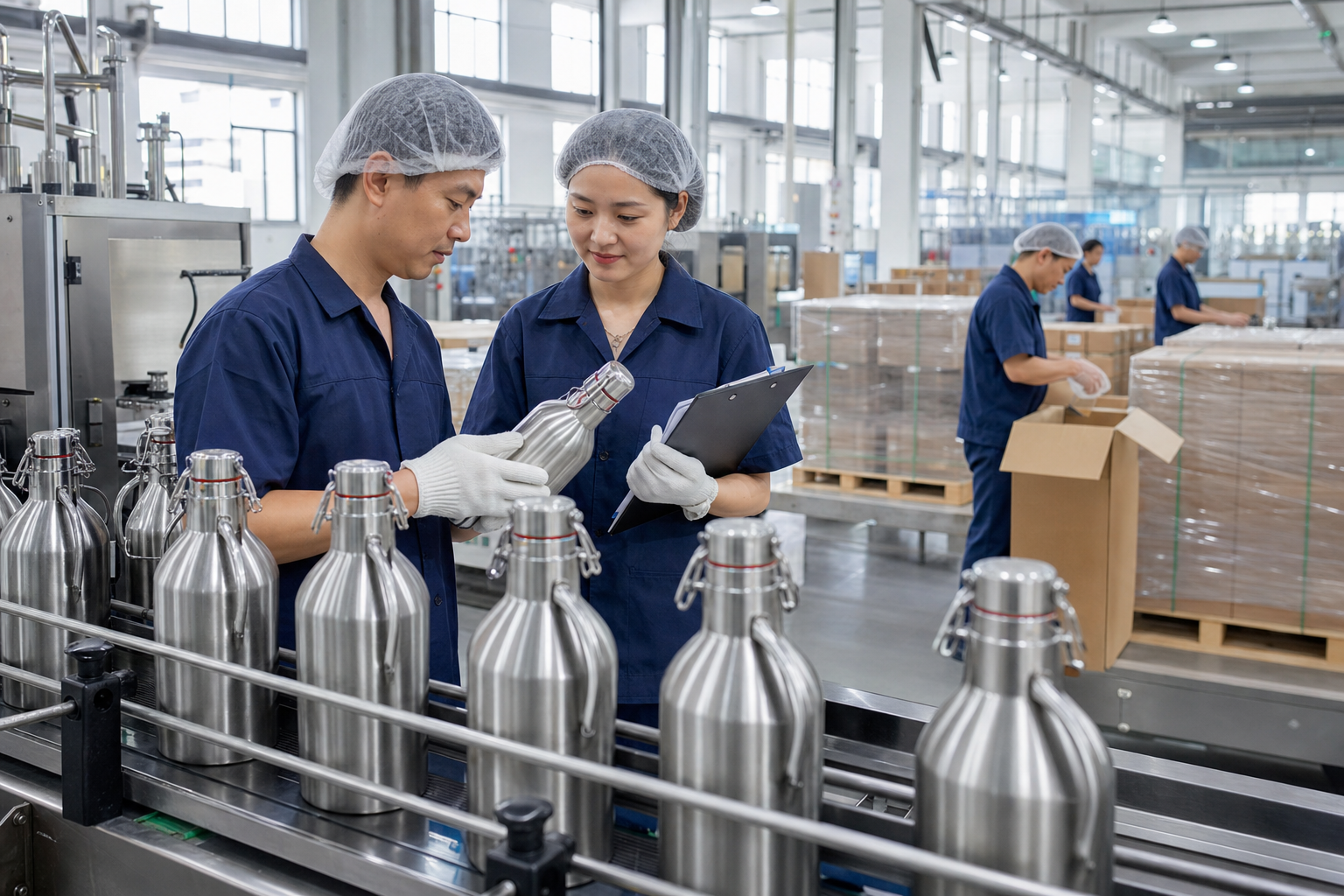
If you are sourcing from a beer growler vendor, the hard part is not finding a factory that says yes. The hard part is finding one that keeps carbonation, survives a 1.2 m drop in transit, and still holds print, coating, and thread fit from first carton to the 50,000th piece. We run into this all the time: the sample looks clean, then the buyer flags a loose cap after QC pulls the sample from the line. That is the wrong question to ask. The real check is how the supplier runs production, QC, and export paperwork when the order is live.
In Zhejiang and across China, the better custom drinkware programs are built on repeatability: stable molds, AQL inspection, REACH-ready materials, and cartons that pass a 5-layer drop test. If you are buying custom growler, customized drinkware, or a canteen custom line for retail or promotions, the vendor choice sets the real landed cost, not just the FOB quote. A solid Zhejiang factory should state MOQ, lead time, monthly capacity, and decoration limits without guessing. We have seen it go sideways when a PO typo changed the neck finish, and the buyer had to choose between a 12-day rework and an 18-day delay.
Start With The Use Case
Before you ask for a price, pin down the use case. A beer growler vendor needs to know if the order is for retail shelf display, brewery taproom refills, corporate gifting, or distributor resale. That choice changes the bottle shape, the cap or swing-top, and the decoration method. A 32 oz stainless growler for a taproom run is not the same job as a 64 oz glass unit for a retail pack. On the line, we have seen a buyer approve a 1 mm wall spec for shelf weight, then flag scuffs after pallet stretch wrap. If you are also buying canteen customizable formats, the same rule applies: the use case decides the material and the failure point.
Ask for three things first: capacity, closure, and compliance target. Capacity sounds simple, but you need tolerance, not just nominal volume. A solid vendor should state fill volume tolerance within +/-5%. Closure is the part buyers complain about after delivery, because carbonation loss and leaks show up fast. I have seen a 58 mm cap spec fail a drop test because the liner sat crooked. For export, the supplier should state what they can support for REACH, LFGB, FDA contact expectations, and whether the pack is meant for beer, water, or dry storage only.
Practical buyers also specify decoration and retail handling. Screen print, laser engraving, powder coat, and full-wrap labels each wear differently. If you need canteen promotional stock for a campaign, lighter specs can work. If you need a customized growler for breweries or a customized drinkware line for retail, the graphics and finish have to survive repeated wash cycles and bar handling. QC pulled the sample with a scratch at the handle base after 12 dishwasher passes, and the buyer flagged it. That is where a real canteen vendor or canteen distributor mindset helps: think in use cycles, not catalog photos.
Materials That Actually Ship
Most beer growlers fall into stainless steel, glass, or PET/PC-style specialty constructions. For export jobs, stainless is usually the cleaner pick because it shrugs off dents, impact, and repeated wash cycles better than glass. In a serious canteen manufacturer or canteen factory, the standard body spec is 304 stainless steel, with 201 used only when the buyer accepts a tighter corrosion margin. If the product will touch acidic liquids or get washed every day, 304 is the safer call. Wall thickness on a typical stainless growler usually sits around 0.5 to 0.8 mm; go thinner and you save weight, but the line starts seeing denting and weld distortion. QC pulled a 0.45 mm sample last month, and the buyer flagged it after one round through the sling test.
Glass can look premium, and a customized canteen made in glass can work for shelf display or home use, but freight and taproom handling punish it fast. We ship enough breakage claims to know the wrong carton spec turns into a headache. If you go glass, ask for a defined carton compression spec and a drop test plan, not a vague promise. For stainless, check weld consistency, seam finish, and whether the inner surface is electropolished or just brushed. A brushed internal finish is fine for a lot of buyers, but if your brand is aimed at premium retail, the cleaner finish wins on first touch. We had one PO where the buyer wrote “mirror inside” by mistake, and that typo changed the whole polishing quote.
Do not let the word canteen customizable distract you from the substrate. Many canteen suppliers can decorate well, but not every canteen distributor understands metal thickness, seam strength, or passivation. That is the wrong question to ask if you are sourcing from China at scale. A good vendor in Zhejiang will tell you what is stock, what is tool-dependent, and what needs a new mold or a new polishing jig. We run 0.6 mm and 0.8 mm bodies as separate setups for that reason. That is the gap between a product that photographs well and one that ships profitably.
MOQ, Lead Time, Capacity
I’m rewriting the section directly in HTML, keeping the tag structure intact and tightening the language so it reads like a factory-side sales engineer, not marketing copy.MOQ is where buyers find out whether a beer growler vendor runs an actual line or just flips quotes. For a custom growler with standard tooling, 500 to 1,000 pcs per SKU is the normal band, depending on lid type and decoration. We had a buyer flag a PO that showed 800 pcs but split into three colors, and the screen room did not care about the typo. For more complex custom growler work, MOQ climbs because the factory has to pay for printing screens, laser jigs, or carton inserts. If you are buying canteen customized models or a custom canteen family with multiple colors, expect separate MOQs by color or finish. This is the wrong question to ask: "Can you go lower?" Ask what setup cost sits behind each variant.
Lead time should be quoted in stages, not slogans. A Zhejiang canteen supplier should be able to give 25 to 35 days for a standard stainless order after sample approval and deposit, with no new mold work. On the floor, that usually means 3 days for tube stock, 5 to 7 days for forming and welding, and the rest for polish, packing, and QC pull checks. Add 7 to 15 days if you need a new finish, special carton, or multi-step print. We have seen buyers push back on a quoted date and then ask for a gold spray finish with a color box, which is where the schedule slips. If a factory cannot tie the date to production stages, the math does not work.
Capacity matters when you scale from test order to distributor program. A Zhejiang canteen factory that runs 180,000 units per month has room for repeat purchase planning, not just one-off sample work. That is useful if you are a canteen distributor, a distributor growler buyer, or a distributor drinkware buyer managing seasonal spikes. Ask how many lines are dedicated to stainless, what the daily output per line is, and how many QC inspectors are assigned. On a healthy line, two inspectors can cover one shift, and QC pulled the sample from the conveyor before packing on a 304 stainless run last week. If they cannot answer that cleanly, the quoted price is not stable enough for a long-term program.
Decoration And Branding Limits
Decoration decides whether a growler looks built for sale or built to be discounted. Before you approve art, we run the actual method on the line and show the limits. Silk screen stays the low-cost choice for one to three colors on flat panels or a mild curve. Laser engraving gives a clean mark that lasts, but it suits metal and smaller logos. Powder coat gives full color and a solid feel, yet we still check chip points at the lip, base, and lid contact area after the drop test.
If you are buying for retail, lock down artwork placement in mm. A 2 to 3 mm shift is fine on a utility piece, but on a premium canteen custom run it breaks the set when the logo sits off-center by eye. We had one buyer flag a 3 mm move on a PO and ask for a reprint, so this is the wrong question to ask only after approval. For distributor canteen or canteen promotional runs, simpler decoration is often the right call if the landed price target needs it. Say that tradeoff upfront.
Ask what the factory can repeat on batch 2, not just what one sample can do. QC pulled the sample, then the second carton drifted because the ink code was not locked the same way. That is a process-control issue. Require a pre-production sample, a golden sample, and a sign-off sheet that fixes ink code, Pantone reference, logo size, and placement. We have seen a PO typo turn a clean logo spec into a mess on a multi-SKU drinkware run, and once that starts, the line spends a day recovering instead of shipping.
Quality Control For Export
Export buyers need more than a factory promise. You need QC points you can measure. On our line, a practical beer growler plan starts with incoming material checks, then seam and print inspection in process, then final inspection at AQL 2.5 for major defects and AQL 4.0 for minor defects unless your buyer spec is tighter. For premium retail or brewery contracts, tighten the lid leak limit and add random drop testing after packing. We have seen a growler pass bench test and fail after a 1 m drop in a corner carton. For Europe or North America, the paper trail has to match the carton and the bottle, not just the sample on your desk.
Ask for material declarations, test reports, and the standard behind each report. Depending on the product and market, that can include REACH, LFGB, FDA contact guidance, ISO-based management controls, and packaging compliance. If the spec calls for 304 stainless, ask for the mill cert and the lot number. For lids and hardware, we run salt spray or corrosion checks, often 48 hours, because a clean surface on day one does not mean the hinge will hold up in transit. This is the wrong question to ask if a supplier says "we can do it"; ask what they actually tested and when.
Inspection on the floor matters too. A good canteen factory in China should show you how it checks sealing gaskets, cap torque at 0.8 to 1.2 N·m, print alignment, and carton count before the pallets leave the dock. If the supplier also handles canteen distributors or a canteen supplier network, they should know how to pack mixed SKUs without label confusion. QC pulled the sample on a 500-piece order last month and found a PO typo that said 50 cartons instead of 5; that kind of mistake burns a day fast. The defect rate is not a mystery. It follows the process, and the process is visible before shipment.
How To Compare Suppliers
Compare suppliers on total landed risk, not unit price alone. A low quote can turn expensive after rework, late vessels, or cartons splitting at 1.2 kg drop tests. We build a side-by-side sheet with material grade, wall thickness, MOQ, sample fee, lead time, carton spec, decoration method, and testing scope. If a seller is a real beer growler vendor and not a generic canteen vendor, the answers are exact, not vague.
Look for signs that the factory understands custom drinkware as a system. They should talk about tool life, line bottlenecks, spare lids, replacement gaskets, and photo approval rules without checking three people first. We also check whether they can run a custom drinkware mix, like a custom growler with a canteen custom accessory line, without mixing cartons or labels on the packing bench. If you sell retail and wholesale, you need a supplier that can handle distributor drinkware and distributor growler orders without changing the packing spec every week.
Because a lot of buyers source from China through multiple channels, check whether you are talking to a true manufacturer or a trading company. A direct canteen factory in Zhejiang usually gives better traceability and cleaner capacity data; on one PO, QC pulled the sample and found the wall thickness at 1.1 mm instead of the promised 1.3 mm. A trading layer can still work, but you need to ask who owns molding, printing, and QC. That is the wrong question to dodge. It also tells you whether the supplier can scale when your next PO is 5,000 pcs instead of 500.
Get a spec-first growler quote
Send your capacity, material, and decoration targets. We will match the right factory route, MOQ, and lead time for your market.
Frequently asked questions
What MOQ should I expect for a custom beer growler order?
For a standard stainless custom growler, 500 to 1,000 pcs per SKU is a practical MOQ with most factories in China. If you need special powder coating, a new cap, or custom packaging, MOQ can move higher because the factory must cover setup cost. A dependable beer growler vendor should break out MOQ by body style, lid type, and decoration method. If the seller quotes 100 pcs with full customization, check whether that is a stock item with a logo only, not a true custom tool order.
How do I verify the growler will not leak in transit?
Ask for a lid torque spec, gasket material detail, and a leak test at room temperature and after vibration. For export cartons, request a random packed drop test and a hold test with water or air pressure depending on design. A good supplier should be able to show a defect standard under AQL 2.5 for major issues. For stainless growlers, inspect the weld seam, lid thread, and gasket fit. If the factory cannot explain how it checks seal retention, do not treat the sample as proof.
Can one factory handle both growlers and canteens?
Yes, if the factory has the right metal forming, polishing, coating, and packaging lines. Many canteen manufacturers in Zhejiang also produce custom drinkware, custom canteen, and custom growler programs because the process overlap is real. The key is not the product name; it is whether the factory controls drawing, welding, sealing, and decoration in-house or through stable partners. A supplier that can make 180,000 units per month usually has enough line discipline to run more than one category cleanly.
What compliance documents should I request for Europe and North America?
At minimum, ask for material declarations and test reports tied to the actual production spec. For contact-sensitive drinkware, REACH is relevant for the EU, and LFGB is often requested by buyers who want stronger food-contact assurance. For the U.S. market, ask the supplier to confirm the materials and coatings used for your order. If the item includes a coated lid, gasket, or printed surface, verify those components separately. A real canteen supplier should know how to assemble the paper trail before shipment.
What is a realistic lead time from China for a custom order?
For a straightforward stainless order, 25 to 35 days after sample approval and deposit is normal in China. Add 7 to 15 days if you need new artwork, special packing, or a fresh color match. Sea freight then adds transit time based on destination and booking window. If your seller claims 7 days total for a full custom program, they are likely quoting stock only. A Zhejiang factory with stable capacity should give you a staged timeline: sample, production, inspection, and dispatch.