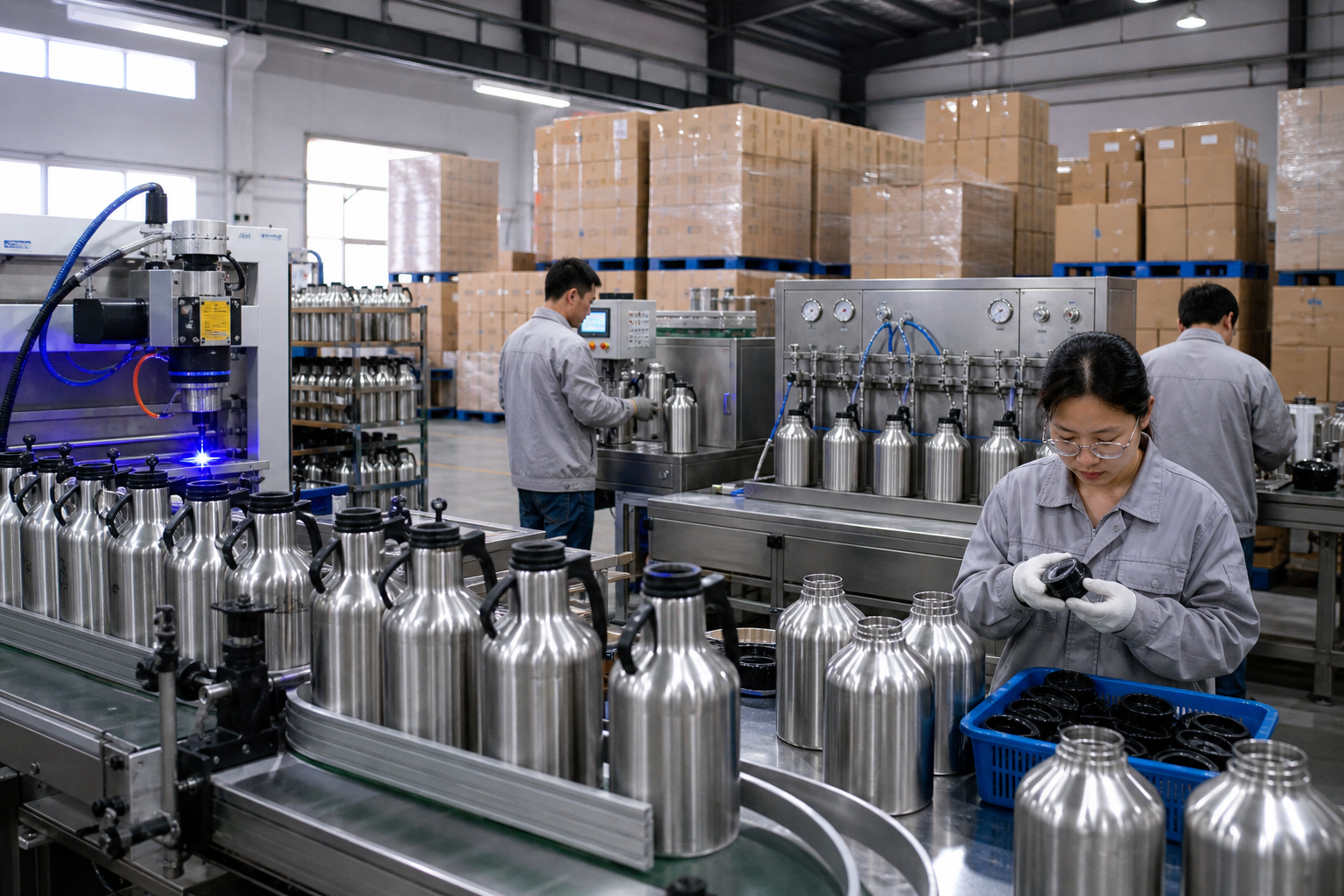
Key Takeaways
- A realistic custom growler MOQ is 500-1,000 pcs per SKU, with samples in 7-10 days and mass production in 30-45 days.
- 304 stainless at 0.5-0.7 mm is the usual baseline for reusable beer growlers; glass is cheaper but breaks more in export freight.
- Ask for REACH, LFGB, AQL 2.5, and leak-test records before you approve any custom drinkware order.
- A Zhejiang factory with 300,000 units/month capacity is useful only if it can show real QC logs, not just a catalog.
If you buy from beer growler vendors, you are not buying a simple bottle. You are buying a sealed, branded container that has to survive filling, 48-hour storage, cross-dock shipping, and retail handling without leaks or print lift. The same plant might also run canteen custom or customizable drinkware, but a custom growler needs tighter closure control, stronger cartons, and QC that checks the cap torque, not just the artwork.
Factories in Zhejiang, China can do this well, but only if you push the right spec from day one. Start with capacity, material, lid, and logo method, then lock MOQ, lead time, and test standards. If you skip those details, a canteen manufacturer can still ship a pretty sample that fails on the line, and you pay for that mistake twice. We have seen a 500 ml sample pass print check and still leak at the cap after one drop test, so this is the wrong question to ask late.
Start With Use Case, Not Artwork
For beer growler vendors, the first mistake is starting with logo placement. Start with the job the bottle has to do. Is it a taproom retail growler, a distributor promo piece, or a reusable vessel for craft beer shoppers who will bring it back 20 times? A 32 oz bottle and a 64 oz bottle do not behave the same, and a swing-top is not the same as a screw cap when carbonation loss is on the table. On our leak bench, that difference shows up fast.
If you already source canteen custom or customizable canteen lines, some of the workflow looks familiar: capacity, coating, carton test, and artwork sign-off. The weak spot is the seal. Beer packaging needs tighter neck tolerances, and QC will pull the sample if the lid sits off by even 1 mm. Ask for these basics before you talk about decoration:
- Net capacity and fill line tolerance, usually within plus/minus 5 percent
- Neck finish and lid type, with a leak-test requirement at the line
- Intended use, retail shelf, on-premise, or giveaway
- Case pack, master carton strength, and drop-test expectation from 76 cm
A good canteen vendor can make a custom canteen look sharp. A good growler vendor makes it survive opening, closing, and shipping again and again. We have seen buyers chase artwork first, then flag a PO typo on the neck finish after the mold is already booked. That is the wrong question to ask. If you are buying distributor drinkware for more than one market, lock the use case first and let the artwork follow the function.
Pick the Right Bottle Material
For a custom growler, material choice drives margin and claims, not looks. Stainless steel costs more than glass, but it takes a drop from 1.2 m on the packing line, holds temperature better, and cuts breakage in warehouse handling. For export, that is the difference between a clean shipment and a claims file. A glass growler can work for taproom sales, but once cartons hit pallet stacking and distributor routes, 3% breakage turns into real money.
On stainless builds, 304 is the standard starting point. If the use case justifies it, 316 gives stronger corrosion resistance, but most beer growler vendors do not need it. Ask for body thickness in the 0.5-0.7 mm range, welded seam finish, a food-grade silicone gasket, and passivation on food-contact surfaces. We checked one lot with a micrometer at 0.46 mm; QC pulled the sample and the buyer flagged the denting risk. For coated bodies, check whether the powder line runs canteen customized products too. Shared equipment is normal in a canteen factory, but the oven cure still has to hold 180 C for the full cycle.
- Glass: lower unit cost, easier to inspect under a light box, higher breakage risk in 12-bottle trays
- Stainless: higher tooling and material cost, better for reusable custom drinkware, safer on palletized export loads
- Insulated stainless: best for premium retail, higher MOQ and 10 to 15 days longer lead time
If your buyer wants a customizable growler that feels premium, stainless usually wins. If the buyer wants a cheap promotional item, a canteen promotional spec is better handled as a simple stock shape with logo only. We had a PO last month where the buyer typed 3041 instead of 304; that kind of typo wastes a day, and the math does not work if you are trying to hit a promo price.
Branding That Survives Shipping
Printing is where a lot of customized drinkware orders go sideways. We have seen a logo look clean in PDF, then fail on a curved, coated growler because the supplier missed ink viscosity, curing time, or artwork prep. On our line, the press check is the first gate. For beer growler vendors, the safe call is simple: pick the decoration that will survive shipping and still meet shelf expectations.
Laser engraving is the most durable option on bare stainless. It does not peel, and it holds up in dishwashers better than most prints. Silkscreen works on powder-coated bodies, but it needs tight registration and proper curing. If you want a color wrap or full-body graphic, ask the canteen supplier how many print stations they run in-house. A canteen distributor can resell a nice sample; a real canteen manufacturer should give you line width, color count, and reject limits. QC pulled a sample last week with a 0.6 mm shift, and the buyer flagged it immediately.
- Laser: best for one-color branding and long-life retail units
- Silkscreen: good for 1-3 colors on coated bodies
- Heat transfer or UV: useful for promotional runs, but check abrasion resistance
- Emboss/deboss: premium look, but only if the mold supports it
For distributor growler programs, I usually push a restrained logo, a clean neck area, and carton graphics that match the shelf. That beats a giant mark that chips on the first carton drop. The math does not work otherwise. If you also sell custom canteen SKUs, keep the art system consistent so the same buyer can reorder without rebuilding files. We once shipped a PO with the neck print location typed as 15 mm off, and that typo cost a day on the line.
Demand Real Compliance Proof
Compliance is where buyers avoid a costly recall. If you are sourcing in China, do not take a loose "food safe" claim and move on. Ask for the actual test reports, then check the issue date, the sample reference, and the factory name on the report. For one beer growler order, the buyer flagged a report with the wrong carton code, and we caught it at the filing desk before it became a shipment dispute. For Europe, REACH and LFGB matter. For North America, you still want food-contact declarations, BPA-free statements where relevant, and a supplier who keeps the paperwork clean.
Quality control should be written into the purchase order. I prefer AQL 2.5 for general cosmetic defects and 1.0 for critical defects such as leaks, off-spec threads, or sharp edges. If the product is insulated, add vacuum retention testing and thermal hold targets, for example 6 hours hot and 12 hours cold on a defined test fill. On the line, QC pulled the sample at 23 degrees Celsius and held it for a full shift. If it is glass, add drop tests and carton compression to ASTM D4169 or an equivalent packaging standard. If it is a coated stainless body, add tape adhesion and rub tests. The math does not work if you leave that out.
Useful paper trail for beer growler vendors includes:
- BSCI or similar social compliance audit if your retailer asks for it
- ISO 9001 system evidence, not just a logo on the website
- Incoming material control for 304 stainless, lids, and gaskets
- Pre-shipment inspection records with photos of each defect class
The same discipline matters whether you buy custom drinkware, customized canteen items, or a custom growler line. The product changes, but the factory habits do not. We ship enough mixed orders to know this goes sideways fast when a PO typo slips in, so if the supplier cannot show the records, treat it as a risk, not a detail.
Price, MOQ, and Lead Time
Most beer growler vendors want a clean price before they approve art. Fair ask. On our line, the number changes with body type, lid, decoration, and carton spec. A plain stainless 32 oz custom growler usually lands around USD 3.20-6.50 FOB on larger runs. A vacuum-insulated version with a better lid and premium finish sits more in the USD 6.80-12.50 range. Glass looks cheaper on paper, but one cracked carton at 18 kg can wipe out the gap fast.
MOQ needs to match the decoration method. For one logo and one finish, many factories in Zhejiang, China start at 500-1,000 pcs per SKU. Add multiple Pantone colors, separate cartons, or gift boxes, and the MOQ climbs. We had a buyer flag a PO typo on the carton count last month, and that kind of mistake changes the quote by a real amount. A serious canteen factory should give sample lead time at 7-10 days and mass production at 30-45 days after sample approval. If a supplier says yes to everything and never mentions tooling, they are a trader, not a real canteen manufacturer. That is the wrong question to ask.
Useful commercial checkpoints:
- Tooling fee for a new mold or lid: often USD 1,500-4,000
- Monthly capacity: a midsize Zhejiang line can reach 300,000 units
- Packaging: confirm master carton test, pallet height, and FNSKU placement before booking freight
- Payment terms: 30 percent deposit, 70 percent before shipment is still common
That is the range where a distributor drinkware buyer can plan margin without guessing. QC pulled the sample, checked the lid torque, and the deal held because the numbers matched the freight math. A distributor canteen or distributor growler program stays viable after freight.
Choose a Factory, Not a Catalog
I’m rewriting the section in place, keeping the HTML structure intact and tightening the language so it reads like a factory-side sales engineer, not generic copy.In China, the gap between a factory and a reseller shows up fast when you ask for proof. A trader can send polished photos. A Zhejiang factory can open the coating line, point to the leak test bench, show the welding schedule, and pull yesterday's QC log. We had a buyer flag a neck-size typo on a PO once; the reseller missed it, the factory caught it before the cartons left. That is the bar for beer growler vendors orders at scale.
Choose a supplier that owns tooling, decoration, testing, and carton control. If they also run canteen suppliers or canteen manufacturers work, fine, but the growler line has to stay separate. A factory that makes custom canteen, customized drinkware, and canteen promotional items should still tell you which line handles food-contact stainless and which line cures paint at 180C. Ask how many operators run each shift and whether they ship 30,000 or 80,000 units a month; the math does not work if the sales deck says one thing and the packing room says another.
Ask for three things before you place the order: recent factory audit photos, a pre-shipment inspection checklist, and the contact details for the person who signs off on CAPA when defects are found.
For export buyers in Europe and North America, the brochure is the easy part. The plant that matters can run a 20,000-unit order, keep the cap-torque setting steady on the line, and ship the next PO with the same finish. If a canteen distributor only wants one SKU, fine. If you want a distributor growler program, you need a canteen factory that can repeat the spec without drift. China has the capacity; the hard part is finding the factories that can actually execute.
Request a real growler quote today
Send capacity, lid style, logo art, target MOQ, and destination port. We will price the spec, not a generic catalog item.
Frequently asked questions
What MOQ should I expect for custom growlers?
For a stock shape with one logo and one finish, 500 pcs per SKU is a normal starting point. If you want a new mold, a premium lid, or two print positions, 1,000 pcs is more realistic. Some Zhejiang factories will quote 300 pcs for a repeat shape, but the unit price usually rises 15-25 percent. Sample lead time is usually 7-10 days, with a freighted sample costing USD 30-80 depending on decoration. The cleanest way to control MOQ is to keep one capacity, one lid, and one artwork file per order. That is how distributor growler programs stay profitable.
Should I choose stainless or glass for retail growlers?
If the product is going to bars, events, and distributor drinkware programs, stainless is the safer bet. 304 stainless at 0.6 mm with a good seal can survive drops and repeated use. Glass wins on lower upfront cost and clearer product visibility, but one broken case can wipe out the savings. For retail, stainless insulated units often give you a better margin because you can charge USD 2-4 more per piece. If you sell a simple promotional canteen or custom canteen line, glass may still work, but beer growlers are handled more roughly than water bottles, so breakage math matters.
Can I get logos that survive dishwashing?
Yes, but you need to choose the right decoration method. Laser is best for bare stainless, silkscreen is fine on coated bodies. Ask for a minimum stroke width of 0.2 mm and avoid fine lines under 1.5 mm. For dishwashing, laser can handle 200 plus cycles without visible fading because there is no ink layer to peel. A 1-color logo on powder coat can still look good, but it needs proper curing and an abrasion test. Customized drinkware fails most often at the artwork stage, not the body stage, so do not approve thin script just because it looks elegant on a screen.
How do I verify a China supplier is real?
Ask for factory registration, a live video walk-through, recent audit reports, and a sample from the same production line, not a hand-made prototype. In Zhejiang and other parts of China, real factories can show you raw material receipts, QC logs, and shipment photos from the last 30 days. Check whether they have BSCI or ISO 9001, but do not stop there. Ask for leak-test records, carton compression results, and the name of the person who signs pre-shipment inspection. If the answer is vague, you are dealing with a trader, not a canteen manufacturer or growler factory.
What is a realistic timeline from approval to delivery?
A practical timeline is 7-10 days for samples, 30-45 days for production, and 20-35 days for ocean freight depending on destination port and season. Add 3-7 days for customs and inland delivery if you are shipping into Europe or North America. If artwork is not final, add another week. If you need new tooling, add 10-15 days. For a first order, a 60-90 day planning window is safer than trying to land stock for a fixed event date. Beer growler vendors who promise everything in 15 days usually leave out the real bottlenecks.