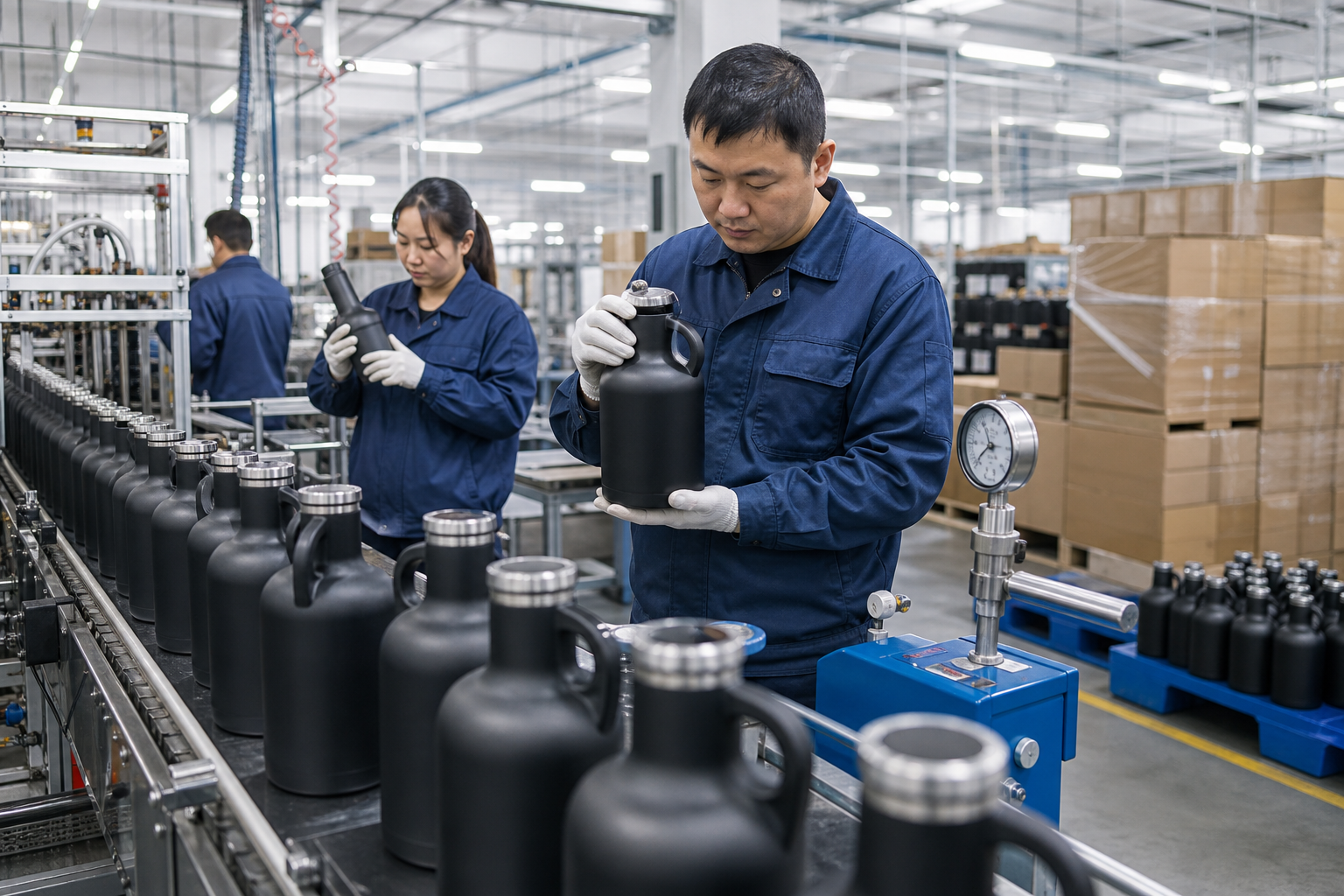
Key Takeaways
- Most beer growler wholesale programs land at 32 oz, 64 oz, or 128 oz, with 64 oz the most common retail size.
- A Zhejiang factory with 80,000-120,000 units/month output can usually support 500-1,000 pcs MOQ and 35-45 day lead time.
- 304 stainless and a 0.5-0.8 mm body are the practical default; 316 and heavier gauges add cost without helping every buyer.
- A good RFQ should specify AQL 2.5, leak testing, REACH or FDA needs, and the exact artwork method before you approve samples.
Beer growler wholesale looks simple until the buyer asks for 1.0 mm wall thickness, lid seal compression, coating adhesion, carton drop test, and a real FOB quote from the same line. A 64 oz or 128 oz growler can swing 20-35% in cost because steel grade, finish, and cap style change the build; we have seen a $0.80 sample turn into a $1.35 production part once QC pulled the sample with a caliper and checked the lid ring. Cheap sample, bad signal.
If you buy for a brewery, retail chain, or distributor, you need a China supplier that can hold spec, print cleanly, and ship on time. In Zhejiang, a serious factory will quote in 2-3 days, not 2 weeks, and will tell you straight whether your target price fits a 500-1,000 pcs MOQ or whether the build has to change. The buyer flags a PO typo on carton marks, we run the line anyway, and the math does not work if you wait until after approval to fix it.
Choose The Right Growler Format
Start with the use case, not the catalog shot. A beer growler for taproom carryout is a different job from a retail gift box or a chain promo drop. On our line, 64 oz is the size that usually balances shelf presence, freight cost, and day-to-day use; a 32 oz piece fits sampling or solo pours, while 128 oz makes sense for club and refill programs where the buyer wants fewer return trips. The math does not work any other way.
Single-wall stainless is the practical call for lower price points and bar back use. Double-wall vacuum build gives better insulation and a higher perceived value, but it also adds weight, cost, and more QC checkpoints. If you are comparing beer growler bulk options, lock down the mouth size, lid type, handle style, and whether the body needs matte powder coat or bare brushed finish. We have seen a buyer lose two weeks over a 2 mm mouth mismatch on a PO.
- 32 oz for gift retail and trial sets, usually the cleaner fit for small counter displays
- 64 oz for standard beer growler wholesale programs, the size most buyers run for taproom carryout
- 128 oz for clubs, refill shops, and promo bulk orders, where fewer refill trips matter more than box count
The best wholesale drinkware is the piece that survives daily handling, not the sample table. For bars and breweries, that means a shape that stacks cleanly, seals without fuss, and does not skate on a wet counter. QC pulled the sample after a lid wobble test, and we fixed the base ring before the next run. That is the right question to ask.
Materials And Finish Drive Cost
For a beer growler wholesale order, material choice is where you protect margin. We run 304 stainless steel as the default because it gives the right mix of corrosion resistance, supply stability, and price. 316 has a better corrosion profile, but unless the buyer is filling in harsher conditions, the extra cost usually changes nothing on the shelf. If someone pushes for a lower quote by thinning the steel, that is the wrong question to ask. Once the body drops below 0.5 mm, the sample starts to feel flimsy, and a growler can pick up dents in transit fast.
On the line, 0.5-0.8 mm with a reinforced base is the range we trust for bulk growler production. Powder coating is common when the buyer wants color and grip, and 60-80 micron is a clean target we can measure with the gauge. Brushed or polished bare steel works when the brief calls for a cleaner industrial look. Ask for a food-safe gasket in silicone or EPDM, and check that the lid thread stays consistent across the run. QC pulled a sample last month where the cap seated fine on one bottle and sat crooked on the next, and that kind of finish issue is not cosmetic only. It shows up in dishwasher cycles too.
What To Lock Before Sampling
- Steel grade: 304 by default, 316 only when justified
- Wall thickness: 0.5-0.8 mm for most wholesale drinkware runs
- Finish: powder coat, brushed, or polished
- Seal: food-grade silicone or EPDM gasket
If you also source bulk canteen, canteen wholesale, or drinkware bulk SKUs from the same China factory, lock the material spec early. We have seen this go sideways when one PO typo changed the finish code on a 3,000-piece order, and the buyer flagged it after sampling. A shared spec sheet keeps the program aligned and saves a second round of approvals.
MOQ, Lead Time, And Pricing
Buyers ask for the FOB price first, but we judge the order by volume, decoration, and packing complexity. A mid-sized Zhejiang plant runs 80,000-120,000 units per month across different drinkware lines. For a standard beer growler wholesale order, MOQ is commonly 500-1,000 pcs per SKU, with 35-45 days for production after sample approval. On the line, QC checks the 28 mm neck finish and cap torque before we release mass production. If you need a custom lid, a special carton, or a multi-color print, the buyer should plan on the longer end of that range. That is the right question, not the first FOB number.
Sampling usually takes 5-10 days if the body is already in production tooling. New surface treatment, custom packaging, or a fresh artwork layout adds time fast. The real cost drivers are steel grade, vacuum construction, finish, lid complexity, and the number of print colors. A one-color silk screen on a 64 oz growler is far cheaper than a wraparound design with registration tolerance on a curved surface. Our pad printer holds a 0.3 mm registration window, and the buyer flags it the moment the logo starts to ghost. If you chase the lowest unit price, you often get a thinner shell, weaker coating, or less consistent leak performance. The math does not work.
Ask for an itemized quote: unit price, sample cost, print setup, carton spec, and a clear lead time. If the supplier will not separate those numbers, you do not yet have a usable purchasing quote. We see this go sideways when the PO says "as sample" and leaves the carton spec blank.
For wholesale growler programs, FOB Ningbo or Shanghai is easier to compare than vague ex-works numbers. Freight and customs stay separate, but the factory quote should still be clean enough that your landed cost model does not guess at hidden packaging or artwork charges. A 5-layer carton with a 250 gsm outer liner changes the freight and damage rate fast, and we have seen that pushback from buyers who wanted the same price on a stronger pack. If the line has to switch from a plain carton to a color box, the quote should say it plainly.
Branding That Survives Real Use
Branding is where a lot of wholesale drinkware looks sharp in a mockup and flat on the shelf. For beer growler wholesale, the decoration has to match how the bottle gets used. On our 60W fiber laser line, a clean mark holds up better than most buyers expect. Silk screen works for 1 or 2 colors if the cure is tight, and we run it that way when the art is simple. Full-wrap graphics can sell well, but they pick up scratches fast, and one bad color match on a 500 pcs batch will get flagged by QC before it leaves the line.
If you sell to breweries, taprooms, or gift channels, keep the logo placement simple and repeatable. One centered mark on the shoulder or body beats trying to cover every inch. This is the wrong question to ask: "How much space can we fill?" Ask for Pantone matching when color matters, and approve the artwork before we print the first sample. We had one PO with a barcode typo on the carton label, and that single line would have caused a relabeling mess on an Amazon run. If the order is going to Amazon or a similar channel, lock the carton label, barcode, and FNSKU logic before production starts.
- Laser engraving for premium durability
- Silk screen for low-cost, high-volume runs
- Powder coat underbase only when the artwork needs contrast
For buyers comparing beer tumbler wholesale bulk against wholesale growler programs, the branding rule stays the same: cut the decoration variables down and keep the spec tight. We have seen this go sideways when a buyer adds a second logo, a wrap, and a color swap on the same order. The math does not work. Fewer variables keep color, alignment, and reorders stable, and that is what the line can actually hold.
Compliance For EU And US
If you are selling into Europe or North America, compliance is the price of entry. It is not paperwork for the binder. For the EU, ask for REACH-related material declarations and, where it applies, LFGB testing for food contact. For the US, you need written food-contact suitability and a supplier who can state the resin, ink, coating, and gasket materials without hand-waving. If the growler is vacuum insulated, check the adhesive, inner welds, and decorative finish against the stated food-contact scope. We had one buyer flag a PO because the gasket was written as "silicone" with no grade, and the line stopped until the spec sheet was cleaned up. This is the wrong question to leave open.
Factory audits matter just as much as lab reports. BSCI or another accepted social compliance audit helps when a retail customer asks for it, and ISO 9001 shows process discipline, though it does not replace a real quality inspection. On the line, we run AQL 2.5 for major defects and 4.0 for minor defects unless the buyer spec is tighter. Leak testing should be 100 percent on finished growlers. Cartons should pass drop and compression checks that match export handling, not a casual in-plant shake test. QC pulled one sample with a 0.3 mm cap gap last quarter, and that kind of miss becomes a claim if you ship blind.
Minimum QA Questions
- What is the material declaration for body, lid, gasket, and ink?
- Are samples and mass production tested separately?
- Is every unit leak tested before packing?
- Do you have batch traceability by lot and date code?
For canteen bulk and canteen wholesale buyers, the same logic applies. Whether you are ordering a beer growler in bulk or an alcohol flask wholesale bulk program, the compliance file should be complete before the order leaves China. We ship enough cartons to know the math does not work any other way. If the file is missing one test report, the buyer will catch it at receiving, and then you are paying for rework, delays, and a second round of approvals.
How To Run A Clean RFQ
A clean RFQ saves hours because it cuts out guesswork. Put the capacity, material, wall thickness, finish, lid type, logo method, carton count, target market, and test standard in writing. If you want quotes you can compare across suppliers in China, leave nothing open. A buyer who asks for only perfect size and best price usually gets three different answers back. On the line, we still see PO notes missing lid color or carton load weight, and that is where the trouble starts.
Use a simple sequence: request quotation, review sample, approve the pre-production sample, inspect the first bulk run, then fix repeat order terms. If the supplier in Zhejiang sends a clean pre-production sample and the color stays within the same batch on the first run, reorders get easier fast. Ask for a production schedule that names raw material purchase, decorating, assembly, packing, and ship date. We run better when the buyer pins down dates instead of asking for "soon." That is the wrong question to ask. A 7-day slip on stainless stock can turn into 18 days if the blank tube is not booked early.
For a broader drinkware wholesale program, standardize where you can. Shared lid parts, shared carton sizes, and shared pallet patterns cut freight waste and reduce warehouse damage. If your catalog also includes bulk drinkware, wholesale drinkware, or a best wholesale drink bottle line, do not let one growler force a unique box or label unless the margin pays for it. QC pulled the sample last week because one carton spec was 2 mm off, and the whole pallet stack shifted in transit. The math does not work if every SKU gets its own packaging.
Strong sourcing is boring in the best way: fixed spec, fixed inspection standard, fixed packaging, and a supplier who can repeat the same result on the next 10,000 units.
That is the gap between a one-off buy and a program you can scale.
Send your growler spec for a factory quote
Share capacity, finish, lid type, and target market. We will quote from China with the MOQ, lead time, and test scope spelled out.
Frequently asked questions
What MOQ should I expect for beer growler wholesale orders?
For a standard beer growler wholesale order, 500-1,000 pcs per SKU is normal in China, especially if you want a custom logo or color. A simple brushed 64 oz model can sometimes start near 300 pcs, but once you add powder coating, special lids, or carton printing, the practical MOQ rises. In Zhejiang, many factories will also ask for a small sample fee or tooling charge for new caps. If your channel is brewery retail or distributor replenishment, 1,000 pcs is often the safer number because it keeps your unit price stable and gives you enough stock for a second-order test.
Is 304 stainless enough, or should I pay for 316?
For most beer growler wholesale programs, 304 stainless is enough. It covers standard beverage use, is easier to source in China, and keeps the price competitive. Move to 316 only if you have a specific reason, such as harsher coastal storage, unusually acidic contents, or a premium specification from a retail client. In many cases, 316 increases the cost by 8-15% without changing the end-user experience. What matters more is whether the sheet thickness is consistent, the welds are clean, and the lid seals reliably. A good 304 growler with a proper gasket will outperform a poorly made 316 one.
What size sells best in retail channels?
The 64 oz size is the most common choice for beer growler wholesale because it matches taproom carryout, looks substantial on shelf, and keeps shipping weight under control. A 32 oz unit works for gift sets, samplers, and smaller basket programs. A 128 oz growler is better for club memberships or refill-heavy channels, but it takes more carton space and can be harder to move in e-commerce. If you are launching a new line, start with 64 oz unless your customer already told you the target size. It is the safest size for beer growler bulk ordering.
What inspection documents should I request before shipment?
Ask for a pre-shipment inspection report with AQL 2.5 for major defects and 4.0 for minor defects, plus a 100% leak test record for the finished growlers. For export, you should also request carton count verification, drop-test evidence if the packaging is fragile, and batch traceability by lot. If your buyer is in Europe, ask for REACH-related material declarations and any food-contact test reports that apply. In China, a serious factory in Zhejiang will usually have an internal QC sheet for body finish, lid torque, and print quality. Do not accept a photo-only inspection.
Can I add logos, labels, and retail packaging?
Yes, and you should define them early. For beer growler wholesale, laser engraving is best when you want a durable premium mark, while one-color silk screen is usually the lowest-cost option. If you need retail packaging, specify the insert, barcode, warning label, and carton artwork before the pre-production sample is approved. That avoids rework and keeps the print registration stable. If the same program also includes wholesale canteen or alcohol flask wholesale bulk items, standardizing the box size and label placement will reduce your warehouse complexity. The logo is easy; the packaging discipline is what protects margin.