Key Takeaways
- For beer tumbler custom made orders, expect MOQ from 300-1000 pcs per design and 20-35 days lead time after sample approval.
- A 18/8 or 304 stainless body with 0.6-0.8 mm wall thickness is a safer commercial spec than thin, low-grade metal.
- For EU and US shipments, ask for REACH, LFGB, food-contact declarations, and AQL 2.5/4.0 inspection terms before production.
- A Zhejiang canteen factory with 300000 units/month capacity can usually handle repeat distributor drinkware orders more reliably than a trading-only source.
If you are buying beer tumbler custom made products for retail, promotions, or channel programs, the risk is not the shape. The gap shows up between the screen mockup and the cartons on arrival. We run these jobs with a caliper on the line, and if the steel grade, wall thickness, coating method, and test standard are not in writing before the PO, you are buying trouble.
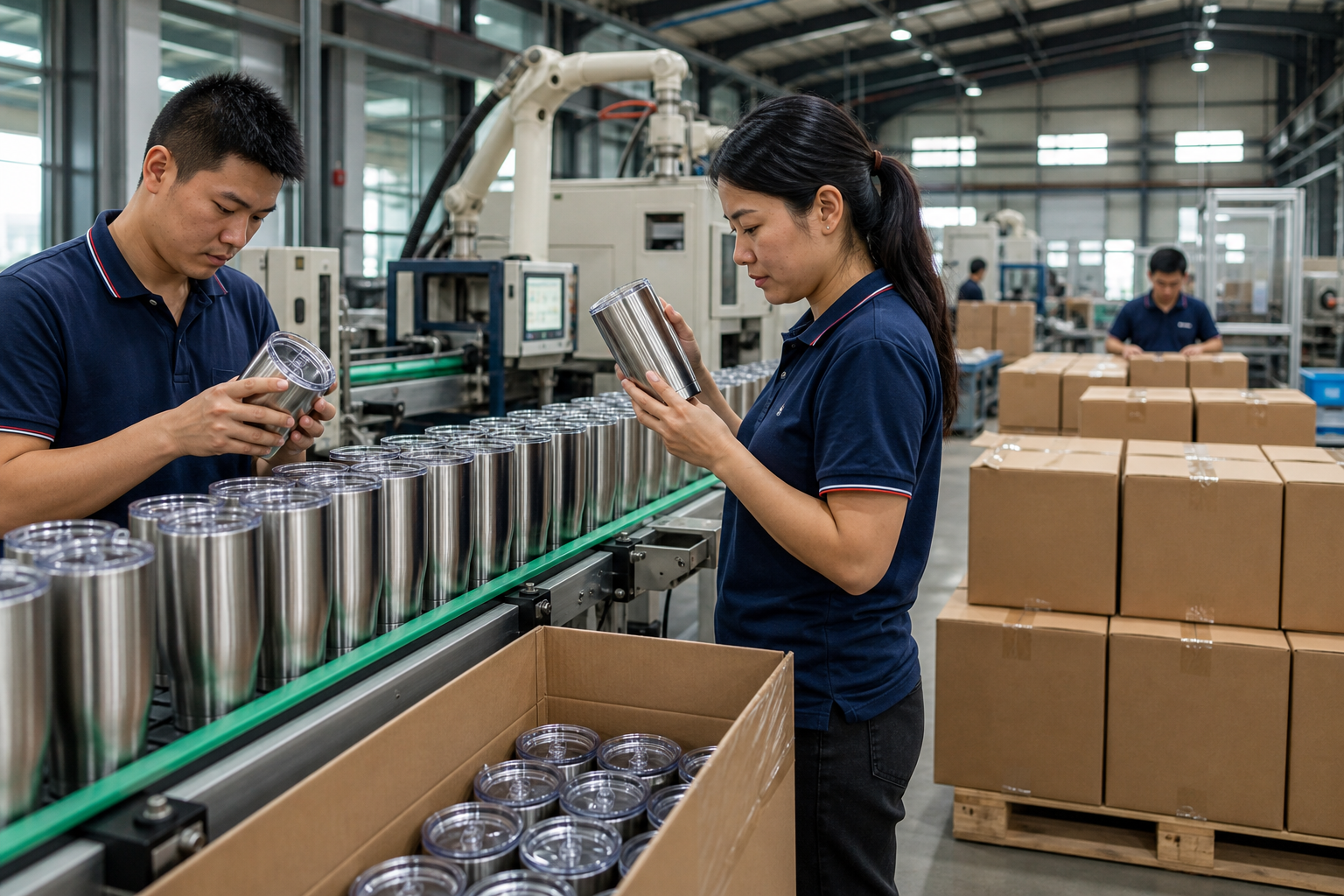
In Zhejiang and across China, the better factories treat beer tumblers like an engineering job, not a print job. That matters when you need 500, 2,000, or 10,000 pieces with steady insulation, logo placement that does not drift by 2 mm, and export cartons that hold up in transit. If you also buy custom canteen, custom growler, or other customized drinkware, the rule is the same: ask for proof, not promises. The buyer flagged it, and the math does not work any other way.
What beer tumblers actually need
A beer tumbler is not a shorter travel mug. On the line, we treat it as a cold-drink vessel with a different job: hold temperature, stay steady in a hand, and stay neutral after repeated washes. For a beer tumbler custom made program, start with 18/8 stainless steel, a 0.6-0.8 mm shell, and a powder coat or polished finish that fits the channel price. If it is vacuum insulated, ask for a real claim like 6 hours cold retention under controlled test conditions. We have seen buyers accept vague copy, then QC pulled the sample and the numbers did not hold.
For bar programs and distributor drinkware, silhouette decides a lot. Straight-wall tumblers stack cleaner in cartons and sit better on shelves; a slight taper feels nicer in hand, but if your artwork sits too close to the base curve, print loss goes up fast. We have shipped both versions from Zhejiang, and the sample table makes the choice obvious within a day. A buyer flagged one PO because the art file left 4 mm less clearance than the spec allowed. That kind of mistake costs time.
Practical buying rule: if the supplier cannot state steel grade, vacuum layer method, and a leak or sweat test standard, the design is not ready for approval. This is the wrong question to ask after the layout is signed. Ask before the tool is cut. We have seen it go sideways when the PO said '304' in the notes but the drawing was blank, and the line had to stop.
Choose the right body and lid
The body and lid set the feel in hand. For cold beer, a double-wall vacuum body with a 304 inner liner is the stock commercial choice we run on the line. If the order is for event giveaways and the buyer wants the lowest landed cost, a single-wall customized drinkware version works, but it sweats fast and drops temperature fast. The math does not work for retail, and QC will spot that on the first 10-minute bench test.
Lids are where orders slip. A press-on lid costs less and tools faster, but it is weaker in transit. A slide lid or splash-resistant clear lid usually sells better in North America because buyers want to see the drinking path and cut spill claims. If you are sourcing a customized growler or a customizable growler alongside tumblers, standardizing the lid family keeps carton counts down and avoids spare-part mess. We had one PO where the buyer flagged a lid code typo, and that one line cost a full rework.
- Press-fit lid: lowest cost, good for giveaways and bulk campaigns with MOQ 500 pcs.
- Slide lid: stronger retail value and easier one-handed use at the bar or on site.
- Clear Tritan-style lid: better shelf appeal, but check heat resistance and compliance before you sign off.
Ask the canteen supplier to confirm the gasket material, usually silicone or TPE, and to send the drop test result from the 1.2 m check. If the lid pops off in transit, you pay for the loss twice, once on the unit and once on the claim.
Decoration drives sell-through
I’m rewriting the section in place and keeping the HTML structure intact. The pass is focused on stripping the canned phrasing, adding factory-level specifics, and making the selling logic read like someone who actually runs the line.Decoration is not a cosmetic afterthought. It moves unit price, yield, and how buyers read the product on shelf. For beer tumbler custom made work, we run silk screen, laser engraving, heat transfer, and UV printing. Silk screen is still the lowest-cost choice for one or two spot colors, especially on a matte powder-coated body. Laser engraving gives a permanent mark with a cleaner retail feel, but it works best on brushed steel or coatings that expose base metal cleanly. On the line, QC pulled the sample after the first pass because a 0.3 mm stroke broke on the curve.
If you are managing a canteen distributor program, keep the color count down. Every extra color adds setup time and raises the misregistration risk. On curved surfaces, a large logo should stay clear of weld seams and the base radius zone. A good canteen factory will send the actual print area in a dieline before production starts. If they skip that step, you are paying for rework. We have had buyers push for a 4-color logo on a 55 mm print band; the math does not work.
For premium distributor canteen or distributor growler lines, use a two-step look: laser logo on the front and a small capacity mark on the back. That keeps the item usable in retail and corporate gifting. For canteen customized campaigns tied to seasonal promotions, simple graphics are safer than full-wrap artwork because they survive carton rubbing and handling better. We have seen a PO typo turn 500 ml into 550 ml on the art file, and the buyer flagged it before we cut plates.
Rule of thumb: on a 360 ml or 500 ml tumbler, keep the main logo no larger than 70 mm wide unless you have approved a full-wrap print path.
Compliance for EU and US
For Europe and North America, compliance is where cheap sourcing claims break first. A serious beer tumbler custom made order should ship with food-contact files, material declarations, and test reports that match the destination market. For the EU, ask for REACH and LFGB support if the design has coatings, inks, or lid parts that touch food or drink. On the line, we check whether the silicone gasket and print ink sit in the same contact zone, because that is where the buyer flags it.
Do not assume a canteen vendor knows your importer checklist just because they ship export orders. You need the paperwork tied to the PO: carton marks, inner bag spec, drop-test expectation, and pallet pattern if required. If the product is for kids or school channels, the file stack gets heavier. This is the wrong question to ask if someone says “we export everywhere.” The buyer asked for a missing carton code on one PO, and QC pulled the sample before packing started.
Inspection has to be set before production starts. AQL 2.5 for major defects and 4.0 for minor defects is common, but we tighten it for retail orders. If you work with a Zhejiang canteen manufacturer that already runs export audit systems, ask for BSCI status, factory photos, and a recent internal audit summary. You do not need 30 certificates; you need the 3 or 4 that match your SKU. We ran one batch at 5000 pcs last month, and the 0.2 mm print shift would have failed if we had not caught it at pre-shipment.
MOQ, pricing, and lead time
Pricing for beer tumbler custom made jobs moves with body size, surface treatment, lid type, and carton setup. A plain single-wall promo cup with one-color print can stay sharp on cost; a double-wall vacuum cup with a custom lid and multi-color decoration runs higher, and that is normal because the margin usually holds better. We quote from FOB China first, then the buyer adds freight, duty, and delivery to the door. One PO typo can throw the whole sheet off, and we have seen a buyer write 12 oz on the order while asking for a 500 ml sample.
At a Zhejiang canteen factory with a stable line, MOQ is often 300-1000 pcs for a stock body with custom print, and 1000-3000 pcs if you want a new mold or a unique lid. Lead time is usually 20-35 days after sample approval, then 5-10 days more to get the goods to a consolidation port. Our line runs 300000 units/month, but that only helps when the specs stop moving. QC pulled a sample at the bench with a caliper on the 1.2 mm rim, and that is the kind of detail that keeps the schedule honest.
If your program includes canteen promotional sets, ask for a stepped quote: 500 pcs, 1000 pcs, 3000 pcs. That shows where the unit cost really settles. This is the wrong question to ask if you only look at the lowest price, because packing fees, thin cartons, and extra color charges can erase the savings fast. We run carton drop tests for a reason. A good canteen manufacturer puts the full landed math on the table early, not after the buyer has already approved the artwork.
How to source the right factory
Pick a factory the way you pick an engineering partner. Ask what runs out of the line each month, not what they say they can quote on paper. A solid canteen factory should show vacuum leak tests, coating adhesion checks, and incoming steel and lid inspections, with records from the last 7 days. QC pulled one sample off the line and checked a 0.2 mm scratch limit under a light box. If they also run custom growler and customizable canteen work, that is a good sign: they already handle different neck sizes, lid threads, and print positions in one system.
When you compare canteen suppliers, look at three things: sample stability, deviation notes in writing, and lead time you can actually hold. A canteen distributor should not need ten messages to get one revised proof. In Zhejiang, the direct factories will tell you if your 500-unit MOQ needs a 12-day sample run or an 18-day reprint because the powder coat line is booked. The buyer flagged a 1 mm logo shift once, and that is the sort of mistake that turns into a refund fight. The math does not work if the quote hides that.
Use this filter:
- Can they send a pre-production sample with your exact logo placement, down to the same 1 mm offset?
- Can they explain the difference between a custom canteen and a customized canteen quote without hiding the tooling cost?
- Can they support repeat orders without changing carton size, print tone, or lid fit on the next run?
If you need one source for beer tumblers, canteen customizable lines, and distributor drinkware programs, a factory that already exports from China to Europe and North America is the safer long-term choice. Ask for a carton spec sheet, not a promise. We've seen this go sideways when the outer box changes by 8 mm and the buyer only notices after the first pallet lands.
Build your beer tumbler line with real specs
Send your target MOQ, logo file, and market. We will quote the right body, lid, decoration, and compliance path from Zhejiang.
Frequently asked questions
What is a realistic MOQ for beer tumbler custom made orders?
For a standard body with custom logo, many factories quote 300-1000 pcs per design. If you need a new mold, a special lid, or a unique color matched to Pantone, MOQ often rises to 1000-3000 pcs. The number also depends on whether the supplier is a direct canteen factory in Zhejiang or a trading company. For export programs, ask for tiered pricing at 500, 1000, and 3000 pcs so you can see where your margin starts to improve. A supplier that can offer sampling in 5-7 days and production in 20-35 days is usually better for seasonal sales.
Which decoration method is best for branded beer tumblers?
If you want the lowest cost, silk screen is usually best for one or two colors on a powder-coated body. If you want a premium permanent mark, laser engraving is stronger because it does not wash off or fade in normal retail use. UV printing is useful for complex full-color art, but it adds cost and can be more sensitive to abrasion. For distributor drinkware, I usually recommend keeping the logo area small and away from curved seams. That lowers defect risk and improves yield. Always approve a physical sample, not only a PDF proof.
What compliance documents should I request for EU and US shipments?
Request food-contact declarations, material specs for the stainless steel and lid, and test reports that match your market. For Europe, ask for REACH support and, where relevant, LFGB-related test coverage. For the US, ask for FDA food-contact confirmation and make sure the decoration inks and lid materials are documented. If the product is sold through retail, also define your inspection standard, commonly AQL 2.5 for major defects and 4.0 for minor defects. For repeat orders, keep the same carton spec and label format so customs and warehouse intake stay clean.
How long does production usually take in China?
For a standard beer tumbler custom made order, lead time is often 20-35 days after sample approval and deposit receipt. If you change lid tooling, embossing, or packaging, add another 7-15 days. Shipping time from China depends on route, but you should also budget time for sampling, artwork approval, and carton validation. In Zhejiang, mature canteen manufacturers can usually move faster because they already run multiple custom drinkware lines and keep stock components on hand. For seasonal programs, I would start the project at least 8 weeks before you need inventory.
Can I source beer tumblers together with custom canteen and growler items?
Yes, and it often makes commercial sense. If you source custom canteen, customized canteen, and customizable growler items from one canteen supplier, you can standardize packaging, decoration, and carton sizes. That reduces setup costs and helps a canteen distributor manage one consolidated shipment instead of three separate ones. The key is to avoid forcing one mold spec onto every SKU. A beer tumbler, a custom growler, and a custom canteen have different closure and insulation needs, so treat them as related programs, not identical products.