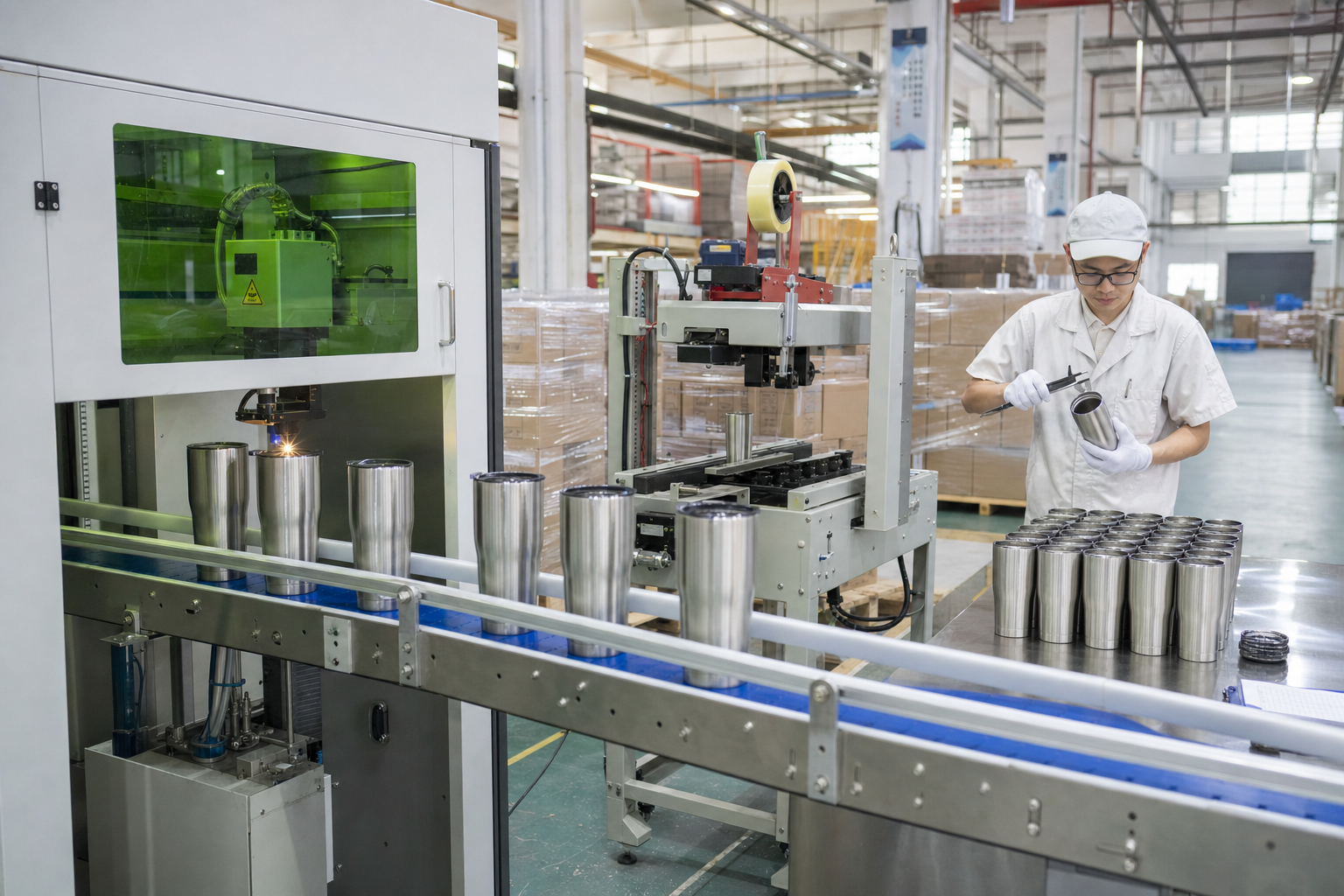
Key Takeaways
- Most beer tumbler custom orders sit at MOQ 500-3,000 pcs, with 25-35 day lead times after sample approval.
- 304 stainless at 0.5-0.7 mm wall thickness is the practical baseline for retail and promo programs.
- Laser engraving and 1-2 color silk screen usually hold up better than complex full-wrap prints.
- Ask for REACH, LFGB or FDA declarations, ISO 9001, and AQL 2.5 inspection before you place the order.
If you are buying beer tumbler custom programs for retail, promotions, or distributor drinkware, the main risk is not price. It is vague specs. A 16 oz tumbler can look fine in a quote and fail later on wall thickness, lid fit, or decoration durability. We have pulled samples off the line and seen a 0.8 mm spec turn into 0.6 mm at the cup body. In Zhejiang, China, that is usually where orders get lost: the buyer assumes the factory understands the target, but the brief never locked it down.
The practical approach is simple. Define the use case, choose the alloy and finish, set your MOQ and packaging target, then ask for compliance papers before sample approval. A serious canteen factory or canteen manufacturer will work this way too, whether you are buying a beer tumbler, custom canteen, custom growler, or broader customizable drinkware program. Our Zhejiang line runs 180,000 units per month, so we see the same mistakes repeatedly. The math does not work if the PO leaves carton count blank or the buyer wants a lid change after sample sign-off.
Start With the Drinking Use Case
Before you talk decoration, lock down how the beer tumbler will be used on the line. A pub giveaway, a retail shelf SKU, and a distributor bundle do not take the same spec. A 16 oz straight wall tumbler for cold beer is a different build from a double-wall vacuum cup meant to ride in a car cup holder. If the buyer cannot say 12 oz, 16 oz, 20 oz, or 24 oz, the factory will guess, and that guess shows up later in the sample room as a rework.
For beer service, ask the plain questions first: do they want cold retention, stackable cups, or a gift item with box packing? This is the wrong question to ask last. We had one buyer flag the carton size after QC pulled the sample, and the whole schedule slipped 6 days because the foam insert was cut for the wrong height. If you are sourcing canteen custom, canteen customizable, or customized growler items at the same time, keep one order sheet for capacity, lid type, finish, logo area, and carton count. That is how canteen distributors keep mixed programs from turning into chaos.
- Define the channel first: retail, promo, hospitality, or e-commerce.
- Set the capacity in ounces and milliliters, not only by product name.
- Confirm whether the buyer needs a lid, straw slot, or open cup format.
- State whether the artwork must match a brand PMS color or only a general tone.
A clean use case cuts two sampling rounds fast, sometimes 12 days instead of 18. That matters when your canteen supplier or canteen vendor is running a custom drinkware calendar with 8 SKUs and a 500 pcs MOQ on each. We ship faster when the buyer answers the use case up front, and the math does not work any other way.
Choose Material and Wall Thickness
I’m rewriting the section to sound like a factory-side sales engineer: tighter, more specific, and less generic, while keeping the HTML structure intact.For beer tumbler custom work, 304 stainless steel is still the default on our line. It runs clean on the polishing wheel and holds up in shipping. If the item is going into a premium retail line or a custom growler style promotion, we usually push for a heavier body and a tighter brushed or powder-coated finish. On the floor, the buyer often likes the sample until QC pulls it beside a dent gauge and the difference shows. For lower-cost canteen promotional programs, thinner walls save money, but going too thin makes the cup feel light in hand and dents faster in carton drop tests.
Practical wall thickness is 0.5 mm to 0.7 mm for most stainless tumblers. At 0.45 mm, the shell starts to ring in your hand; at 0.8 mm, unit cost climbs and freight weight follows. For insulated models, check vacuum seal performance on the leak rack and ask the factory for a real temperature-retention range, such as 12 hours cold versus 18 hours cold, instead of marketing copy. If you are comparing a custom canteen or customized drinkware program, the same rule applies. The math does not change.
What to request in a sample
- Stainless grade confirmation, usually 304 or 201 depending on budget, plus the mill cert if you want fewer surprises.
- Measured body thickness and rim finish with calipers at the line.
- Weight per piece and carton weight, since 24 pcs/carton can move freight fast.
- Lid fit test if the tumbler ships with a cover, including a shake test and one hand-open check.
In China, the cheapest quote often comes from a spec that was never fully written. I have seen a PO say "matte black tumbler" and leave out the 420 ml size, so the line had to stop and ask again. In Zhejiang, the better factories will ask for dimensions, finish, and packing before they quote cleanly.
That is the right behavior. We’ve seen this go sideways when a buyer squeezes the number and the factory guesses on thickness, then the next reorder lands 15 g lighter and the lid gap changes. A canteen manufacturer that works only on price usually leaves you with a product that is hard to repeat on the next run.
Decoration That Actually Holds Up
Decoration is where beer tumbler custom jobs go off the rails. If the cup will live through event washing, distributor canteen drops, and detergent every day, the logo has to survive abrasion, not just a mockup. We run a scratch test on the brushed 304 panel, and if the mark scuffs after 20 passes, it does not ship.
For one-color logos, laser engraving is usually the safest bet. It stays clean, does not depend on ink adhesion, and looks right on brushed stainless. For higher brand impact, silk screen makes sense on runs of 1,000 pcs or more when the artwork is simple; QC pulled the sample on a 2 mm registration drift, and that is the kind of thing the buyer flags fast. If you need a customized canteen or customizable growler with full graphics, plan for more prepress time and a higher reject rate.
- Laser engraving: durable, low maintenance, premium look.
- Silk screen: strong value for flat logos and limited colors.
- Powder coat plus print: better visual contrast, more process control needed.
- Laser plus color-fill: useful when you want a sharp retail finish.
For canteen manufacturers and canteen suppliers, the wrong question is which method looks best in a rendering. Ask whether the mark still holds after 500 wash cycles and a carton drop from 1.2 m. We have seen that question save a PO more than once.
MOQ, Price, and Lead Time
Beer tumbler custom pricing starts with the build, not just the size. A 16 oz straight stainless cup with one-color logo and a standard kraft box can land far below a vacuum-insulated unit with a custom sleeve and retail insert. We run into this every week on the line: a quote that leaves out logo tooling, Pantone matching, or export cartons is not a fair quote, just a cheap one.
In our Zhejiang factory, MOQ is 500 pcs for a simple decoration run and 1,000-3,000 pcs for more complex custom drinkware programs. Lead time runs 25-35 days after sample approval, and peak season adds 7-10 days when the line is loading custom canteen, custom growler, and distributor orders at the same time. QC pulled one batch last month because the 304 stainless wall thickness was 0.2 mm off spec. The buyer tried to push it through. That math does not work.
Use this structure when you compare offers:
- Unit price at 500 pcs, 1,000 pcs, and 3,000 pcs.
- Sample cost and whether it is refundable against order volume.
- Tooling or plate charge for logos and packaging inserts.
- FOB port, usually Ningbo or Shanghai for Zhejiang shipments.
A canteen distributor who shops only on unit price misses landed cost. Freight, cartons, breakage rate, and reprint risk matter more than a two-cent gap in factory price. We once caught a PO typo that changed 3,000 pcs to 300 pcs, and the reprint ate the margin. This is the wrong question to ask if you want a clean order.
Compliance and Inspection Basics
For Europe and North America, compliance is not optional. Before you sign off the final sample, ask for the paperwork first. For stainless beer tumbler custom items, that means food-contact declarations, REACH where it applies, and LFGB if you are selling into stricter retail channels. For the U.S. market, buyers usually ask for FDA food-contact statements. Check the packaging inks and coating chemistry too. We had one buyer flag a PO because the inner carton print sat next to the cup wrap, and that kind of detail matters in retail.
Quality control needs to be on the purchase order, not left to a promise. AQL 2.5 for major defects and AQL 4.0 for minor defects is a normal start for consumer drinkware. If the order is visible on shelf, tighten checks on logo placement, lid fit, and surface scratches. ISO 9001 is a process baseline, nothing more. The line still has to show carton counts, drop-test logic, and photo evidence from pre-shipment checks. We run a 1.2 m drop test on packed cartons, and if the corner crush looks off, QC pulls the sample again.
Ask for a sample report, not just a promise. A serious canteen factory in China will already have batch photos, thickness checks, and carton drop results ready before shipping.
This is where many canteen vendors split. A supplier that handles inspection cleanly will save you more money than a cheaper quote that turns into a claim later. We have seen this go sideways on a 5,000-piece order because the buyer approved the sample but never checked the shrink-wrap spec. That is the wrong question to ask. Ask what they measure, who signs the report, and what happens when the carton fails.
How to Brief Your Factory
The best beer tumbler custom jobs start with a brief we can price without guessing. One page is enough if it is tight. List the product name, capacity, material, finish, decoration method, color, packaging, target market, and shipment term. If you need a matching set with a custom canteen, customized canteen, or customizable drinkware bundle, spell out which SKUs share one logo and which need a second plate. On our line, that saves two rounds of artwork checks and keeps proofing from drifting.
Your supplier should have these items before quote confirmation:
- Reference photo or line drawing with dimensions in mm.
- Logo file in vector format, ideally AI or EPS.
- Target retail price or target landed cost.
- Packing requirement, including gift box, sleeve, or master carton count.
- Compliance needs for EU, U.S., or both.
If you want to compare a travel tumbler line with a beer tumbler line, use the same method. A 500 ml tumbler with a flat lid does not price like a 12 oz beer cup with a rolled rim, and the buyer who ignores that usually gets a bad quote. See our travel tumbler product range for a sense of how capacity and lid choice affect pricing, and review our MOQ explanation for custom drinkware before you ask for quotes. If you need factory support, check our production capabilities and quality control process, or go straight to contact the team with your spec sheet.
A clear brief is also what turns a one-time canteen order into repeat business. We have seen this go sideways over a typo on the PO, then the buyer flagged the carton count after QC pulled the sample. That matters whether you are a canteen distributor, a distributor growler buyer, or a brand owner building a new China sourcing program.
Send your spec sheet for a clean quote
We can price the tumbler, confirm the decoration method, and give you a realistic MOQ and lead time before you commit to tooling.
Frequently asked questions
What is the usual MOQ for beer tumbler custom orders?
For a simple beer tumbler custom run, MOQ is usually 500 pcs if the artwork is basic and the finish is standard. For full-color printing, special packaging, or a vacuum-insulated body, 1,000-3,000 pcs is more realistic. In Zhejiang and the wider China supply base, lower MOQ is possible, but the unit price rises because setup time is spread over fewer pieces. If you need mixed SKUs, ask whether the factory can combine colors or packaging under one purchase order. That often reduces the total risk without changing the core mold or process.
Which decoration method lasts longest on stainless beer tumblers?
Laser engraving is usually the most durable because it removes the finish instead of relying on ink. If you need color, silk screen with a proper curing process is the next practical option for most custom drinkware. For premium retail, powder coat plus laser or spot print can look strong, but it needs testing on the final surface. Ask the factory for rub tests, dishwasher guidance, and a photo of the final proof. If the tumbler will be handled at events, repeated washing matters more than a perfect mockup.
Can I order a beer tumbler and a custom canteen in one shipment?
Yes, and that is common for canteen distributors and brand owners who want a wider drinkware mix. The factory can usually combine beer tumblers, custom canteen items, and even a custom growler in one export shipment if the packing plan is clear. The benefit is better freight efficiency and one compliance file set. The risk is weak planning: different products can have different lead times, carton sizes, and decoration methods. A clean PO should separate each SKU by spec, artwork, and packaging so the shipment does not become a last-minute sorting job.
What documents should a China factory provide before production?
At minimum, ask for product specs, a pre-production sample, material declaration, and the compliance statement you need for your market. For Europe, REACH or LFGB-related documentation may be relevant depending on the exact build and channel. For North America, many buyers request FDA food-contact confirmation. You should also ask for ISO 9001 if you want a process baseline, plus a pre-shipment inspection plan using AQL 2.5 or a stricter level if the order is retail-facing. Good canteen manufacturers will not treat this as unusual.
How long does a typical beer tumbler custom order take?
A normal beer tumbler custom order takes 25-35 days after sample approval. If the order includes special packaging, multiple colors, or a busy season in China, add 7-10 days. For repeat orders, the timeline can be faster because tooling and artwork are already approved. If you are buying from Zhejiang, check the shipping window as well, because port timing can change your landed delivery by several days. The fastest way to protect schedule is to approve the spec once and avoid late artwork changes.