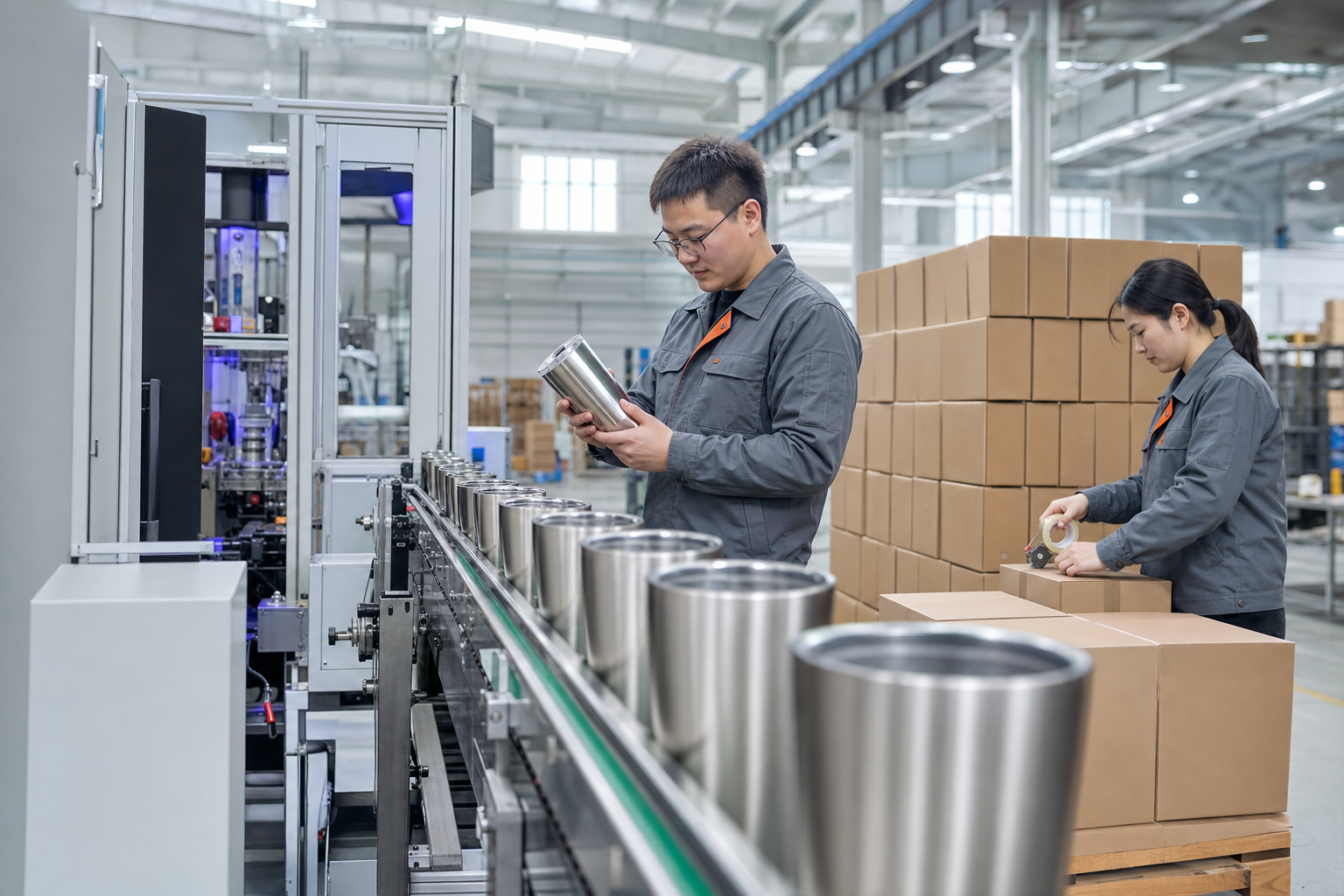
Key Takeaways
- A practical beer tumbler customizable program usually starts at 500 pcs MOQ for stock shapes and 3,000 pcs for fully custom tooling.
- For export orders, 304 stainless, 0.5 mm wall thickness, and AQL 2.5/4.0 inspection are common baseline specs.
- Laser engraving lasts longer than ink on heavy-use drinkware, while silkscreen is still the lower-cost choice for simple logos at scale.
- A serious Zhejiang or China supplier should quote FOB price, test standards, carton details, and a 20-45 day lead time upfront.
If you are buying a beer tumbler customizable for retail, bar programs, or event promotions, the hard part is not finding a cup. The hard part is choosing a spec that still looks clean after 5,000 units, 50 cartons, and one rough freight cycle. We have seen a 0.3 mm lid gap turn into a pile of complaints, and a weak coating or logo method that fails in dishwasher use will do the same.
For buyers in Europe and North America, the decision usually comes down to price, compliance, and repeatability. A canteen factory in Zhejiang or another China-based canteen manufacturer should give you MOQ, lead time, and test records, not just a sample photo from the line. QC pulled the sample, the buyer flagged a 2 mm print shift, and the math does not work if the numbers are fuzzy. That is the standard for custom drinkware, whether you need a customized beer tumbler, a custom growler, or a broader canteen custom program.
What You Are Actually Customizing
When buyers say beer tumbler customizable, they usually mean more than a logo on a metal cup. On one PO we saw a 16 oz callout turn into 15.5 oz because the buyer copied the wrong spec sheet, and that kind of mistake changes tooling, packing, and carton count. You are picking the material, shape, finish, capacity, lid style, and decoration method together. Two cups that look the same on a screen can run very differently on the line and in the market.
For most custom drinkware programs, we start with 18/8 or 304 stainless steel. That is the safe commercial choice because importers know it, QC knows how to check it, and it holds up on repeat orders. Common beer tumbler sizes are 12 oz, 16 oz, and 20 oz. A straight-wall profile feels closer to a pint glass; a tapered wall gives a better grip and stacks tighter in a 58 mm carton slot. If your channel is hospitality, an open tumbler with a simple rolled rim is easier to wash than a lid-based cup, and that matters when the buyer is counting labor minutes.
- Capacity: 12 oz for tasting, 16 oz for standard retail, 20 oz for event and gift sets.
- Finish: brushed steel, powder coat, or matte paint for premium customized drinkware.
- Construction: single-wall for cold beer presentation, double-wall if you want less condensation.
- Branding area: front logo only, 360-degree wrap, or mixed decoration with text and graphics.
If you already buy a custom canteen or customizable growler, the same factory discipline applies. A good canteen manufacturer should quote the beer tumbler, canteen customizable line, and a matching canteen promotional set without moving off the same quality bar. We have seen this go sideways when one buyer asked for a 500 pcs MOQ on the tumbler but 3,000 pcs on the canteen, then expected the print match to land perfectly across both. That is how a canteen distributor keeps the catalog coherent instead of ending up with random SKUs.
Specs That Protect Margin
Most margin problems start with vague specs. If wall thickness, coating type, and pack standard stay open, the supplier will quote the cheapest build of your idea, not the one that ships cleanly. For a beer tumbler customizable order, write down stainless grade, wall thickness, rim finish, and the height and diameter tolerance before you approve the sample. We saw one PO with “0.5mm” typed as “5mm”; that typo would have blown the quote apart on the line.
On metal drinkware, 0.4 mm to 0.5 mm is a normal commercial band. Go thinner and the cup feels soft in the hand. Go thicker and cost climbs fast, then freight weight climbs with it. For export, the packaging spec needs to protect the lip and the base. An inner box and master carton works for distributor orders. For marketplace sellers, we usually push for heavier corrugated board and a drop test at 80 cm, because QC pulled the sample and the rim dented on the second drop.
Here is the discipline buyers should insist on:
- Dimensional tolerance: write it down, do not assume it. A 1.0 mm shift on diameter can change lid fit.
- Weight tolerance: confirm the sample weight and the batch range you will accept.
- Surface finish: state the gloss level or matte level so repeat orders match the first run.
- Pack-out: carton count, divider type, and master carton gross weight.
For a canteen custom line, this gets even tighter because the same factory may be running three beverage SKUs at once. If you want a customized canteen, customized growler, or custom drinkware range with one brand feel, the spec sheet has to be locked from day one. We run 304 stainless on one table and powder coat on the next, so a loose spec is the wrong question to ask.
Decoration That Survives Use
The fastest way to wreck a beer tumbler customizable program is choosing decoration by looks alone. A logo can pass on a render and fail after 30 dishwasher cycles, soap, or stack storage. We run the decision off channel, target price, and how the buyer will actually handle the cup on the line.
When laser beats ink
Laser engraving is the safer call when you need a permanent mark, especially on brushed stainless. It does not peel, and it fits premium distributor drinkware, corporate gifts, and custom growler programs where the buyer wants a cleaner technical finish. Silkscreen still makes sense on large flat panels and one-color logos because the setup cost stays lower at 1,000 pcs. For a canteen promotional item or a canteen customized order, silkscreen usually wins when the art is simple and the PO calls for speed.
Buy for the way the product will be used, not the way it looks on a render. A logo that survives 50 wash cycles is worth more than a cheap print that chips after five.
Powder coating adds color and grip, but it changes the decoration sequence. Some factories print before coating, some print after, and that changes lead time and scrap. We had one buyer flag a Pantone drift on a 12 mm sample band, and QC pulled the reference parts before the next run. If you want a full-wrap graphic or a seasonal retail design, ask whether the supplier can hold color on reorders. This is the wrong question to ask after the first shipment. A good canteen factory in Zhejiang will record the print method, ink type, curing temperature, and reorder sample number so the second purchase does not turn into guesswork.
Compliance And QC You Should Demand
I’m rewriting the section in place, keeping the HTML tags and structure fixed while tightening the language for a factory-side, buyer-facing tone. I’m also weaving in concrete QC details and removing the generic AI phrasing the brief called out.For export drinkware, compliance is part of the spec sheet, not paperwork on the side. If you are importing into the EU, ask for REACH paperwork and, when the product touches food, LFGB migration test reports. For the US, ask for food-contact declarations plus the lab report behind them. A BSCI or ISO 9001 audit tells you the factory can keep records and run the line, but it does not prove the cup passes test.
A workable QC plan for beer tumbler customizable orders starts with incoming material checks, then in-process inspection, then pre-shipment sampling. AQL 2.5 for major defects and 4.0 for minor defects is a normal commercial setup, but put it in the PO so nobody argues later. On double-wall items, we run vacuum leak tests; on coated surfaces, check adhesion; on the body, look for scratches, dents, and logo shift. For a single-wall cup, rim smoothness and lot-to-lot consistency matter more. QC pulled the sample, and a 1.2 mm burr at the rim is the kind of miss that gets a buyer to flag the batch.
For outer cartons, ask whether the supplier can run ISTA 3A or ASTM D4169 style transport tests, especially if you sell through distributors or e-commerce. A carton drop from 760 mm onto a corner tells you more than a pretty product photo. A factory that ships every month should have batch photos, test records, and drop-test results ready on the same day. That matters even more if you mix a beer tumbler with a canteen custom line, because the weakest SKU sets the buyer's opinion of the whole program.
If your product will be sold as customized drinkware in Europe and North America, do not skip material traceability, coating safety, and a batch numbering system that lets you chase one 5,000-piece run back to the raw coil and the laser mark on the bottom. We have seen a typo on one PO turn into a mixed-lot claim, and that is a bad trade for a 40HQ. These checks cost less than one rejected shipment, and the math does not work any other way.
MOQ, Pricing, And Lead Time
Buyers often ask for price first, but MOQ and lead time set the real landed cost. On our Zhejiang line, we can push 120,000 units a month, yet the number shifts fast once tooling, decoration, and packaging enter the job. For a stock beer tumbler shape with a new logo, 500 pcs is a workable start. For a new body shape or a custom lid, 3,000 pcs is the number we usually put on the table.
FOB pricing for a simple metal tumbler moves around, but a sane budget for a custom beer tumbler is often USD 1.80 to 4.50 per piece, depending on size, wall structure, coating, and print method. A laser mark is usually cheaper than a multi-color wrap, and a custom box, sleeve, or retail label adds cost fast. We ran one job last month where QC pulled the sample because the wrap art missed the seam by 2 mm, and that kind of miss turns into scrap. If you are planning a canteen distributor program, ask for the price at 1,000, 3,000, and 5,000 pcs so you can see where the curve improves.
Lead time is where China buyers lose weeks by being vague. A repeat order with existing tooling may ship in 20 to 25 days after sample approval. A new decoration setup plus cartons often takes 30 to 45 days. If you need new molds, a custom canteen, or a matching custom growler set, add engineering time before production starts. One PO we saw had the carton size typed wrong by 10 mm, and the buyer flagged it only after the box dieline was already in flight. Freight also matters: if the goods are going into a retail launch, book carton dimensions and gross weight early so your forwarder can quote accurately.
For a canteen supplier or canteen vendors list, the right question is not just 'What is the unit price?' The real question is 'What is the landed margin after print, box, compliance, and ocean freight?' That is how distributor drinkware programs stay profitable. We have seen this go sideways when a buyer chased a low FOB and then lost the margin on a 0.8 kg carton and a last-minute label change.
Build A Line Buyers Can Reorder
The best beer tumbler customizable programs are not one-off SKUs. They are small families that we can reorder without opening the artwork, packaging, or compliance file again. On our line, that usually means 2 or 3 core sizes, one premium finish, and one lower-cost promo version. The math works; anything looser turns into a spare-parts problem.
A clean lineup can start with a 12 oz tasting tumbler, a 16 oz retail tumbler, and a 20 oz event cup. If you also sell custom drinkware, match it with a travel tumbler or a custom canteen so the buyer sees the same finish across the shelf. A canteen customizable program works best when the logo stays in one position, the wall thickness stays at 0.8 mm, and the carton spec does not drift from box to box. We had a buyer push back on that once, and the reorder went sideways fast.
For breweries, beverage brands, and distributors, the money is often in the set, not the single item. A customized canteen for outdoor retail, a customized growler for taproom sales, and a branded beer tumbler for gift packs can all run from the same brand file and color standard. QC pulled the sample last week and found the Pantone match off by one shade on a 304 stainless unit. That is the sort of miss that costs time, and it is why we keep the same draw gauge on the table before we approve a new run.
If you already source from a canteen factory in Zhejiang, ask whether the same production team can handle your beer tumbler, canteen promotional SKU, and distributor drinkware program under one QC file. That keeps artwork, test reports, and carton specs aligned. It also makes the next replenishment easier. We ship faster when the PO is clean, and we have seen one typo on a PO delay a 3,000-piece lot for a full week.
Build your custom drinkware lineup with a clear spec
Send your target price, logo file, and carton requirements. We can quote a beer tumbler customizable program with MOQ, lead time, and compliance details.
Frequently asked questions
What is the usual MOQ for a beer tumbler customizable order?
For stock shapes with a new logo, 500 pcs is a normal commercial MOQ. If you want a new mold, custom lid, or a fully new body profile, plan on 3,000 pcs or more. Many China factories, including Zhejiang suppliers, can support smaller test runs, but the unit price will rise. Ask for pricing at 500, 1,000, and 3,000 pcs so you can see the breakpoints clearly. If you also need a matching canteen custom line, the same MOQ logic usually applies.
Which decoration method lasts the longest on custom drinkware?
Laser engraving is usually the most durable because it does not rely on ink adhesion. It is a strong choice for distributor drinkware, custom growler programs, and premium retail lines. Silkscreen is cheaper and works well for one-color logos, but it can wear if the item is scrubbed often or stacked hard. Powder coat plus laser can be very durable if the factory controls curing correctly. For a canteen promotional order, ask for wash-cycle expectations and a sample after abrasion testing.
What compliance documents should I request from a China supplier?
For Europe, ask for REACH and, where applicable, LFGB food-contact test reports. For the US, request food-contact declarations and any supporting migration or material certificates. A BSCI or ISO 9001 audit is useful, but it does not replace product testing. You should also ask for batch traceability, coating data, and AQL inspection records. A reliable canteen manufacturer in Zhejiang should be able to provide these documents without delay.
How much should I budget for a customized beer tumbler?
A practical FOB budget is often USD 1.80 to 4.50 per piece, depending on size, wall thickness, finish, and print method. A simple single-color logo is cheaper than a full-wrap design, and a custom box adds cost quickly. If you need a premium finish, double-wall construction, or a matching custom canteen set, the price rises. Always ask for landed cost, not just unit price, because freight and carton quality can change your margin by several percentage points.
Can I combine beer tumbler orders with canteen or growler programs?
Yes, and that is often the smartest way to buy. If your canteen supplier already controls print, packaging, and compliance, you can usually add a customized beer tumbler or customized growler into the same sourcing file. That keeps Pantone colors, logo placement, and carton specs consistent across the range. It is especially useful for canteen distributors and distributor drinkware buyers who want one factory relationship instead of several small vendor accounts.