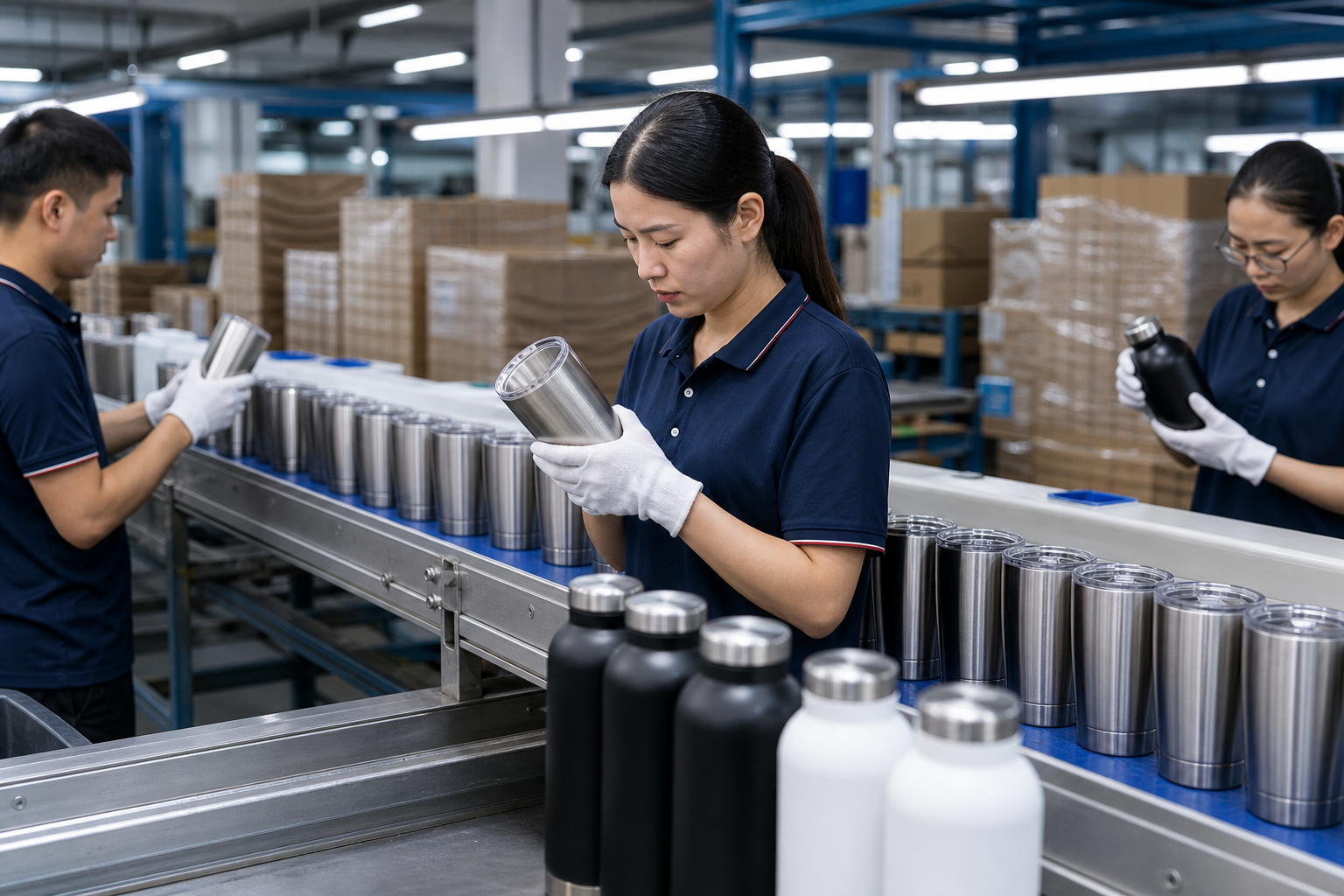
Key Takeaways
- A beer tumbler distributor should lock spec, decoration, and packaging before PO; small changes after approval can add 7-15 days.
- Typical MOQ for custom drinkware from China starts around 300-1,000 pcs per SKU, with lead times of 25-45 days after sample approval.
- For EU and North America, ask for REACH, food-contact declarations, and documented AQL inspection, not just a sales promise.
- The same sourcing logic applies to canteen custom, custom growler, and customizable drinkware lines if you want one factory to support multiple categories.
If you are a beer tumbler distributor, the job is not just to chase the lowest quote. You need a factory that holds decoration quality, ships on time, and keeps the same spec on reorder. We have seen a 1 mm lid mismatch or a weak laser mark turn a clean margin into a pile of returns. That is the wrong question to ask if the buyer is only looking at unit price.
The better move is to treat the factory like part of your sales system. In Zhejiang and across China, the right canteen factory or beer tumbler line can support 3,000 to 100,000 units per month, but only when construction, packaging, and compliance are locked before the first run starts. On our line, QC pulls a sample with a caliper and checks the lid fit at 0.5 mm tolerance before we release mass production. That is where margin is made or lost.
What your buyer spec must cover
Most distributor problems start with an incomplete spec sheet. If you only ask for a 16 oz beer tumbler price, you leave the factory to pick wall thickness, coating system, lid type, and carton quality. That is the wrong question to ask. On the line, QC will still pull a caliper and a coating gauge, and the first sample can look fine while the batch drifts. That is useful for a sample. It is not useful for repeatable distributor drinkware.
A proper spec should define capacity in milliliters and ounces, body material, wall structure, rim finish, coating type, logo method, and carton count. For double-wall stainless models, state whether you want 18/8 or 304 stainless steel, a 0.4 mm or 0.5 mm shell, and whether the base should be anti-slip. If you sell into retail or Amazon FBA, lock down unit pack dimensions and barcode placement before production starts. We had a buyer flag a PO with the wrong carton count after packing began, and the repack burned 12 days instead of 18. The math does not work.
For a beer tumbler distributor, consistency matters more than a one-time low price. The same goes for a canteen distributor. A canteen customizable model with different lid torque or print position from batch to batch will trigger complaints even if the cup still works. We run into this on the assembly table all the time. The factory should sign off on a golden sample, not just send a photo. We have seen this go sideways when the buyer approved a picture and never checked the rim finish in person.
- Capacity tolerance: keep it within +/-5%
- Coating thickness: request a measured standard, not a marketing term
- Logo placement: define distance from seam and base
- Carton test: ask for drop and compression requirements
That level of detail keeps your China sourcing under control and gives the factory one clear target. A line that runs from one drawing does better than a line that guesses.
Materials that protect your margin
Beer tumblers are sold as lifestyle items, but the margin lives in the basics. Material comes first. 304 stainless stays the safest pick for distributor lines because it takes a hit, holds temperature better, and supports a stronger FOB price. We ran a 12-day sample round on a 350 ml spec and the painted steel version picked up dents at the bottom seam. For lighter promo runs, a single-wall metal cup can work. If the buyer expects insulation, complaints show up fast.
For double-wall builds, the air gap between shells changes heat retention and line stability. During TIG welding, vacuum control has to stay tight, and the base closure must survive truck vibration. Ask the canteen manufacturer for weld and vacuum leak checks, plus a drop test. QC pulled one sample with a 0.3 mm pinhole at the base after transit simulation. If the factory cannot explain its test method, the math does not work.
On coatings, powder coating usually gives the best balance for custom drinkware. The grip is better, the color range is broad, and rework on the line is manageable. Soft-touch looks sharp in photos, but we have seen it go sideways on 5,000-piece runs when the film thickness drifts by 20 microns. For laser-marked stainless, keep the artwork clean and vector-ready. Fine gradients do not hold up at volume, and the buyer will flag it on the first pre-shipment sample.
If your catalog also includes a custom growler or customizable growler, run the same material review. Growlers are heavier, and a 2 mm wall sounds simple until the PO typo turns 20 oz into 22 oz. One Zhejiang factory can run both beer tumbler and canteen custom orders if it has separate forming and finishing lines. A showroom is not enough. We want to see the press brake, the seam welder, and the packed-carton stack before we say the capacity is real.
Decoration choices that actually sell
Decoration is where distributor programs win or fail. The wrong logo method makes a good tumbler look cheap, while the right one can add 3 to 5 dollars to the shelf price. On the pad printer, a 0.2 mm shift shows up fast. Pick the process by artwork complexity, order volume, and channel, not by habit. That is the wrong question to ask if you start with the logo first.
Silkscreen is still the best fit for bold 1-color logos and promo runs. It is stable, fast, and usually the cheapest at scale. We run an 80-mesh screen for these jobs, and the first 300 pcs tell you whether the ink laydown is clean. Laser engraving works better for metal tumbler lines that need a premium, permanent finish. For a large retail program with multiple SKUs, a simple combo works: powder coat body, laser logo, and a clean one-color print on the box. That keeps the brand hierarchy clear without turning the line into a mess.
For canteen promotional orders, the same logic applies. A canteen promotional line needs low decoration cost, but durability still matters. If the print rubs off after a few washes, the buyer blames you, not the end user. QC pulled the sample after a 72-hour abrasion check, and the edge ink still smeared at the rim. A canteen supplier should show abrasion test results or at least a documented curing and adhesion process. We have seen this go sideways too many times to trust a handwave.
Distributors also need to think about artwork flexibility. A canteen customized with a large wrap print may look stronger than a simple chest logo in a mockup, but the wrap can add 8% waste and make color matching harder. The buyer flagged a PO with a 2 mm artwork shift last month, and that small error burned a full reprint. If you serve multiple channels, ask the canteen vendors or canteen suppliers to prepare a decoration matrix: one setup for promotional, one for retail, one for premium. That saves time when buyers switch from a beer tumbler to a custom canteen or a distributor growler program.
Rule of thumb: if the artwork needs more than two colors and the SKU volume is under 1,000 pcs, ask whether laser engraving or a single-color print gives you a better landed cost. We ran that comparison on a 350 ml beer tumbler batch, and the cleaner process won on setup time as well as unit price.
Compliance for Europe and North America
Compliance is not paperwork for its own sake. It is the cheapest way to avoid a 14-day delay, a pallet hold, or a customs email asking for one missing declaration. If you buy from China, ask for documented food-contact compliance before you approve the first run. For Europe, REACH and food-contact declarations are standard; for North America, buyers often ask for FDA-aligned testing, and some retail accounts want ASTM references or their own safety file. On the line, we have seen one typo on a PO turn into a week of back-and-forth, so this is the first document check, not the last.
Ask whether the factory is BSCI audited or can show another recognized social compliance program. That does not replace product testing, but it helps when a retailer audits your supply chain. A good canteen manufacturer in Zhejiang will already have third-party reports for coatings, lid materials, and migration limits, with test dates and batch numbers on file. If the only answer is a verbal promise, the math does not work.
For a beer tumbler distributor, control the whole risk chain: raw material, finished goods inspection, and shipping cartons. Require incoming material records for the stainless steel coil if the order size justifies it; on a 5,000-piece run, that paper trail is worth the time. Ask for AQL 2.5 for major defects and AQL 4.0 for minor defects on finished goods unless your customer contract says otherwise. QC pulled the sample, found two lid scratches at 1.2 mm, and the shipment was still salvageable because the standard was clear.
This is where a canteen distributor can learn from drinkware programs that fail. The same document discipline applies to custom drinkware, customized drinkware, and distributor drinkware whether the SKU is a tumbler, a canteen custom item, or a custom growler. The category changes; the compliance logic does not. We ship different shapes, same headache, same answer.
MOQ, lead time, and factory reality
Factories in China like to quote a clean number, but the real story sits behind it. For standard stainless tumblers, we usually see MOQ at 300 to 1,000 pcs per design and color. Multi-color print pushes that up, because every screen or pad plate adds setup time and scrap risk. If you buy as a beer tumbler distributor with accounts in three or four regions, ask for a mixed-SKU plan. That is the smarter move. It lets you test sell-through without stacking dead stock in the warehouse. On our line, QC pulled the sample after the first print pass because one Pantone shade drifted by 2 mm at the seam.
Lead time is usually 25 to 45 days after sample approval, but that only holds when the artwork is frozen and the material is already in stock. Add 7 to 10 days if you need special packaging, molded inserts, or a custom lid. We have seen buyers miss this and then blame the factory when the PO was still changing on day 12. For a 20,000-piece order, a Zhejiang plant may commit to 60 to 90 days if it has to run extra shifts. Ask for monthly capacity in units, not a sales rep's guess. A plant that can really ship 50,000 or 100,000 units per month will say it plainly and tell you where the bottleneck is, usually polishing, deco, or packing. The math does not work any other way.
Pay close attention to commercial terms. FOB works when you have your own freight forwarder and want control over the shipping leg. If you are still building the program, ask the supplier to quote landed packaging options separately so you can see the true margin. We have had buyers flag a simple PO typo on carton count, and that one line changed the whole cost sheet. This is how serious canteen suppliers run distributor business: clear MOQ, clear lead time, clear FOB terms, and no surprise carton fees at the end.
If you are also sourcing a distributor canteen or distributor growler, use the same method. One China factory can handle multiple product families, but only if you keep the order structure simple and predictable. Split too many specs across one run, and the line slows down fast. We ship cleaner when the SKU plan stays tight.
How to choose the right factory partner
Price is not the first filter. Process control is. The right beer tumbler distributor partner should show you how they handle sampling, color matching, inspection, and replenishment. Ask for a sample flow that includes pre-production sample, production sample, and final sealed golden sample. Skip one stage and you usually pay for it later. On the line, QC should be able to point to the exact sample record, not guess from memory.
Look for practical signs of discipline. Does the supplier use batch trace codes? Do they keep a record of cap torque, weld checks, and carton drop tests? Can they explain what happens when a logo position is off by 2 mm? A serious canteen factory or canteen manufacturers group in Zhejiang will answer that fast, because they run that check every day. If they stumble here, the math does not work for repeat orders.
For branding programs, ask whether the factory can support private label expansion. A beer tumbler line should be easy to extend into canteen customized, customizable canteen, or custom canteen programs when your customer wants a broader assortment. If the vendor can handle one product category but cannot adapt artwork, packaging, or barcodes for another, you need a second supplier. We have seen a PO stall over a barcode typo on a 1,000 pcs carton, and the buyer flagged it before the goods even left the warehouse.
The best partner thinks like a production engineer and a sales support team at the same time. They should be able to quote a custom drinkware program, explain why a 0.8 mm coating change affects scratch resistance, and suggest packaging that keeps breakage low in transit. That is the level you want if you are building a distributor line out of China. We ship that way ourselves, and we know the wrong factory turns a 12-day job into 18 days without saying why.
Build your beer tumbler line with a real factory
Send your spec, target price, and artwork. We will map MOQ, lead time, and decoration options for your distributor program.
Frequently asked questions
What MOQ should I expect for a custom beer tumbler order?
For most custom drinkware programs from China, a practical MOQ starts at 300 to 1,000 pcs per SKU. Simple laser-engraved stainless tumblers may sit at the lower end, while multi-color printed or special-packaging orders usually need more. If you want multiple colors or mixed artwork, ask the factory whether the MOQ is per color or per total design. A serious Zhejiang factory will also tell you the real limit for a re-order. For a beer tumbler distributor, the key is not just MOQ, but how that MOQ fits your sell-through window and cash cycle.
How long does production usually take after sample approval?
Typical lead time is 25 to 45 days after you approve the pre-production sample and confirm artwork. If you need custom packaging, molded inserts, or a new lid, add 7 to 10 days. Peak season in China can push that longer, especially if the factory is already running full schedules for canteen suppliers and other custom drinkware accounts. If your launch is tied to a retail window, build in buffer time for inspection, freight booking, and carton rework. In practice, a distributor should plan 6 to 8 weeks from final approval to shipment readiness.
What compliance documents should I ask for?
At minimum, ask for food-contact declarations, REACH-related documentation for Europe, and third-party test reports for coatings, lids, and any plastic parts. If your customer is in North America, keep documentation ready for FDA-style food-contact review and any account-specific testing. For retail buyers, BSCI audit status and ISO-based quality processes also help. Ask for AQL inspection records on the finished batch. A reputable canteen manufacturer in China should provide these without delay, and the paperwork should match the exact SKU and production lot.
Should I choose silkscreen or laser engraving?
Choose silkscreen if you need bold color, simple artwork, and a lower unit cost on promotional volume. Choose laser engraving if you want a permanent premium mark on stainless steel or a cleaner retail look. For a beer tumbler distributor, the better choice depends on channel and price point. If the order is under 1,000 pcs and the design is simple, laser can be efficient. If the order is large and color branding matters, silkscreen often gives better economics. You can also combine powder coating with laser for a stronger retail presentation.
Can one factory handle beer tumblers and canteen custom projects?
Yes, if the factory has separate forming, finishing, and packing capacity. Many Zhejiang and China suppliers handle beer tumbler, custom canteen, and custom growler programs under one roof, but only a few manage all three well. Check whether they can maintain consistent wall thickness, coating adhesion, and packaging standards across categories. The advantage for you is simpler sourcing and stronger volume leverage. The risk is overloading a weak factory with too many SKUs. Ask for monthly output, sample workflow, and a clear production schedule before you combine product lines.