Key Takeaways
- A workable MOQ for custom beer tumblers is 500 pcs per SKU, with 25 to 35 day lead time from a China factory.
- 304 stainless is the default for most markets; 316 is worth it when you need stronger corrosion resistance and higher price points.
- For Europe, ask for LFGB and REACH documentation; for the US, confirm food-contact compliance and coating test reports.
- Distributors usually make better margin on 12 oz, 16 oz, and 20 oz sizes than on oversized novelty shapes.
If you are buying for beer tumbler distributors, the common mistake is treating every stainless cup like a generic promo item. It is not. Retail buyers ask for straight sidewalls, lids that seat the same way every time, and print that still looks clean after a dishwasher cycle. Promo buyers chase a lower entry price, but they still reject rough welds, weak seals, and coatings that scuff in the carton. We see it on the line all the time. In Zhejiang, the buyers who win are the ones who send clear specs before the first sample, not after the PO typo lands in QC.
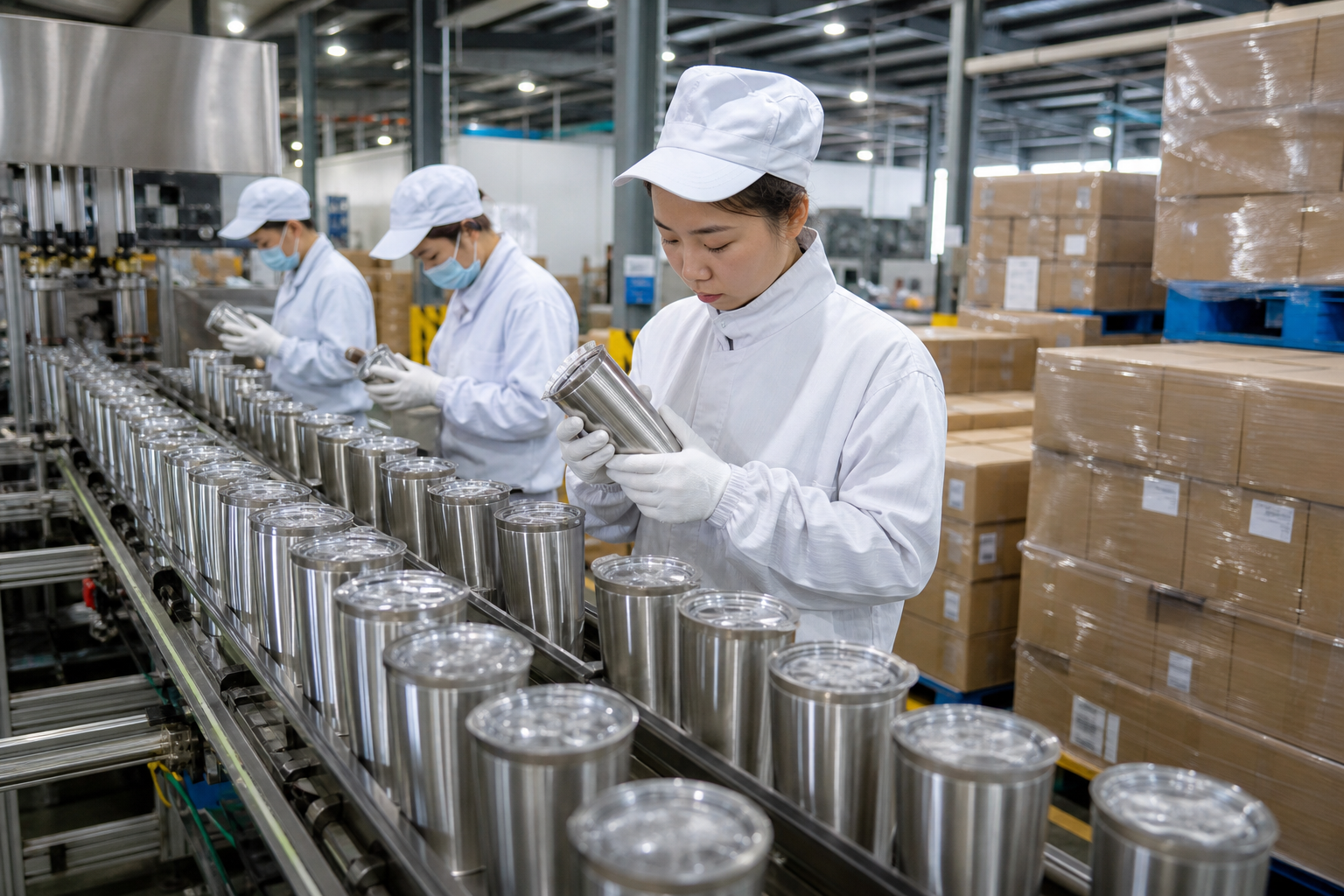
At BottleForge Industrial, a typical beer tumbler line runs at 120,000 units per month, with a 500 pcs MOQ per SKU and 25 to 35 days for standard custom orders. That is what matters when you are a canteen distributor, a custom drinkware wholesaler, or a growler buyer trying to keep the program repeatable. QC pulled the sample at the lid station last week and flagged a 0.3 mm gap on one batch, which is the kind of detail that saves a container from turning into claims. The math does not work if you chase the lowest quote and accept mixed quality.
Start With The Right SKU Mix
If you are a beer tumbler distributor, the first decision is not decoration. It is SKU discipline. We see the line behave best with three core sizes: 12 oz for bar and tasting sets, 16 oz for general retail, and 20 oz for premium insulated use. Those sizes line up with carton counts, shelf pricing, and repeat orders. A tight lid set works too: sliding lid, press-fit lid, and a simple splash cover. More lid variants look flexible on paper. On the packing table, they turn into mix-up claims and after-sales headaches.
In Zhejiang and across China, many factories can make almost anything, but the buyer who orders everything usually loses margin. Start with one body shape, one wall structure, and one finish family. Then run print, laser, or a single powder coat color across the same base. We tested this on a 500-piece sample run last month; QC pulled the sample and the defect rate stayed low because the tooling stayed simple. That is how canteen custom and custom drinkware lines stay profitable instead of filling the warehouse. If you also sell canteen customizable or customized growler formats, keep them in the same visual family so the catalog does not look like three unrelated factories.
For distributor drinkware, the winning mix is usually practical, not flashy. A flat-sided tumbler is easier to box, easier to print, and less likely to roll off a retail shelf. If your buyers run beer halls, outdoor events, or gift channels, a slightly tapered body can improve grip without adding much to unit cost. We ship a lot of these in 24 pcs per carton, and the buyer usually notices the packaging before the finish. Do not pay for decorative geometry unless the customer has already accepted a higher retail price. The first order should prove sell-through. This is the wrong question to ask if the goal is a healthy reorder.
Material Choices That Hold Up
Most beer tumbler buyers start with 304 stainless steel because the math works: cost stays sane, durability is solid, and corrosion resistance is good enough for most distributor programs. For a standard insulated cup, a 0.5 mm inner wall and 0.4 to 0.5 mm outer wall is common. That keeps the cup from feeling flimsy without pushing weight up. If the customer sells into coastal markets, wants a premium claim, or will pour acidic drinks, 316 stainless is the better upgrade. On the line, we check wall thickness with a caliper at the weld bead, and the buyer usually notices the difference as soon as the first sample lands on the table.
Do not ignore what happens inside the wall. Vacuum quality, seam uniformity, and weld consistency matter more than a glossy catalog shot. A decent factory should show target insulation data, such as 6 to 12 hours for cold retention on a double-wall tumbler, depending on lid design and fill temperature. QC pulled one sample last month and logged 9 hours with a 22 C fill; the steel was fine, the lid was the weak point. If you are selling a custom growler or distributor growler, the lid seal and shoulder finish matter even more because the buyer is paying for less spill and better temperature hold. Same story for a canteen manufacturer pushing canteen promotional SKUs. The wrong question is, "Is it stainless?" The real question is whether the assembly holds up after 50 open-close cycles.
Ask for REACH testing on coating materials and check that the product can survive normal transit abuse. A drop test from 1.2 m, a 24-hour leak check, and a lid cycle test are basic controls, not extras. If the buyer flagged a dent after carton drop testing, the pack-out was wrong, not the steel. If you are importing into Europe, ask for LFGB documentation on the drinking surface. If the factory cannot tell you which coating system it uses, you are not dealing with a serious canteen factory or beer tumbler supplier. You are buying a sample that looks good and fails later.
Decoration Sells The Product
Decoration is where many beer tumbler distributors leave money on the table. A plain stainless cup can move, but the right logo placement, finish, and packaging usually move faster and at a better margin. On our line, QC pulled the sample after the first 200 pieces because the laser mark sat 2 mm off-center. Silkscreen is still the low-cost choice for large logos and simple one-color art. Laser engraving fits better when the mark has to survive retail handling. UV print can carry more complex artwork, but we only push it when the order size pays for the setup and the buyer accepts the feel of the finish.
For custom logo programs, keep the art zone simple. Flat or slightly curved surfaces give cleaner results and fewer complaints. Skip tiny text below 4 pt, thin strokes under 0.3 mm, and color gradients unless the end buyer knows the limits. We have seen buyers push for 3 pt copy on a 120T mesh screen; the math does not work. That advice applies to a canteen custom program just as much as it applies to beer tumblers. The same buyer who orders a customized canteen for a campaign may also want a customizable canteen or customized growler for event merchandise, so the decoration rules should stay consistent across the range.
If you are running distributor drinkware programs for retail chains or promo agencies, ask the factory for a digital proof and a physical sample before mass production. The sample cost is small next to reprinting 5,000 pieces because the logo sits 8 mm too low. A reliable canteen vendor or canteen supplier should also tell you whether the decoration survives 50 dishwasher cycles, because that is where return claims start. We had a buyer flag a PO typo on the finish code once, and the packing line caught it only because the carton label did not match the art file. If the customer is selling beer tumblers as giftware, packaging is part of the decoration. A plain white box with a clean insert often beats a loud sleeve that adds cost but no shelf value.
How To Vet A China Factory
The factory matters more than the catalog. A real canteen factory in Zhejiang should answer plain questions without stalling: annual output, main materials, QC checkpoints, and export markets served. Ask for BSCI or equivalent social compliance, ISO 9001 if available, and a clear incoming-material inspection process. If the sales team cannot say where the vacuum sealing happens, who checks lid torque with a torque wrench, or what AQL they run on the line, you are talking to a broker with a nice sample room.
For beer tumbler distributors, the metric that matters is stability. The lowest quote is the wrong question to ask. A plant that holds 120,000 units per month and still runs a 500 pcs MOQ per SKU is usually better organized than one that promises anything and then slips a shipment by 12 days instead of 18. We have seen that go sideways when the buyer flagged a PO typo on carton count and the warehouse had to rework labels at the pallet wrapper. Ask for production photos, line count, packaging layout, and the exact inspection points for surface defects, dents, and vacuum failure.
Check mixed orders too. If you plan to buy a beer tumbler line together with canteen customized bottles, custom canteen products, or distributor canteen assortments, the factory should group cartons by SKU and keep artwork files separate. That matters in peak season. QC pulled the sample, and the carton code on one batch was off by 2 mm; that is the kind of miss that turns into a claim if nobody catches it early. A solid supplier will also keep 200 spare lids in reserve, replacement gaskets by size, and a carton reprint window for late artwork changes, so you can ship a 20-piece replacement order instead of opening a full case dispute.
Price The Landed Cost Correctly
I’m rewriting the section in place, keeping the HTML tags and the existing numbers intact while tightening the wording into a more concrete factory-side voice.Most buyers start with ex-works and miss the real math. A 304 stainless beer tumbler at USD 1.35 is not cheaper if the unit comes back for weld touch-up, thin EVA inserts, or a carton that pushes the master case to 12.8 kg and lifts freight. For a simple custom drinkware order from China, a realistic FOB range for insulated beer tumblers is often USD 1.60 to USD 3.20 depending on size, steel grade, finish, lid type, and decoration. Laser engraving is easier to quote cleanly than 2-color pad print because the jig, artwork check, and sample time are shorter. On the packing line, we run carton fit checks with a tape measure before the first bulk run. The math does not work any other way.
Build landed cost line by line: unit price, decoration, inner box, master carton, sea freight or air freight, duty, and local distribution. If you are selling into retail, add a 3 to 5 percent damage reserve and a small sample budget. For a beer tumbler distributor, the hidden cost is often not freight but inconsistency across repeat orders. A 2 percent color shift can turn a reorder into a discount conversation. QC pulled the sample from the color cabinet at 9:30 a.m., and we keep the signed master sample, color chip, and PO printout together so the buyer cannot argue the target later. We have seen this go sideways on a 600 pcs reorder.
Be cautious with low MOQs that look attractive on paper. A factory that offers 100 pcs on a complex customized drinkware item may be using slower processes, shared tooling, or weak QC. For distributor growler programs, a 500 to 1,000 pcs run is usually a better balance between price and control. If you need a custom logo on top of a powder coat, ask whether the factory charges a one-time plate fee, a per-color print fee, or a re-proof fee. On station 3, the laser head needs a fresh fixture when the logo shifts 1.5 mm, and that is where the schedule slips start. We had a buyer flag a PO typo from "powder cot" to "powder coat" after the artwork proof, and that extra round cost 2 days. This is the wrong question to ask if the only target is the lowest MOQ.
Build A Distributor Program That Moves
Beer tumbler distributors should build around channel use, not one-off novelty SKUs. If you sell to breweries, bars, gift wholesalers, and corporate buyers, the line has to cover all four without turning into a mess. We usually run three tiers: one core insulated tumbler, one lighter promo line, and one premium gift line. The premium tier can carry custom growler sizes or a larger canteen customizable format when the buyer wants a stronger perceived value. The promo line should stay plain and low cost so you can quote in hours, not days. That is the right question to ask.
Seasonality drives the schedule. In Europe and North America, spring and summer orders need to land 60 to 90 days before peak use. If you place a China order in May, you are late for most event programs. Build the calendar around product photography, proof approval, production, inspection, and sea transit. For custom drinkware, a realistic timeline is 7 days for artwork and sampling, 25 to 35 days for production, and 20 to 35 days for ocean delivery, depending on route. If the buyer wants Amazon FBA or retail RDC delivery, add carton checks and labeling time. QC pulled the sample at 2.2 mm wall thickness last week, and the buyer still pushed back on the print placement.
Keep the line extensions tight. A canteen promotional order, a customized canteen for a distributor, and a beer tumbler program can share the same factory relationship, but they should not share loose standards. Each SKU needs its own packaging spec, barcode logic, and claim sheet. We’ve seen this go sideways when a PO typo swaps 500 ml for 550 ml and the cartons miss the pallet count by 12. That is how a canteen vendor becomes a repeat supplier instead of a one-time quote source. If the account is growing, ask for inventory buffer on best sellers and reserve tooling slots early so you do not lose a seasonal window because the line is full.
Source your next beer tumbler line with less risk
Share your target price, MOQ, and market. We will match the right China factory spec, decoration method, and compliance path.
Frequently asked questions
What MOQ should I expect for beer tumbler distributor orders?
A realistic MOQ from a China factory is usually 500 pcs per SKU for standard custom beer tumblers. If you want multiple colors, multiple logos, or a special lid, expect 1,000 pcs total or separate MOQs by variant. Very low MOQs can work for samples or pilot runs, but they usually raise unit cost by 10 to 20 percent. For a distributor program, 500 pcs is the practical floor because it keeps carton planning, printing, and inspection efficient. If the factory also handles canteen custom or customized growler items, ask whether they can combine SKUs under one production batch without mixing packaging.
Which material is better, 304 or 316 stainless steel?
For most beer tumbler distributors, 304 stainless is the standard choice because it gives strong corrosion resistance at a sensible cost. Use 316 when the buyer wants a premium spec, coastal durability, or a stronger chemical-resistance story. The price difference is often noticeable, so do not upgrade by default. A 304 body with a 0.5 mm inner wall is enough for most retail and promo programs. If you are selling in Europe, ask for LFGB and REACH support on the full finished product, not just the raw steel. The decoration and lid materials still need to pass the same review.
How long does custom production take in China?
For a standard custom drinkware order in China, production usually takes 25 to 35 days after artwork and sample approval. If the order includes a new lid, unusual shape, or a multi-color print, add 7 to 10 days. Ocean freight to Europe or North America can add another 20 to 35 days depending on the route and port congestion. If you need a fast retail launch, build a 60-day minimum from approval to arrival. Factories in Zhejiang can move quickly, but only if your files, carton specs, and compliance documents are complete at the start.
Can I mix beer tumblers with canteen or growler products in one order?
Yes, but only if the factory has the line discipline to keep SKUs separate. A good canteen manufacturer in China can usually combine beer tumblers, custom canteen items, and custom growler sizes in one commercial relationship. The risk is operational, not technical. You need separate packaging specs, barcode labels, and artwork approvals for each item. A mixed order can save time on sourcing and freight, but only if each product has its own QC checklist. If the supplier cannot explain how they prevent carton mix-ups, keep the order single-SKU.
What documents should I ask for before shipment?
Ask for the commercial invoice, packing list, AQL inspection report, and the specific compliance documents your market needs. For Europe, that usually means LFGB and REACH-related support; for the US, ask for food-contact confirmation and any coating test data. If your customer is a retailer, request carton dimensions, gross weight, and barcode verification before the goods leave the factory. For a distributor drinkware program, it is also smart to keep signed approval samples and color references. Those two items save time when there is a claim or a repeat order six months later.