Key Takeaways
- Factory-direct beer tumbler pricing usually starts around USD 1.20–2.80 per unit at 3,000 pcs, depending on material and finish.
- A practical MOQ for custom drinkware is often 500–1,000 pcs per SKU, but multi-color printing or special coatings can push it higher.
- Typical lead time from a beer tumbler factory in China is 18–35 days after sample approval; rush orders cost more and increase defect risk.
- Use AQL 2.5 for critical inspection and confirm REACH, LFGB, and dishwasher testing before you approve mass production.
If you are buying beer tumbler factory direct, you are usually solving three things at once: unit price, print consistency, and ship date. You want margin that survives packing, freight, and a few broken cartons. You also need enough customization to make the cup yours without turning the order into a mess on the line.
This is where a lot of B2B buyers get burned. The seller says “customizable drinkware,” then the real MOQ is 5,000 units, the print area is 45 mm smaller than the mockup, and the lead time slips from 25 days to 55. We saw that on a 12,000-piece beer tumbler order last month; QC pulled the sample, and the buyer flagged a typo on the PO before we ran the first box. If you are sourcing from China or Zhejiang, you need factory numbers, not brochure talk. A real beer tumbler factory in Zhejiang should give you capacity, coating options, wall thickness, and QC standards before you send a deposit.
What factory direct really means
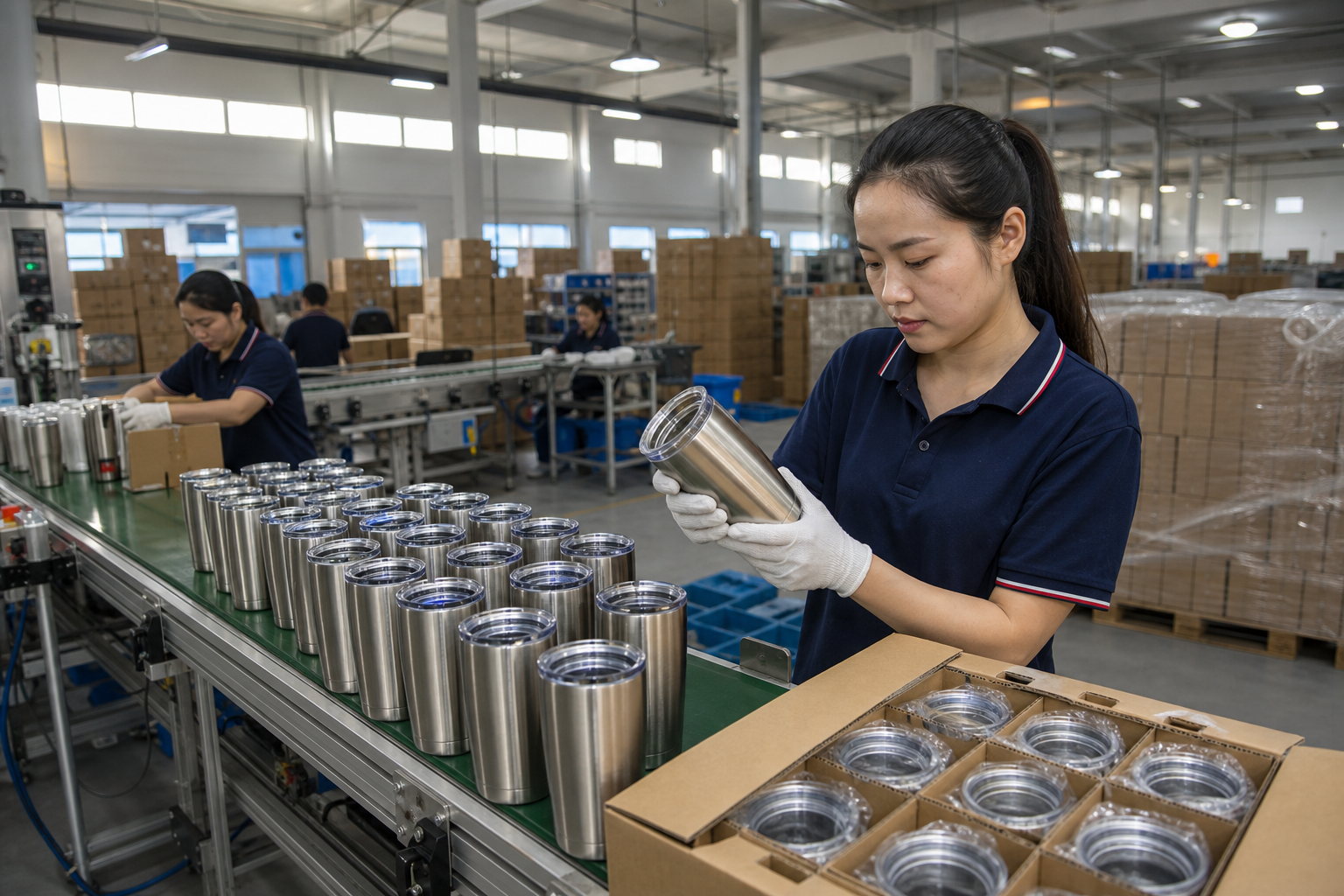
“Factory direct” looks simple, but in drinkware it usually means three setups. The seller may be the actual canteen factory, a trading company, or a procurement desk sitting between you and the line. If you are buying a beer tumbler factory direct, ask for the factory license, export records, and photos of the molding, polishing, printing, and packing lines. A real canteen manufacturer or tumbler plant should show monthly output, not just catalog pages. QC pulled the sample on our side last week and found a 1.2 mm wall variance; that is the kind of detail a real plant can explain fast.
At BottleForge in Zhejiang, the factories worth dealing with usually run 300,000 to 500,000 units per month across several drinkware lines. That scale matters because stable output keeps color within tolerance and repeat orders on track. A 12-day reprint beats an 18-day scramble every time. If you are a distributor, you need that stability more than a low first quote. The lowest quote often hides extra cost in packaging, tooling, or print setup. We have seen buyers flag a PO typo on the carton spec and lose a week while the line waits.
- Ask whether the seller is the factory, a canteen supplier, or a canteen vendor.
- Confirm whether your order ships FOB Ningbo, FOB Shanghai, or EXW Zhejiang.
- Request the actual production photos for your SKU, not generic samples.
Choosing the right beer tumbler spec
I’m rewriting the section to sound like a real factory-side spec discussion: tighter wording, fewer stock transitions, and a few concrete line details so it reads like someone who ships these every week.A beer tumbler is not a mug with a logo. We match the wall build, finish, and lid to the channel. A bar shelf can take a 16 oz or 20 oz stainless double-wall vacuum cup; a festival pack often works better with a lighter single-wall body or an insulated can shape because freight and unit cost stay under control. On our drop tester, a thin shell shows dents fast, and the buyer flags it on the first carton check. If you are sourcing custom drinkware for retail, the wrong wall thickness turns into returns from dents, sweat, and heat loss.
We usually see practical stainless specs at 0.4 mm to 0.5 mm inner/outer wall thickness for vacuum tumblers. That is thick enough for daily use without making the cup feel like a brick. On the vacuum line, QC pulled the sample after a 24-hour ice test, then checked the base plug and the weld path. Confirm whether the unit is argon-welded or laser-welded. If you need a custom growler or a customizable growler format, use thicker stainless and a wider mouth opening, usually 52 mm or above. A growler is not a standard beer tumbler, and the cap system matters more than the artwork.
Common spec choices buyers should lock early
- Capacity: 12 oz, 16 oz, 20 oz, or 32 oz
- Finish: powder coat, matte paint, polished stainless, or UV print
- Lid: no lid, sip lid, slider lid, or screw cap
- Use case: on-premise, retail shelf, canteen promotional, or festival giveaway
If you are building a line for a canteen distributor network, keep the specs simple. We run fewer SKUs, cleaner cartons, and tighter pallet math that way. A distributor cares about repeatability, carton efficiency, and products that can move across accounts without a new PO every time. This is not the place for a wide spec stack.
MOQ, price, and landed cost
I’m rewriting the section in-place, keeping the HTML tags and the same structure while tightening the sales language and adding a few factory-floor specifics.Most B2B buyers stare at unit price and miss landed cost. A beer tumbler at USD 1.45 can cost more than one at USD 1.68 once you add separate inner boxes, a higher defect allowance, or a slower vessel schedule. For China sourcing, a realistic FOB price for custom stainless beer tumblers often sits around USD 1.20–2.80 per unit at 3,000 pieces, depending on material, finish, and decoration. In Zhejiang, a factory that runs its own powder-coat booth and print line keeps the number tighter than a plant that sends half the job out the gate.
MOQ changes with the build. A one-color logo on a standard model may start at 500 pcs. A customized canteen shape, mixed colors, or laser engraving across multiple positions can push MOQ to 1,000–3,000 pcs. For canteen customized packaging, add another USD 0.15–0.45 per set for color boxes if you want export-ready retail presentation. The buyer flagged a carton that was 8 mm too tall, and the extra air filled the container fast. Do not ignore freight: 3,000 units of 16 oz stainless tumblers can take around 1.2–1.8 CBM depending on carton design.
Smart buyers price the unit, print setup, carton spec, and freight together. The cheapest quote on paper often loses once you add real export costs, and we have seen that go sideways on the first shipment.
If you are a distributor drinkware buyer, push for a tiered price structure at 1,000 / 3,000 / 5,000 pcs. That shows whether the factory wants repeat orders or just a quick trial. We run this check on every inquiry, and the math does not lie.
Custom branding without print failures
Decoration is where a lot of custom drinkware jobs go sideways. The artwork looks fine on a PDF, then the line starts printing on stainless, powder coat, or a curved wall and the edges walk off. We had a buyer flag a 1-color logo on a 750 ml tumbler because the seam cut through the wordmark. If you want a dependable custom canteen or beer tumbler, match the print method to the logo and the wear level. Screen print works for 1 or 2 colors. Laser engraving stays clean for retail shelves and takes abuse. UV print handles full-color graphics, but QC has to watch adhesion on every batch.
At sample stage, ask for the exact print size in millimeters and the safe area around the seam. We run this check with a steel ruler and a caliper, not guesswork. A good factory in China will tell you when the logo needs to move 3–5 mm to avoid distortion. If you are buying from a canteen manufacturer or canteen suppliers network, confirm the ink system meets REACH and ask for test reports on the spot. For Europe, LFGB matters where required. A verbal promise does not ship.
- Screen print: best for 1–2 spot colors, lower cost
- Laser engraving: best for premium, permanent branding
- UV print: best for complex graphics, but test scratch resistance
- Emboss/deboss: useful for a premium customized growler or limited edition line
If your line also includes canteen custom products, keep the brand system tight. One logo family across bottles, tumblers, and growlers cuts artwork cost and keeps the catalog clean. We saw a PO with three different logo sizes on one order, and the buyer asked why the samples looked off. Fair question. For canteen distributors, that kind of mismatch hurts sell-through fast.
Quality control you should demand
Quality control is not a formality. It decides whether the next order is smooth or turns into a claim. On a proper beer tumbler factory direct run, we expect incoming material checks, in-process inspection, leak testing, and final carton inspection. Put AQL 2.5 in writing for major defects and AQL 4.0 for minor defects if the order is retail-facing. If the buyer is a canteen distributor or distributor canteen partner, carton crush matters almost as much as the cup itself. We had one PO with “50 pcs” typed as “500 pcs”; QC caught it before the line ran.
For vacuum tumblers, ask for vacuum retention data and temperature tests. Our bench standard is 95°C hot water, then a reading at 6 hours and 12 hours. For durability, check drop resistance, coating adhesion, and lid fit. If the unit is sold as customizable drinkware for promotions, test whether the coating chips after 20–30 dishwasher cycles. The math does not work if a cheap unit fails on the second wash. We run a 1.2 m drop test on the concrete floor beside the packing table, and that tells you more than a glossy sample photo.
A Zhejiang factory with real export experience should share inspection photos, defect breakdowns, and batch codes without arguing. That is basic. If a canteen vendor will not document QC, you are buying risk, not product. We have seen this go sideways when a buyer skipped the lid torque check; the cartons looked fine, then the field complaints started.
How to work with China suppliers
Working with a China factory is simple if you run the process. Start with a technical brief: 500 ml or 16 oz capacity, 304 stainless, matte or powder-coated finish, logo method, carton spec, test standard, and target ship date. Then ask for sample lead time, tooling cost, and production lead time in writing. A solid Zhejiang line will usually ship samples in 7–10 days and mass production in 18–35 days after approval. If the shape needs new tooling, add 15–25 days. We had a buyer push back on a 0.5 mm wall-thickness change, and the math did not work.
Do not accept vague answers on compliance. For Europe, ask for REACH and food-contact paperwork; for North America, ask whether California Proposition 65 applies and if the inks or coatings need a separate declaration. If you are building a canteen promotional program or a private label line, lock carton markings, barcode position, and pallet pattern early. QC pulled the sample and found a wrong barcode font once. Rework at the end burns time and margin.
We get the best results when buyers treat the factory as a production partner, not a catalog storefront. That is the right way to work. Zhejiang export drinkware runs on repeat orders, with MOQ at 3,000 pcs on many models and a line set up for consistency, not one-off chaos. We ship faster when the PO is clean. One PO typo on a carton count can hold the whole order.
Get factory-direct beer tumbler pricing today
Send your target capacity, logo file, and order volume. We will quote from Zhejiang with real MOQ, lead time, and packaging options.
Frequently asked questions
What MOQ should I expect for beer tumbler factory direct orders?
For a standard beer tumbler, expect MOQ around 500–1,000 pcs per design if decoration is simple. If you need a special shape, mixed colors, or multi-position printing, the MOQ often rises to 1,500–3,000 pcs. A true factory in China should state this before sampling. If someone offers 100 pcs with full customization, the price is usually padded or the quality control is weak. For repeat orders, ask for tier pricing at 1,000, 3,000, and 5,000 pcs so you can judge the real factory cost structure.
How much does a custom beer tumbler cost from China?
At factory level, a standard custom beer tumbler often lands around USD 1.20–2.80 FOB depending on stainless grade, wall structure, lid, and print method. Laser engraving is usually cheaper than full-color UV on a per-unit basis, but setup and carton choices change the math. Add USD 0.15–0.45 for retail packaging if needed. Freight can add another 10%–30% depending on volume and shipping method, so always calculate landed cost, not just EXW or FOB price.
What compliance documents should I request?
For Europe, ask for REACH-related material declarations and LFGB testing if the product touches food or drink. For North America, ask for food-contact declarations, coating and ink information, and any relevant migration data. If the beer tumbler uses stainless steel, confirm the grade, usually 304 or 316 for higher-end use. Also request a factory audit file if you are buying larger volumes: BSCI, ISO 9001, and inspection reports are useful, but only if they match the exact production site.
Can I order a custom growler and a beer tumbler in one program?
Yes, and it often works well for distributors. A custom growler, customizable growler, or customized growler can share the same branding family as your beer tumbler line, which reduces artwork time and gives you a stronger retail story. Just do not force one spec across both. Growlers usually need thicker stainless, a different cap system, and larger packing volume. A factory can bundle them in one PO, but the MOQ and lead time may differ by SKU.
How do I know if a canteen manufacturer is actually factory direct?
Ask for the business license, factory address, production photos, and a recent export invoice sample with sensitive data masked. Then ask specific questions: monthly output, number of coating lines, print methods, and whether they handle tooling in-house. A real canteen manufacturer or canteen factory can answer in minutes. Trading companies usually need time to “check with the workshop.” If you are comparing canteen suppliers, canteen vendors, or a canteen vendor claiming direct factory pricing, those details will expose the difference fast.