Key Takeaways
- A serious beer tumbler factory in China will usually quote MOQ from 1,000 to 3,000 pcs per SKU and 25-35 day lead time after sample approval.
- For 18/8 stainless drinkware, wall thickness often runs 0.35-0.50 mm; anything thinner needs stricter QC for dents and weld quality.
- FOB Zhejiang pricing for a plain 16 oz beer tumbler can start around USD 1.20-2.40, while decoration and packaging can add 15-40%.
- Ask for AQL 2.5/4.0 inspection, REACH test reports, and dishwasher or condensation test data before you confirm the PO.
If you are sourcing from a beer tumbler factory, the real question is not whether the cup looks good in a catalog. It is whether the line can hold a 0.2 mm wall tolerance, survive carton drop tests, and leave enough margin after logo work, inner box, and ocean freight. We have seen a clean sample hide a 0.6 mm thin spot, a lid that pops loose in transit, or pad print that starts fading after 30 dishwasher cycles.
Buying custom drinkware from China, especially from Zhejiang, means you judge the factory like a production engineer, not a shopper. The same rule applies whether you order a beer tumbler, a custom growler, or a canteen custom program for retail or promotion. If you want a dependable canteen manufacturer or beer tumbler factory, start with material spec, process control, MOQ, and lead time before you talk about Pantone colors. QC pulled the sample with an AQL 2.5 sheet on the bench for a reason.
What a good factory actually controls
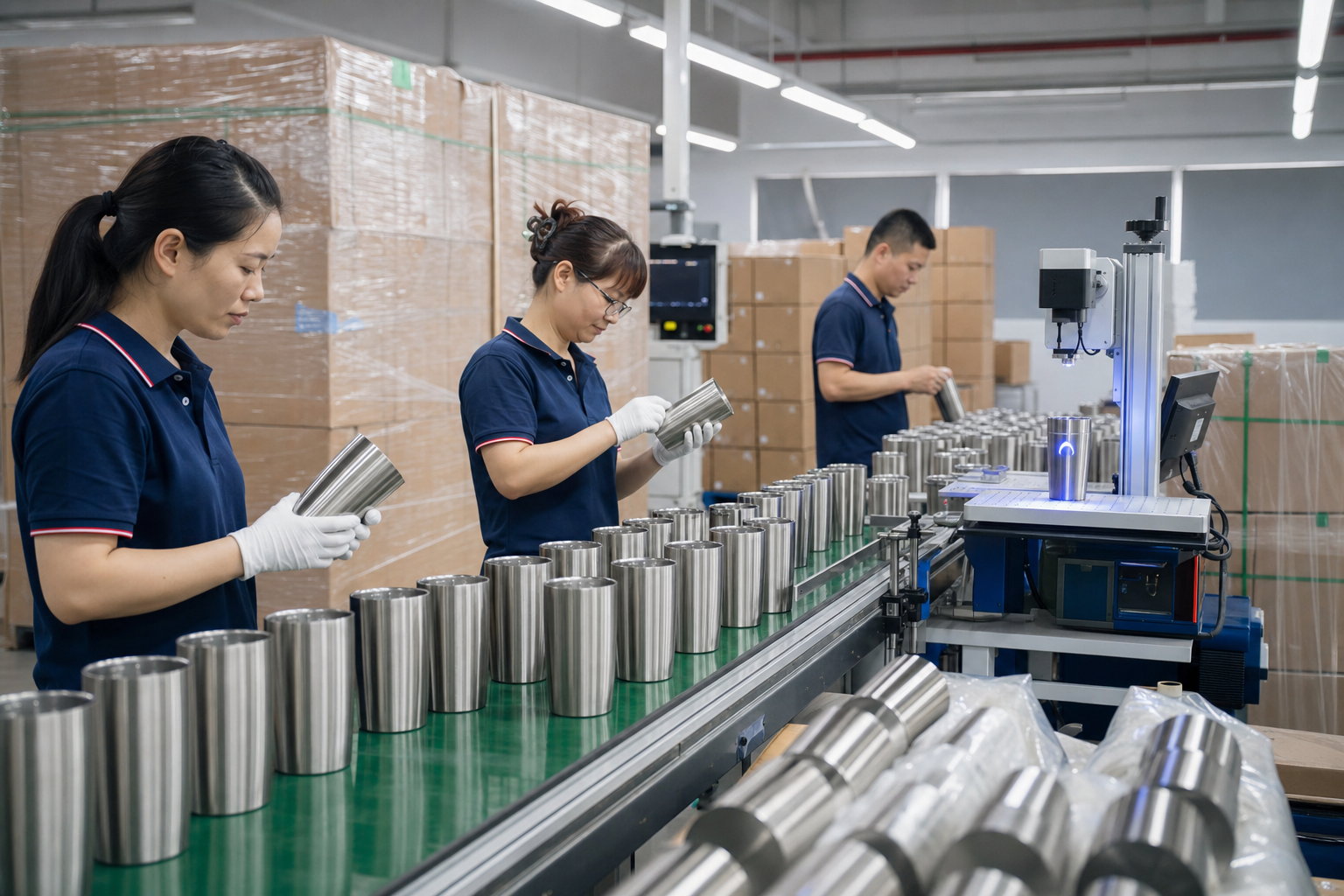
When buyers say they want a beer tumbler factory, they usually mean a supplier that controls more than one step. That is the right question. In Zhejiang, plenty of plants can buy a finished shell and print a logo in 1 day, but fewer run tube drawing, trimming, seam welding, polishing, vacuum forming, and final packing without the line drifting. We have seen this go sideways on a 2 mm wall spec: one loose weld, then scrap jumps and cartons start showing dent marks before export loading.
A proper drinkware factory should tell you monthly output, the wall thickness it runs, and the failure rate at each stage. At BottleForge in Hangzhou, for example, a standard line runs 300,000 units per month across stainless tumblers and bottles, with typical MOQ starting at 1,000 pcs for decorated SKUs and a 25-35 day production window after sample sign-off. QC pulled the sample on a recent run and flagged a 0.3 mm deviation on the rim, so the buyer held shipment until we rechecked the die. If a canteen factory or canteen supplier cannot give you those numbers fast, the math does not work.
- Material traceability: 304 or 316 stainless, PP, Tritan, or aluminum should be documented by batch.
- Process control: welds, polishing, coating, and laser engraving must have set tolerances.
- Packaging control: export cartons, drop testing, and barcode labeling should match your channel.
You are not just buying a cup. You are buying repeatability from a canteen manufacturer, a canteen vendor, or a beer tumbler factory that can ship the same item six months later without changing the fit or finish. We once caught a PO typo on lid color at packing, and the whole lot would have missed the buyer's shelf plan if the line had not stopped for a reprint.
Beer tumbler specs that matter
Most product failures are not dramatic. They are annoying: the lid rattles, the powder coat chips at the base, the vacuum seam shows a line, or the logo fades after ten wash cycles. We see this on the line all the time. That is why specs need to be written down before we cut steel. For stainless beer tumblers, ask for 304 stainless steel by default and 316 only when the use case earns the higher cost. A 16 oz tumbler normally runs around 0.4 mm wall thickness; for a premium build, we go to 0.45-0.5 mm to buy more dent resistance.
For custom drinkware programs, the internal and external tolerances matter. If the tumbler has to sit under a coffee machine or drop into retail shelf trays, 2 mm can decide whether it fits or gets rejected at receiving. Same story on a custom canteen: neck finish, cap torque, and drop resistance all need numbers, not guesses. We have seen a buyer flag a PO because the brim volume was written as 16 oz and the working volume was what they actually needed. Buyers who source customizable drinkware for retail often ask for these data points:
- Capacity: 12 oz, 16 oz, 20 oz, or 24 oz, measured to brim or working volume
- Finish: matte powder coat, glossy spray, raw steel, or UV print
- Lid fit: push-on, threaded, or splash-proof
- Performance: 6-hour cold retention, 4-hour condensation control, or dishwasher-safe cycle count
Do not let a canteen distributor or canteen vendors sell you a generic item if your channel needs a real specification sheet. That is the wrong question to ask. A customized drinkware order should read like a product brief, not a color request, and if the buyer says “same as last time,” QC should still pull the sample and check the torque band, because we have seen that go sideways on a 5000-piece run.
MOQ, pricing, and where margins vanish
Price is where first-time buyers lose control. A fair FOB China quote for a plain 16 oz stainless beer tumbler usually lands around USD 1.20-2.40, depending on steel grade, finish, and lid structure. Add single-color silkscreen or laser engraving and the number moves by another USD 0.08-0.35 per piece. Printed gift boxes can add USD 0.20-0.60. We had a buyer flag a PO typo once: “5000 pcs” on the cup line, “500 pcs” on the carton line. The line stopped for an hour while we checked the packing sheet. Cheap on paper. Not cheap after inserts, barcodes, and export carton labels.
MOQ is not a slogan; it is a cost breakdown. A beer tumbler factory in Zhejiang can hold a lower MOQ for existing molds and standard colors, but custom shapes, new tooling, or a custom growler body push it up fast. A realistic custom MOQ is often 1,000-3,000 pcs per color. If a canteen supplier offers 300 pcs on a fully customized canteen, that is the wrong question to ask. QC pulled the sample on one job because the buyer wanted three colors, two lids, and one carton spec at 300 pcs total. The math does not work. For distributor canteen buyers, mixed-SKU deals only make sense after carton allocation and label rules are locked down.
Ask the factory to break the quote into shell cost, decoration cost, packaging cost, and freight-ready carton cost. That is the fastest way to see where your margin is leaking.
For distributor drinkware programs, one extra cent in packaging can erase 2-3% of your gross margin. We ship these numbers every week, and the pattern is the same: a 0.6 mm carton insert, a barcode sticker, or a plain kraft box turns into real money across 20,000 units. Factories in China that quote line by line usually keep tighter control over secondary costs than trading companies acting like manufacturers. We’ve seen that go sideways too many times.
Decoration choices for retail and promotion
Decoration is not cosmetic trivia. It drives wash durability, shelf reaction, and how fast the buyer calls about returns. On our beer tumbler line, we usually quote silkscreen, laser engraving, heat transfer, UV print, and embossing. Laser engraving stays clean for premium retail. Silkscreen works well for 1 to 2 colors and keeps the unit cost down. UV print gives stronger shelf pop for promo canteen runs and seasonal drops. If you want a premium customized growler or customizable canteen, laser on stainless or embossing on select caps can lift the perceived value without touching the base material.
Here is the practical part: if your logo has fine lines, gradients, or small text below 5 pt, silkscreen will start to lose detail. We had a buyer flag a PO once because the logo file had a 0.3 mm stroke and the artwork looked fine on screen but not on the steel cup. For a custom canteen going into a distributor canteen program, ask for an actual-size print proof and a wash test, ideally 50 dishwasher cycles for retail claims or at least a simulated abrasion test. For promo orders, some buyers accept lower longevity, but that needs to be written down. Same rule for canteen customized goods going to a sports event or a corporate bundle. The math does not work if you skip the test and then try to argue later.
- Laser engraving: best for 304 stainless, durable, no ink matching issue
- Silkscreen: lower cost, good for solid logos, 1-2 colors
- UV print: good for full-color branding, needs scratch testing
- Emboss/deboss: strong premium feel, requires tooling or special shells
If your SKU is meant to sit next to custom drinkware in retail, keep the decoration process simple. Every extra color or effect adds another QC check, and QC pulled the sample twice on one 2,000-piece run because the white underbase was 0.2 mm off center.
Compliance buyers should demand
Compliance gets ignored until customs, a retail auditor, or a chain buyer asks for the file pack. If you are sourcing from a beer tumbler factory in China, do not wait until the last week to chase documents. For Europe and North America, we usually see REACH testing for relevant materials, food-contact declarations, and, where needed, FDA-aligned materials information. If the cup has coatings, inks, or silicone parts, each one needs its own paper trail. On our line, QC will pull the sample and check the finish before the lab report even lands.
For a canteen manufacturer or canteen suppliers, the documents that actually matter are a material declaration, a third-party lab report, and the factory QC checklist. Ask if the plant runs AQL 2.5 for major defects and AQL 4.0 for minor defects. Ask about carton drop tests and barcode verification on the packing line. If you sell on marketplaces, the factory should print FNSKU labels or set cartons up so your 3PL can relabel them fast. We have seen a PO typo on the barcode suffix turn into a 2-day rework; that math does not work.
Some buyers ask for documents after production. That is the wrong question to ask. The file check should happen before sample approval. If you need a canteen customizable program for North America, ask for compliance papers from the same Zhejiang production site that will run your order, not some office file from another address. Paperwork quality varies more than most buyers expect, and the factories that ship export every week know the difference. We run into this when a buyer flags a test report with the wrong carton spec, and then the whole schedule slips.
Also check whether the plant has handled BSCI or a similar social compliance audit if your retail customer requires it. Ask for the last audit date, the scope, and the nonconformities. A serious export factory answers fast. If they stall, we have seen it go sideways before the order even leaves the mold shop.
How to compare suppliers without guessing
Comparing a beer tumbler factory, a canteen vendor, and a general customized drinkware trader gets easier when you force every supplier onto the same scorecard. Ask who owns the tooling. Ask where the shell is pressed. Ask who does the coating and printing. Then request one full pre-production sample with the exact logo position, carton size, and shipping mark. We have seen buyers approve a nice-looking cup and then find the logo shifted 3 mm on the real line. That is the wrong question to ask if you want fewer surprises.
A serious factory in Zhejiang answers with production facts, not sales talk. For example: lead time 30 days, MOQ 1,000 pcs, sample 7 days, capacity 300,000 pcs/month. A weak supplier says “fast delivery” and “good quality” and stops there. That does not work when a canteen distributor or distributor growler buyer needs a repeat program, and QC pulled the sample because the wall thickness was off by 0.2 mm.
Use these checks in your RFQ
- Material grade and wall thickness, not just “stainless steel”
- Decoration method, ink brand if relevant, and color tolerance
- Packing spec, carton count, drop test standard, and pallet height
- Compliance docs: REACH, food-contact, and any market-specific requirements
If you need a custom growler, ask whether the neck and cap come from a standard mold or a new tool. If you need a custom canteen, ask for the cap torque spec and leak test rate. We run into buyers who skip these points and then complain about slow samples later. The math does not work. A real canteen factory can answer with a torque wrench reading, a leak test sheet, and a clear PO note; a reseller usually cannot.
When to choose stock, custom, or hybrid
I’m rewriting the section in place, keeping the HTML structure intact and tightening the sales language so it reads like a factory-side buyer guide, not generic marketing copy.Not every buyer needs a fully custom mold. We run enough orders to see the pattern: stock body, custom color, custom logo, and a tailored box. On the pad-print line, that mix keeps MOQ sane and still gives the product its own face. For a canteen distributor, that is often the difference between a launch that ships and cartons sitting under wrap.
Use stock-plus-custom when speed matters. Use full custom when the shape is the sell. A customizable canteen or customized growler should only go full tooling if the projected volume supports it. Tooling can add USD 3,000-15,000 depending on complexity, and you may need 45-60 days before mass production starts. The mold room quotes that against the EDM schedule, so this is the wrong question to ask if you are only comparing unit price. It works if the SKU will run for multiple seasons or across several sales channels. For a one-off promo, the math does not work.
For canteen promotional orders, hybrid programs usually win. For premium retail, a fully customized drinkware line can justify the mold spend. For wholesale distributor drinkware programs, look at the whole set: beer tumbler, travel tumbler, and custom canteen sharing the same finish and packaging language. We shipped a 3-SKU set last quarter with one carton spec and two lid colors, and QC pulled the sample after the 1.5 mm fit check passed. A factory in China that can keep those variants consistent is worth more than the lowest quote.
If a canteen manufacturer tells you every idea needs a new mold, they are not solving your problem. They are selling tooling. We have seen that go sideways when a buyer signed off on a new cavity, then the first PO came back with a typo in the color code. A better beer tumbler factory will show you where the margin is in stock geometry, decoration, and pack-out instead.
Request a factory quote with real specs
Send your capacity, finish, logo, and carton requirements. We will quote MOQ, lead time, and FOB China pricing without guessing.
Frequently asked questions
What MOQ should I expect from a beer tumbler factory?
For standard stainless beer tumblers, expect MOQ around 1,000 pcs per SKU for decorated orders and 3,000 pcs for custom colors or packaging. If you want a new mold or a custom growler shape, MOQ often rises to 3,000-5,000 pcs. Some Zhejiang factories can do lower quantities for stock shells, but you pay more per unit. A realistic sample lead time is 5-7 days, and mass production usually takes 25-35 days after sample approval.
How much does a custom beer tumbler cost FOB China?
A plain 16 oz stainless beer tumbler from China can start around USD 1.20-2.40 FOB depending on steel grade, lid, and finish. Add USD 0.08-0.35 for logo decoration and USD 0.20-0.60 for gift-style packaging. If you choose premium powder coating, double-wall construction, or a special cap, the price can move up another 15-30%. Zhejiang factories usually quote more clearly when you request a full cost breakdown.
What quality tests should I ask for?
At minimum, ask for leak testing, vacuum retention for insulated models, coating adhesion, and carton drop testing. For export to Europe or North America, request REACH or relevant food-contact test reports. Many buyers also specify AQL 2.5 for major defects and AQL 4.0 for minor defects. If your product is a customized drinkware retail item, ask for abrasion or dishwasher-cycle data, ideally 30-50 cycles depending on your claim.
Can one factory handle beer tumblers and canteen customized orders?
Yes, if the factory has multiple lines and the right tooling. A strong canteen factory in China can usually produce beer tumblers, custom canteen models, and some custom growler or travel tumbler variants in the same plant, but not always on the same line. Ask whether they own the molds and where coating, printing, and packing are done. If the factory runs around 300,000 units per month, it usually has enough capacity to support mixed programs, provided the specifications are not too fragmented.
Is it better to order stock or fully custom drinkware?
If you need speed and lower risk, use stock shells with custom logo, color, and packaging. That keeps MOQ lower and lead time shorter. Go fully custom only when the shape itself supports your brand and you can sell enough volume to justify tooling, which may cost USD 3,000-15,000 and add 45-60 days before production. For many distributor drinkware and canteen promotional programs, hybrid is the smarter choice. It gives you a customized canteen or beer tumbler without locking cash into inventory too early.