Key Takeaways
- Typical MOQ for a custom beer tumbler in bulk is 500 to 3,000 pcs, with lead time around 20 to 35 days after sample approval.
- For export, ask for food-contact compliance such as LFGB, FDA, REACH, and finished product testing to ASTM or ISO methods where relevant.
- A 304 stainless body with 0.5 mm to 0.7 mm wall thickness is a practical baseline for drinkware bulk orders.
- In Zhejiang, a capable factory should quote clear output, such as 200,000 to 500,000 units per month, plus carton dimensions and FOB terms.
If you are buying beer tumbler in bulk for retail, promo programs, brewery taprooms, or ecommerce bundles, the real risk is not the quote. It is locking the wrong spec and finding out after the first 500 units that the powder coat flakes, the lid seeps at the seam, or the carton count blows up your margin. A beer tumbler looks simple. It is not. On our line, one 0.3 mm wall-thickness change can move the whole cost and hand feel, and QC will catch the issue only if you ask for the right sample check before PO release.
Buyers in Zhejiang and other parts of China see this every week: one buyer wants a 16 oz beer tumbler wholesale program with laser logo, another needs beer growler wholesale bulk packaging for a festival pack, and a third is trying to combine canteen wholesale and alcohol flask wholesale bulk in one shipment. We ship these mixed orders all the time, but the math has to work first. A PO typo on carton size or a loose AQL 2.5 request will slow the run, and this is the wrong question to ask before you define use case, target price, and test standard for the sample.
Start With the Use Case
Before you talk price, lock the use case. A brewery taproom giveaway, a retail shelf item, and a corporate summer promo are three different jobs. If the beer is staying cold, 16 oz or 20 oz double-wall stainless is usually the safest call. For stadium use, we run a lighter single-wall body with a tight lid and a stackable profile. If the buyer asks for beer tumbler wholesale with no clear use case, the factory defaults to the cheapest spec. That is where the trouble starts.
Put the brief in plain shop-floor terms: capacity, finish, lid style, packing method, target FOB price, and whether you want a gift box or bulk pack. For beer tumbler bulk orders, the sales channel matters too. Amazon FBA needs carton labels, FNSKU handling, and tight dimension control. Brewery merchandising needs stronger branding and better-looking packaging. Wholesale drinkware for distributors usually needs neutral packaging and a lower landed cost. If you are mixing product lines such as bulk canteen, bulk growler, or wholesale canteen, keep each SKU separate in the RFQ. We have seen a buyer flag one PO typo and the supplier quoted the wrong mold for 5,000 pcs.
What to specify in the RFQ
- Capacity: 12 oz, 16 oz, 20 oz, or 24 oz
- Material: 304 or 316 stainless steel, or another approved material
- Wall structure: single wall or double wall vacuum
- Logo method: silkscreen, laser engraving, debossed, or UV print
- Packing: polybag, white box, color box, or master carton only
- Compliance: LFGB, FDA, REACH, California Prop 65 if needed
A buyer who sends this list gets a faster, cleaner quote from a China factory. The math works. The supplier does not have to guess, and sample churn drops fast. That matters in Zhejiang, where a good line can turn fast, but only if the input is clean. On one 20 oz run, QC pulled the sample because the carton size was off by 3 mm and the buyer had to wait another 12 days.
Choose the Right Body Material
Material choice drives performance, unit price, and complaint rate. For a beer tumbler in bulk, 304 stainless steel is the base spec for most export programs. It gives corrosion resistance, stable forming on the line, and food-contact behavior buyers can defend. We run this grade every week, so QC knows where it bites: weld seams and rolled rims. 316 stainless is there for harsher use, but most buyers skip it for standard beer service because the extra cost shows up on the PI faster than it shows up in the cup. For alcohol flask bulk items, the same rule applies: grade and finish matter more than a glossy quote.
Wall thickness gets ignored too often. A 0.4 mm wall can pass a sample check, then show dents after carton transit and pallet squeeze. The practical range is 0.5 mm to 0.7 mm for drinkware wholesale orders, with 0.6 mm usually giving the best balance of hand feel and cost. If the buyer wants a heavier feel, specify net weight in grams. If thermal retention matters, use double-wall vacuum insulation and ask for a vacuum leak test on every batch. For beer growler in bulk programs, the same control logic applies, but the body volume and cap style change where failures show up.
Finish matters too. Powder coating holds up well, but not every coating survives abrasion the same way. Brushed stainless is straightforward and easy to keep clean. Mirror polish can look premium, but it shows fingerprints and micro-scratches fast. If you are comparing beer tumbler bulk options across several factories in China, ask for the coating type, the salt spray test result if they have one, and the adhesive or ink system behind the logo. We have seen a low quote hide a weak coating spec, then the buyer flagged it after 200 pcs came back with scuff marks. That is the wrong question to ask if you only look at unit price.
Practical rule: if the tumbler is for daily bar use, choose the spec that survives handling, not the one that looks best in a sample photo.
Know the MOQ and Price Drivers
MOQ is where a lot of buyers burn time, because they want a unit price before they know how the line actually runs. A custom beer tumbler in bulk usually starts at 500 to 3,000 pcs per design, depending on whether we are pulling a stock body or cutting a fully custom mold. On our side in Zhejiang, we can run short jobs and volume jobs, but the math changes fast from 1,000 pcs to 5,000 pcs to 20,000 pcs. If you want beer tumbler wholesale bulk pricing, ask for the break at each quantity and each pack style, not one tidy number.
Three items push the quote up faster than buyers expect. Decoration is the first one. Laser engraving is clean and durable, but at 500 pcs it is not always the cheapest route. Packaging is next. A printed retail box can add real cost per unit, and custom inserts raise it again. Color work is the third. A single-color powder coat is easier to run than a two-tone finish or a metallic gradient. We see the same thing in growler wholesale and wholesale growler programs, where caps, handles, and special cartons add cost the buyer did not budget for.
Factory capacity matters because it sets lead time and how much we can move the order without breaking the schedule. A medium-to-large drinkware factory in China may run 200,000 to 500,000 units per month across several production lines, but your order still has to fit the calendar. Ask for the real timing: sample in 5 to 10 days, mass production in 20 to 35 days after sample approval, and more if the logo has multiple colors or the packing is special. QC pulled the sample once and found a Pantone mismatch on a 3-color print, so we had to rework the plate before the line could go. If a supplier cannot give you a clear lead time, they do not control the schedule tightly. That is a red flag for campaign work with fixed launch dates.
For buyers comparing drinkware bulk and drinkware wholesale offers, ask for one quote sheet that can be checked line by line. The sheet should split out unit price, logo setup, sample fee, carton cost, and the freight term such as FOB Ningbo or FOB Shanghai. We have seen POs with a typo on the carton count turn a good quote into a bad shipment. Without that split, the cheapest quote is often the highest landed cost.
Control Quality Before Shipment
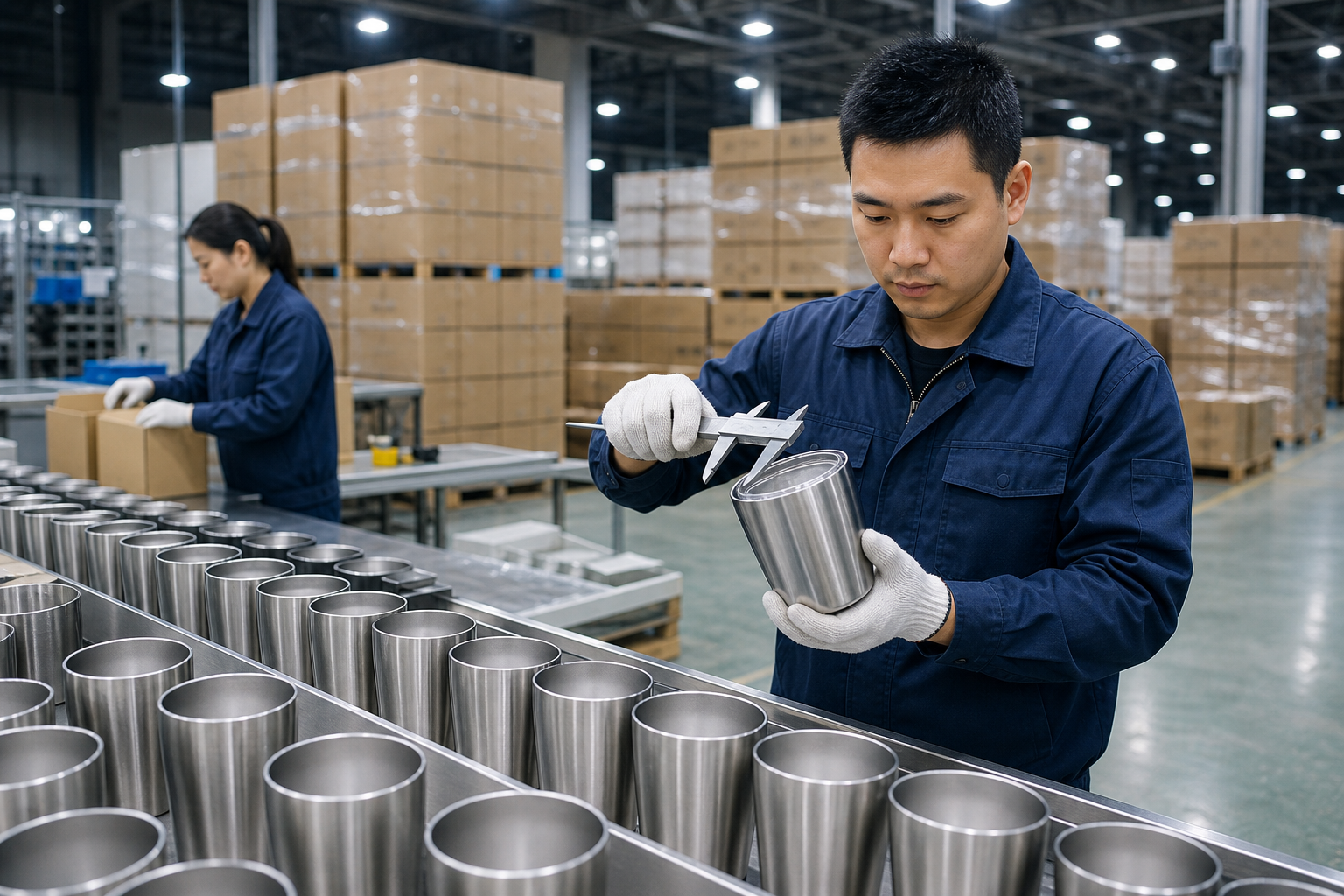
I’m rewriting the four paragraphs directly in HTML, keeping the tag structure intact and tightening the language so it sounds like a factory-side QC note, not a generic guide.For export orders, quality control has to sit in the PO, not in someone’s memory. Set the AQL for appearance and function, then tie acceptance to measured checks. For a beer tumbler in bulk, the checks that matter are capacity tolerance, lid fit, vacuum retention, coating adhesion, logo alignment, and leakage. If the tumbler is insulated, add a hot or cold retention test and a vacuum integrity test. We usually ask the factory to prove the cup stays in range for 6 to 12 hours, depending on the build. If QC pulled the sample and one unit sweats at hour 8, that is a reject, not a debate.
For Europe and North America, compliance is not optional. Ask for food-contact declarations, LFGB for Germany-sensitive channels, FDA or equivalent U.S. food-contact support, REACH statements for chemical restrictions, and material traceability for stainless steel and coatings. If you sell through Amazon or into retail chains, keep the test reports on file and match the SKU exactly to the tested sample. We have seen this go sideways when the buyer changes the lid, coating, or Pantone after approval and expects the old report to still cover it. The line does not care about that logic, and neither does customs.
Packaging inspection matters as much as the tumbler itself. Inner cartons should protect the rim and base, especially on beer tumbler wholesale orders where the product is polished or coated. Drop tests and carton compression checks are worth doing if the shipment will move through multiple warehouses. A carton that passes in Zhejiang but fails after ocean freight is not a usable carton. Ask for master carton dimensions, gross weight, and the number of units per carton so your freight forwarder can calculate the cube accurately. We normally check the carton stack under 32 kg for 24 hours before we sign off.
If your program includes adjacent items such as bulk canteen, canteen bulk, or canteen wholesale, use the same inspection logic across the line. If the buyer wants one QC standard for a 500 ml canteen and another for a beer tumbler, the math does not work. Consistent QC saves time at destination, cuts chargebacks, and makes re-order decisions cleaner because you are comparing the same data, not sales language. One shared checklist, one set of numbers, fewer arguments at the dock.
Branding That Sells
Decoration is where a plain tumbler turns into something that moves. For a brewery, bar chain, or alcohol brand, the logo method has to match how people actually handle the cup. Laser engraving gives the cleanest premium stainless look, and on the line we set it at about 0.2 mm depth so it holds up. Silkscreen is the better call for a simple one-color logo on a promotional run. UV print or heat transfer can carry a busy graphic, but run an abrasion test first. We have seen a buyer approve artwork on Monday and then flag a scuffed sample on Friday. The wrong decoration method makes a decent beer tumbler wholesale order look cheap fast.
If you are building a retail line, do not stop at the logo. Buyers look at mouth feel, base stability, and whether the finish still looks deliberate under harsh store lights. A 16 oz beer tumbler bulk SKU usually needs one main color and one seasonal color, not five. A bulk growler or beer growler bulk item needs a tougher label zone and a larger cap for handling. If you also sell alcohol flask in bulk or alcohol flask wholesale bulk, keep the visual language separate. Mixing them up is the wrong question to ask. We ran that kind of assortment once, and the shelf read like three unrelated products.
Branding also has a production side. If the logo sits too close to a seam or a tight curve, it can drift during forming or land off-center after curing. Ask the factory for a print template before you sign off on artwork. QC pulled the sample on one job because a 1.5 mm shift made the mark look crooked from 30 cm away. In Zhejiang, factories that ship real volume know this because they spend all day fixing decoration on curved stainless bodies, not guessing from a PDF. That is one reason buyers keep coming back to China suppliers for wholesale drinkware.
If you want the best wholesale drinkware result, match the branding to the channel. Retail needs shelf pull. Corporate gifting needs a clean unboxing moment. Taproom merchandise needs durability and a price point that still leaves margin. A practical buyer beats a spec-sheet buyer here. You are not just buying a tumbler. You are buying sell-through, and the math does not work any other way.
Plan Shipping and Packout
Freight and packaging can erase margin if you treat them as side issues. For beer tumbler in bulk shipments, the carton layout should match the route. Ocean freight rewards dense cartons and stable 5-layer stacking. Air freight punishes extra volume right away. If you are sourcing beer tumbler wholesale bulk for a tight retail launch, ask for the individual box size, master carton dimensions, and pallet count. That gives your freight forwarder a real landed-cost number before the cargo leaves the line. We had one case where a 6 mm insert pad added 0.8 kg per carton, and the math stopped working fast.
A useful packaging decision is whether the tumbler ships in a plain polybag, an individual white box, or a printed gift box. Bulk drinkware programs for distributors usually run plain packaging to keep the MOQ and cube down. Retail and ecommerce jobs need better box presentation and stronger corner protection. If you are running Amazon FBA, the supplier should mark cartons correctly, print FNSKU labels if required, and keep the carton weight under 15 kg if the warehouse limit says so. QC pulled the sample on one run and found a 2 mm corner crush after the drop test. The buyer flagged the PO typo before it turned into a receiving headache.
For China sourcing, ask the supplier whether they can consolidate multiple SKUs into one shipment. If you are combining beer tumbler bulk with related lines such as drinkware wholesale, wholesale canteen, or wholesale growler, the factory should pack by SKU and issue a clean packing list. Mixed shipments are fine when the labels are disciplined. Mixed shipments go sideways when the cartons are not keyed to the PO. We run a Brother label printer on the packing table for that reason. The same rule applies to European delivery, where customs paperwork, HS code accuracy, and product descriptions need to match across every document.
One last point: do not let a low EXW price distract you from shipping reality. A slightly higher FOB quote from a factory in Zhejiang or elsewhere in China can still land cheaper if the carton size is tighter and the packing density is better. I have seen one 3 mm carton change save a full pallet position on a 40HQ. That is the wrong question to ask if you only compare unit price. A procurement manager should demand the full shipping math before approving the order.
Request a spec and price sheet today
Send your capacity, logo method, carton target, and annual volume. We will quote a beer tumbler in bulk program that fits your channel and margin.
Frequently asked questions
How do I reduce freight cost on bulk drinkware?
The fastest way to reduce freight cost is to improve packing density and avoid wasted box volume. Ask the supplier for the exact master carton dimensions, units per carton, and whether a thinner individual box is acceptable. For ocean freight, dense cartons and stable pallet patterns help. For air freight, every extra millimeter matters. If you are sourcing beer tumbler wholesale bulk plus related items like bulk canteen or wholesale growler, coordinate the carton sizes so mixed shipments stack efficiently. In China, a good factory should be able to revise packout to lower cubic volume without damaging the product. That can save more than negotiating a few cents off the unit price.