Key Takeaways
- Most custom beer tumblers land at MOQ 3,000 to 5,000 pcs, with 30 to 45 days production after sample approval.
- 304 stainless steel at 0.4 to 0.5 mm wall thickness is the common baseline for retail-grade insulated drinkware.
- Ask for REACH, FDA, LFGB, BSCI, and ISO 9001 documents before you approve China production.
- A Zhejiang factory running 600,000 units/month can support mixed custom drinkware programs without killing lead time.
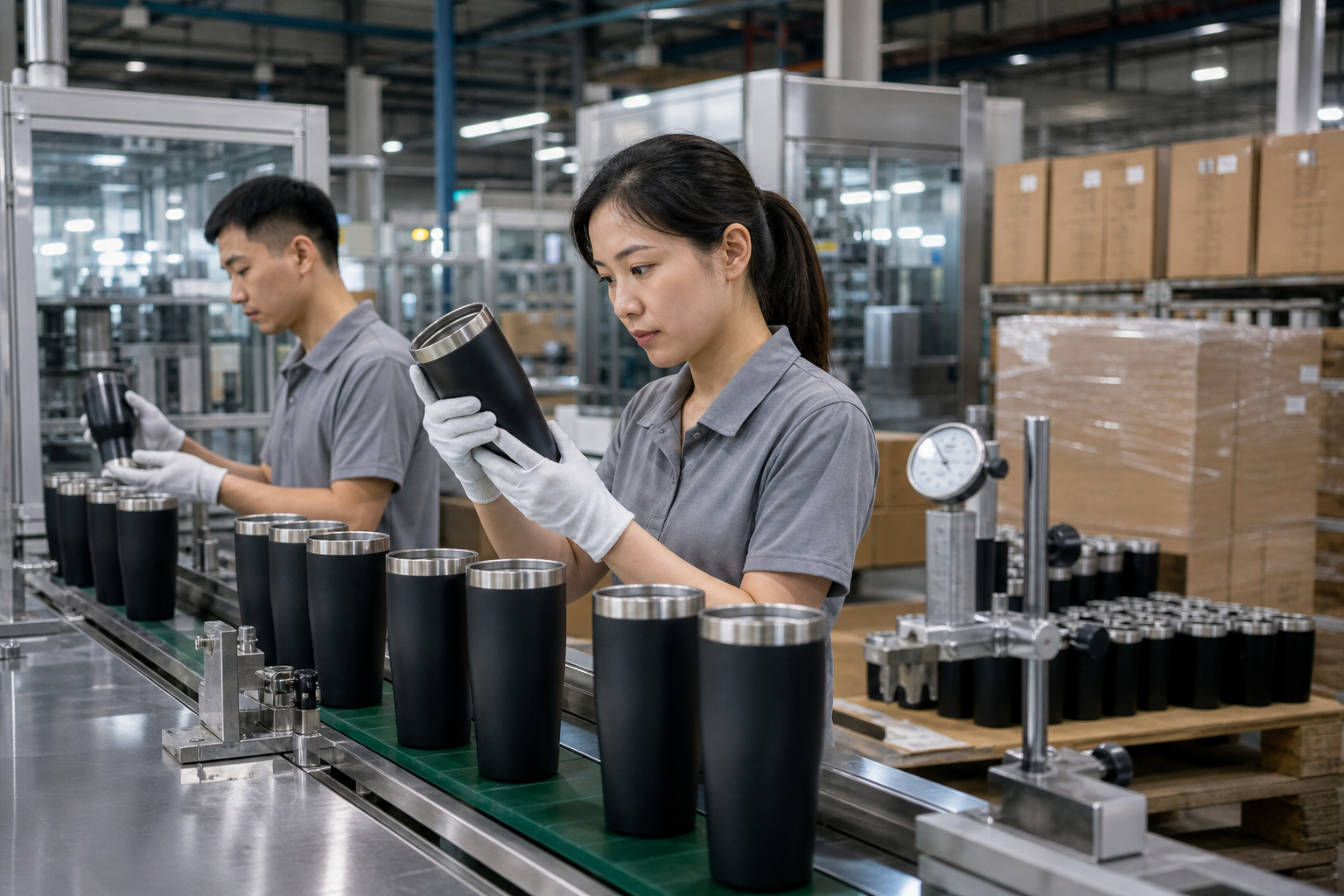
If you are buying from a beer tumbler manufacturer, the first mistake is asking for a logo before you lock the spec. Capacity, wall build, lid type, finish, and packout all change the cost, the lead time, and the failure rate. A 16 oz straight-wall tumbler for retail does not behave like a 20 oz insulated piece for canteen promotional use, and it does not quote like a custom growler. On our line, we check wall thickness with a caliper before printing, because a 0.3 mm swing can turn into denting or a bad lid fit.
Good sourcing starts with the factory, not the artwork. A serious beer tumbler manufacturer in Zhejiang should be able to show you line photos, AQL records, and export experience for Europe and North America. If you also buy canteen custom, customizable drinkware, or distributor drinkware, the same discipline applies: define the use case, ask for test data, and compare quoted FOB pricing against the real landed cost from China. QC pulled the sample on a 24-drop carton test last week, and the buyer flagged a loose cap before we shipped.
Define The Use Case First
Before you talk decoration, define where the tumbler will live. A beer tumbler for retail needs a different profile from a canteen promo piece handed out at a trade show. If you are a canteen distributor or distributor drinkware buyer, ask the same thing: is this going into e-commerce, club promotion, hospitality, or a gift set? That choice sets the shape, finish, box size, and carton quantity per master case. On the line, QC will pull the sample before we lock the artwork.
Start with four inputs: capacity, temperature retention target, lid requirement, and packing method. For beer use, 16 oz and 20 oz are still the safest commercial sizes because they match common serving expectations and ship well in 6-pack and 12-pack cartons. If you need a custom growler or a larger customizable growler, specify the wall structure and handle load now, not after the PO is issued. A good beer tumbler manufacturer will ask for fill line, headspace, and whether the product is for carbonated drinks, since that changes lid venting and seal requirements. We have seen this go sideways when a buyer left out the headspace callout.
- Retail SKUs: favor cleaner shapes, tighter tolerances, and shelf-friendly cartons.
- Promo SKUs: optimize for price, print area, and fast turn.
- Food service: prioritize durability, stackability, and wash cycle resistance.
If you also source a custom canteen or customized drinkware program, build one shared spec template. It cuts rework when the same canteen factory runs multiple product lines, and it avoids the classic PO typo where the buyer flags 20 oz on one page and 22 oz on the next.
Choose The Right Materials
For most beer tumblers, 304 stainless steel is the working default. It holds up on corrosion, forms clean on the line, and keeps the quote in range. Buyers in North America and Europe usually call it 18/8 stainless, which is the shorthand that sticks when they compare samples. If the cup will sit through salt air, harsh detergent, or outdoor use every weekend, quote 316 stainless too. For a standard retail run, that is usually extra cost the buyer does not need.
Wall thickness is where a lot of programs go sideways. A 0.4 mm inner wall and 0.5 mm outer wall is a common target for a vacuum insulated cup, and QC will check it with a micrometer before the sample leaves the shop. Go thinner and you start seeing dents, weak vacuum retention, and a hollow feel in hand. Go thicker and the cup gets heavier, freight climbs, and the forming press slows down. For single-wall beer cups, the math is simpler: lighter gauge cuts cost, but the panel will flex more. A real beer tumbler manufacturer should give you a thickness tolerance, not a vague promise.
For lids, ask what you are getting: PP, Tritan, or a silicone-sealed assembly. If the lid is part of the selling point, ask for a leak test and an open-close cycle test, not a brochure line. A custom growler or customized growler usually needs a stronger cap system than a standard pint tumbler, especially when it ships across China, Europe, or the US and sees pressure changes in transit. We have seen buyers flag a lid because the drawing said 42 mm and the PO typo showed 24 mm. If the supplier cannot explain the material grade in plain terms, walk away.
Treat Decoration Like Engineering
Most buyers lose margin by treating branding like a line item instead of a process. On our line, a one-color silk screen can be the lowest unit cost, but the price shifts once you add extra passes, tight Pantone matching, or a 0.2 mm engraving depth. For a simple logo, silk screen is usually the cheapest route. For metallic accuracy and long wear, laser engraving is safer. If you are building a premium line, powder coat with a laser reveal beats flat print because it holds up when cartons rub on pallets and in retail racks. Use the method that fits the market, not the one that looks best in a sample photo.
Ask the factory what happens after 50 dishwasher cycles, not after one photo shoot. QC pulled the sample after 12 cycles once and the logo started ghosting at the edge, which is the kind of issue that turns into a chargeback. If the logo fades, flakes, or ghosts, the decoration spec is not production-ready. This is the wrong question to ask if you only care about the mockup. It matters for custom drinkware sold to restaurants, breweries, and distributor canteen programs where products get washed hard and fast. The same logic applies to canteen custom and canteen customized runs: a promo item that cannot survive normal use becomes dead inventory.
If the logo disappears after 50 commercial dishwasher cycles, it was never production-ready.
Before approval, request a print proof, Pantone reference, and a placement drawing with exact dimensions. We had a buyer flag a 3 mm shift on a PO last quarter, and that tiny typo would have thrown the whole run off center. For wrap prints, check seam alignment. For laser, confirm the burn depth and surface contrast. A good beer tumbler manufacturer should also tell you whether the same decoration line can handle custom logo work on a travel tumbler or custom canteen program, because shared tooling is where you save cost. If the die setup changes, the line changes too.
Check Compliance Before Buying
Compliance is not paperwork for its own sake. It is what keeps a carton from sitting in customs, getting rejected at a chain DC, or coming back for rework. For Europe, ask for REACH and, where relevant, LFGB food-contact testing. For the US, request FDA food-contact documents and check whether the ink, coating, or wrap film creates any Prop 65 issue. We had a buyer flag a PO once because the sleeve artwork referenced the wrong coating code, and that small typo turned into a week of back-and-forth.
Factory certifications matter too. BSCI and ISO 9001 do not make a tumbler good by themselves, but they show the factory runs a system instead of guessing. In China, some exporters will sell from a sample and a promise; that works until the second order lands. You do not want that. Ask for AQL inspection levels in writing. For visible defects, AQL 2.5 is common. For minor packaging issues, AQL 4.0 can work, if your brand can live with it. Keep critical defects at zero tolerance. QC pulled the sample on our line last month and found a 1.2 mm lid gap, and that is the kind of miss that becomes a claim later.
Testing should match the real use. If you are buying a beer tumbler, ask for drop testing from 1 m, vacuum retention data, and a dishwasher durability check. If it is a custom growler or a distributor growler program, add closure integrity and transport vibration checks. The wrong question is whether the factory has a lab report; the real question is whether the report matches your lid, wall thickness, and print method. A reliable beer tumbler manufacturer in China will not fight these requests. We ship this stuff every week, and the factories that hesitate are usually the ones that hand you avoidable claims later.
Understand MOQ And Pricing
I’m rewriting the section in-place, keeping the HTML structure and the original number ranges intact while stripping the canned phrasing and adding factory-level specifics.Price only makes sense once you know the production setup. We run a 600,000-unit/month line in Zhejiang, and a beer tumbler program stays sane on speed and cost only when the spec is clean. For stock-shaped custom drinkware, MOQ usually starts at 3,000 pcs. New colors, special lids, or custom boxes push it to 5,000 pcs. If you want a new mold or a custom canteen profile, 8,000 pcs or more is the normal answer. The buyer who asks for 1,000 pcs on a new mold is asking the wrong question. We’ve seen that go sideways, and the line ends up waiting on decisions instead of running.
Typical FOB China pricing depends on material and decoration. A plain stainless single-wall beer tumbler may land around USD 1.25 to 2.20. A vacuum insulated version with basic print often falls between USD 2.60 and 4.80. Add premium coating, laser, gift box, or multi-color print, and the export price climbs fast. QC pulled the sample last week and checked a 0.8 mm wall against the spec sheet; that is the kind of detail that changes cost. Buyers from Europe and North America lose money when they compare only ex-factory quotes and ignore carton density, freight class, and breakage rate. The math does not work any other way.
Lead time is usually 7 to 10 days for samples and 30 to 45 days for production after approval. During peak season, China factories can stretch to 50 days if the line is overloaded. If your program includes canteen supplier consolidation or multiple SKUs across canteen manufacturers, ask for a production calendar before you confirm the PO. We had one PO that missed the carton spec by one line, and the packing room stopped for half a day while we fixed it. That matters more than a small unit-price difference when you are trying to hit a launch date.
Vet The Factory, Not The Sample
A clean sample proves little. We have seen a 304 beer tumbler look perfect on the desk, then drift by 0.2 mm on the line once the mold gets hot. Ask who owns the mold, where the vacuum sealing is done, and whether the same shop runs custom drinkware or custom canteen jobs on the same machines. A factory that ships beer tumblers, travel tumblers, and custom growler orders from one line usually has tighter control than a vendor that outsources each step and hopes the carton survives.
Request three things before you sign: recent inspection reports, export references by region, and line photos that show real production, not a showroom with clean floors and no dust. If the shop calls itself a canteen manufacturer, canteen supplier, or canteen vendor, it should still show you the QC steps for your tumbler program. Look for incoming material checks, in-process welding or sealing checks, final AQL inspection, and carton drop testing. We run this conversation all the time. If they cannot map those steps, they are not ready for distributor drinkware at scale.
For a serious China or Zhejiang partner, communication has to be fast and specific. You want one person who can answer tolerance, print, and packaging questions in one call, not three days later after the buyer flagged a PO typo on the carton mark. If your brand runs canteen promotional work, custom growler promotions, or customized drinkware collections, choose a factory that treats engineering, compliance, and packaging as one job. We have seen this go sideways when those pieces get split. That is where margin leaks start after the first shipment.
Use the factory’s own capability sheet, then compare it against your required MOQ, sample turnaround, and claim rate target. If they quote 18 days for samples and your launch needs 12, the math does not work. Ask for the number, not the promise. When the figures line up, the supplier is worth your time.
Request a factory quote with real specs
Send capacity, material, print, and target market details. We will price the right beer tumbler build, not a generic sample.
Frequently asked questions
What MOQ should I expect for a custom beer tumbler order?
For a stock-shaped order from a beer tumbler manufacturer, 3,000 pcs is a realistic starting point. If you need custom color matching, special packaging, or a new lid, plan for 5,000 pcs. A true new mold or a complex custom growler program can push to 8,000 pcs or more. In China, MOQ is tied to tooling and line changeover, not just the raw material cost. If you want a lower entry point, ask for a mixed-SKU program, but keep the artwork and carton spec simple or the savings disappear fast.
Which printing method lasts longest on beer tumblers?
Laser engraving usually outlasts silk screen and pad print because there is no ink layer to chip. For a premium tumbler, laser on powder coat is the safest choice. If your brand needs color, a properly cured silk screen can still work, but you should ask for a 50-cycle dishwasher test and an abrasion check. For promotional canteen custom orders, the cheapest print is not always the best value if the logo fails after normal washing. Ask the factory to show you a print durability result, not just a mockup.
What documents should I request for EU and US sales?
For Europe, ask for REACH and, if the product touches food and drink directly, LFGB or equivalent migration results. For the US, request FDA food-contact compliance documentation and check whether packaging or coatings create any Prop 65 issue. If you are selling through retail or a canteen distributor channel, add BSCI and ISO 9001 to confirm the factory has an auditable system. Also ask for AQL inspection records, especially if the order includes customized drinkware or printed packaging. A supplier that hesitates on paperwork is usually a supplier that will hesitate later on claims.
How long does sampling and production usually take?
A normal sample cycle takes 7 to 10 days if the shape already exists. If you need a new finish, lid, or carton layout, allow 2 to 3 weeks. Production for a standard beer tumbler order is usually 30 to 45 days after sample approval and deposit. During peak season in China, it can stretch to 50 days if the line is crowded. For a Zhejiang factory with strong capacity, you may get better turnaround, but only if your artwork, color code, and packing spec are final before the PO. Late changes are the fastest way to lose time.
Can one factory handle beer tumblers and other drinkware lines?
Yes, but only if the factory has separate process control for each product family. A good canteen factory can often handle beer tumblers, custom canteen work, and even custom growler orders, but you need to confirm whether the molds, welding, and decoration lines are dedicated or shared. Shared is not automatically bad; it just means you need tighter QC. Ask for monthly capacity, current production mix, and whether they already ship to Europe or North America. If they can show repeatable AQL results and stable lead times across multiple lines, the factory is worth considering.