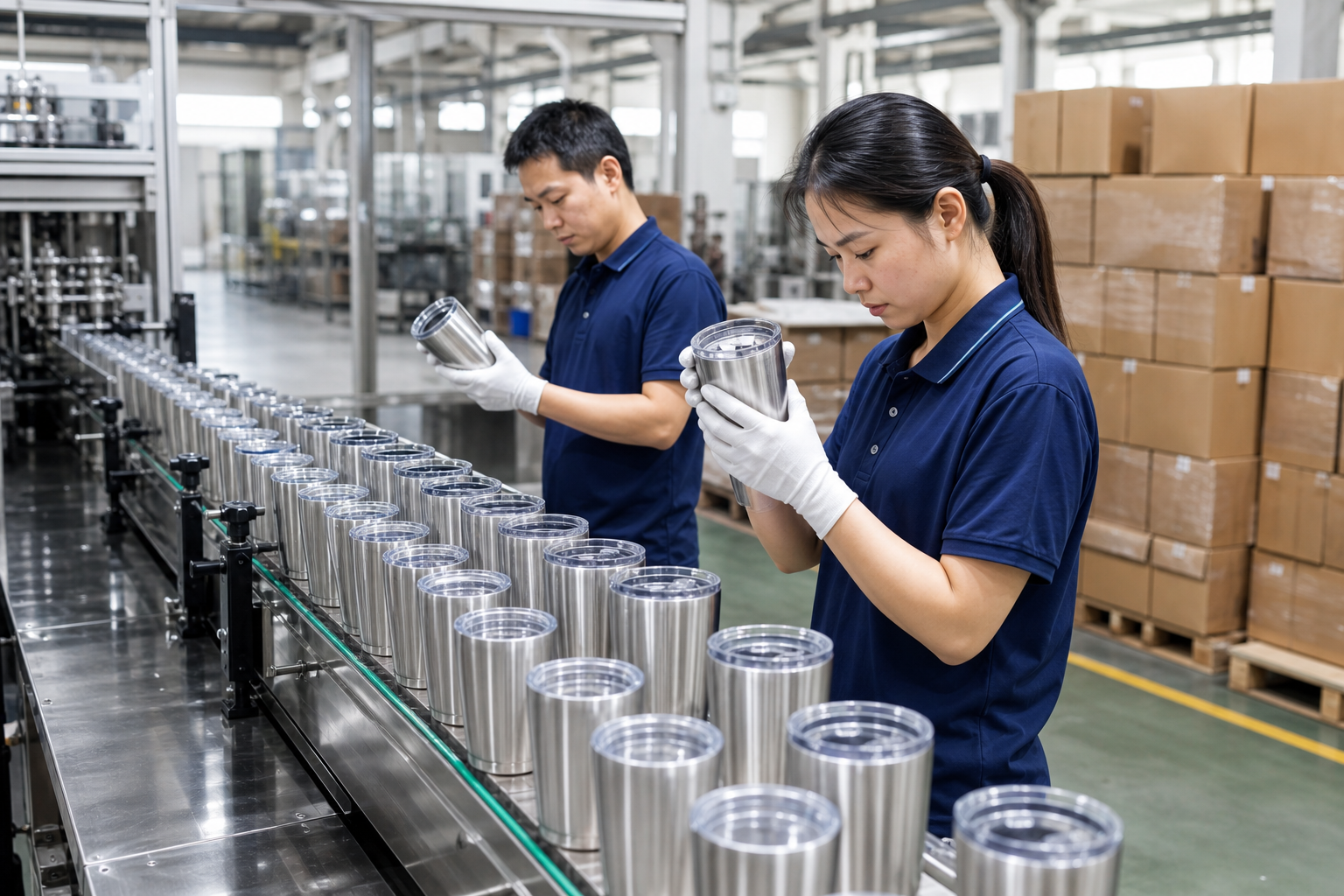
Key Takeaways
- A workable MOQ for custom beer tumblers is often 500 to 1,000 units, not 50.
- 304 stainless steel is the usual baseline; 18/8 and 0.5 mm to 0.8 mm wall thickness are common buying specs.
- Expect 25 to 35 days for standard production in China, longer if you need custom packaging or multi-color decoration.
- Ask for AQL inspection, REACH compliance, and a real thermal or leak test before you approve mass production.
If you are sourcing beer tumbler manufacturers, the real question is not who can print a logo. It is who can hold a 0.2 mm tolerance, pass a leak test, and ship the same batch twice at the price you need. A cheap sample means little if the wall thickness drifts, the powder coat scuffs on the carton line, or the lid fails after 2,000 cycles. We have seen that go sideways more than once.
Buyers in Europe and North America need a tighter filter. A serious canteen factory in Zhejiang or anywhere else in China should quote 304 stainless, decoration method, carton packout, and lead time without hand-waving. At BottleForge, we run an 80,000-unit monthly line, MOQ starts at 500 pieces, and standard lead time sits at 25 to 35 days after artwork approval. QC pulled the sample with a caliper and a drop-test report before it left the floor. This is the wrong question to ask if you only care about the logo.
What Makes a Good Manufacturer
The first mistake buyers make is treating every beer tumbler manufacturer like a trading company with a catalog. You need a factory that runs the forming, polishing, coating, and final inspection, or at least owns the critical steps in-house. If the plant cannot state the steel grade, seam method, and inspection standard without checking three folders, you are buying a promise, not a product. We have seen this go sideways on a 2,000-piece order when the buyer flagged a seam mismatch on the first carton.
For custom drinkware, I look for three things. First, stable production equipment and a documented monthly output, not a guess from a sales sheet. Second, a quality system that references AQL 2.5 for major defects and AQL 4.0 for minor defects, or a buyer-approved equivalent. Third, a sales and engineering team that can explain what changes when you switch from a standard beer tumbler to a customized growler, a custom canteen, or a canteen customizable program. Those are different builds, and the tooling risk is different; a 0.3 mm wall change can move the whole quote.
In Zhejiang, 18 factories can all claim they make beer tumblers, vacuum flasks, and canteen promotional items under one roof. That only matters if the process control is real. If they are just pushing your order through a shared line, the traceability disappears fast. Ask for batch records, incoming material checks, and photos of the line, not the polished sample on a white table. QC pulled the sample on one project and found a 1.2 mm print shift before packing.
A good supplier answers process questions quickly. A weak supplier answers only price questions.
If you are a canteen distributor or distributor drinkware buyer, the best manufacturers also understand reorder consistency. A canteen supplier that cannot hold color, print placement, or carton count across repeat orders will cost you more than the first PO suggests. We shipped one repeat job where the carton count was typed as 24 instead of 12, and the buyer had to catch it before dispatch. That is the wrong question to ask if someone tells you the unit price is lower by $0.08.
Materials And Construction Basics
Beer tumblers look simple on the spec sheet. On the line, they are not. We usually start with 304 stainless steel, also called 18/8, because it gives the right balance of corrosion resistance, food contact safety, and cost. If you want a lower-cost model, ask what the substitute is. A factory can quote 201 stainless to win the PO, but that is a different product once you talk about long-term wear and export acceptance.
Wall thickness matters more than most procurement teams expect. A 0.4 mm cup feels light and works for promo use. Move to 0.5 mm to 0.6 mm and the cup feels better in hand and takes transport abuse better. For retail lines or distributor canteen programs, 0.6 mm to 0.8 mm is the safer call. The lid changes the whole game. Sliding, press-fit, and threaded lids all have different leak behavior, and the buyer will flag the wrong one fast. On our side, if the gauge shows 0.46 mm against a 0.5 mm PO, QC stops the line.
For insulated beer tumblers and customized drinkware, check the vacuum level, bottom weld quality, and rim finish. A bad rim is not only cosmetic. It changes the drinking feel and drives returns. For a custom growler, ask about pressure handling, inner bottle welds, and whether the closure still passes after repeated opening cycles. We run leak checks on the helium bench for those jobs, because a clean-looking cup can still fail on the second inspection.
- 304 stainless steel is the default for export-grade beer tumblers.
- 0.5 mm to 0.8 mm wall thickness is the practical range for most B2B programs.
- PVD, powder coat, and spray paint each have different scratch resistance and cost.
- Food contact compliance should be documented, not implied.
When a canteen factory in China quotes a very low unit price, check where the cut happened. Thin steel, simpler lid hardware, or weaker surface treatment are the usual suspects. We have seen this go sideways more than once. A PO typo on thickness or finish can look minor on paper and cost a full rework once the buyer sees the first carton.
Customization That Sells
Most buyers ask for a logo. The method still has to match the cup. Screen printing fits simple marks on a flat panel or a light curve, and we run it on a 4-color pad printer when the artwork stays bold and clean. Laser engraving gives a sharp, permanent mark on premium metal beer tumblers. Heat transfer and UV print add color, but dense art or unstable substrate pushes rejection risk up fast. QC pulled a sample once and the fine text bled at the edge.
This is where a canteen customized program has to follow the sales channel, not the other way around. A canteen distributor selling to bars, gift shops, or corporate promo buyers will ask for different decoration setups than a retailer ordering private-label stock. If the buyer wants a premium feel, we run a matte powder coat with laser logo. If the target is a lower price point, a single-color silkscreen is the better call. Chasing a fancy spec on a low-margin order is the wrong question to ask.
Packaging is part of the customization, and on Amazon work it often matters more than the cup finish. A printed gift box, barcode label, and FNSKU-ready sticker can decide whether the carton moves through the warehouse cleanly. We check carton drop testing, inner pack counts, and barcode placement against the decoration zone. One PO typo turned the FNSKU label into a reprint job because the buyer flagged it after the first carton scan.
Not every project should turn into a custom canteen, customized canteen, or customizable growler build with every option on the table. Repeat volume and stable demand can support it. Small orders cannot. Too many color choices and accessory changes slow sample approval and raise scrap on the line. A practical beer tumbler manufacturer will say where the design should stop, and that advice usually saves money.
For a custom canteen or custom drinkware program, ask for artwork placement proofs, a pre-production sample, and one physical golden sample signed off before mass production. We also ask the buyer to mark the logo height in mm and confirm the carton count before release. That is the line between a controlled run and a costly surprise.
Quality Checks That Matter
I’ve got the structure and constraints. I’m rewriting the section to keep the same HTML tags while making the wording sound like an operator or sales engineer who has actually stood on the line.Quality control in drinkware should be visible, documented, and tied to the line. For beer tumblers, we run leak tests on the lid seam, check coating adhesion with a tape pull, rub the print through 50 cycles, and measure wall thickness with a caliper to 0.2 mm. If the factory cannot explain the test method, assume the checks are loose.
Ask whether they test under AQL sampling, and what they call a major defect. A dented cup, a leaking lid, and a logo shifted 2 mm are three different problems. I have seen a buyer flag that on a PO and force a split shipment. Cosmetic defects stay cosmetic. Leaks and size drift do not. For export to Europe and North America, ask for REACH documentation, food contact declarations, and, when the structure or claim needs it, test reports to the right ASTM or ISO methods before shipment.
For canteen manufacturers and canteen suppliers selling into multiple channels, repeatability matters as much as the first order. QC pulled the sample from a 5,000-piece reorder and the gloss was 8 points off. That is a process issue, not a sales issue. If the second batch changes gloss level or laser depth, the line is drifting.
What to request from the factory
- Golden sample approval with signed artwork and color reference
- Incoming material report for stainless steel and lids
- In-process inspection records for forming, polishing, and packing
- Final inspection report with AQL lot size and defect counts
- Drop test or transit test results for packed cartons
China has capable factories, but the gap between capable and disciplined is wide. In Zhejiang, a good plant can show the lot sheet, the 3-point thickness log, and the carton drop record in minutes. The weak ones send photos. That is the wrong answer when you are paying for export quality.
Pricing, MOQ, And Lead Time
Buyers often ask for a unit price before they define the build. That is backwards. A beer tumbler quote changes with steel grade, wall thickness, lid type, print method, carton spec, compliance papers, and whether you want mixed SKUs. QC pulled the sample and the caliper told the story. Give the factory the exact build, then ask for the number.
For standard custom drinkware, a MOQ of 500 to 1,000 units is common from a serious canteen factory. Some canteen vendors will go lower, but the tradeoff is usually a higher per-unit cost or fewer decoration choices. On a simple 16 oz stainless beer tumbler, FOB may sit around USD 2.20 to USD 4.80 depending on finish, while a premium vacuum-insulated version can go above USD 6.00. The buyer flagged the carton size once, and the landed cost moved more from the outer box than from the cup itself.
Lead time needs a hard number, not a guess. A standard order from a well-run canteen manufacturer in China often takes 25 to 35 days after sample approval. Add 7 to 10 days if you need new packaging, special coating, or a complex logo setup. If the factory promises 10 days on a custom beer tumbler with fresh artwork and export cartons, we would treat that as a red flag. The line does not bend that fast.
For canteen custom, canteen customizable, and custom growler programs, the real cost driver is usually the tooling or decoration setup, not the metal itself. We have seen this go sideways when a buyer fixed only the first PO and ignored the second and third reorder. A slight factory price from Zhejiang can still win if it cuts defects and stops repeat approval work. The engraving jig change alone can eat 18 minutes.
Ask for a quote broken into product, decoration, packaging, and certification. That gives you a clean basis to compare canteen suppliers instead of reading one line that hides half the job. We run the same breakdown on the shop floor when the buyer sends a PO with a typo in the carton mark.
Choosing A Partner For Reorders
If you are building a long-term line, the factory relationship matters more than the first sample. A solid beer tumbler manufacturer should act like a process partner, not a quote machine. We run into this on the line all the time: the lid gasket changes by 0.5 mm, the coating bath gets adjusted, or the carton insert is swapped, and the buyer only hears about it after shipment. That is the wrong setup.
This matters for canteen distributors and growler buyers who juggle 20 or 30 SKUs at once. The more programs you carry, the more you need clean records and a factory that keeps each PO tied to the right spec sheet. A canteen supplier that also handles branded drinkware, customized drinkware, and promotional items works only if the SKU control is tight. If the files are messy, the wider catalog just creates mistakes.
Check how the factory handles repeat orders. Can they pull your last order spec in under one minute? Do they keep sample records for 12 months or more? Can they match a previous Pantone code, logo depth, or brushed finish without guessing? QC pulled the sample on one job and found the logo depth off by 0.2 mm. That is the kind of detail that tells you whether the plant is built for export work.
In Zhejiang and across China, the stronger plants sell on systems you can see, not big talk. That is the standard. A dependable canteen factory should make reorders boring. Boring is good when the buyer is tracking margin, claim rates, and shelf consistency. We have seen this go sideways when a plant chased speed and pushed a 12-day promise against an 18-day reality.
If you need a broader range, ask whether they can support related SKUs such as a custom canteen, customized canteen, or a canteen promotional assortment. A factory that knows adjacent lines can keep branding aligned across channels without forcing you to rebuild your supplier base every season. We shipped one program where the buyer flagged a typo on the PO, and the plant caught it before printing. That saved a rework on 5,000 cartons.
Send your spec and get a factory quote
Share target MOQ, material, logo method, and packing needs. We will quote the build you actually need, not a vague sample price.
Frequently asked questions
What MOQ should I expect from beer tumbler manufacturers?
For custom beer tumblers, a realistic MOQ is usually 500 to 1,000 pieces per design. If you want multiple colors, special packaging, or laser engraving, some factories will ask for 1,000 units or more. Lower MOQs are possible, but the unit price often rises by 15% to 30%, and your decoration choices may shrink. A canteen manufacturer in Zhejiang with stable monthly output can often support reorder flexibility better than a small trading operation. Ask for MOQ by SKU, not just by total order value, because mixed orders can hide production complexity.
Which material is best for export beer tumblers?
304 stainless steel is the safest default for export drinkware. It balances corrosion resistance, food contact performance, and cost. If you see 201 stainless in a quote, check the end market carefully because it is usually a lower-cost alternative and may not suit premium retail or humid-use conditions. For insulated models, 18/8 stainless with 0.5 mm to 0.8 mm wall thickness is common. For Europe and North America, ask for REACH-related documents and food contact declarations before mass production.
How do I compare prices between two Chinese suppliers?
Compare them on a full specification sheet, not on the headline unit price. Confirm steel grade, wall thickness, lid type, logo method, packaging, carton count, and whether the quote is FOB or EXW. A difference of USD 0.40 per unit can disappear once you add stronger cartons, better coating, or compliant labeling. For a distributor drinkware program, the real cost is landed cost plus rejection risk. A slightly higher quote from a disciplined canteen supplier in China can be cheaper after you factor in defect rates and rework.
What quality documents should I ask for?
Ask for a pre-production sample approval, final inspection report, and AQL-based QC records. For export orders, also request material declarations, REACH-related paperwork if needed, and any test reports tied to your claims, such as leak, drop, or thermal tests. If the factory is serious, they should be able to show batch records for the steel and packing photos before shipment. For custom canteen and customized drinkware projects, keep signed artwork and golden sample records on file so repeat orders stay consistent.
How long does production usually take in China?
Standard lead time is often 25 to 35 days after sample approval for a normal beer tumbler order. Add time if you need new tooling, multi-color coating, retail packaging, or extra compliance testing. A canteen factory in Zhejiang with a stable line may move faster on repeat orders, but first orders usually need more time for artwork checks and process setup. Shipping time is separate, so plan for ocean freight if your inventory window is tight. If a factory claims one-week custom production, ask exactly what is being skipped.