Key Takeaways
- A normal OEM MOQ for vacuum beer tumblers is 3,000 pcs per design, with samples at USD 30 to 80 and lead time around 25 to 35 days
- For export orders, 18/8 stainless steel, 0.5 mm wall thickness, and AQL 1.5 major or 4.0 minor are the baseline worth asking for
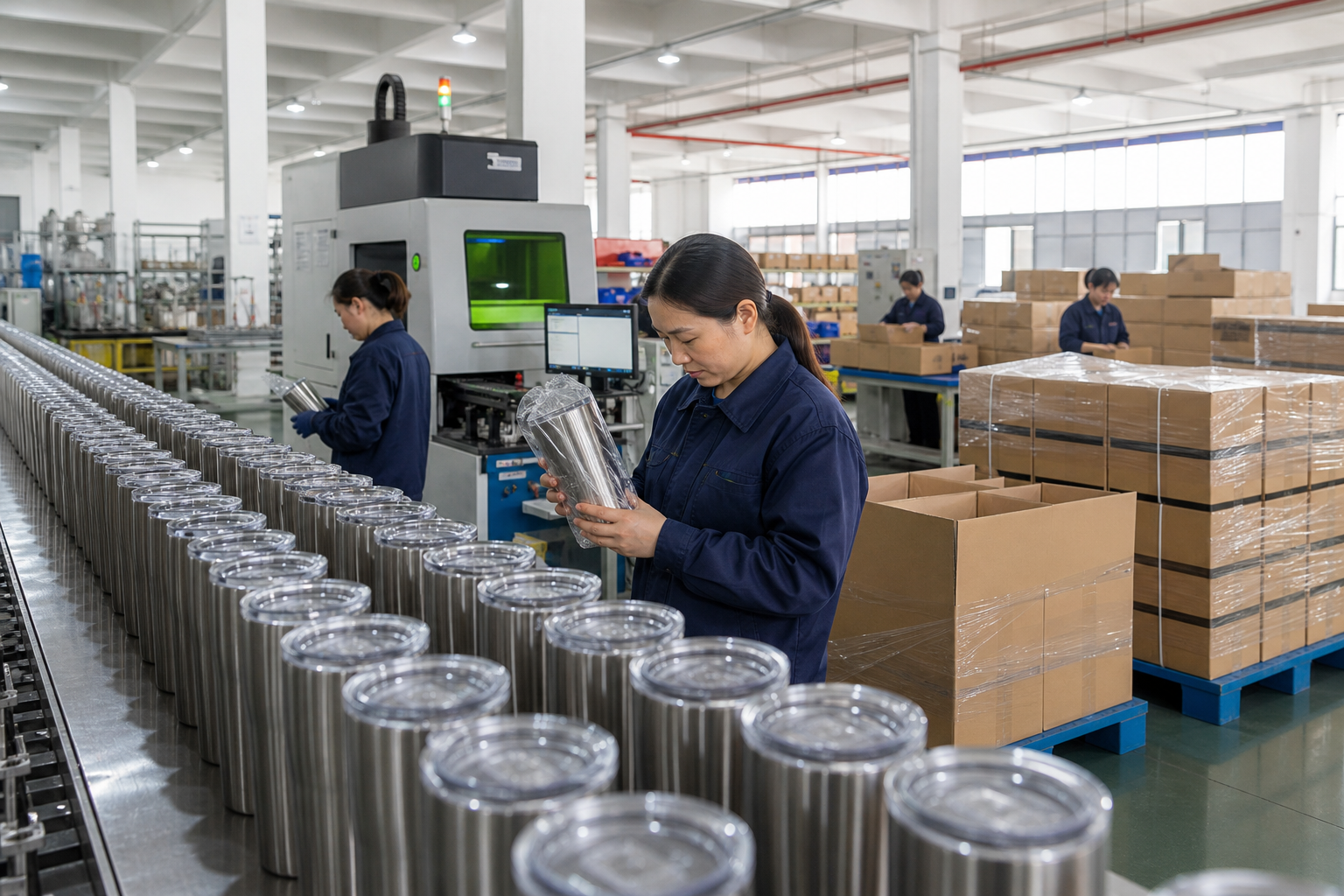
- A Zhejiang factory with 500,000 units/month capacity can support beer tumblers, customizable growler orders, and canteen promotional SKUs without retooling every week
- REACH, LFGB, FDA, ISO 9001, and BSCI documents matter more than a sales promise when you sell into Europe or North America
If you are sourcing a beer tumbler OEM manufacturer, the real decision is not the shape. It is whether the factory holds ±0.3 mm on the rim, protects your margin, and repeats the same result on the next 10,000 units. We run into this every week: QC pulled the sample at 0.75 mm wall thickness, then the mass run drifted to 0.68 mm and the buyer flagged the lid fit. Buyers in Europe and North America get burned when a clean sample turns into coating loss or a loose lid on the production line.
A serious supplier in Zhejiang or wider China should quote 304 stainless, print method, carton spec, and test method without guessing. If you also buy custom drinkware, custom growler, or canteen custom programs, one partner should handle the lot; a canteen vendor that improvises every PO is the wrong question to ask. We have seen it go sideways on a 3,000-piece MOQ when the PO typo changed the finish code, and the line caught it only after the cartons were printed. The difference shows up in lead time, reject rate, and how your distributor drinkware line performs after launch.
Start With The Right Beer Tumbler Spec
Before you ask for pricing, lock the spec in numbers. A beer tumbler OEM manufacturer needs the exact body size, so say 12 oz, 16 oz, or 20 oz, then confirm straight wall or tapered, plus the lid choice: sip-through, sliding, or no lid. If those points stay open, the quote looks low on paper and turns messy after QC pulled the sample and the buyer flagged the wrong mouth size.
For B2B drinkware, the workhorse spec is double-wall vacuum insulation with 304 stainless steel, a 0.5 mm inner and outer shell, and a powder-coated exterior. That is not a premium trick. It is a stable spec we run every week. If your customer wants a higher-end feel, move to brushed steel, copper plating under the vacuum layer, or 316 for niche use cases, but do not pay for extras that do not lift sell-through. The math does not work.
Think about the channel, not just the cup. A taproom retail program needs a different look from distributor drinkware sold through e-commerce or brewery gift packs. If you also sell canteen customizable, customized drinkware, or a custom growler line, standardize lid parts and carton dimensions where you can. We have seen that go sideways when one PO typo changed the carton size by 8 mm and the pallet count fell apart at packing.
- 12 oz for draft-style retail sets
- 16 oz for the broadest beer tumbler demand
- 20 oz when you want a stronger perceived value
- 0.5 mm steel for balanced cost and durability
If the factory cannot explain why the body height, rim roll, and base diameter were chosen, keep looking. Ask for the reason, not just the drawing.
Materials And Build Quality
For serious beer tumbler orders, we start with 18/8 stainless steel, usually sold as 304. That is the baseline because it is food safe, resists corrosion, and stays consistent across a 5,000-piece run without batch drift. On the line, QC will check the coil certificate before the first press. If a Zhejiang canteen factory is quoting anything else as the default, I want to know why.
Wall thickness matters more than the sales deck. At 0.4 mm, you save a little weight, but the cup feels thin, rings louder, and dents faster in transit or on retail shelves. At 0.5 mm, the balance is better for export. Go thicker only when the market pays for the extra metal. The same logic applies to the bottom pad, vacuum seam, and powder coat. We have seen buyers push for the cheapest spec, then flag a crushed corner after carton drop testing. The math does not work.
Ask for the factory's test method, not a vague promise. A solid beer tumbler oem manufacturer should show hot and cold retention data, vacuum leak testing, salt spray results for coated parts, and carton drop testing for export. On our side, the salt spray cabinet and leak rack are not decoration; they decide whether a batch ships. If the factory also makes canteen suppliers' catalog lines or a customizable growler range, check whether the same inspection sheet follows every SKU. That tells you if the quality system is real or just sample-photo polish.
One practical rule: if the sample feels heavy but the weld line looks uneven, you are buying steel, not control.
In China, the better suppliers are clear about what is standard and what is an upgrade. That saves time. We have seen a buyer flag a PO typo on the powder coat code and the whole order shifted by a week because the factory had to rework the print file. A low FOB number is nice on paper, but if it changes later, you still lose money.
Decoration That Sells The Shelf
Decoration is where a lot of projects slip. We see it on the line all the time: a buyer approves a clean render, then the logo line is too fine for silkscreen, the gradient breaks on powder coat, or the art lands awkwardly over the body seam. A solid beer tumbler OEM manufacturer should flag that before you cut the PO.
For one-color brewery logos, laser engraving gives the cleanest result on brushed steel. For coated bodies, silkscreen is still the lowest-cost choice for 1 to 2 colors, especially when your MOQ is 3,000 pcs or more. UV print works when the design needs more color, but we test abrasion hard. The buyer will ask for a cheaper visual. The math does not work. If you want a retail look, ask for Pantone control, matte powder coat, and a sample with the exact production finish, not a close match from the sample room.
The same decoration logic applies beyond beer tumblers. A canteen customizable program, a customized canteen gift set, or a custom growler line can use the same print and engraving setup if the substrate is matched correctly. That is useful for canteen distributors and canteen vendors who want to turn one account into three SKUs. A strong canteen supplier or custom drinkware factory earns margin here by knowing what survives shipping, shelf handling, and dishwashing, not by saying yes to every decoration method.
- Laser engraving for durable one-color marks
- Silkscreen for simple, low-cost branding
- UV print for more complex graphics
- Full wrap for promotional canteen and tumbler sets
Do not approve decoration from a digital mockup alone. Ask for a physical proof on the exact coating and body shape you plan to sell. QC pulled a sample with a 0.3 mm registration shift once; that is the kind of miss the render will never show.
MOQ, Pricing, And Lead Time
I’m rewriting the section now, keeping the HTML structure intact and tightening the copy so it reads like a factory-side sales note, not marketing text.Buyers ask for price first. That is the wrong question to ask. On our line, a normal custom beer tumbler order from a Zhejiang factory still starts at 3,000 pcs per design, and sample charges usually sit at USD 30 to 80 because the laser engraver, pad print screen, and finish setup all need time. If you need a new mold for a special lid or body shape, budget another USD 1,500 to 6,000 before production starts. We had one PO where the buyer typed the lid code wrong, and that typo cost a week.
For standard vacuum beer tumblers, FOB China pricing often lands around USD 2.20 to 4.80 per piece on larger runs, depending on steel grade, lid, coating, and decoration. That range is real. A 304 stainless body with a 0.35 mm wall, a tighter lid fit, and a better box will sit near the top; a bare spec with thin carton and weak ink may look cheap, then QC pulls the sample and finds lid rattle or coating rub. If a quote comes in far below that, the math does not work.
Lead time usually runs 25 to 35 days after sample approval, but only when the artwork is final and the raw material is already in stock. A factory with 500,000 units/month capacity in China can absorb a seasonal spike better than a small workshop, especially when the same automatic spray line is already running canteen promotional products, custom growler SKUs, or distributor drinkware bundles. We have seen this go sideways when the buyer keeps changing logo size after approval. Then the line stops, and the ship date slips.
If you are a distributor canteen buyer, order batching matters. One supplier that groups custom canteen, canteen customized, and beer tumbler production on the same line can cut freight and admin cost, but the packing spec must be fixed before the first carton is closed. Loose carton control is where margin disappears. A 5-ply export carton that misses the tape spec by 2 mm will fail a drop test, and the buyer will flag it before the booking even lands.
Compliance You Should Actually Check
Compliance is not paperwork. If you sell into Europe or North America, the cup on the line has to match the lab report, and the lab report has to match the exact SKU. For a beer tumbler OEM manufacturer, the first files I ask for are LFGB or FDA food contact support by destination, REACH screening for restricted substances, ISO 9001 certification, and a current BSCI audit if your buyer checks social compliance. We have seen PO typo issues on 16 oz versus 18 oz cause trouble before the carton even leaves packing.
Do not mix up factory certificates with product proof. A supplier can show BSCI and still fail decoration adhesion, coating heavy metals, or lid migration data. Ask for the report number and the model name, not a PDF screenshot. If the factory also runs canteen manufacturers' lines or a customized growler range, confirm the same 304 stainless, ink system, and coating recipe are being used for your SKU, not a cheaper substitute pulled from another order. That is the wrong question to skip.
For QA, AQL 1.5 major and 4.0 minor is a solid export standard for drinkware. I would also want leak testing, vacuum retention checks, carton drop tests, and visual checks for scratches, dust, and print alignment. For retail cartons, a 1.0 m drop test on six faces is the floor, not a bonus. For dishwasher-safe claims, ask for repeated cycle testing, not one pass through a lab washer. QC pulled the sample on our side before, and a 0.3 mm print shift was enough for the buyer to flag it.
When you work with a canteen factory or canteen manufacturer in China, the same discipline applies. Canteen suppliers and canteen vendors often sell on price first, but the real cost shows up in rejects, chargebacks, and rework. On one run, the line saved 0.12 USD per unit by changing ink, then lost the whole shipment after the buyer's lab caught the coating issue. Buyers who check reports before approval usually spend less across the program.
If a factory says the certificate is available later, treat that as a warning, not a courtesy.
How To Qualify The Factory
The best way to qualify a beer tumbler OEM manufacturer is to ask for proof that is hard to fake. Request three recent order photos, a production flow chart, and the inspection record for a similar SKU. Then ask how they handle seam polishing, rim rolling, and vacuum sealing on the leak tester. A real factory will answer in process terms, not in slogans. If the sales team can explain the difference between prototype approval and pre-shipment inspection without checking with the boss, you are probably talking to someone who knows export work.
You should also check how the plant handles mixed-category programs. A Zhejiang custom drinkware supplier that runs beer tumblers, canteen custom projects, and custom growler packaging on the same QC table can usually keep the same control points in place. That matters for canteen distributors and distributor drinkware buyers who want to consolidate purchasing. We've seen buyers split one program across five vendors, then get stuck with different artwork formats, carton specs, and payment terms. The math does not work.
Look at packaging discipline. Are the cups separated well enough to avoid scuffing? Is the carton print readable at arm's length? Does the inner tray protect the coating during a 1.2 m drop test? Are the master cartons labeled with SKU, quantity, and country of origin? Those details decide whether a retail launch stays clean. A canteen promotional program, a customized drinkware gift pack, or a distributor growler line all face the same problem: one bad pallet and the margin is gone. The buyer flagged it for a reason.
- Ask for a live video of the production line
- Confirm monthly output, not just annual capacity
- Check whether the same team handles sample and mass production
- Verify packing labels, carton counts, and pallet specs
In China, the difference between a sales office and a true canteen factory shows up fast. The real ones can walk you past the line, the QC table, and the stock area in one hour, and they do not need to buy time first.
Source Your Next Beer Tumbler Run
Send the spec, target MOQ, and destination market. We will quote the right beer tumbler build and keep the China sourcing practical.
Frequently asked questions
Can one factory handle beer tumblers and canteen programs?
Yes, if the factory has real production depth. A strong canteen factory in Zhejiang should be able to manage custom canteen, customizable canteen, customized canteen, beer tumbler, and custom growler programs with the same basic QC system. That is useful for canteen distributors and canteen vendors who want to consolidate sourcing. The key is whether the plant can keep material, decoration, and packing standards separate by SKU. If they can, you can build a broader distributor canteen or distributor drinkware line without multiplying your supplier count.