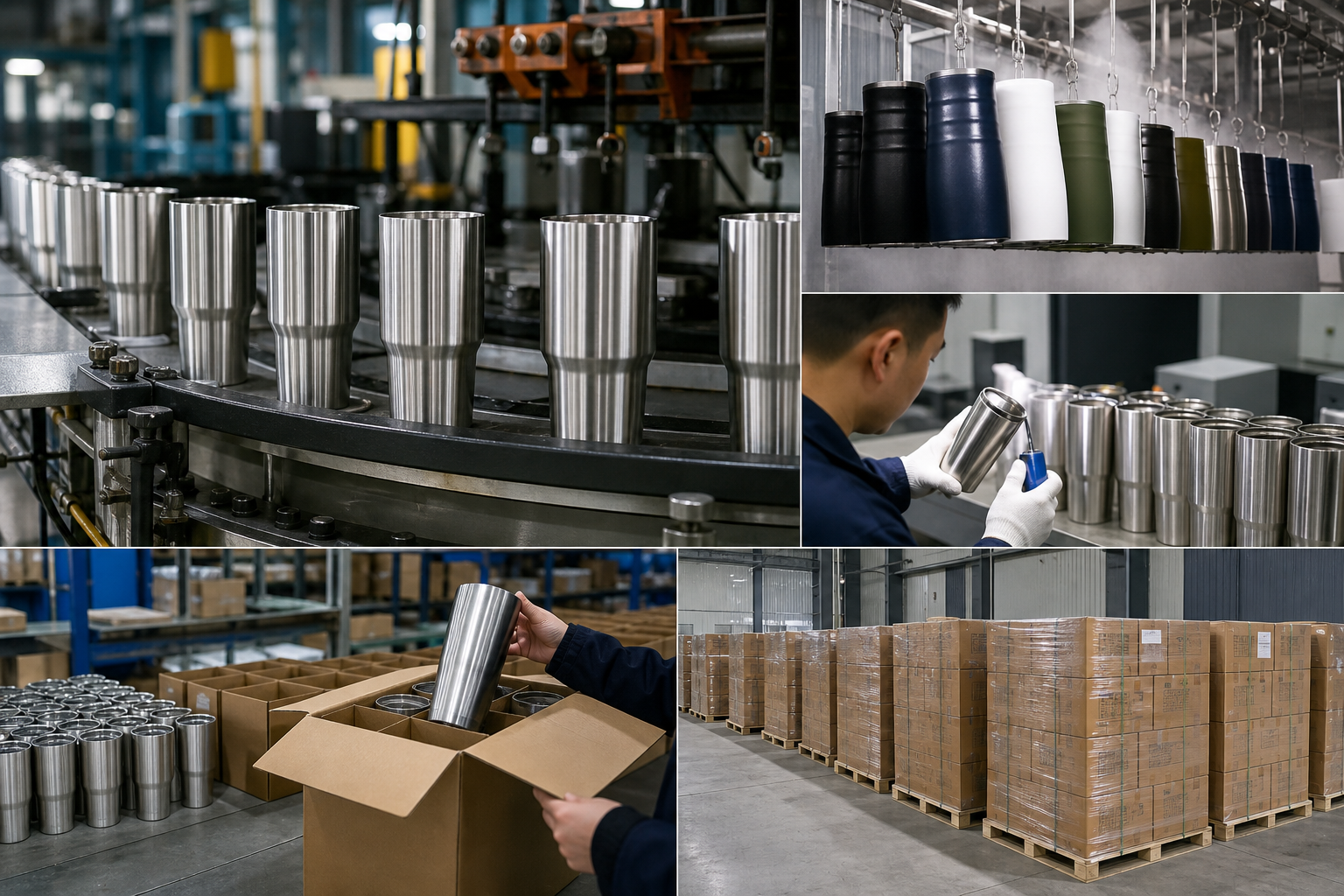
Key Takeaways
- For stock beer tumbler shapes, expect MOQ from 1,000 pcs; deeper customization often starts at 3,000 to 5,000 pcs.
- A typical FOB China price range for a private-label stainless beer tumbler is about USD 1.20 to USD 3.80, depending on finish and decoration.
- Laser engraving lasts longer than simple print, but one-color silkscreen is still the lowest-cost option for canteen promotional orders.
- For EU and North America, ask for REACH, LFGB, FDA food-contact support, AQL inspection, and carton packing details before PO release.
Beer tumbler private labeling looks easy until the first PO lands on the line. The sample can pass by hand, then the 5,000-piece run shows loose lids, a powder coat that flakes at the rim, or a logo that rubs off after three dishwasher cycles. We have seen a buyer flag a 1 mm lid gap after QC pulled the sample with calipers. The real work is not choosing a cup shape. It is fixing the spec, the decoration method, the test standard, and the carton pack before we cut steel.
If you already buy custom drinkware, the pattern is familiar. A beer tumbler program moves like a canteen custom or custom growler order: change wall thickness by 0.2 mm, switch from matte to gloss, or add an insert tray, and MOQ, lead time, and landed cost all move with it. We run into this every week on the Hangzhou line. Asking only for cup price is the wrong question. A supplier that knows the work should quote the full stack plainly, not leave the risk buried in a vague line item.
Start With The Right Tumbler Spec
Beer tumbler private labeling starts with the base cup, not the logo. We usually narrow it to three bodies: straight-sided stainless, double-wall insulated, or a taller pint-style profile. For most B2B orders, 16 oz or 20 oz is the cleanest commercial pick. Those sizes fit bar service, shelf display, and carton packing without forcing odd inserts or weak box layouts. If you are buying for a distributor program, this is the right question to ask first. Keep the shape simple. Simple shapes stack better, ship cheaper, and crack less in transit.
For stainless steel, 18/8 or 304 is the normal spec, and 0.4 mm to 0.5 mm wall thickness gives a solid hand-feel without pushing weight up too far. If you want a heavier body, 0.6 mm feels more premium, but the material bill moves fast. We run this kind of work on the same line that handles custom canteens and customized growlers, and QC pulled the sample if the wall ran uneven by 0.08 mm. On a Zhejiang factory floor, the mold has to stay realistic. If the buyer wants a deep draw with a tight neck and fancy embossing, the math does not work at low MOQ.
Check the small things buyers often miss: lip curl quality, bottom flatness, and whether the cup rings on a table after a 300 mm drop test. A buyer who only checks capacity is buying the wrong part. We have seen that go sideways when the PO said 20 oz but the approved drawing showed 18 oz, and the carton count no longer matched the shelf plan. A good supplier should send a drawing with top diameter, bottom diameter, height, tolerance, and recommended box size. If they cannot do that, they are acting like a trading desk, not a real canteen manufacturer.
- 16 oz: good for pub retail and gift sets
- 20 oz: better for volume-driven custom drinkware orders
- 0.4-0.5 mm wall: practical balance of cost and durability
- 304 stainless: default choice for beer contact and general food use
Choose Finish And Material Wisely
The finish decides how the tumbler sells and how it holds up once it leaves the carton. Powder coating is the usual pick for private label beer tumblers because it adds color, grip, and solid scratch resistance. On our line, QC checks the coating at 0.08 to 0.12 mm, and that range usually ships clean. Brushed stainless looks more industrial and hides small scuffs. Polished surfaces look premium, but fingerprints show up fast. If your buyers are bars, outdoor retailers, or distributor canteen programs, matte powder coat is the safer call.
Material choice matters just as much. Use 304 stainless unless you have a clear reason to move to 316 for stronger corrosion resistance. For beer, soda, and general cold drink use, 304 is enough in most cases. We run a lot of 0.5 mm and 0.6 mm wall builds, and the buyer usually cares more about consistency than a spec sheet trophy. If the tumbler will be sold as a customizable canteen or cross-listed as a customizable drinkware item, keep the range aligned so the buyer does not end up juggling different test files and care notes.
For Europe, ask for REACH screening and a food-contact declaration. For the UK and EU, buyers often ask for LFGB migration testing when coatings or inks are involved. For North America, request FDA food-contact support documents and, if the retail channel requires it, California Prop 65 handling guidance. We once saw a PO typo turn one ink code into the wrong batch number, and the buyer flagged it before packing. A real canteen supplier in China should know how to prep these files without drama.
The cheapest finish is not the lowest-risk finish if it needs rework after the first container lands.
If you are also sourcing canteen promotional items, keep the color palette tight. One or two stock colors cut setup waste and make reorders easier. This is the wrong question to ask if you are trying to look broad on paper. In practice, that is why many canteen distributors go with black, white, navy, or brushed steel for the first run. MOQ is easier to hold, and the line does not lose time changing powder too often.
Pick A Branding Method That Holds Up
Logo work is where beer tumbler private labeling often slips. A mark can look clean in a mockup and still fail after 12 dishwasher cycles, carton rub, or a curved wall. On the line, we check the print zone with a caliper and keep the seam offset within 0.2 mm. For retail giftware, laser engraving gives a permanent mark. For promo runs and distributor orders that watch unit cost, one-color silkscreen still wins. For full-color branding, UV print or heat transfer can work, but the cure oven and registration need tighter control.
Ask the factory for the artwork file format before quoting. EPS, AI, PDF, or SVG is normal. If the logo has fine strokes or small text, ask for a proof at actual print size, not a flat layout. QC pulled a sample last week where a buyer sent a PDF with 0.5 pt text, and it vanished once we wrapped it around the body. A good canteen vendor will tell you where the art sits relative to the seam, the handle line, and the curved shoulder. If they do not discuss placement, they are guessing.
Color count affects cost fast. One spot color is cheap. Two or three colors add setup time, and a wraparound print raises scrap risk. For a custom growler or customized growler order, the same math applies: more surface coverage means more attention to registration and cure time. For a customized canteen or custom canteen program, the best results usually come from keeping branding simple and repeatable. The math does not work any other way.
- Laser engraving: durable, premium, low maintenance
- Silkscreen: best for canteen promotional runs and low unit cost
- UV print: good for color logos, but needs scratch testing
- Heat transfer: useful for complex graphics, but test wash resistance first
Understand MOQ, Price, And Lead Time
I’m rewriting the section in place, keeping the HTML structure intact and tightening the sales language so it reads like a factory-side buyer guide, not generic copy.The fastest way to lose money is to treat every supplier quote as equivalent. For beer tumbler private labeling, a stock shape with one-color logo and standard box often starts around 1,000 pcs MOQ. If you want a custom lid, a new color, or a different wall spec, the order can move to 3,000 or even 5,000 pcs. We ran a 500 ml cup with a 0.8 mm wall, and the lid station had to change its setup. A factory that says yes to everything without changing MOQ is usually hiding cost somewhere else.
In Zhejiang and across China, a capable canteen factory should be able to quote a realistic lead time. For stock tooling, 25 to 35 days is common after artwork approval and deposit. If the order needs a new mold or a deeper customization step, expect 40 to 60 days, sometimes longer if you need test reports before shipment. Sample timing is usually 5 to 7 days for a simple logo sample and 10 to 15 days for a more complex decorated sample. QC pulled one sample at 24 hours and found a 1.2 mm lid gap, so the buyer did not get a shiny promise, just a fix.
FOB China pricing for a private-label stainless beer tumbler often lands in the USD 1.20 to USD 3.80 range, depending on size, wall thickness, coating, and decoration. Shipping, duty, and local warehousing are separate. If you are comparing offers from canteen suppliers or canteen manufacturers, make sure each quote uses the same carton count, the same insert, and the same freight term. Otherwise, the numbers are not comparable. We have seen a PO typo turn FOB into EXW on one line and the buyer flagged it the same day.
For distributor canteen programs, ask for tiered pricing at 1,000, 3,000, and 5,000 pcs. That tells you whether the factory is a real production partner or just throwing out a single number. This is the wrong question to ask if you only chase the first quote. We ship a lot of 18/8 stainless runs, and the real break usually shows up at print setup, not in the headline price.
Check Compliance Before You Commit
Compliance is not a paperwork exercise. It decides whether your shipment clears warehouse receiving or gets held up at the dock. For Europe, we ship with REACH support, and many buyers ask for LFGB or equivalent food-contact documents for stainless drinkware. For North America, ask for FDA food-contact support papers and a current material declaration. If the coating or print ink sits in the sales claim, get that covered in writing. One missing ink spec can sink a PO fast.
Quality control needs to be set before production starts. Use AQL 2.5 for major defects and 4.0 for minor defects if you are buying a standard retail item. For gift programs, we tighten the callout for logo centering, color variance, and surface scratches to within 1.5 mm on the print zone. A serious canteen manufacturer should show drop-test results, leak checks for any lid, and carton compression data if the route is 12 days by ocean instead of 18 by a slower lane. QC pulled the sample on the line for one buyer last month, and the math showed the defect limit was the wrong question to ask.
Packaging gets the same treatment. Ask whether the unit ships in an individual box, a polybag, or a simple tray. If you sell on Amazon, you may need FNSKU labels, suffocation warnings, and carton marks that match your warehouse plan. If you are buying through a canteen distributor channel, ask the supplier to pack by SKU and by sales set, not loose bulk. We had a buyer flag a PO typo on carton count once, and it turned into 300 extra units sitting in the wrong lane.
Good factories in China already know how to prepare these documents. The real split is simple: clean batch records and fast replies, or a stack of files that only appears after you ask three times. We run this every week. If a supplier hesitates on traceability, send them the sample spec sheet and see how they answer.
Place The Order Without Surprises
A clean order file keeps beer tumbler private labeling under control. Start with a signed spec sheet that covers size, material, finish, logo method, carton count, and tolerance. Then approve a pre-production sample, not a catalog photo. On our line, QC pulled the sample with calipers and a gloss meter because a screen shot will hide a 0.3 mm gap every time. Once the sample is signed off, lock the artwork and color reference. Change the coating shade or move the logo 5 mm later, and you should expect time and cost changes. Buyers push back on that all the time. It still changes the job.
The best buyers treat the first order as a process test. Ask the canteen supplier for photos during production, not just at the end. Request batch numbers, carton labels, and packing photos before balance payment. We ship this way because one typo on a PO, like 24 pcs printed on the form when the carton mark says 12 pcs, can stall the booking fast. If the factory is also building custom drinkware, customized canteen, or custom growler lines for your account, keep one approval template for all SKUs. That saves time and cuts handoff mistakes when the line runs three items on the same shift.
One practical rule: if the vendor cannot explain how they control color delta, logo alignment, and spot-check frequency, keep looking. A reliable China partner should talk in numbers, not slogans. The math does not work if they say they inspect everything but cannot show the log. We run 1 in 20 carton checks on tighter orders, and QC pulled one lot after finding 1.2 mm logo drift on 80 lids. That stopped a bad batch before it hit the warehouse.
When the paperwork is tight and the sample is signed, the rest of the job turns routine. At that point a beer tumbler is no longer a quote; it is inventory you can sell. We have seen deals go sideways because the buyer skipped the carton mark proof and then blamed the factory for the wrong 12-pack count.
Get a beer tumbler quote with clear specs
Send your logo, target MOQ, and packing needs. We will quote the right China production path, not a vague catalog price.
Frequently asked questions
What MOQ should I expect for beer tumbler private labeling?
For a stock stainless beer tumbler with one-color logo, 1,000 pcs is a common MOQ. If you want a new color, a custom lid, or deeper shape changes, expect 3,000 to 5,000 pcs. Sample orders are usually 1 to 3 pcs, but the factory may charge tooling or setup fees for custom decoration. In Zhejiang, a standard run often takes 25 to 35 days after artwork approval, while customized projects can reach 40 to 60 days. If a supplier claims 300 pcs MOQ for a fully customized tumbler, check whether they are actually offering stock inventory with a printed label, not true production.
Which branding method lasts the longest on stainless steel?
Laser engraving usually lasts the longest because it removes surface material instead of sitting on top of the coating. It does not peel, and it handles repeated washing well. If you want color, UV print or silkscreen can work, but you should test abrasion, dishwasher cycles, and scratch resistance before mass production. For retail drinkware, a 0.1 to 0.2 mm engraving mark is often enough for visibility without weakening the wall. For a canteen promotional order, silkscreen is still the lowest-cost route, but it is not as durable as engraving. The right choice depends on whether the tumbler is for gift, bar, or long-term branded retail use.
What compliance documents do I need for Europe and the US?
For Europe, ask for REACH support and, if the buyer or retailer requires it, LFGB or comparable food-contact testing for the tumbler body, coating, and inks. For the US, request FDA food-contact support documentation and a material declaration. If you sell through retail accounts that monitor lead or phthalates, add a current Prop 65 statement. For both regions, a serious factory should also provide batch traceability, AQL inspection records, and carton packing details. Do not rely on a verbal promise. Ask the canteen manufacturer to attach the exact test scope to the PO so the documents match the product you actually received.
How should my beer tumblers be packed for Amazon or retail?
For Amazon, each unit should have its own retail box or protective inner pack, plus the correct FNSKU label and outer carton markings. If the item is sold as a set, the factory should pack by SKU and by case count, not in mixed cartons. Standard outer cartons are often 5-ply or stronger, but the real check is whether they pass compression and transit drop expectations. Many buyers also ask for a polybag warning and barcode placement on the same side every time. If you are selling through distributor drinkware channels, consistent case counts are more important than fancy packaging because they reduce warehouse errors and damaged goods.
What is a realistic FOB price for a private-label beer tumbler?
For a simple 16 oz or 20 oz stainless beer tumbler made in China, a realistic FOB price often falls between USD 1.20 and USD 3.80 per piece. The low end usually means a stock shape, one-color logo, and basic packing. The higher end usually includes powder coating, laser engraving, gift box packaging, or a heavier wall thickness. A custom lid, full-wrap print, or special color can add USD 0.20 to USD 1.00 per unit. If your quote is far below that range, ask what is missing. If your quote is far above it, the factory may be padding the margin or quoting a lower-volume setup.