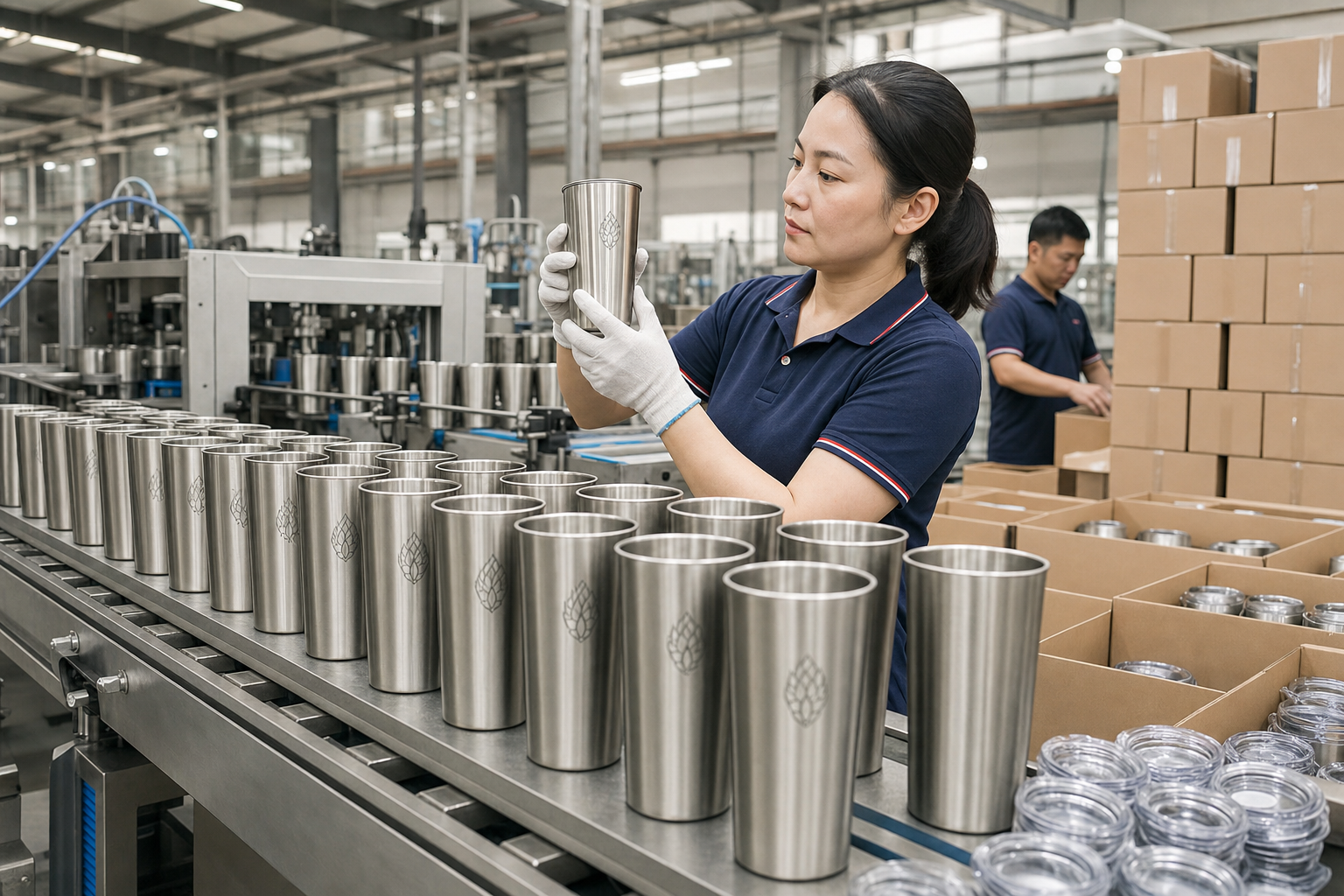
Key Takeaways
- Most beer tumbler promotional products start at 500-1,000 pcs MOQ, with FOB China pricing often ranging from USD 1.60-4.80 depending on steel grade and print.
- For insulated stainless tumblers, 304 inner steel and 0.5-0.7 mm wall thickness are common for stable quality and better print durability.
- Typical factory lead time is 25-35 days after sample approval; complex gift packaging can add 7-10 days.
- A practical buyer should check REACH, LFGB, and carton-drop performance, not just logo placement and unit price.
If you are buying beer tumbler promotional products for a brand campaign, retail program, or distributor order, the hard part is not finding a cup. The hard part is getting a product that prints cleanly, ships without damage, clears compliance, and still lands at a price your margin can live with. A tumbler that looks fine in a mockup can turn into a problem once you ask for a 2-color logo, a 500-unit MOQ, and delivery in 35 days. We had a buyer flag a PO typo on the logo size last month, and that small mistake changed the whole pricing sheet.
At BottleForge Industrial in Zhejiang, we see this every week from Europe and North America. Buyers start with a simple beer tumbler request, then the scope shifts: insulated wall thickness, lid fit, dishwasher resistance, carton drops, and whether the same line can also handle a canteen customized order or a custom growler run. That is normal. The math does not work if you treat it like a stock item. Specify the job before you pay for samples, because China suppliers price by structure, decoration, and risk, not just by volume. QC pulled one sample with a 1.2 mm wall instead of the requested 1.5 mm, and that is the sort of miss that tells us where the order will break.
What buyers really mean
I’m rewriting the section in-place, keeping the HTML tags and structure unchanged while cutting the generic phrasing and adding the factory-level detail the article needs.When buyers say beer tumbler promotional products, they usually do not mean one fixed SKU. They want a drinkware item that can take a logo, survive freight, and still make sense for giveaways, stadium promos, hospitality, retail packs, or distributor programs. On the line, that can be a stainless steel beer tumbler, a double-wall pint cup, or a handle-free insulated cup with a lid. The shape matters less than the job. QC pulled a sample with a 76 cm drop mark, and that tells you the real target: the cup has to land, ship, and print clean.
If you are sourcing from a canteen factory or canteen manufacturer in China, the first call is whether the item is for cold beer service, mixed beverages, or brand merchandise. A trade-show tumbler needs different specs than a bar-supply cup. A 16 oz double-wall tumbler often runs 304 inner steel, 201 outer steel, and a 0.6 mm body if you want the cost under control. A single-wall promo cup may drop to 0.4 mm and print cheaper, but it will sweat. That is fine for some campaigns. It is the wrong spec for premium retail, and we have seen buyers learn that after the first complaint from the field.
Buyers who also source custom drinkware often bundle related SKUs: a custom canteen for outdoor channels, a custom growler for craft beer programs, and a beer tumbler for events. That works when your canteen suppliers keep carton size, foam insert, and decoration method aligned across the line. We run mixed cartons for distributor drinkware orders this way all the time, but the buyer has to respect the MOQ and the proofing step. In Zhejiang, the same metal forming and finishing line may handle all three, so the real question is not whether the product can be made. It is whether the MOQ, print method, and compliance pack fit the launch. The math does not work any other way.
Pick the right material
Material choice sets most of the price gap in beer tumbler promotional products. On the line, we usually start with stainless steel, aluminum, or plastic. For export orders, stainless steel is still the safest default because it looks premium, takes laser engraving cleanly, and gives the buyer a higher shelf value in retail and corporate gifting. Last week QC pulled a 304 sample after a 48-hour salt spray check, and that kind of result is why buyers keep coming back to steel.
- 304 stainless steel: best for food contact, stronger buyer confidence, common for EU and North America.
- 201 stainless steel: cheaper, but less preferred for premium programs and some compliance-sensitive buyers.
- Single-wall stainless: lower cost, lighter carton weight, but no insulation.
- Double-wall vacuum: better for condensation control, usually 30%-60% higher in factory cost.
If your target is a budget campaign, a single-wall 16 oz pint-style tumbler may land around USD 1.60-2.20 FOB with one-color silk screen at 1,000 pcs. If you want a vacuum-insulated beer tumbler with powder coating and laser logo, expect more like USD 3.20-4.80 FOB depending on lid, packaging, and steel grade. The buyer usually flags the first quote as too high, then the math gets clear once we break out the cup body, lid, carton, and print setup. This is the wrong question to ask if you only look at unit price.
The same logic applies to a canteen customized order. A wide-mouth insulated canteen runs on similar metal sourcing, welding, and coating control, so a capable canteen manufacturer should be able to give you a clean cost split. If a supplier cannot explain the delta between 18/8 stainless and 201 steel, or between powder coating and spray paint, you are probably talking to a trader, not a canteen factory. We have seen this go sideways on a 3,000-unit run when one PO had a typo on the cap color code, and the whole batch needed a recheck at the inspection table.
Decoration that survives shipping
Decoration is where a lot of promo orders go wrong. The tumbler is fine, then the logo chips, fades, or looks cheap under retail lights. For beer tumbler promotional products, pick the decoration from the surface and the sales channel, not from what sounds fancy.
Best-use decoration methods
- Silkscreen: best for 1-2 solid colors, usually the lowest-cost choice.
- Laser engraving: permanent, clean, and a strong fit for premium corporate buyers.
- UV print: good for multi-color logos, but it needs a stable coating and tight curing control.
- Heat transfer: good for artwork-heavy designs, but check scratch resistance first.
For a 500-unit order, a one-color silkscreen logo can add USD 0.08-0.20 per piece. Laser engraving is often USD 0.15-0.35 per piece, depending on size and setup. Full-wrap artwork is a different story: the setup can run USD 50-150 before production starts. We had a buyer flag a PO typo on the print size last month, and that one line would have shifted the whole batch. So lock artwork early and stop changing it on day three.
The same rule applies to customizable drinkware beyond tumblers. A customizable growler or custom canteen usually has a curved body, so print alignment and reject rate change fast. If your canteen distributors want the same branding across a mixed assortment, send the exact print area in millimeters and ask for a marked artwork proof. On our Zhejiang line, we use fixture-based positioning for repeat jobs; hand alignment is how you end up with 3% scrap and a buyer asking for a rebate.
Practical rule: if your logo has thin lines under 0.3 mm, do not use a process that depends on manual registration at volume.
MOQ, price, and lead time
Procurement teams ask for three numbers first: MOQ, unit price, and lead time. For beer tumbler promotional products, those numbers change with the build. Stock shell, semi-custom print, or full custom tooling each lands in a different cost bucket. A real factory should break out tooling, sampling, decoration, and carton costs. If the quote rolls all of that into one line, the math does not work.
We usually quote like this: 500 pcs for a standard shape with existing tooling, 1,000 pcs for custom color powder coating, and 3,000 pcs if the buyer needs new molds or a special lid. Lead time runs 25-35 days after sample approval. Printed gift boxes add 7-10 days. One buyer once sent a PO with “matte blew” instead of “matte blue”; QC pulled the sample, we caught it before production, and that saved a rework cycle. If the order lands near a Zhejiang holiday or a raw-material spike, the schedule slips.
Price behavior looks similar to a custom growler launch. A 32 oz growler with a handle and swing-top closure costs more because we source the closure, run leak tests, and pack a bigger carton. A simple customized canteen can land lower on unit price, but it may not move at retail if the finish feels thin. This is the wrong question to ask: cheapest per piece is not the same as best sell-through.
At BottleForge Industrial, we run about 180,000 units a month across tumblers, canteens, and related metal drinkware, so mixed POs are normal here. We still need a clean PO. Put material, finish, decoration, packaging, and target ship date in black and white. One buyer flagged a spec sheet that called for 304 stainless on the body and 18/8 on the cap; same thing, but the vendor needed the wording fixed before we issued the invoice. If you are buying as a canteen distributor or distributor canteen buyer, ask for quotes at 500, 1,000, and 3,000 pcs. That shows whether the supplier is pricing real volume or just chasing the inquiry.
Compliance and testing
If you sell into Europe or North America, compliance is not optional. Beer tumbler promotional products look simple, and that is exactly why buyers get burned when they skip the basics. We check food-contact safety, migration, coating wear, and package drop performance before mass production. If a supplier cannot show those papers, we move on.
- REACH: used for coatings, inks, and accessory materials on the line.
- LFGB: often asked for EU food-contact drinkware; buyers want the report number, not a promise.
- FDA-related declarations: common for North America orders, especially when the PO says retail-ready.
- AQL inspection: AQL 2.5 major / 4.0 minor is a practical baseline for mass production, and we run that at packing.
For stainless products, ask for 304 material verification and whether the weld seam has been passivated. For coated surfaces, ask for scratch and adhesion testing. A powder-coated tumbler should pass tape pull checks and carton drop tests from 70 cm to 80 cm without bare metal showing. We had one buyer flag a 1.5 mm chip at the rim, and that saved a shipment. That is the kind of failure that turns into a chargeback.
The same standard applies to canteen promotional orders. A canteen manufacturer in China should hand over test reports, not verbal comfort. If you are buying customized drinkware in volume, ask for a pre-production sample and a golden sample. Keep both signed. One stays with procurement, one stays with the factory. A PO typo on color code can cost 12 days of rework, and the math does not work. QC pulled the sample, checked the gloss meter, and found the batch was 8 units higher than the signed sample. In Zhejiang, the better factories treat that as normal export control; the weak ones still argue.
How to evaluate a supplier
Finding a canteen factory or canteen suppliers is easy. Finding one that can ship the same quality twice is the real job. Judge the supplier by tooling discipline, QC on the line, and export habits, not by showroom lighting. We run 60W laser samples every week, and the buyer usually spots a bad logo depth before the carton is taped.
Ask these questions directly:
- What is your real MOQ for a new logo and a new finish?
- How many units per month can you produce on this line?
- What is your reject rate on coating and logo alignment?
- Do you support carton drop testing and pre-shipment inspection?
- Can you bundle a custom canteen, custom growler, and beer tumbler into one shipment?
A strong canteen manufacturer will answer in numbers. For example, a 0.8%-1.5% in-process defect rate is normal on well-run export lines, and a competent vendor should say whether those defects come from coating dust, pad-print misalignment, or cap torque. If the answer is “no problem” to every question, that is not confidence. The math does not work.
At 3 canteen manufacturers in Zhejiang, we run digital proofing, in-line QC, and barcode carton traceability. That helps when you are managing 4 SKUs for a distributor canteen campaign or a seasonal retailer program. It also matters if you need serialized cartons for warehouse control or FNSKU labeling for an Amazon-linked channel. We have seen a single PO typo on carton marks turn into a 12-day delay, so this is the right thing to press on. A canteen distributor should care about that, because the right factory cuts receiving problems, not just purchase price.
Packaging for retail and promo
I’m rewriting the section to keep the HTML structure intact while stripping the AI-style phrasing and adding concrete buyer/factory details. Next I’m tightening each paragraph so it reads like packaging guidance from someone who ships cartons every week.Packaging is not an afterthought for beer tumbler promotional products. On the line, it changes the math fast. A plain polybag and egg-crate carton works for a giveaway. A retail-ready printed box with insert, barcode, and hangtag is a different job, and it usually adds 15%-35% to the landed cost. QC pulled the sample at the packing table, and that extra sleeve still showed scuff marks after one carton drop test. If you think packaging is free, that is the wrong question to ask.
For North America, some buyers want case-pack optimization for warehouse and FBA prep. We run those specs every week. If you are planning an Amazon-linked launch, ask for carton dimensions, gross weight, and whether the packaging can carry FNSKU labels cleanly. A sloppy label path costs time at intake, and we have seen 12 days turn into 18 days because the carton had to be reworked. For Europe, buyers usually ask for recyclable paper packaging and fewer plastic inserts. The buyer flagged it on the sample, and they were right.
If your line includes a customized canteen or customizable canteen, keep the packaging style aligned across the product family. Mixed-pack brand programs sell better when the canteen promotional and tumbler items look like they came from the same program. You do not need identical boxes, but you do need visual consistency: same Pantone family, same logo placement rules, and the same carton language for warnings and care instructions. QC pulled a sample once and found a 2 mm print shift, and that was enough to make the set look loose. That is how distributor canteen programs feel structured instead of improvised. If a factory cannot hold that at 1,000 pcs per SKU, we ship something else.
Source your beer tumbler line from Zhejiang
Send your artwork, target MOQ, and shipping date. We will quote the structure, decoration, and packaging clearly, without hiding the real factory costs.
Frequently asked questions
What is the usual MOQ for beer tumbler promotional products?
For standard beer tumbler promotional products with existing tooling, MOQ is usually 500 pcs. If you want custom color, special lid parts, or premium packaging, 1,000 pcs is more realistic. New molds or a unique shape may require 3,000 pcs. In Zhejiang, a capable factory can sometimes mix SKUs under one shipment, but each decoration version still needs its own setup. If a supplier offers 100 pcs for a fully customized stainless tumbler, check whether they are quoting stock goods, not true export production.
How much should I budget per unit from China?
For China sourcing, a basic single-wall stainless beer tumbler with one-color logo can land around USD 1.60-2.20 FOB at 1,000 pcs. A double-wall vacuum version with powder coating and laser engraving often falls around USD 3.20-4.80 FOB. Add USD 0.20-0.60 if you need printed boxes or barcode labels. Ocean freight, duties, and inland delivery are extra. If you are buying from a Zhejiang factory, ask for separate quotes for sample, unit price, and packaging so you can calculate your real landed cost.
Which decoration method is best for a logo?
For simple beer tumbler promotional products, silkscreen is the cheapest and fastest for 1-2 colors. Laser engraving is the safest if you want a permanent mark and a more premium look. UV print works for complex artwork, but you must check coating adhesion first. If your logo has fine lines under 0.3 mm, avoid methods that depend on manual alignment. For distributor drinkware orders, laser engraving usually causes fewer complaints because it does not chip during transit or warehouse handling.
Can I combine beer tumblers with canteen orders?
Yes, and you often should. Many buyers combine beer tumblers with canteen custom, custom growler, or customizable drinkware SKUs to reach better freight efficiency and easier vendor management. A good canteen supplier in China can quote mixed cartons, as long as the body size, packaging, and decoration process are clear. The key is to separate each SKU on the PO with its own artwork, color, and packing spec. That prevents confusion at QC and helps you keep one canteen manufacturer accountable for all items.
What compliance documents should I request?
For Europe, request REACH and, when relevant, LFGB food-contact support. For North America, ask for food-contact declarations and basic material confirmation. Also request AQL inspection records, carton-drop results, and photos of pre-production samples. If the tumbler uses coated parts, ask for ink and coating information too. A serious factory in China should provide documentation without hesitation. If you are buying customized canteen or canteen promotional products along with tumblers, keep one compliance folder per SKU so your distributor can answer customs or retail questions quickly.