Key Takeaways
- A realistic starter MOQ for a simple beer tumbler promotional order is 1,000 pcs per SKU, with 25-35 days after sample approval.
- 304 stainless, 0.5 mm wall thickness, and a 60-80 micron powder coat are the practical baseline for export drinkware.
- Laser engraving is best for permanence; silkscreen works when you need color and lower setup cost.
- For Europe and North America, ask for REACH, food-contact paperwork, AQL 2.5 inspection, and carton labels before you pay a deposit.
Beer tumbler promotional orders look easy until the sample lands with a 0.5 mm wall that feels flimsy, print that scuffs off after a few washes, and retail packing that the distributor rejects on sight. We run into this all the time. QC pulled the sample, checked lid fit with a caliper, and the buyer flagged the same issue we did: a promo tumbler that cannot hold up in a cold chain is dead stock, not a marketing tool.
For buyers in Europe and North America, the job is to turn a plain cup into a controlled custom drinkware program with clear specs, a realistic MOQ, and lead time the line can actually hold. A serious factory in Zhejiang should quote by 304 stainless, finish, and carton pack, not by a logo mockup, and if the PO says "12,000" but the packing list says "12000 pcs" with the wrong lid code, the math does not work. We have seen this go sideways before.
What Makes a Promo Tumbler Work
Most beer tumbler promotional orders fail for one reason: the buyer treats the tumbler as a print panel, not a cup that gets rinsed, dropped, and carried around all day. If the wall is too thin, the shell rings and flexes under hot-fill testing; if the rim has a burr, users catch it on the first sip; if the lid drips, the giveaway goes straight to the trash. We saw this on a 500-piece brewery order last month—the buyer wanted the logo bigger, QC pulled the sample, and the leak test still failed at 45° tilt. For breweries, bars, sports events, and distributor programs, promo value only works when the cup feels like a product.
Start with the use case. A 12 oz stackable beer tumbler for tasting trays has different needs from a 20 oz insulated cup for festival retail. The first can run lighter and simpler. The second needs tighter thermal retention, stronger powder coat adhesion, and enough flat area for a logo without crowding the seam. Same story on custom canteen or canteen promotional orders: set volume, grip, lid, and decoration first, then ask for a price. Otherwise the quote is a guess. We had a buyer send a PO with “16oz” typed as “16 ozs,” and the line had to stop while we checked whether they meant stackable or insulated; that kind of typo changes the tooling and the carton count.
- 12 oz for tasting and taproom giveaways
- 16 oz for the broadest retail and promo use
- 20 oz for premium insulated programs
Ask for a production sample with the exact steel, lid, and print method you plan to ship. A white sample and a production sample are not the same product. We run that check with a caliper and a lid-fit gauge before mass production.
Materials, Wall Thickness, and Finish
For export buyers, 304 stainless steel is the safe default. We quote 304, 201, or 18/8 on the line here in Zhejiang, but 201 only makes sense when the buyer accepts a shorter service life and a weaker corrosion story. For North America and Europe, 304 with a food-contact declaration keeps the paperwork clean.
Wall thickness is where catalogs get sloppy. A vacuum beer tumbler usually runs 0.5 mm for both inner and outer shells; 0.4 mm cuts cost but feels tinny in hand, while 0.6 mm gives better stiffness and dent resistance at a higher unit price. Powder coating usually lands at 60 to 80 microns, and the rim polish should leave zero sharp edge. QC pulled one sample last month with a 0.3 mm burr at the lip, and the buyer flagged it immediately. If the lid is transparent, specify BPA-free material, gasket hardness, and whether it is press-fit or threaded. That spec sheet is the difference between a return and a repeat order.
For beer, mouthfeel matters. A wide mouth with a thin rolled rim reads closer to glassware; a narrower mouth and insulated wall leans more toward utility. If you are buying for a canteen distributor or growler program, keep the same steel grade and coating system across sizes so the SKU family looks deliberate, not patched together. One PO typo on the finish code can throw the whole batch off, and we have seen that go sideways.
Decoration Methods That Hold Up
The logo method has to fit the buyer’s use case. A one-off expo order can run pad print or a single-color silkscreen and still make sense. If the beer tumbler promotional piece is going into retail or getting sent through dishwasher cycles, laser engraving or a baked-on print is the safer call. We’ve seen a 0.2 mm ink build look fine on day one, then turn patchy after two washes.
Laser engraving works when the buyer wants a permanent mark with no color at all. Silkscreen is better for strong brand colors and larger solid areas, but QC will check cure temperature, abrasion resistance, and whether the logo still passes repeated hand-wash tests. For metallic looks, some canteen customized and customized canteen orders use powder coat plus a laser reveal, so you get contrast without stacking on another ink layer. That setup saved us on one 500 pcs run when the buyer flagged color fade on the proof.
- Choose laser for durability and low-maintenance branding.
- Choose silkscreen for multi-color logos and lower setup costs.
- Choose 360-degree wrap print only when the artwork and MOQ justify the tooling and labor.
If you want a clean process, line up the decoration method with the artwork file, carton layout, and selling channel before approval. This is the right question to ask, not “can we print it somehow.” A canteen manufacturer can convert the proof into production fast, but one wrong AI file or a PO typo on logo placement turns into a new round of samples on the line.
MOQ, Lead Time, and QC
Ask for numbers before you talk artwork. A Zhejiang factory that ships drinkware should put MOQ, lead time, and monthly output in the same email. For a plain beer tumbler promotional order, we usually see 1,000 pieces per SKU with one logo and one finish. Add a magnetic lid, two colors, or gift box packing, and the MOQ moves to 3,000 pieces. On a steady line, 25 to 35 days after sample approval is normal. If the plant says 300,000 units a month, that is enough room for repeat orders without crowding the line. If they dodge the numbers, the math does not work.
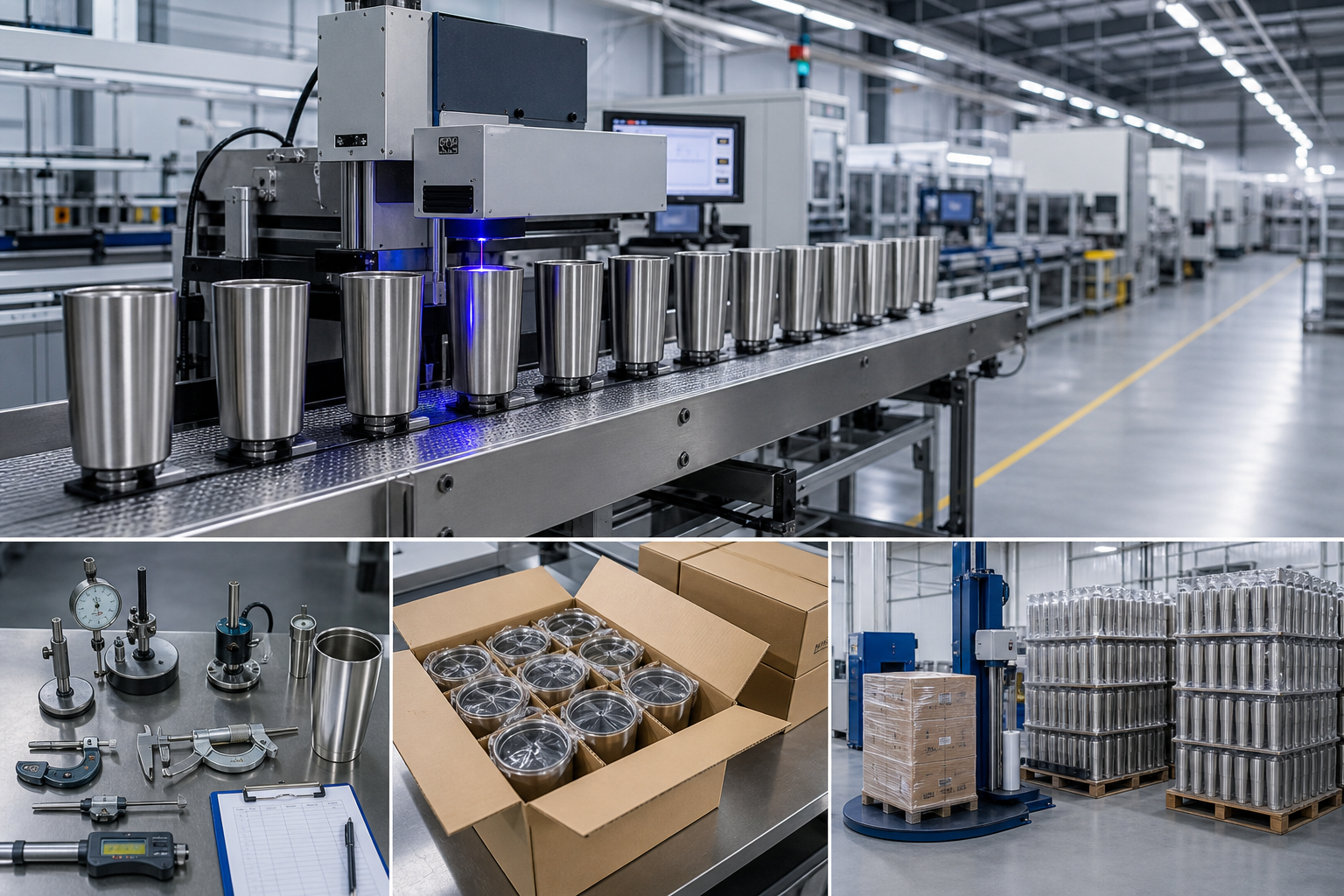
Do not sign off on a sample until QC pulled the sample and measured it. Check cup height, diameter, lid fit, coating thickness, logo placement, and carton count with a caliper and a 0.2 mm feeler gauge. Ask for pre-production photos, then hold one production lot to AQL 2.5 for major defects and AQL 4.0 for minor ones if your QA team uses that standard. Leak testing, a 1.2 m drop test, and a dishwasher abrasion check cost less than one freight claim. We have seen this go sideways from a lid that sat 1.5 mm high.
The cheapest order is the one that does not trigger a chargeback, relabel, or replacement shipment.
For distributor canteen and distributor drinkware buyers, a factory that will not state its actual output or inspection routine is a risk, not a partner. Ask for the packing table count, the last inspection report, and the PO line that shows the carton qty; a plant that ships 20,000 pieces a day can answer in minutes. If they start talking around the question, walk. We have seen buyers lose two weeks on a typo in the PO and a missed lid spec.
Compliance and Packaging for Export
Compliance is not paperwork theater. For Europe, we check REACH status, LFGB where it applies, and a food-contact declaration that names the coating, steel, and lid. On the line, QC pulled a sample with a 0.3 mm lid gap last week, and that kind of miss is what gets a carton stopped at customs. For North America, keep the material spec, test report, and country-of-origin mark clean. If you are selling through retail or Amazon, packaging matters as much as the tumbler itself: barcode placement, carton strength, and master carton count all hit margin. This is not the place to improvise.
If the program is channel-driven, lock packaging before production starts. A beer tumbler promotional pack can run in a simple kraft box, but a club-store or e-commerce set needs an inner tray, barcode, and FNSKU label. We shipped one 24-pack to a U.S. warehouse where the carton was 2 mm too tall, and the dimensional weight pushed freight up on a 40HQ. A 2 mm change can cost more than a 3 cent print upgrade. The buyer flagged it after the PO had a pack-out typo, and the rework wiped out the first week of margin.
BSCI and ISO 9001 tell you the factory has a system, not that every carton passed. Ask whether the same line can handle custom growler, customizable growler, or customized growler builds, because mixed materials slow cleaning and packing. We run 304 stainless and powder-coated bodies through different bins; if the magnet test and foam sleeve count are not separated, QC will catch it late. The right canteen supplier will tell you what is shared, what is dedicated, and where the risk sits. We have seen this go sideways on a 5000 pcs order, so this is the wrong question to ask after production starts.
How Beer Tumblers Fit the Range
The best buyers think in families, not one-off items. If you already source custom drinkware, you can line up steel grades, lid styles, and carton specs across beer tumblers, custom canteen, canteen custom, customizable canteen, and customized canteen programs. We run the same 18/8 spec across several SKUs when the buyer wants fewer moving parts. That keeps tooling, color match, and packing under control.
This is where distributor relationships matter. A canteen distributor or canteen distributors network usually wants one factory to handle the same base platform in multiple sizes: beer tumbler promotional units for events, custom canteen units for clubs, and custom growler or customizable drinkware orders for retail packs. If the line in Zhejiang can do silkscreen, laser, and retail boxing without changing the carton size every time, the buyer cuts SKU confusion fast. QC pulled a sample last week with a 2 mm print shift, and the buyer flagged it before shipping.
The practical rule is simple: pick one base spec, one or two decoration methods, and one packaging standard. That is how a canteen promotional line stays profitable after the first shipment. We saw a PO last month with a typo on the lid code, and the math did not work once the cartons were already printed. Keep the spec tight, or the order turns into a custom problem every quarter.
Send Your Spec, Get A Real Quote
Share volume, artwork, and packaging needs. We can price your beer tumbler promotional run, confirm MOQ, and sample the decoration fast.
Frequently asked questions
What MOQ should I expect for a beer tumbler promotional order?
For a standard 304 stainless beer tumbler promotional order, 1,000 pcs per SKU is a realistic starting point if you keep one logo, one finish, and standard packaging. If you want mixed colors, gift boxes, or a special lid, 3,000 pcs is more common. Samples usually take 5 to 7 days, then production runs 25 to 35 days after approval. If a supplier promises 200 pcs with custom packaging and fast delivery, check whether they are quoting stock goods rather than true custom production. In Zhejiang, China, a factory with real output should state MOQ, lead time, and monthly capacity clearly.
Is laser engraving better than silkscreen for beer tumblers?
It depends on the channel. Laser engraving is the safer choice if you want a permanent, dishwasher-resistant mark with no ink to wear off. Silkscreen is better when the logo needs brand color, larger filled areas, or lower setup cost. For promotional use, a single-color silkscreen logo can be fine, but confirm cure temperature and abrasion testing. If the tumbler is going into retail or repeat-use hospitality, laser often performs better over time. For a beer tumbler promotional program, I would not choose decoration first and product later; I would match the print method to the selling life of the cup.
Can one tumbler work for beer, coffee, and cold drinks?
Yes, but only if the structure matches the use case. A 304 stainless insulated tumbler with a BPA-free lid can handle beer, iced coffee, and soft drinks. The details matter: a wider mouth and thin rim feel more natural for beer, while a tighter lid and better spill resistance help with coffee. If your customer will use the cup mainly for beer, do not over-spec the seal and make the drinking experience awkward. If you want one SKU across multiple channels, ask for a lid family that fits the same shell size. That keeps custom drinkware, customized drinkware, and distributor drinkware programs easier to manage.
What compliance documents should I ask for from a China factory?
For Europe, ask for REACH-related material statements and LFGB if the product or coating requires it. For North America, ask for a food-contact declaration, material specs for steel and lid, and any test reports you need for your sales channel. If you sell on Amazon or to a warehouse distributor, also confirm FNSKU labeling, country-of-origin marking, and carton packing data. BSCI and ISO 9001 are useful signals about factory management, but they do not replace product testing. A serious Zhejiang factory in China should be able to show you what was tested, by whom, and under which standard before you place the order.
How do I keep freight and landed cost under control?
Start with the carton. A 2 mm change in box height can shift dimensional weight enough to change your freight bill. Next, standardize the base cup, lid, and inner pack so you are not paying for unique packaging on every SKU. FOB Ningbo or another Zhejiang port is often cleaner if you have a freight forwarder who knows your lane. If you are shipping to a U.S. warehouse, check whether FNSKU, master carton count, and pallet build are already aligned before production. The fastest way to lose margin on a custom canteen or beer tumbler order is to optimize the unit price and ignore the packaging math.