Key Takeaways
- A practical beer tumbler supplier should quote MOQ, lead time, and unit price together; on 5,000 pcs, FOB China often starts around USD 1.20 to 3.80 depending on material and finish.
- For stainless beer tumblers, specify 18/8 steel, 0.5-0.7 mm wall thickness, and REACH-compliant coatings before you approve samples.
- Export buyers should request AQL 2.5 inspection, carton drop test results, and lid leak testing for every custom drinkware PO.
- If you also source canteen custom or custom growler items, confirm whether the same canteen manufacturer can support laser engraving, silk screen, and matte powder coating at scale.
If you are sourcing from a beer tumbler supplier, the first trap is thinking every factory can handle retail-grade custom drinkware. They cannot. Some can print a logo, then miss the basics: condensation control, lid fit, coating durability, and export packaging. We have seen 0.3 mm wall thickness drift turn into a bad batch, and that turns into claims, chargebacks, and dead stock fast.
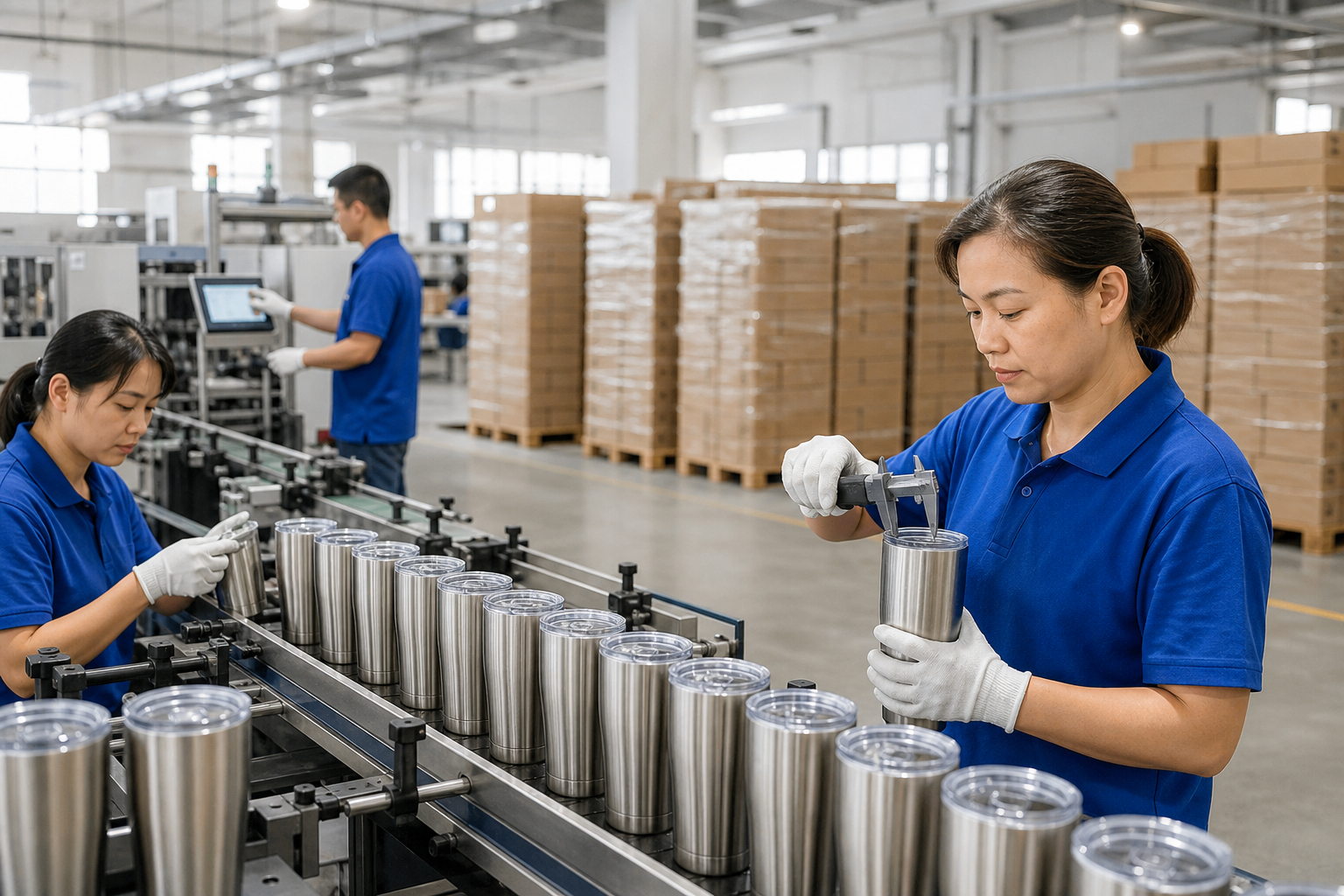
Buy it like an engineering job, not a catalog order. Ask for wall thickness, steel grade, testing records, and actual line capacity. A serious canteen factory in Zhejiang will tell you the MOQ, lead time, and defect limits up front. At BottleForge Industrial in Hangzhou, we run 300,000 units per month with standard lead times of 25 to 35 days after sample approval. QC pulled the sample, checked the lid seal with a 2 kg pressure test, and that is the level of detail you should expect from any beer tumbler supplier in China.
What a beer tumbler supplier should prove
Skip the product photos for a minute and ask the beer tumbler supplier to prove the basics. Show me material specs, line flow, and test sheets, not a polished sales PDF. For stainless drinkware, 304/18-8 is the floor for food-contact use. If they quote 201 steel, fine for some promo runs, but the math changes on corrosion and how the finish looks after 6 months of washing. For insulated cups, ask for the vacuum leak rate, weld check, and the results after 24 hours at 4°C and 95°C cycles. We’ve seen a buyer flag a seam leak after the first carton landed.
The gap between a trading desk and a real factory shows up fast in the shop floor details. A factory can tell you whether the cup body is drawn in 2 stages or 3, whether the lid gasket is silicone or TPE, and how many QC points run per line. At BottleForge in Zhejiang, we check incoming steel, in-process dimensions, and final pack-out before export. Basic? Yes. Cheap to skip? Also yes. I’ve seen a PO typo on the lid color code turn into a whole week of rework. If you buy for a distributor network, that missing check will come back as uneven wall thickness or a loose lid fit.
- Ask for steel grade: 304/18-8 for premium orders, 201 only when the buyer is chasing the lowest landed cost.
- Ask for wall thickness: 0.5 mm is standard, 0.6-0.7 mm gives a heavier hand feel.
- Ask for inspection standard: AQL 2.5 is a solid export baseline.
- Ask for compliance: REACH, LFGB, and FDA reports where relevant.
Materials and finishes that sell
Beer tumblers are not sold on capacity alone. Retail buyers and bar buyers check the hand feel, cup weight, cold retention, and how the finish holds up after 50 wash cycles. A polished cup can still look cheap if the rim leaves a burr. We have seen QC reject that at 0.3 mm, and the buyer flagged it before the cartons even left the line. A matte powder-coated model can read premium, but only when the coating thickness stays under control. For a customizable drinkware program, the finish often carries as much weight as the print method.
Most B2B orders land in three workable builds. Single-wall stainless is lighter and cheaper, so we run it for outdoor events, distributor drinkware, and canteen promo programs. Double-wall vacuum models cost more, usually adding USD 0.80 to 2.20 per piece at export quantities, but they keep beer cold longer and cut sweating on the table. Glass beer tumblers still come up from some canteen distributors, but they need stronger cartons and tighter breakage control; a 2% damage claim wipes out the margin fast. If you are building a custom canteen or customized growler line alongside beer tumblers, standardize lids, carton sizes, and decoration zones. That cuts tooling and freight headaches. The wrong question is which product looks nicest in a catalog. In Zhejiang, the repeat buyers go back to the factory that can keep one body family moving across custom drinkware categories, not the shop chasing one-off drawings.
Finish choices that usually make sense
Brushed steel: practical, hides scratches, good for distributor canteen programs.
Powder coat: strong retail look, useful for customized canteen or canteen customizable ranges.
Clear coat over print: better for logos that must survive repeated handling.
Mirror polish: lower cost, but fingerprints show fast and can raise complaint rates.
MOQ, price, and lead time reality
Do not let anyone dodge the commercial basics. A serious beer tumbler supplier puts MOQ, production time, and payment terms on the table before sample approval closes. On our line, a plain 18 oz stainless tumbler usually starts at 3,000 to 5,000 pcs per design. Once you move to a double-wall model with a custom lid and printed gift box, 5,000 to 10,000 pcs is the normal ask. If someone offers 500 pcs with full customization, ask where the stock body is coming from. We have seen that story end with a canteen item and a fake logo plate.
At ex-works or FOB China pricing, a plain single-wall tumbler may land around USD 0.95 to 1.80 at 5,000 pcs, while an insulated model with powder coat and laser logo can sit in the USD 2.40 to 4.20 range depending on size and lid. Add another USD 0.15 to 0.60 for color box or mailer packaging. Lead time is usually 25 to 35 days after sample sign-off for standard configurations, and 40 to 50 days for new molds or special lids. On a real job, the buyer flagged a 12 mm lid thread mismatch on the first preproduction sample, and that alone pushed shipment back 4 days. Zhejiang factories with stable export systems do not promise a 15-day turnaround on a fully custom order. The math does not work, and rushed jobs usually crack coating on the spray line or throw off pack counts at the carton station.
For distributor drinkware, the cheapest unit price is often the most expensive mistake once you factor in rejects, freight damage, and unsold inventory. QC pulled three dented cups after the 1.2 m drop test, and the carton corners were still soft from the packing room. That is the wrong place to cut cost.
If you need to supply canteen distributors or a retail chain, ask the supplier to quote both FOB Ningbo and DDP options so you can compare landed cost properly. We once caught a PO typo that changed 6,000 pcs to 600 pcs, and the factory only spotted it when the sales order hit the packing list. Get both numbers in writing. Then compare the real landed cost, not the sticker price.
Decoration methods for beer branding
Your logo method changes the look and the scrap rate. For a beer tumbler supplier, decoration is part of the product, not a side service. Silk screen works for one-color logos and 5,000-piece runs. Laser engraving gives a clean permanent mark on stainless steel, and we usually steer premium distributor canteen programs to that side. Heat transfer and UV print handle full-color graphics, but we always check scratch resistance before you sign off. One bad print lot can sink the whole order.
For custom drinkware, the right method depends on who is buying. Bar and hospitality buyers usually ask for understated engraving. Promotional buyers want a canteen promotional look with bold color and unit cost under control. Retail buyers want a more finished canteen customizable look with a matte body, spot gloss, or wrap print. If you are also sourcing custom canteen, customized canteen, or custom growler items, keep the decoration spec locked across SKUs so the brand color and logo size do not drift. We had one PO where the buyer flagged a 2 mm logo shift on the second SKU. Ask for a pre-production sample and a 48-hour dishwasher test. If the print dulls after a few cycles, reject it before mass production. A canteen manufacturer worth using will have samples from exports to Europe and North America, and they should show which inks are REACH compliant.
Testing, compliance, and claim control
Beer tumblers cross borders, so compliance is a gate, not a nice-to-have. For Europe, ask for REACH paperwork and, where needed, LFGB or a food-contact test report from the same batch. For North America, we ship with FDA material declarations and third-party lab reports when the buyer asks. If a beer tumbler supplier cannot say which resin, coating, or silicone part the report covers, stop there. We saw a buyer flag a 2-year-old PDF because the actual lid compound changed on line 3.
QC has to go past a quick look. A solid canteen factory should run vacuum retention, lid leakage, coating adhesion, drop resistance, and carton compression tests. For export cartons, 90 cm drop tests on corners and edges are a fair base line. For lids and straws, we test inversion and pressure, because that is where weak parts show up. AQL 2.5 for major defects and AQL 4.0 for minor defects works well on retail orders. This is the wrong question to ask: "Does it look fine?" Ask what failed, on which lot, and who signed off. In Zhejiang, the better factories keep a lot code on the carton and often on the cup base, which saves a lot of back-and-forth after shipment. QC pulled the sample, measured the lid gap at 0.8 mm, and found the issue before the pallet left the floor.
- Request batch traceability by production date and line; we run it by shift number too.
- Confirm packaging ISTA-style drop resistance for e-commerce shipments.
- Check that inks, coatings, and silicone parts have matching compliance files; one missing silicone report can kill the PO.
- Store one golden sample signed by both sides before mass production.
Sourcing from China without surprises
Buying from China is still the practical route for most B2B drinkware programs, if you keep control of the process. A good beer tumbler supplier in China should work like a factory partner, not a catalog broker. Ask who owns the mold, whether the cups run in-house or get subcontracted, and how many lines are live. We once saw a PO typo turn “304 stainless” into “304S”; QC pulled the sample, and the buyer flagged it before packing. If the same plant also runs canteen custom, customizable canteen, customizable growler, or customized drinkware ranges, that is fine. The real question is whether they hold spec drift under 0.3 mm across those SKUs.
In Hangzhou and the wider Zhejiang manufacturing belt, a serious canteen manufacturer or canteen suppliers network usually has separate teams for engineering, sales, and export docs. That matters when you need OEM drawings, carton marks, FNSKU labels for Amazon FBA, or a mixed container with three colorways. Ask if the factory supports mixed-model loading at carton level; on a 40HQ, that can save freight when you build distributor drinkware assortments. If a canteen vendor says they can do everything, ask for samples, test reports, and production photos. We’ve seen that line go sideways fast. The good factories answer in hours, quote cleanly, and tell you straight when tooling needs 7 to 10 days. That is the gap between a real canteen distributor partner and a reseller with a polished site.
How to place a safer first order
For a first order, keep the scope tight. Run one body style, one logo method, and one packaging spec. Three sizes, two finishes, and custom inserts on day one is the wrong question to ask; you are testing the supplier, the carton plant, and your own forecast at the same time. We usually tell buyers to start with 3,000 pcs of one stainless beer tumbler model and one engraving position. On the line, that means one laser jig, one 0.2 mm placement check, and a packing setup QC can actually hold. It gives you enough volume to read demand without filling the warehouse.
Put the deal in a purchase order that names tolerance, defect categories, and replacement rules. Spell out the Pantone code, logo size, and placement coordinates, or expect a fight when the buyer flags a 1.5 mm shift. We've seen a PO typo turn a carton mark into the wrong count on the first sample sheet, and that costs a week. If you need a custom canteen or distributor growler later, build it from the same supplier after the first order passes inspection. That lets you compare output from the same canteen suppliers team instead of learning a new factory every round. A disciplined beer tumbler supplier will accept that kind of paperwork because it keeps the line honest. The weaker ones push back because their process is loose. In China, especially in Zhejiang, the factories that last through export season are the ones that can follow a tight spec and still ship on schedule.
Source your beer tumblers with fewer surprises
Send your spec, target MOQ, and logo file. We will quote the right build, test it, and keep the export process clean from Zhejiang.
Frequently asked questions
What MOQ should I expect from a beer tumbler supplier?
For standard stainless beer tumblers, expect 3,000 to 5,000 pcs per design. If you want vacuum insulation, custom packaging, or a new lid, 5,000 to 10,000 pcs is more realistic. Some canteen suppliers will quote 500 to 1,000 pcs, but that is usually stock-based customization, not true OEM. For distributor drinkware programs, a higher MOQ often gives you a better FOB price and more stable decoration quality.
What is a fair FOB price for custom beer tumblers from China?
At 5,000 pcs, a plain single-wall tumbler may be around USD 0.95 to 1.80 FOB China. An insulated model with powder coating and laser logo is often USD 2.40 to 4.20, depending on size, lid, and packaging. If a beer tumbler supplier quotes much lower than that, check the steel grade, coating, and carton spec. Zhejiang factories with real export volume usually price more consistently than trading-only canteen vendors.
Can I combine beer tumblers with canteen custom products in one order?
Yes, if the factory is a true canteen manufacturer with stable production lines and export packing systems. Many buyers mix beer tumblers with custom canteen, customizable canteen, or custom growler items to improve container utilization. The key is to confirm whether the same supplier controls mold tooling, decoration, and final inspection. If not, you may save on unit price but lose control of lead time and defect rates.
Which decoration method lasts longest on stainless drinkware?
Laser engraving is usually the most durable because it removes the surface layer and does not depend on ink adhesion. For a beer tumbler supplier, that makes engraving a strong choice for premium custom drinkware. Silk screen can still be fine for one-color logos, but you should test it after at least 50 dishwasher cycles. Powder coat with laser reveal is another durable option for canteen promotional orders and retail sets.
What quality checks should I require before shipment?
Ask for AQL 2.5 final inspection, leak testing, lid fit checks, and carton drop tests. For insulated tumblers, confirm vacuum performance and coating adhesion. For Europe, request REACH-related material documents; for North America, ask for food-contact declarations and any relevant third-party test reports. A good beer tumbler supplier in Zhejiang will also provide lot traceability, signed golden samples, and pre-shipment photos before the container leaves China.