Key Takeaways
- A realistic MOQ for a custom beer tumbler is usually 1,000 pcs, while laser logo jobs can sometimes start at 500 pcs.
- Most stainless beer tumblers use 304 inner steel with 0.5 mm to 0.7 mm wall thickness; the coating and lid often decide the final price, not the cup body.
- FOB China pricing for a basic 16 oz customized drinkware item often falls around USD 1.80 to 4.20, depending on finish, lid, and packaging.
- For Europe and North America, ask for REACH, LFGB or FDA-related food-contact documentation, AQL inspection terms, and carton-drop test data before shipment.
If you are sourcing from a beer tumbler vendor, the first mistake is treating every cup as the same commodity. A 16 oz stainless beer tumbler, a custom growler, and a canteen for promotions behave differently on the line: wall thickness, lid fit, print area, and carton count all change the cost. We have seen buyers push back on a quote because the artwork looked the same on paper, then the 0.8 mm rim and the wider base changed the packing rate. That is where FOB pricing from Zhejiang starts to separate fast.
You need more than a low unit price. You need a canteen manufacturer or beer tumbler vendor that can hold tolerances, pass REACH and food-contact checks, and ship on time. In our Hangzhou factory, we run over 500,000 units per month, with a standard MOQ from 1,000 pcs for most printed drinkware and 30 to 45 days lead time after sample approval. QC pulled the sample, checked the lid gap with a 0.2 mm gauge, and cleared it before production moved. That is the level of control you should expect before you place a real order.
What a beer tumbler vendor should prove
Any beer tumbler vendor can send a catalog and a low price. The real test is control. Can they hold the parts that hit your margin and your complaint rate? For stainless beer tumblers, we check body material, lid fit, surface finish, insulation performance, and packing efficiency. If you buy for retail, a distributor program, or private label, you are not buying metal alone. You are buying repeatability.
Start with the metal spec. A serious canteen factory in Zhejiang should tell you whether the inner wall is 304 or 316 stainless steel, whether the outer wall is 201 or 304, and what the gauge is. For a standard vacuum beer tumbler, 0.5 mm inner wall is common; 0.4 mm is cheaper but dents faster and takes more abuse in transit. We run a feeler gauge on the line, and QC pulled one sample that failed at the weld seam after 100% fill testing. Ask for vacuum retention after 24 hours at room temperature, not just a pretty spec sheet. If a vendor cannot answer that, they are a packaging agent.
Decoration matters as much as the cup body. Screen print, laser engraving, and full-wrap UV all have different limits. A canteen customizable program with two-color print may look fine on a white sample, then miss on a dark powder coat because the contrast drops. We had a buyer flag a PO typo once: logo width written as 8 cm instead of 80 mm, and the whole carton label had to be reworked. If you are planning canteen promotional campaigns, ask for logo size in millimeters, print tolerance, and placement distance from the seam. The factories that ship export orders speak in numbers, not adjectives.
Buy the process, not just the sample. If the sample looks perfect but the vendor cannot repeat it across 5,000 pcs, you do not have a supplier yet.
Materials, lids, and wall thickness
Material choice decides whether your beer tumbler vendor quote is real or just a nice-looking number. A double-wall stainless steel tumbler with a PP lid and silicone gasket is the standard build we run for custom drinkware in this category. For a custom growler, the body gets thicker, the cap gets larger, and the carton weight goes up. We shipped one case where the PO missed the heavier lid spec, and the freight landed 8% to 15% higher once the carton size was final.
For beer tumblers sold into Europe and North America, the safe baseline is 304 stainless steel for food-contact surfaces and BPA-free lid components. If the buyer wants a custom growler with premium positioning, 316 inner steel is on the table, but it usually adds USD 0.25 to 0.60 per unit at factory level. Powder coating is another cost lever. Matte finish holds up better on scratch checks; glossy paint looks stronger on shelf, then shows scuffs after one round of carton rubbing. A distributor pushing retail stock cares about that because a dinged-up case comes back fast.
- Standard cup body: 304 inner, 201 or 304 outer, 0.5 mm wall
- Premium build: 304/304 or 316 inner, 0.6 mm to 0.7 mm wall
- Lower-cost build: 201 outer with simpler lid and single-color print
- Lid options: push-on, screw lid, sliding closure, stainless cap, or hybrid Tritan lid
If you need custom packaging for retail, ask whether the lid is assembled in-house or outsourced. A 0.3 mm gasket difference is enough to change the feel, and outsourced lids are where we see fit variation most often. The buyer flagged a sample once because the lid passed leak test but felt loose on the twist. That is the wrong question to skip. Test the twist force, gasket compression, and whether the lid survives a 1.2 m drop test in the corner of the carton.
Pricing, MOQ, and lead time
The price structure for a beer tumbler vendor is simple only after you pin down the spec. A plain stainless blank looks cheap on paper, then logo setup, color matching, lid tooling, and packing upgrades change the number fast. For a standard 16 oz custom beer tumbler, FOB China usually sits around USD 1.80 to 4.20. That range moves with insulation type, print method, and whether you want a single retail box or a bulk master carton. We once caught a buyer PO that said “single box” in one line and “bulk pack” in the carton note. The math did not work.
At our Hangzhou facility in Zhejiang, MOQ is 1,000 pcs for printed customized drinkware, 3,000 pcs for special colors, and 5,000 pcs if you want a new mold for a custom canteen or custom growler lid. Lead time is usually 30 to 45 days after artwork confirmation and sample approval. A 10-day promise for a new printed vacuum tumbler is the wrong question to ask unless it is stock and the line is already running that finish. QC pulled the sample on a 304 stainless run last month, and the first issue was a 1.2 mm lid gap, so we stopped before packing. Faster is possible for existing inventory, but not for a true customized canteen program.
Watch the hidden cost blocks:
- Logo setup: USD 25 to 80 per color for screen print
- Laser logo: often no plate fee, but higher per-unit labor
- Color matching: Pantone deviation tolerance should be agreed in writing
- Packing: retail box, egg-crate tray, or gift box can change carton count by 10% to 18%
If you are a canteen distributor or distributor growler buyer, ask for a landed-cost worksheet, not just FOB. A product that saves USD 0.15 at factory can lose USD 0.40 in carton inefficiency or breakage on the route to your warehouse. We ship enough cartons to know this: one 12 kg master carton saved by 8 mm in box height can change the pallet count. The buyer flagged it after the first booking, and we fixed the pack-out. That is where the margin sits.
Decoration choices that sell
Decoration decides whether a beer tumbler vendor helps you sell or leaves you with dead stock. Buyers know they need a logo. They do not always know which mark survives real use. For bars, festivals, outdoor shops, or corporate gifting, we want the logo readable after 50 to 100 wash cycles. That is a shop-floor benchmark, not a slogan.
Screen printing is the cheapest route for promotional orders and simple beer tumblers. It fits logos with one to three solid colors and higher volume. Laser engraving works on stainless and gives a permanent finish, especially for a canteen customized with a premium look. UV printing handles finer graphics, but abrasion can wear it down, so we often add a protective coat. If you are comparing a canteen manufacturer for retail against a canteen supplier for giveaways, the decoration call changes. We had one buyer flag a PO typo on the logo Pantone, and the sample came back dead on arrival.
Match decoration to channel
For distributor drinkware, pick the finish with the lowest failure rate first. For e-commerce, the photo value carries more weight, so a sharper print or deeper engraving earns its keep. For a private-label bar program, a customized growler or customized canteen with deep laser engraving can support a higher selling price. Do not let a pretty sales sample hide weak adhesion. QC pulled the sample after dishwasher testing, then ran cross-hatch and rub checks; if it fails there, we do not ship it.
One rule we use on the line: if you want a customizable canteen or customizable growler with dark powder coat, keep the stroke width at 2.5 mm minimum. Thin type looks clean on a mockup and disappears in a warehouse inspection. The math does not work.
Compliance for Europe and North America
If your beer tumbler vendor cannot explain compliance in plain terms, stop there. For Europe and North America, we need paper and process. On our line, QC pulled the sample against the retained master and the batch card before we even talked price. That means food-contact declarations, REACH awareness for coatings and inks, and proof the goods came through a controlled quality system. Many buyers ask for FDA, but for drinkware that is the wrong question to ask. The better package is material traceability, migration testing where required, and production records by lot.
A canteen factory shipping to the EU should know LFGB expectations, even when the exact rule changes by market and product build. For the US, buyers usually ask for food-contact suitability and tests to ASTM-related methods or equivalent lab protocols, especially for insulation performance or drop durability. We run a 1.2 m drop check on the pack-out side because the buyer flagged crushed corners on a previous PO. Ask whether the factory can support BSCI or a similar social audit if your retail chain requires it. In China, a proper canteen distributor program usually includes lot codes, incoming material records, and AQL 2.5 major / 4.0 minor inspection terms.
Do not assume one certificate covers your exact build. A custom canteen with a new lid, a different coating, or a new print ink can change the compliance picture fast. Ask for test scope by SKU, not by factory name. We had a PO where "stainless" was typed as "stainles" and the carton label carried the wrong lid code, which is how mistakes start. If your order is going into Amazon FBA, you also need FNSKU labeling, carton labels, and often a strict carton size limit. That is a fulfillment problem as much as a manufacturing problem.
Compliance is cheaper before production than after customs holds. If you wait for a test failure, your margin is already gone.
How to audit a China factory
A buyer sourcing from China should audit the supplier like an engineer, not like a shopper. Whether you are working with canteen vendors, canteen suppliers, or a direct beer tumbler vendor, the same questions apply: who owns the tooling, what runs in line QC, and how often do they scrap parts that miss spec. On one of our lines, the mold room keeps the tool tags on the rack, and that is the kind of proof you want. If a factory gets defensive when you ask for process evidence, that is a bad sign.
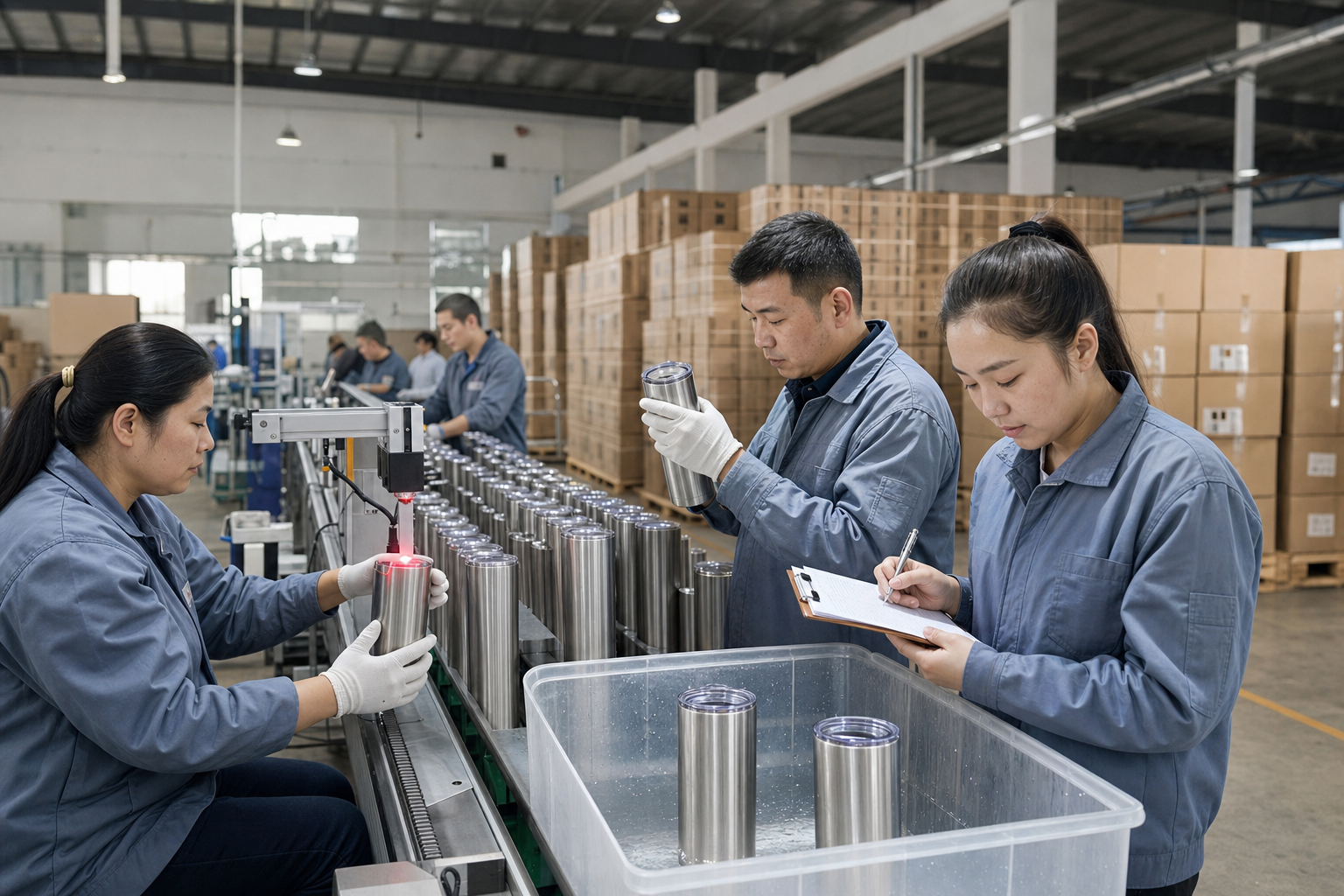
Ask for three things before you confirm order: sample photos from the same production line, a packing video from a live batch, and a pre-shipment inspection plan. In our Zhejiang workshop, we run a 100% leak test on vacuum cups, then do AQL sampling on appearance, print position, and carton quality. QC pulled a carton from pallet 4 last week because the tuck flap was 3 mm off. For custom drinkware with retail packaging, carton compression matters because crushed boxes kill shelf appeal even when the cup is fine.
Look at these red flags:
- No batch code on cartons or inner bags
- Sample and mass production use different lid materials
- No written tolerance for logo position or color deviation
- Factory refuses third-party inspection at pre-shipment stage
If you are comparing a canteen manufacturer in Zhejiang with a canteen supplier elsewhere in China, insist on the same evidence. The location matters less than the process, and this is the wrong question to ask if you care about reorder rate. A good factory will tell you where automation stops and handwork starts, like the packing table where two workers still tape 200 cartons before the night truck leaves.
Ordering the right custom program
The best beer tumbler vendor is the one that fits your channel. A distributor canteen program for warehouse sale needs fixed SKUs, tight carton counts, and low breakage. A canteen promotional order needs fast decoration and a sharp printed price. A premium retail custom growler program needs stronger packaging, cleaner welds, and tighter surface control. One supplier rarely does all three well. Define the commercial purpose first.
Build your brief around the basics: capacity in ounces or milliliters, insulation requirement, body finish, logo method, lid type, target market, packaging, and target incoterm. If you want a canteen customizable offer that is easy to approve, ask for one base shape with three finish options rather than five random variants. That keeps tooling simple and helps the canteen factory quote accurately. We have seen the buyer swap the lid spec after sample approval, and the line lost 4 days. If you need a customized canteen or customized drinkware line for a distributor network, lock the spec before mass production. Mid-order changes are where delays start.
A practical sourcing pack should include: approved sample, signed spec sheet, color reference, label file, packing instruction, test requirements, and late-change approval rule. That is what separates a serious canteen distributor program from a loose one-off order. We run AQL 2.5 on the line, and QC pulled the sample against the signed sheet before carton sealing. You do not need a perfect factory. You need a factory in Zhejiang or elsewhere in China that repeats the same result at 1,000 pcs, then 10,000 pcs, without inventing surprises.
Request a factory quote for your beer tumbler
Send your capacity, logo file, and target market. We will quote the right build, MOQ, and lead time without guessing.
Frequently asked questions
What MOQ should I expect from a beer tumbler vendor?
For a standard custom beer tumbler, 1,000 pcs is a normal MOQ in China. Laser engraving can sometimes start at 500 pcs because there is no plate cost. If you want a new lid mold, special color, or boxed retail set, expect 3,000 to 5,000 pcs. At our Zhejiang factory, common export lead time is 30 to 45 days after sample approval, which is realistic for a true customized drinkware order.
What is a fair FOB price for custom beer tumblers?
A basic 16 oz stainless beer tumbler often quotes at USD 1.80 to 4.20 FOB China. The lower end usually means simpler print, standard lid, and bulk packing. The higher end is for premium coating, better insulation, laser logo, or retail packaging. If the quote is far below that, check the steel grade, wall thickness, and carton spec before you chase the savings.
How do I know if a canteen manufacturer is legitimate?
Ask for business license details, export photos, batch coding examples, and recent third-party inspection reports. A real canteen manufacturer should also provide material traceability, AQL standards, and evidence of production capacity. In practice, a factory producing 500,000 units per month will have stable workflows, while a trading-only canteen supplier often cannot explain line-level QC or tooling ownership clearly.
Which decoration is best for a customized growler?
Laser engraving is usually the safest for a customized growler because it is permanent and resists abrasion. Screen printing is cheaper for one-color or two-color canteen promotional orders, but it can wear faster under heavy washing. UV print is attractive for graphics, but it needs the right coating and handling. For retail, choose the method that still looks good after 50 wash cycles, not just the one that photographs well.
What compliance documents should I ask for before shipping?
For Europe and North America, ask for food-contact declarations, REACH-related material awareness, and any LFGB or equivalent test reports that match your exact SKU. If you sell through Amazon FBA, add FNSKU labeling and carton label requirements. Also request AQL inspection terms, batch codes, and packing photos. For custom drinkware, documents should match the exact lid, coating, ink, and body material you ordered.