Key Takeaways
- A workable MOQ for custom beer tumblers is often 500-1,000 units, with printed samples in 5-7 days and mass production in 25-35 days.
- For stainless beer tumblers, 18/8 steel with 0.5 mm wall thickness is common; 0.7 mm gives a heavier feel and better dent resistance.
- Ask for AQL 2.5/4.0 inspection, REACH or FDA-relevant material declarations, and carton drop-test results before you approve shipment.
- A Zhejiang factory with 300,000+ units/month capacity is useful only if its decoration line can match your logo method and color standard consistently.
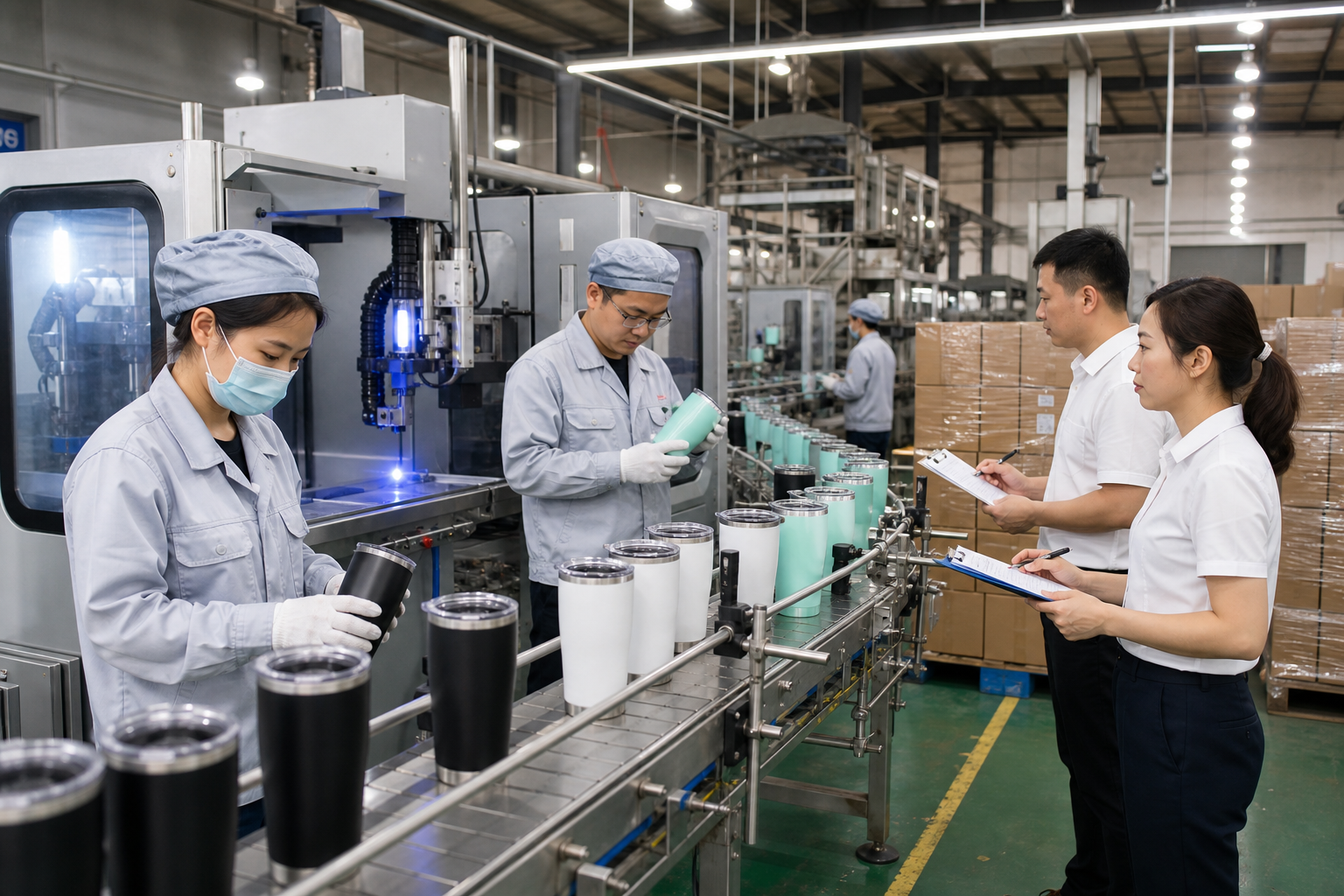
If you are sourcing from beer tumbler vendors, the hard part is not finding a name on Alibaba. It is telling a real factory from a polite trading office that cannot hold a 0.5 mm wall, keep laser engraving clean, or hit the promised ship date. We run these cups on the line every day, and the first thing we check is simple: 18/8 stainless steel, lid fit within 1 mm, coating adhesion that survives a tape pull, and whether 10,000 units leave on time without excuses.
Buyers in Europe and North America should treat beer tumblers like a spec sheet, not a brochure. That is the right question to ask. In Zhejiang, the factory that wins is usually the one that shows tooling records, AQL 2.5 inspection data, and a decoration process we can repeat on 5,000 or 50,000 pieces, not the one with the slickest sales pitch. We once saw a PO with “beer tumber” typed three times; QC pulled the sample, caught the typo, and the buyer still asked for a price break. If you are comparing canteen suppliers, distributor drinkware options, or a custom growler program, the buying math is the same.
Start With the Right Beer Tumbler Spec
Beer tumbler vendors should not quote you on capacity only. That is the wrong question to ask. You need a usable spec sheet: volume, material, diameter, height, wall thickness, finish, and packing. On the line, QC will check the body with a caliper, and a 16 oz stainless beer tumbler at 0.5 mm behaves nothing like a 12 oz insulated tumbler with vacuum sealing and powder coat. A buyer once flagged a PO because the artwork fit the sample but not the production lid box. Retail buyers feel that mistake in returns. Promo buyers feel it in the hand. One looks cheap in 3 seconds.
For most B2B programs, 18/8 stainless steel is the safest baseline. Food-contact resin lids need document-backed BPA-free claims, not a line in a catalog. If you want a canteen customizable range, ask the factory to show tooling for lids, rings, and optional handles. We have seen this go sideways when the rim was 1.2 mm off and the thread pitch did not seat cleanly. A good canteen supplier will tell you where tolerance stack starts to matter: rim, thread pitch, gasket compression. That is where cheap custom drinkware fails.
- Typical MOQ: 500-1,000 pcs per design
- Common wall thickness: 0.4-0.7 mm
- Sample lead time: 5-7 days
- Production lead time: 25-35 days
Check Factory Capacity, Not Sales Claims
Beer tumbler vendors like to talk about fast ship dates. Ask for line capacity, not a big monthly headline. A real canteen factory in Zhejiang may post 200,000 to 500,000 units per month across different drinkware categories, but that number means little if the powder coating line is tied up with travel tumblers and the laser engraver is offline for service. We run into this all the time. What matters is what is open in your order window, not what sounds good in a sales deck.
Ask whether the factory is a canteen manufacturer with in-house forming, welding, polishing, coating, and packing, or if it pushes half the job out the door. Outsourcing raises the risk on custom canteen and customized drinkware orders because the Pantone match can drift by 1 to 2 shades and the logo can shift 3 mm between subcontractors. On distributor canteen programs, that turns into claims and rework. A serious canteen vendor will show you the production flow chart, daily output, and inspection points. If the answer stays vague, the lead time will be vague too.
“If a supplier cannot explain where the defect happens, they cannot stop it.”
When you compare canteen manufacturers, ask for three numbers: actual daily output for your SKU, first-pass yield, and the average days from material receipt to finished packing. QC pulled the sample, the buyer flagged a 2 mm print offset, and that was enough to expose the weak spot. This is the wrong question to ask if you only want a pretty brochure.
Decoration Methods Change The Economics
Logo method is where a lot of buyers lose margin. Screen print is cheap, but it is the wrong pick if you need abrasion resistance on a distributor growler or a customized growler going into retail resale. We ran this on a 500 pcs PO last quarter: the buyer flagged a scratched logo after carton rub test. Laser engraving costs more upfront, usually USD 0.20-0.60 per unit depending on area and artwork complexity, but it holds up through shipping, dishwashing, and daily handling better than low-end ink. UV print gives strong color, though you still need to check adhesion on powder-coated bodies. Heat transfer works for multi-color artwork, but edge sharpness on curved bodies is where some canteen suppliers slip.
For beer tumbler vendors, the rule is simple: pick the decoration method by use environment, not just by artwork. If the tumbler will sit in bars, laser or durable powder coat plus engraving is the safer call. If it is a canteen promo run with a short shelf life, pad print or silk screen can be enough. If you are building a customizable canteen line for retail, ask the factory for a decoration matrix. We run those sheets all the time, and they show price, MOQ, and failure risk side by side. The math does not work any other way.
What to ask the vendor
- Can they match Pantone within ΔE 2.0 to 3.0?
- Will the logo stay legible after 200 dishwasher cycles?
- Is the decoration done in-house or outsourced?
- What is the reprint rate on your last 3 orders?
A capable canteen distributor or custom drinkware vendor should answer these fast and clean. If they start guessing, QC pulled the sample and found the problem already.
Compliance Is Not Optional In Export
Ship to Europe or North America, and compliance has to sit in the quote from day one. Beer tumbler vendors who know the job will hand you a file with the material declaration, test reports, carton markings, and REACH or food-contact support where the SKU needs it. We run into this on 304 stainless all the time: the grade is only half the story, because nickel and chromium migration, coating safety, and the lid or silicone ring that touches the drink can trigger a fail. The wrong question is, “Can you ship fast?” Ask, “Can you pass?”
We ask for third-party testing from a recognized lab, not a screenshot and not a WeChat photo of a report cover. If the seller is a canteen manufacturer or canteen factory in China, they should show batch numbers, test dates, and the exact sample tied to that PO. QC pulled the sample on one 1,000-piece run and found a lid swap in the BOM; that small change forced retesting. For custom canteen and customized canteen orders, the math does not work any other way. One gasket change, one straw cap typo, and the compliance status can move.
Packaging gets checked too. Retail-ready distributor drinkware often needs suffocation warnings, carton barcodes, and FNSKU labels for Amazon, and we have seen buyers get burned when the vendor said, “we can do it later.” No, later is expensive. If your vendor cannot line up the carton spec, the label file, and the outer case count, your warehouse team will catch the problem at receiving, not the line.
Price Benchmarks That Make Sense
If you want a price that makes sense, stop chasing the lowest FOB line. Ask what sits inside it: body finish, logo, inner coating, lid type, individual box, and carton drop test. For a basic 12 oz stainless beer tumbler, FOB China usually starts around USD 1.60-2.40 at 1,000 units, depending on spec and decoration. A double-wall vacuum cup with powder coat and laser logo can land at USD 2.80-4.50. Add a custom box or mold work, and the quote moves fast.
We had one buyer flag a PO because the supplier left out the inner coating line item. The math doesn't work if the factory is hiding tooling or swapping material thickness on the line. For custom growler programs, tooling and thicker wall stock can add USD 0.40-1.20 per unit before freight. In Zhejiang, the better factories spell this out because buyers compare landed cost, not just unit price. If a China quote comes in 15% under market, something is missing: a finish step, a compliance test, or carton protection that QC pulled from the sample and found weak.
For distributors, ask for tiered pricing at 500, 1,000, and 3,000 units. That tells you whether the vendor can run repeat orders or only a one-time promo. A good canteen distributors program should show real breaks, not tiny crumbs. We ship this way when the buyer is serious, and the price steps have to be visible on paper.
Sampling And Quality Control
Samples are where you find out whether a beer tumbler vendor is running a tight line or just answering messages fast. A proper sample should match the final body thickness, coating, logo position, lid function, and packaging structure. If it comes from another mold cavity, another coating batch, or a different laser setting, that is not an approval sample. It is a sales prop, and we have seen that go sideways before.
Ask for pre-production samples, then golden samples with signed approval photos. For mass production, specify AQL 2.5 for critical defects and AQL 4.0 for major defects unless your program calls for tighter limits. Check rim smoothness, thread alignment, coating chips, weld marks, and leakage if there is a lid. A serious canteen manufacturers team will pull a set from the line and test vacuum retention for 12-24 hours, depending on the SKU.
If you are buying customized growler units, ask for a compression test on the lid seal and a carton drop test from 60-80 cm. That matters on distributor canteen orders moving through two or three warehouses. We run this on export jobs because the buyer flagged one PO where the carton mark had a typo and the claims process cost more than the margin. Good factories document the tests, the photos, and the sample sign-off, because the math does not work any other way.
Choose A Vendor For Repeat Orders
One order is easy. The second and third order are where beer tumbler vendors show their hand. We keep the artwork file, Pantone reference, box dieline, and approval photos on file, then run the same cup six months later without a 2 mm logo shift or a color mismatch. QC pulled the sample on the line and checked against the master carton, which is the level you want for a canteen customizable line or a customized canteen SKU going into retail.
Look for a vendor that also ships adjacent items: custom canteen, canteen customized, custom growler, and broader customizable drinkware programs. A factory in Zhejiang that controls steel sourcing, lids, and coating work usually handles a product family better than a trading company. If you are a canteen distributor or distributor growler buyer, that cuts down the number of people you chase for reorders. It also keeps changes cleaner when the buyer flags a 500 ml switch, a new lid, or a logo move by 8 mm.
The right supplier does not promise everything. They tell you what is ready, what needs tooling, and what adds 7-15 days. We run that math on the floor every week, and it matters more than sales talk. This is the wrong question to ask: who says yes fastest. Ask who can repeat the same result on the next PO, because a typo on the carton art or a loose lid spec will turn into a complaint on the second shipment. That is the vendor you keep for more than one season.
Send your spec, get a real factory quote
Share your capacity, logo method, and target market. We will quote from China with MOQ, lead time, and compliance details you can actually use.
Frequently asked questions
Can one factory handle both beer tumblers and growlers?
Yes, and that is often better for repeat business. A capable canteen manufacturer in China can usually produce beer tumblers, custom growler products, and other customizable drinkware if it has the right forming, welding, and coating equipment. The advantage is consistency across your line: similar steel grades, similar decoration standards, and fewer vendors to manage. The key is to confirm actual capacity and process control, not just the product list. For example, a Zhejiang factory may produce 300,000 units per month across multiple drinkware types, but you still need to know how much of that is available for your exact SKU.