Key Takeaways
- For beer tumbler wholesale bulk, expect FOB China pricing from about USD 1.10 for simple single-wall units to USD 4.90 for premium vacuum styles.
- A realistic MOQ is 500 pcs for stock bodies and 1,000 to 3,000 pcs for custom color or logo work.
- For EU and US sales, ask for REACH, FDA, and food-contact declarations, plus AQL 2.5 major and 4.0 minor inspection terms.
- If you need beer growler wholesale bulk, alcohol flask wholesale bulk, or bulk canteen formats, the closure and test requirements are different from a standard beer tumbler.
If you are sourcing beer tumbler wholesale bulk, the first mistake is assuming every stainless cup is the same. It is not. Wall thickness, lid design, coating, print method, and carton packing change your landed cost and your sell-through. A buyer who only compares unit price usually ends up with higher breakage, weak branding, or a product that looks cheap on shelf. We had one PO with "beer tumblers" typed as "bear tumblers"—the buyer laughed, but the box count still had to match.
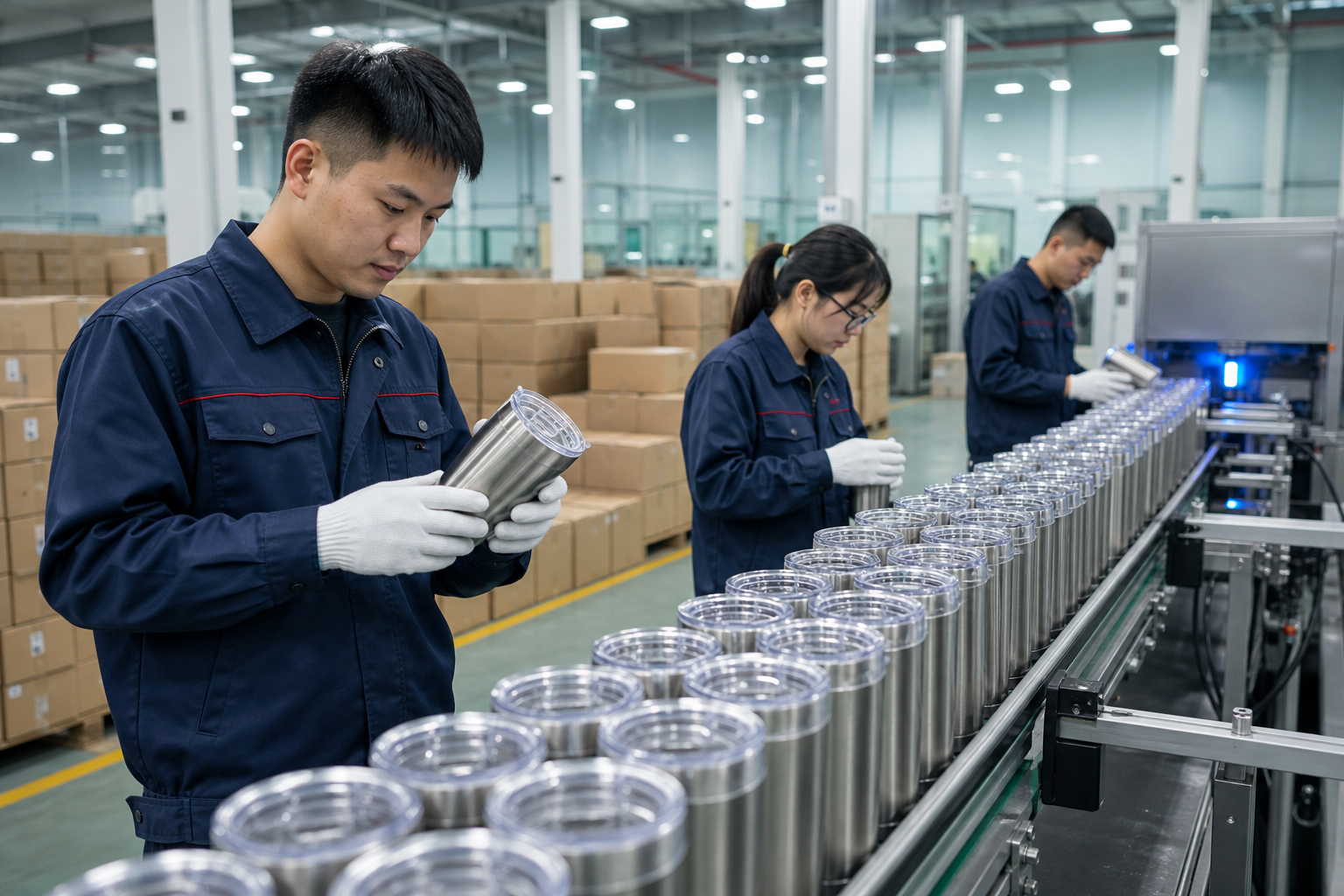
In Zhejiang, our factory runs up to 180,000 units per month, with a common MOQ of 500 pieces for stock specs and 1,000 to 3,000 pieces for custom finishes. That is the scale you want from China if you are buying wholesale drinkware for retail, hospitality, or promo programs. The right spec keeps your margin intact and avoids the usual mess: a good-looking sample that cannot be repeated in bulk at the same quality. QC pulled the sample at 0.3 mm wall thickness and it held; anything thinner starts to get risky on the line.
What Counts As A Beer Tumbler
When buyers ask for beer tumbler wholesale bulk, they usually mean a stainless steel cup or tumbler that keeps beer cold, takes a knock, and still stacks cleanly in cartons. On our line, QC will pull a 16 oz sample, check the wall at 0.7 mm, and make sure the rim does not pinch. The name on the product page matters less than the job it has to do.
If you are supplying pubs, stadium shops, or event programs, a single-wall body with a brushed or powder-coated finish is usually the cheapest route and the easiest to stack. For retail, a double-wall vacuum style gives the buyer more shelf appeal, and the math works better at 20 oz or 24 oz. We ship both, but the spec sheet has to match the service environment; one buyer flagged a PO because the carton count was wrong by 12 pcs, and that kind of mistake slows everything down. For buyers comparing drinkware bulk options, the same factory may also quote bulk drinkware, wholesale drinkware, wholesale canteen, or canteen wholesale items, but the drink and the packing method need to line up.
Do not confuse a beer tumbler with a growler. A beer growler wholesale bulk order needs a tighter lid system, leak testing, and often a larger format such as 32 oz or 64 oz. We have seen a PO use the word “growler” for a straight-wall tumbler, and the buyer had to resend it after QC pulled the sample and checked the cap fit. That is the wrong question to ask if you want the right unit cost. If you need alcohol flask wholesale bulk, the finish, neck shape, and closure change again, and so do the mold, packing method, and defect risk.
Materials That Hold Up In Use
For beer tumbler wholesale bulk, 304 stainless is the workhorse. We ship a lot of it, usually marked 18/8, because it holds up on the line, keeps corrosion under control, and fits food-contact use without drama. If the buyer is pushing into salty coastal markets or a bar program that sees heavy wash cycles, 316 stainless makes sense, but the math does not work for every SKU and it will not save you from bad handling or a weak coating.
Wall thickness is where the complaint calls start. A 0.5 mm single-wall body is standard for value programs, and on insulated cups we run 0.4 to 0.5 mm for the inner and outer walls with a vacuum gap that cuts condensation and helps temperature retention. QC pulled the sample on one 0.35 mm spec and the first freight carton showed dents before it left Ningbo. Go thinner than that and bulk freight gets ugly fast; go thicker and your unit cost, carton weight, and loading efficiency all climb.
For lids, use BPA-free PP, Tritan, or silicone parts with a clear food-contact declaration. Check the gasket compression and lid fit before PO approval; a 0.3 mm gap at the rim turns into leakage complaints once the buyer starts testing samples. We had one PO with the lid code typed as “PPT” instead of PP, and that one typo stopped the line for a day. A clean-looking body with a loose lid is still a bad product, and we see that go sideways all the time.
Pricing, MOQ, And Real Margins
Pricing for beer tumbler wholesale bulk comes down to body type, finish, and decoration. On a plain single-wall tumbler, a China FOB quote usually lands around USD 1.10 to 1.80 for 500 to 2,000 pieces. Powder-coated or vacuum-insulated models usually sit between USD 2.80 and 4.90 FOB, depending on size, coating steps, and lid choice. Laser engraving is usually a small add-on, around USD 0.12 to 0.35 per piece. A multi-color wrap print adds more, often USD 0.20 to 0.70 per unit. We run these jobs on the same line, and the buyer often flags the lid as the hidden cost, not the cup body.
The real margin question is not the quoted unit price. It is the landed cost. Carton structure, inner boxes, master carton count, and ocean freight all hit the final number. A cheap unit packed in weak cartons can turn into dent claims and returns fast. QC pulled the sample on one order and found a 6 mm carton gap at the corner, which is exactly how a low quote starts leaking margin. For drinkware wholesale orders, a factory that knows export packing will usually save you more than a weaker supplier with a lower sticker price. The math does not work any other way.
From a procurement view, an MOQ of 500 pieces works for a market test, but 1,000 to 3,000 pieces usually gives better color consistency and packing efficiency. For canteen bulk and beer tumbler bulk programs with multiple SKUs, ask whether the supplier can combine colors or logo variants in one production slot. We have seen this go sideways when a PO typo split one logo into two versions, and the line had to stop for a recheck. In China, that flexibility is what separates a workable supplier from one that only looks cheap on paper.
Branding That Survives Washing
Your logo method should match the way the tumbler gets used. For beer tumbler wholesale bulk, laser engraving stays clean and hard-wearing on 304 stainless, but it gives you no color. Silk screen printing is the workhorse for one to three colors and keeps the unit cost tight on 5,000-piece runs. UV print can carry richer graphics, but we ask for an abrasion test before sign-off if the cups will see dishwashers, bar sinks, or daily wiping.
Keep the print area honest. A wide wrap can look sharp in a render and fail on the real body when there is a 3 mm seam or a tighter shoulder radius. On stainless cups, we run better with bold contrast and simple marks that still read after repeated hand washing. If you want a premium finish, send Pantone references and ask for a pre-production sample with the exact matte or gloss coat; we once caught a PO typo on the gray code before the line ran 2,000 pieces.
For wholesale drinkware sold in North America, bar and retail buyers want the logo readable from 1.5 to 2 meters away. Thin strokes lose the fight under coating, so keep the type bold and leave enough blank space. If you source beer tumbler in bulk alongside a bulk growler or canteen wholesale line, keep the decoration rules the same across all three SKUs so the shelf set looks planned, not patched together from leftovers. QC pulled the sample once, and a 0.3 mm hairline disappeared after the second wash, which is the wrong question to ask if the art depends on detail that small.
Compliance And QC You Cannot Skip
For Europe and North America, compliance is part of the buying decision, not a checkbox. If you import beer tumbler wholesale bulk into the EU, ask for REACH documents and food-contact declarations. For Germany, or for a retailer with strict market rules, LFGB testing may be required. For the US, FDA food-contact compliance is the floor, and any lid or seal material should be BPA-free with the component list shown on paper. We had one buyer flag a PO because “sillicone” was typed wrong on the spec sheet; the sample was fine, but the paperwork had to be corrected before we could ship.
Quality control should sit in the purchase order. For bulk drinkware, we run AQL 2.5 for major defects and 4.0 for minor defects, with 100 percent leak testing on insulated or lidded units. Put the drop test in writing, usually 1 meter onto a hard surface, and add a dishwasher test if the tumbler will be sold for home or hospitality use. For coated surfaces, ask for scratch and salt spray performance if the product will sit in bars or outdoor service. The math does not work if you leave these out and hope the line catches everything.
A solid Zhejiang factory should show incoming material inspection, in-line checks, and batch traceability. If a supplier cannot explain how they sort defects by lot, that is a warning sign. QC pulled the sample from a 304 stainless run last month and found a 0.3 mm lip variance; we stopped that batch before packing, which is how it should work. China has plenty of factories, but the ones worth your time can show what they inspected, when they inspected it, and how they fixed the issue before shipment.
How To Place A Safer Trial Order
The safest way to buy beer tumbler wholesale bulk is to start with a controlled pilot order. We usually push 500 to 1,000 pieces. That size lets you check print quality, carton strength, barcode placement, and sell-through without tying up too much cash. If you sell on Amazon, ask the supplier to print FNSKU labels or apply sticker labels at the factory, and confirm carton dimensions before freight booking. One 2 mm carton change can break the pallet count. Small mistakes in pack-out get expensive once the goods leave China.
Before you approve production, request a pre-production sample, then a sealed golden sample for reference. Confirm the exact lid, gasket, coating color, and logo placement. QC pulled the sample on our line once and caught a 1.5 mm logo shift that the buyer flagged later in email. If the tumbler sits in a wider range that includes beer growler wholesale, wholesale growler, or alcohol flask wholesale bulk items, each SKU needs its own spec sheet and SKU code. Mixing specs inside one order is where simple projects turn into problem projects.
Lead time from China is usually 25 to 35 days for a standard repeat order and 35 to 45 days for new colors, custom packaging, or a fresh lid tool. That is normal for a Zhejiang supplier with real production capacity. If a factory promises 10 days, check whether they are quoting stock goods only or shifting the risk to you. We had one PO with a typo on the carton mark, and the reprint ate 3 days. This is the wrong question to ask if you want the cheapest quote; the math does not work. A clean trial order is how you find a best wholesale drinkware partner before you commit to a larger program.
Request a bulk quote with exact specs
Send your target size, logo method, and quantity. We will quote beer tumbler wholesale bulk from China with clear MOQ, lead time, and compliance data.
Frequently asked questions
What MOQ should I expect for beer tumbler wholesale bulk?
For a standard stock body, 500 pieces is a realistic MOQ from a Zhejiang factory. If you want custom color, multi-color print, or special packaging, plan on 1,000 to 3,000 pieces. For more complex programs like beer growler wholesale bulk or alcohol flask wholesale bulk, the MOQ can rise because the closure and packing setup are more involved. If a supplier offers 100 pieces with full customization, check whether they are using leftover stock or changing specifications after sampling.
Is 304 stainless steel enough for beer tumblers?
Yes, 304 stainless steel is enough for most beer tumbler wholesale bulk programs. It is the standard 18/8 grade used in wholesale drinkware for food contact. If you are selling into coastal areas, premium hospitality, or products that will see heavier wash cycles, 316 stainless can improve corrosion resistance, but it is usually not necessary. A 0.5 mm wall thickness is a practical starting point for single-wall tumblers, while insulated versions often use 0.4 to 0.5 mm inner and outer walls.
How long does bulk production take in China?
For a standard beer tumbler wholesale order from China, expect 25 to 35 days after sample approval and deposit. If you add custom coating, special lids, or new packaging, the schedule often moves to 35 to 45 days. Sampling usually takes 5 to 7 days if the factory has the base tooling in place. In Zhejiang, factories with real output can handle around 180,000 units per month, but your slot still depends on season and whether the order needs a new print setup.
What inspections should I request before shipment?
Ask for AQL 2.5 for major defects and 4.0 for minor defects, plus 100 percent leak testing for any lidded or insulated tumbler. A 1 meter drop test is a sensible baseline, and coating scratch checks are worth adding if the product is retail-facing. For EU-bound goods, request REACH and food-contact documentation. For the US, ask for FDA-related food-contact declarations and clear material statements for lids and seals.
What is a normal landed cost for beer tumbler wholesale bulk?
A simple single-wall unit can land around USD 1.10 to 1.80 FOB China, while a vacuum-insulated version often sits between USD 2.80 and 4.90 FOB. From there, packaging, inland trucking, and ocean freight add more. For many importers, freight can add USD 0.18 to 0.60 per unit depending on lane, carton count, and volume. The real target is not just the factory price. It is the total landed cost that still leaves room for margin after duty, freight, and damaged units.