Key Takeaways
- Most beer tumbler wholesale quotes start around USD 1.80-4.20 per unit at 3,000-5,000 pcs, depending on steel grade and finish
- A common factory MOQ is 5,000 pcs with 30-45 days lead time after artwork approval
- 304 stainless, 0.5-0.7 mm wall thickness, and BPA-free lids are the practical baseline for export
- For North America and Europe, REACH, food contact checks, and AQL 2.5/4.0 inspection matter more than brochure claims
If you are sourcing beer tumbler wholesale for retail, promo, or hospitality, the surprise is rarely the unit price. The hidden cost shows up in weak insulation claims, lids that pop loose in transit, off-spec coating, and cartons that fail a drop test. We have seen a 24-pack pass sample check and still lose 6 cups in shipping. The first quote is never the full story.
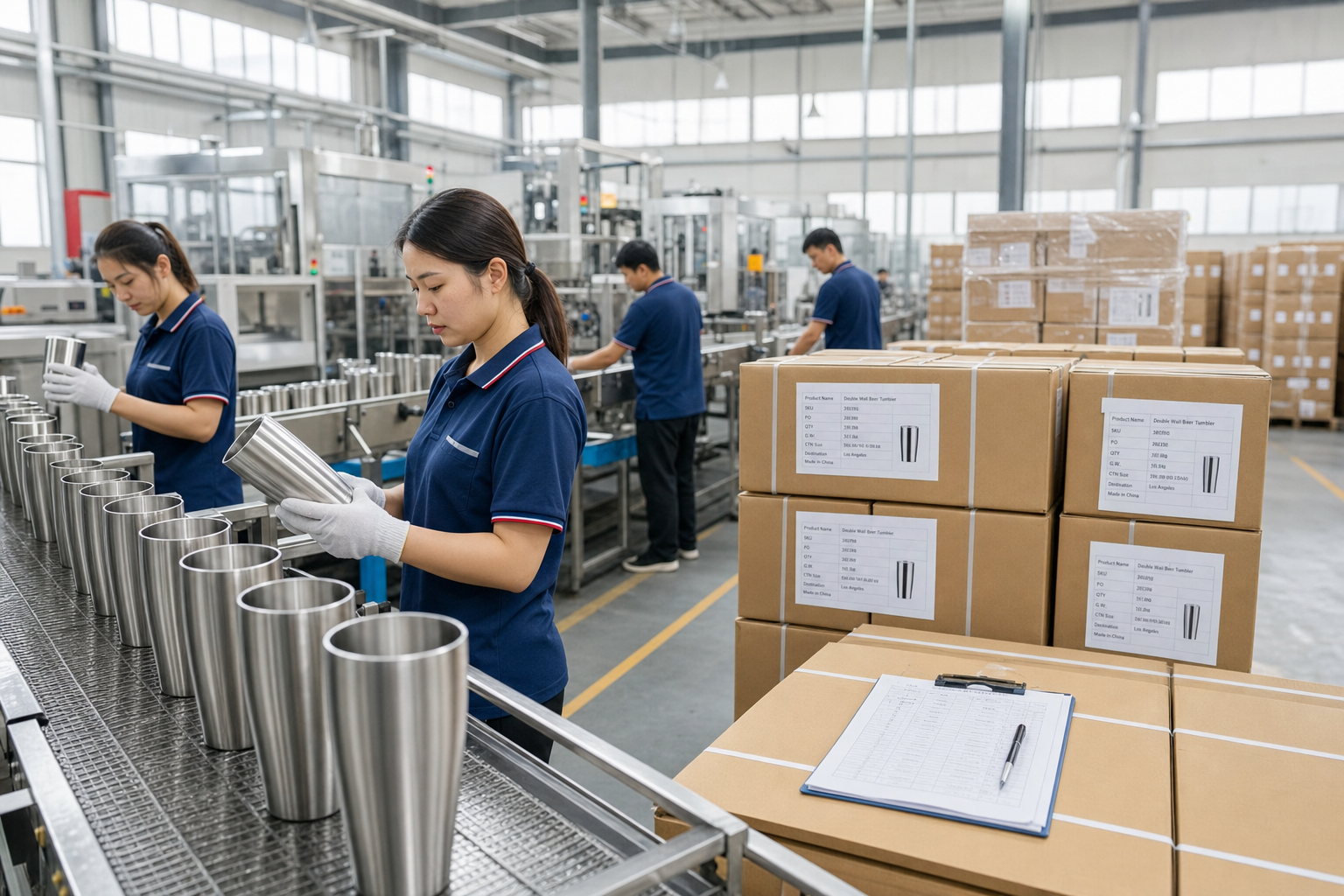
From our factory in Hangzhou, Zhejiang, we see the same pattern every week on the line: a buyer asks for a 12 oz or 16 oz stainless beer tumbler, then the real fight is wall thickness, 304 vs 201 steel, lid fit, finish life, and whether we can hold a 30- to 45-day lead time at a 5,000-piece MOQ. QC pulled a sample last Friday at 0.6 mm wall thickness, and the buyer flagged the logo placement by 2 mm. That is the wrong question to ask if you want beer tumbler wholesale that sells through, because the math only works when the spec is tight from the start.
What beer tumbler wholesale really means
Buyers searching for beer tumbler wholesale are usually not after one random cup. They want one base mold that can serve pubs, ecommerce, gift sets, and event promos with different prints and packaging. We run this way on the line all the time. The same tooling can also sit behind bulk drinkware, wholesale drinkware, wholesale canteen, and bulk growler orders, but the math works only when the spec sheet is tight. A plain cup and a premium cup can come out of the same mold.
For beer tumblers, the decisions start with capacity, insulation, and finish. A 16 oz double-wall stainless tumbler in 304 steel is the safest export SKU for most buyers. If the buyer pushes for a lower price, some factories quote 201 steel, and we’ve seen that go sideways in warm, salty markets. QC pulled the sample with a 0.6 mm wall once because the rim felt thin in hand. A proper beer tumbler wholesale program should tell you:
- capacity: 12 oz, 16 oz, or 20 oz
- steel grade: 304 or 201
- wall thickness: 0.5 mm, 0.6 mm, or 0.7 mm
- finish: powder coat, matte paint, or polished steel
- packaging: color box, mailer box, or bulk tray
In Zhejiang and across China, the better suppliers quote these points on the first reply. If they cannot give you the capacity, steel grade, and packing carton size, they are not running a controlled wholesale program. The buyer flagged it on a PO once because the carton code was typed wrong by one digit, and that tiny typo cost a day. That is the wrong question to ask if someone says they can do everything.
Specs that change your landed cost
Price gaps in beer tumbler wholesale come from hard specs. The same 16 oz tumbler can land at USD 1.92 or USD 3.85 once you change steel, lid, coating, or packaging. We see that every week. What breaks the deal is a low quote with no base spec, then the buyer gets hit with upgrades after the PO is already in the system. QC pulled one sample last month where the PO said powder coat, but the approved piece was plain steel.
The spec stack we run on the line looks like this:
- Material: 304 stainless is the export standard; 18/8 is commonly used as a market term, and we check it with a magnet before packing
- Thickness: 0.5-0.7 mm gives a solid hand feel without turning the cup into a brick
- Coating: powder coat adds durability and usually USD 0.18-0.40 per unit, with the spray booth adding one more pass on the line
- Lid: sliding or press-fit lids add function, but they also change smell retention and leakage risk, so the buyer should ask for a water test
- Print: one-color silkscreen is cheaper than laser engraving and usually faster to run, especially when the artwork is clean and the MOQ stays tight
If you are comparing beer tumbler bulk, beer tumbler in bulk, or beer tumbler wholesale bulk offers, make sure the quotation states carton size, gross weight, and whether the price is FOB Ningbo or FOB Shanghai. A USD 0.12 freight handling gap per carton looks harmless until you ship 8,000 units. This is the wrong question to ask if you only chase unit price. The better supplier in Zhejiang will show the landed-cost math, the pallet count, and the carton mark, not just a clean factory quote.
Ask for the same quotation in two formats: plain unit price and full export spec sheet. If the numbers do not line up, the quote is incomplete.
Materials and compliance for export
If your market is Europe or North America, compliance is not a checkbox. It is what gets the carton cleared at customs and keeps the SKU on the shelf. For wholesale drinkware, especially beer tumbler wholesale, ask for food-contact paperwork, migration test reports where they apply, and material declarations for coatings, inks, and lids. We usually tell buyers to pin down REACH for EU chemical compliance, FDA food-contact expectations for the U.S. market, and factory systems such as ISO 9001. On our side, QC checks the incoming coil by heat number before the line starts.
There is a real difference between products. A stainless beer tumbler is straightforward; an alcohol flask wholesale bulk order with decorative plating brings more risk because the buyer will flag pinholes, scratch marks, and plating thickness. A growler wholesale program needs stronger cap sealing and higher-impact testing. If you are buying bulk canteen or canteen wholesale items in the same shipment, split the test file by product family. One report for everything is the wrong question to ask. We have seen it go sideways on a 1,200-piece order when the lid material changed from PP to Tritan without a new test.
We recommend these checks before you place a PO:
- confirm 304 stainless for the beverage-contact body
- request lid material details: PP, Tritan, silicone, or stainless accents
- ask for REACH-compliant coating and ink declarations
- verify factory QC process with AQL 2.5 for critical defects and AQL 4.0 for minor defects
In China, a good factory should have this file ready, not buried in one assistant's laptop. In Zhejiang, the stronger plants treat compliance as part of production, and we ship that way too. When the buyer asks for a 15 mL migration report or a lid spec at 24 hours, the paper should already match the sample on the bench.
MOQ, lead time, and factory capacity
For most buyers, the question is not whether the beer tumbler looks good. The real test is whether the factory can repeat that finish at scale. A serious beer tumbler wholesale supplier should quote a clear MOQ, lead time, and monthly output. At BottleForge Industrial, our standard MOQ for custom beer tumblers is 5,000 pcs per SKU, with a typical lead time of 30-45 days after sample approval and packaging confirmation. Monthly capacity runs into the hundreds of thousands of units across bulk drinkware product lines. QC pulled the sample on the line last week and checked a 0.3 mm print offset. That is the level that keeps a launch on track.
This matters because export buyers often bundle beer tumbler wholesale with wholesale growler, wholesale canteen, or best wholesale drink bottle programs for one seasonal launch. That is a sound buying plan, but only if the supplier keeps decoration consistent across categories. The math does not work if week one black powder coat looks different from week four. We have seen that go sideways, and retailers catch it fast. On one order, the buyer flagged a PO typo on the carton code and we had to stop packing for a day to fix it.
Use this simple filter when evaluating a supplier in China:
- Can they produce 100,000+ units per month across drinkware categories?
- Do they turn samples in 7-10 days with a clean first shot?
- Can they hold a repeat order without changing lid fit or box size?
- Will they quote FOB, CIF, and door-delivery assumptions clearly?
If you are sourcing beer growler bulk or beer growler wholesale bulk alongside beer tumbler wholesale, ask whether the same polishing line, laser line, and packing line are shared. We run a 6-head polishing line and a separate laser station for logo work, so the bottleneck is obvious when it shows up. Shared capacity is fine. Hidden bottlenecks are not.
Branding options that actually sell
Decoration decides whether a beer tumbler looks like a retail item or a plain blank cup. For beer tumbler wholesale, we pick the method by channel, not by taste. Silkscreen works well for one- or two-color logos and keeps the unit cost down. Laser engraving gives a cleaner premium look, and we have seen it hold up after 500 dishwasher cycles in our test rack. Full-wrap UV print fits bold retail graphics, but QC should run an abrasion check and a dishwasher run before you sign off.
Do not make the art busy. One logo, one Pantone color, and a clean carton usually sell better than a crowded layout. The math does not work when buyers try to pack three messages onto one cup. On the line, we often keep the same visual system across beer tumbler bulk, bulk growler, and alcohol flask in bulk so the carton art, carton size, and prepress stay aligned.
What to confirm with the factory:
- logo size limits on curved surfaces, usually in mm
- color tolerance for Pantone matching, with a sample under daylight
- artwork file type: AI, PDF, or EPS
- sample approval steps before mass production, including a signed golden sample
A practical note: laser engraving is not always the cheapest line item, but it cuts return risk because it does not peel. We ship a lot of premium wholesale beer tumbler orders this way, and the buyer flagged print wear on a previous batch before switching. For a club, brewery, or travel retail program, that is often the safer pick. Same story for best wholesale drinkware when the customer wants a cleaner shelf look and fewer after-sales headaches.
Packaging, cartons, and channel fit
Packaging is logistics, not decoration. A beer tumbler wholesale order can look perfect in the sample room and still fail if the carton eats freight space or the inner tray lets cups rub on a 35-day ocean move. If the buyer is Amazon, a distributor, or a retail chain, the pack spec has to fit the channel.
For DTC or marketplace programs, we ask for individual mailer boxes, barcode placement, and FNSKU labeling. For retail pallet programs, carton strength and master carton count matter more than glossy print. A standard export carton for a 16 oz tumbler might hold 24 or 48 units, depending on the box style and foam. One extra centimeter changes the CBM, and CBM is what the freight quote reads. The buyer flagged a carton at 58 x 38 x 34 cm last month; we reworked it to 56 x 36 x 32 cm and saved space.
We see the same packaging logic in canteen bulk, canteen wholesale, and beer growler wholesale jobs. Different product, same shipping math. If a supplier cannot send carton dimensions, net weight, and gross weight within one day, the line is not ready for export work. QC pulled the sample, checked the tape seal, and found a 2 mm gap at the tray edge. That gap becomes a dent in transit.
For multi-SKU orders, especially when you mix drinkware bulk with wholesale drinkware accessories, insist on a packing list template before mass production. One typo on a PO can send lids to one warehouse and tumblers to another. We've seen that go sideways. That one sheet saves a lot of warehouse calls later.
How to negotiate a better quote
Buyers often push on unit price alone for beer tumbler wholesale. That is the wrong lever. Better quotes come from material choice, decoration, and packing. If you want a lower price, send a cleaner spec and a bigger commitment. A 3,000-piece order might sit at USD 3.40 per unit, while 10,000 pcs of the same SKU can drop to USD 2.45. We see that every week on the line in Zhejiang, especially when the spec stays tight and the coating process does not change halfway through.
Use these negotiation points instead of asking for vague discounts:
- remove unnecessary packaging layers
- standardize lid color across SKUs
- use one decoration method across the order
- combine beer tumbler wholesale with other bulk drinkware to spread tooling and freight cost
If you also source a bulk canteen or alcohol flask wholesale bulk program, ask the supplier to bundle setup costs across the project. A PO typo on the lid count has turned a clean quote into two extra carton runs before. Factories will soften tooling charges when they see repeat business, but they still want a forecast they can build to. The math does not work if the spec keeps moving.
When you compare offers, do not miss the items hiding outside unit price: sample freight, print plates, carton testing, and third-party inspection. QC pulled one sample last month and found a carton burst at 32 kg, which changed the packing quote fast. That is not savings. That is deferred cost.
Get a factory quote for beer tumblers
Send your target capacity, steel grade, logo file, and market. We will quote FOB China with MOQ, lead time, and packaging details.
Frequently asked questions
What is the usual MOQ for beer tumbler wholesale orders?
A common MOQ is 5,000 pcs per SKU for custom beer tumbler wholesale orders, especially when you need logo printing or special packaging. Some factories can do 3,000 pcs if they already have stock molds and standard finishes, but the unit price is usually higher by USD 0.20-0.60. For mixed orders, a supplier may let you combine beer tumbler bulk with other drinkware bulk items, but each SKU still needs its own artwork, carton plan, and QC record. If a factory promises 500 pcs with full customization, check whether they are quoting stock inventory rather than true production.
How much does a custom beer tumbler cost from China?
For beer tumbler wholesale from China, a realistic factory price for a 16 oz double-wall stainless model is often USD 1.80-4.20 per unit, depending on material, coating, lid, and print method. Plain 304 steel with simple packaging sits lower; powder coat, laser logo, and premium box push it higher. FOB port terms matter too. In Zhejiang, a well-run factory can hold consistent pricing across repeat orders if the spec does not change. Always ask for price breakpoints at 3,000, 5,000, and 10,000 pcs so you can see the real volume effect.
Do I need REACH or FDA testing for beer tumblers?
If you sell into the EU, you should ask for REACH-related chemical compliance and food-contact declarations. For the U.S. market, you should expect food-contact suitability evidence aligned with FDA expectations, even if the exact testing package depends on the material and decoration. Do not assume one general report covers every item. A beer tumbler, a wholesale growler, and an alcohol flask wholesale bulk item may need different documentation because coatings, seals, and contact surfaces vary. A professional supplier in China should be able to provide material declarations and, when needed, third-party test reports.
What is the best decoration method for beer tumbler wholesale?
For most beer tumbler wholesale orders, one-color silkscreen is the most cost-effective choice, usually with clean setup and fast production. Laser engraving is better if you want a premium look and lower wear risk, especially for corporate gifting or hospitality use. UV print is useful for full-color branding but needs abrasion checks. If your buyer is a distributor, the safest route is often a simple logo that works across beer tumbler bulk, beer growler wholesale, and other wholesale drinkware items. That keeps sampling, approvals, and reorders easier.
Can I combine beer tumblers with canteens or growlers in one shipment?
Yes, and many buyers do. Combining beer tumbler wholesale with canteen wholesale, wholesale canteen, beer growler bulk, or bulk drinkware can improve container utilization and reduce freight cost per unit. The catch is that each item has different packing dimensions, weight, and sometimes different compliance documents. A factory in China should give you separate carton specs and a consolidated packing list. If the products share decoration or packaging, tooling and setup costs may also spread more efficiently. Just make sure the lead times are aligned before you confirm the order.