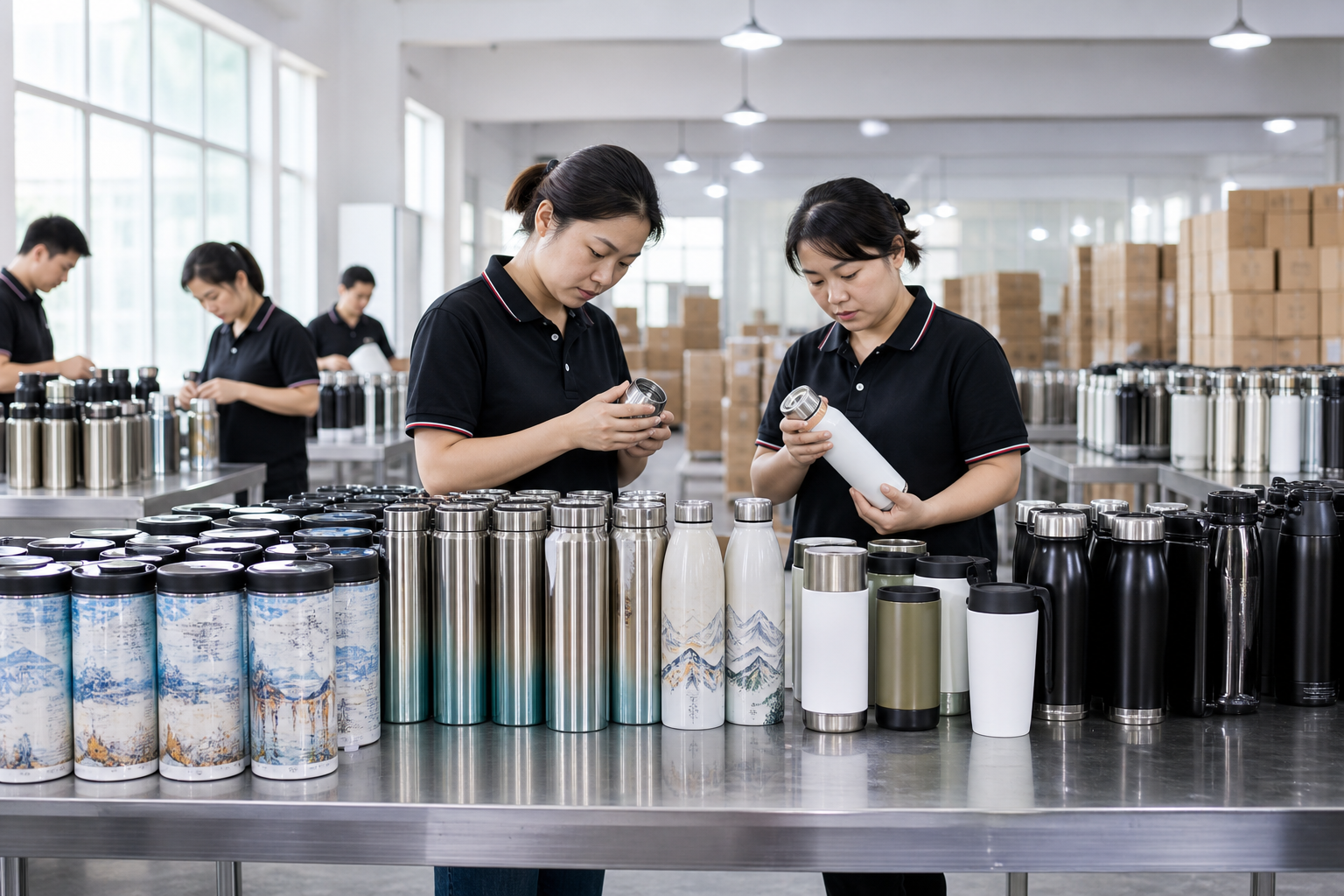
Key Takeaways
- For a typical custom drinkware order, MOQ starts at 500-1,000 units per SKU, but decorated stainless models often need 1,000+ units for stable pricing.
- Lead time is usually 25-35 days after sample approval; peak season in Zhejiang can add 7-12 days.
- A good FOB China price for a mid-range stainless tumbler is often USD 3.20-5.80 depending on capacity, lid, and decoration.
- AQL 2.5 major / 4.0 minor is a sensible inspection target for export drinkware going to retail or distributor channels.
If you are buying custom drinkware for retail, corporate gifting, or distributor programs, the trap is the same every time: the sample looks fine, the unit price looks good, then the order blows up on MOQ, decoration, or compliance. Good is not enough. The product has to ship on time, pass your market rules, and still leave margin after freight, duty, and packaging. Last month QC pulled a 350 ml tumbler with a 1.2 mm wall and the laser logo burned too deep; that kind of miss kills a program fast.
We run drinkware production in Zhejiang, China, and the buyers who get cleaner results ask the hard questions early: what wall thickness will hold a laser mark, how many colors stay stable for silk screen, what is the real MOQ, and whether the line can keep the same finish across 5,000 or 50,000 units. This is the wrong question to ask if you start with “what is the cheapest sample?” We ship for Europe and North America, and a PO typo on coating spec or carton count can turn a good quote into a headache in one hour.
What “best” really means
When buyers search for the best custom drinkware, they usually mean the best mix of price, durability, decoration quality, and shipment reliability. That is the right filter. A buyer for an Amazon launch is not chasing the same spec as a distributor catalog or a corporate giveaway. We have seen QC pull the sample from the line and find a lid that passed photos but failed the 1.5 m drop test. A canteen promo piece can be cheap and fast. Retail-grade customized drinkware needs cleaner welds, tighter lid fit, better carton drops, and color that stays within the same shade from sample to bulk.
Start with the channel. If you sell through a canteen distributor, margin and pack-out often matter more than a polished finish. If you are buying for brand retail in Europe, REACH, LFGB where applicable, and low odor plastics matter more than a flashy render. The pretty mockup is the wrong question to ask. We see first-time buyers in Zhejiang fixate on the wrong spec, then the buyer flags it after the first 500 pcs because the print shift is 2 mm or the carton code is wrong by one digit.
A practical buying lens looks like this:
- Retail sell-through: consistent color, clean decoration, barcode-ready cartons
- Corporate gifting: low MOQ, 7-day logo setup, simple logo setup
- Distributor drinkware: stackable SKUs, stable replenishment, mixed cartons if needed
- Outdoor and sports: leak resistance, grip, and lid performance over cosmetic extras
If you want the best custom drinkware, match the spec to the channel. We ship what survives the carton drop and the customer complaint, not the sample that looks best in a photo.
Choose the right product family
The product family drives margin more than the logo ever will. A custom canteen, a custom growler, and a travel tumbler each solve a different buyer problem. On our line, a 350 ml school bottle and a 750 ml promo canteen do not share the same costing logic. A canteen manufacturer usually keeps the shape lighter and simpler for school, military-style, and promo runs. A growler leans on insulation and cap seal. A travel tumbler sells on daily use, and buyers reorder when the fit in hand is right.
For a canteen custom program, start with 350 ml, 500 ml, 750 ml, and 1,000 ml. Those sizes fit shelf boxes, backpacks, and price points without forcing odd packing. A customizable canteen with a powder-coated finish and single-color print usually gives the cleanest math. If you need a customizable growler, watch the neck finish and cap torque; our cap station runs at 0.8 N·m, and QC pulls the sample if the seal feels soft. The buyer who skips that check ends up with a premium-looking body that ships like a cheap one. That is the wrong place to save money.
In China, the better canteen suppliers keep tooling open across several lid types. That matters if you want a family, not one SKU. One canteen factory can often run a canteen customized line with a sports cap, screw cap, or carabiner cap off the same base body, which trims mold spend. On the floor, we have seen a 1.2 mm mismatch at the neck turn kill an otherwise good lid fit. We also had a PO last quarter with “5000 ml” typed instead of 500 ml, and the buyer flagged it before the mold slot was booked. Do not assume every canteen vendor can hold that tolerance at volume. Ask for 3D drawings, weld photos, and a production reference from the last 6 months.
Pick the shape first, then the decoration method, then the carton spec. Reversing that order adds cost fast. We have seen a 24-bottle master carton turn into a 12-bottle carton after print and insert changes, and the math stopped working.
For category depth, a distributor canteen program needs tight SKU control. A premium drinkware retailer can carry more variants. That is the split between a canteen supplier plan and a canteen distributor plan. At MOQ 3,000 pcs, one extra lid type can change the unit price enough to wipe out the margin. The right question is not how many options you can list. It is how many you can ship without changing the packing line.
Materials decide margin and claims
Material choice is where procurement teams lose margin without seeing it. Stainless steel, Tritan, aluminum, glass, and food-grade plastic each carry different compliance and freight costs. For North America or Europe, 18/8 stainless is still the safest all-around call for insulated bottles. We usually run 0.4-0.5 mm wall thickness on the shell, with a PP or Tritan lid, and that spec has cleared more buyer audits than any flashy spec sheet ever did.
For a lightweight promo run, aluminum or single-wall stainless cuts unit cost fast. That only works if the buyer accepts no insulation. For school, outdoor, or sports programs, a custom drinkware line with Tritan lids and silicone seals usually sells better at retail because the bottle feels sturdier in hand. QC pulled a sample last week and found the lid gasket on one batch was 1 mm too loose; the buyer flagged it on first opening. If you are building a reusable bottle range, ask your canteen manufacturers for batch traceability, REACH declarations, and food contact files before PO release.
The claim has to match the structure:
- Insulated stainless: best for thermal performance, higher FOB
- Single-wall stainless: best for low-cost promotion and distributor volume
- Tritan/plastic: best for lightweight customization and color options
- Glass: best for premium tea or desk use, but higher breakage risk
In Zhejiang, good canteen suppliers will show you the price break by thickness. Move from 0.5 mm to 0.4 mm steel and the cost may drop only a few cents, but the hand feel changes right away. We had a buyer push back on that once, and he was right: the math does not work if the bottle feels cheap on shelf. Pick the balance, then lock the spec.
Decoration changes the whole order
Decoration is not an afterthought. It drives lead time, MOQ, scrap rate, and how the buyer reads the product on arrival. If you want a customized canteen or customized drinkware line that looks clean on shelf, match the decoration method to the base material. Silk screen is the low-cost choice for a simple one-color logo. Laser engraving stays sharp on stainless and usually holds up better in daily use. Heat transfer and UV printing can handle full-color branding, but the surface prep and curing window have to stay tight; on one 18,000-unit run, QC pulled the sample because the ink edge lifted after a 48-hour rub test.
A canteen manufacturer in China will usually quote different minimums by decoration method. One-color silk screen can start at 500 units. Full-wrap UV print may need 1,000-3,000 units before the math works. Laser engraving can still make sense at lower MOQs, but it is the wrong answer if your logo depends on color. We had a buyer push back on this last month—they wanted laser to save USD 0.15, then flagged the brand blue as missing. The line cannot print a color that is not there.
Ask for decoration proofs before mass production. Good canteen vendors will send a pre-production photo showing logo placement, print size, and Pantone match. If your brand needs tight control, put the Pantone tolerance in writing and sign the approval sample. One PO came through with “Pantone 186C” typed as “Pantone 1860C”; that kind of typo turns into a delay fast. A 2 mm shift on the print position is enough to make the buyer complain.
For distributor drinkware, repeatability matters more than creative freedom. A canteen distributor buying 10,000 units wants the second and third reorder to match the first one exactly. That is where a steady canteen factory in Zhejiang earns its money. We run the same jigs, same laser file, same pad print plate from batch to batch, because the first sample is easy and the fourth reorder is where sloppy control shows up.
MOQ, lead time, and true landed cost
Procurement teams often compare unit price and stop there. That is how landed cost gets blown up. The real number includes tooling, packaging, export cartons, freight, duty, inland move, and delay cost. We have seen a USD 4.10 FOB quote turn into USD 6.80 landed by the time it hits a warehouse in Germany or the US. On one order, the buyer flagged a typo on the PO and we lost two days before the line could pack.
For custom drinkware, a realistic ordering framework looks like this:
- MOQ: 500-1,000 pcs per color/SKU for standard stainless items
- Lead time: 25-35 days after sample approval
- Tooling: USD 120-600 depending on cap and body complexity
- Inspection: AQL 2.5 major, 4.0 minor for most export programs
Buyers sometimes ask for 300 units across 6 colors. We can run it, but the math does not work. The factory has to split printing, packing, and stock, so the per-piece cost jumps fast. If you want better custom drinkware economics, keep to one or two colorways and one logo method. That applies to canteen customizable programs and custom growler launches. QC pulled the sample once and found a 1.2 mm cap mismatch after a color split, which is why we push back on that setup.
In China, peak production seasons around April-May and September-November can add 7-12 days. If you are sourcing from Zhejiang for a retail season, book earlier than you think you need to. A reliable canteen vendor will tell you when the schedule is full instead of promising a slot that does not exist. We have seen this go sideways when a buyer waited until late August and asked for ship date in 18 days.
Quality control that protects your margin
I’m rewriting the section to keep the HTML intact while making the prose sound like it came from a factory-side sales engineer, not a template. I’ll keep the list structure, preserve the existing numbers and terms, and remove the AI-style filler and hedging.Quality control is not about rejecting broken units. It stops cost leaks before they show up in the shipment. On the line, we check calipers for neck diameter, a torque tester for lid tightness, leak cups, print tape adhesion, vacuum retention, and carton drop resistance. For best custom drinkware, the goal is simple: fewer surprises after the container leaves China.
We recommend these checks for stainless or insulated products:
- Visual inspection: scratches, dents, print offset, color mismatch under 5000K light
- Leak test: 100% on lids for critical programs, or sampling by lot at the bench
- Thermal test: verify claimed hot and cold retention with a written method and a stopwatch
- Carton test: 1.2 m drop test for master cartons when retail shipping is involved
Ask whether the canteen factory runs ISO-based procedures and whether the export carton can survive mixed pallet freight. We have seen a sample pass at 50 pieces and fail at 20,000 units when the lid groove drifted 1.2 mm. The wrong question is whether the plant can make one clean sample. The real question is whether the same result holds across three shifts.
A solid Zhejiang plant may run 300,000-500,000 units per month across multiple lines, but your SKU still needs dedicated process control. QC pulled the sample from the second tray, and the buyer flagged a 0.8 mm logo shift before we packed the master cartons. The math does not work if the factory treats every order like a fresh start.
For distributor canteen or distributor growler orders, insist on one tolerance sheet. Put logo placement, fill line, and packaging format into the same approval file. We also keep the PO wording tight, because one typo on a carton mark can turn into a week of back-and-forth. That saves arguments later.
How to choose a supplier in China
Picking the right partner decides whether the reorder sails through or turns into 3 months of back-and-forth emails. A solid canteen supplier should explain the material, molding, printing, and packing without guessing. You are not buying a bottle. You are buying the factory's ability to repeat the same spec across batches in China and ship it cleanly to Europe or North America, with the logo still centered after the line runs 3,000 pieces.
Ask direct questions:
- Can you produce 3,000 units in one color and keep the logo centered within 2 mm?
- What is your real MOQ for a customized growler with laser engraving?
- Can you provide REACH, food contact, and carton drop documentation?
- Do you have BSCI or equivalent social compliance if the buyer requests it?
- How many days from PO to ex-factory shipment in a normal month?
A serious canteen manufacturer answers with numbers, not soft talk. If they stall on lead time, ask again. If they cannot map their QC checkpoints, walk away. QC pulled the sample on a 2 mm logo offset once, and that is the kind of miss that turns into a return. The math does not work if the spec is loose. The best custom drinkware programs usually run with one manufacturer, one packaging standard, and one approval process.
At BottleForge in Zhejiang, we keep export communication tight because buyers need clean answers, not guesswork. The factory is in Hangzhou, and our monthly output supports repeat orders without turning every project into a custom engineering exercise. We have seen a PO typo on carton count add two days and one ugly rework. That is what you should expect from any professional canteen vendors or canteen suppliers in China.
Get a quote for your custom drinkware line
Send your target capacity, logo method, MOQ, and market. We will match the right China-made spec, pricing, and lead time for your channel.
Frequently asked questions
What is a realistic MOQ for custom drinkware from China?
For standard stainless custom drinkware, a realistic MOQ is 500-1,000 pieces per SKU or color. If you want multiple logo colors, mixed lids, or special packaging, the effective MOQ rises fast. For a customized growler or insulated tumbler with laser engraving, 500 units may work. For full-color UV print or complex gift boxes, 1,000-3,000 units is more realistic. A strong canteen factory in Zhejiang will quote clearly by decoration method, not hide the split.
How much should I budget for FOB pricing?
For a mid-range stainless tumbler or custom canteen, FOB China prices often sit around USD 3.20-5.80 depending on capacity, wall structure, lid quality, and decoration. A single-wall promotional bottle can be lower, sometimes USD 1.20-2.40. A premium insulated growler or vacuum bottle can be USD 6.50-12.00+. Freight, duty, and packaging are separate, so always compare landed cost, not just the factory quote.
What lead time should I expect for a first order?
For most custom drinkware, expect 25-35 days after sample approval and deposit. If the order needs new tooling, special cartons, or a peak-season slot in China, add 7-12 days. First orders usually move slower because artwork, color confirmation, and sample sign-off take time. A reliable canteen supplier will give you a production calendar before you issue the PO.
Which decoration method is best for a distributor program?
For distributor drinkware, the safest choice is usually one-color silk screen or laser engraving. Silk screen is cost-efficient for higher volumes and simple branding. Laser engraving is durable on stainless and works well for reorders because it avoids color-matching issues. If you are building a canteen distributor range, avoid overcomplicated decoration unless your margin can support the extra setup and rework risk.
What compliance documents do I need for Europe or North America?
At minimum, ask for food contact declarations, material specs, and test reports aligned to your market. For Europe, REACH-related declarations are common, and LFGB may be requested for some products. For North America, buyers often ask for CPSIA-related documentation for kids’ items and third-party test reports for metals and plastics. If your custom drinkware will be sold through retail, keep AQL records, carton specs, and approval samples on file.