Key Takeaways
- A 750 ml sport bottle usually lands between USD 1.85 and 4.20 FOB depending on material, lid, and print coverage.
- For B2B orders, MOQ often starts at 1,000 to 3,000 pieces; lower MOQ usually means higher unit cost by 12% to 28%.
- Stainless steel 18/8 with 0.4-0.5 mm wall thickness is the safer choice for premium custom sport bottle programs.
- Ask for REACH, FDA, LFGB, and AQL 2.5 inspection terms before you approve a canteen customized sample.
If you buy drinkware for retail, promotions, or e-commerce, the best custom sport bottle is not the prettiest sample. It is the one that fits your target price, clears compliance, and holds up after 3,000 to 10,000 cycles of handling, washing, and shipping. We’ve had buyers approve a slick sample, then the first carton shows up with a lid that loosens after two dishwasher runs. That is a bad start.
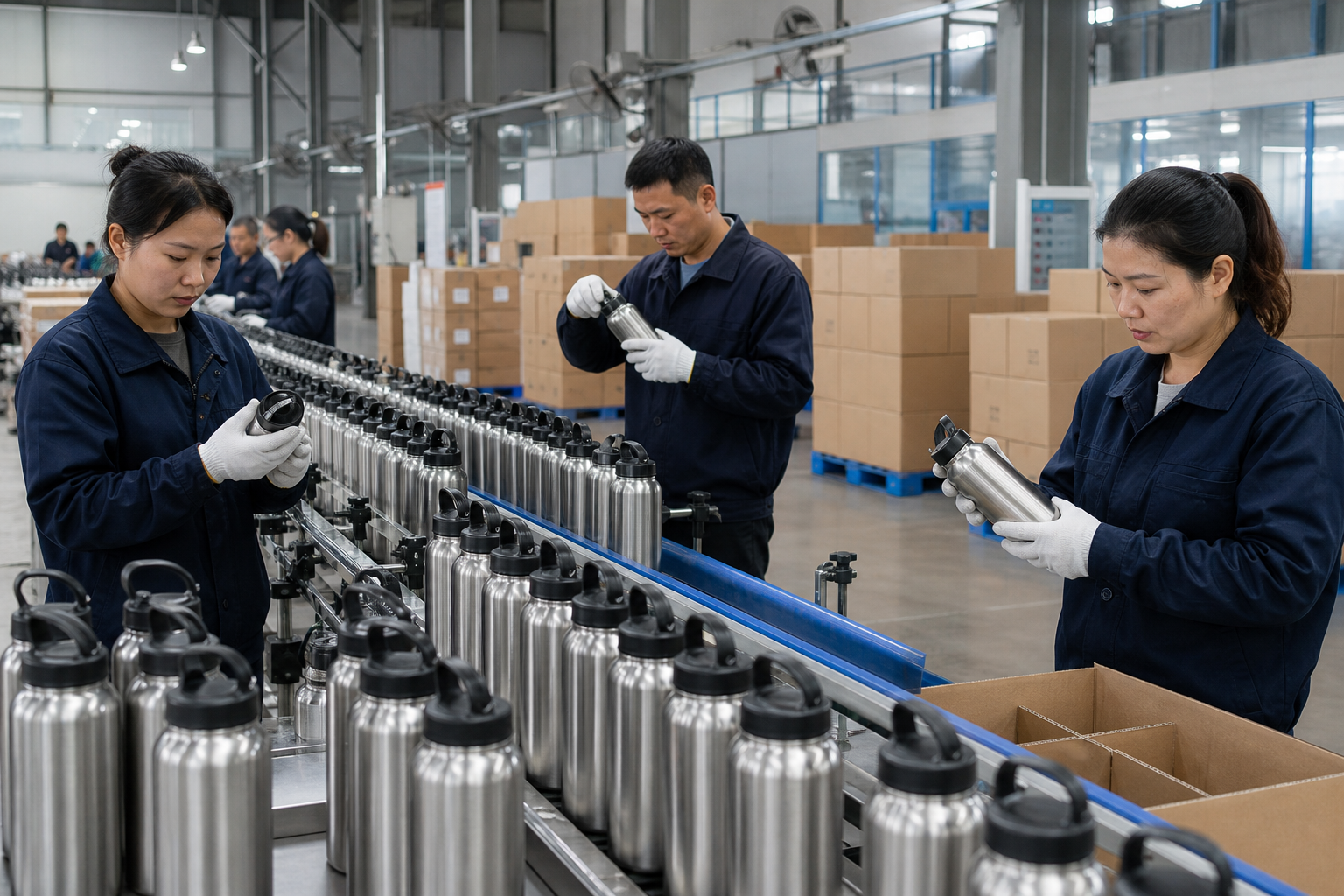
In Zhejiang and across China, the market is packed with canteen manufacturers, canteen suppliers, and canteen vendors обещing fast lead times. The buyer who asks the right questions gets a better result: material, lid design, print method, MOQ, test standards, and whether the factory can keep tolerance steady on a 5,000-piece or 20,000-piece run. On our line in Hangzhou, we run 80,000 units per month with a 15-day lead time on standard custom drinkware jobs, and QC pulled the sample when a 0.8 mm wall spec drifted on a PO. The math does not work if the factory cannot hold that.
What buyers really mean by best
When buyers ask for the best custom sport bottle, they usually mean one thing: the bottle has to hit price, branding, compliance, and delivery in the same PO. We run plenty of programs where the buyer loves the sample, then the repeat order dies because the print smears or the carton count is off by 2 pcs. A distributor can sell a fancy customizable canteen once. A canteen distributor who wants repeat orders needs a model that prints cleanly, nests well in cartons, and comes back with low defect rates. That is a different job.
The strongest commercial options are usually 750 ml to 1,000 ml bottles because they balance shelf presence and freight efficiency. On the line, that size also fits common carton layouts better than odd shapes, so we can keep the outer carton under 12 kg more easily. For a custom canteen or customizable drinkware program, we usually see three workable tiers: PET or Tritan for low-cost promotions, aluminum for lightweight mass-market use, and 304 stainless steel for higher perceived value. A custom growler sits in a separate bucket, but the buyer math is the same. If the lid leaks at 500 units or the coating chips on the first drop test, the program goes sideways fast.
Look past marketing claims and ask for the numbers. Does the factory show thickness in millimeters? Does the lid torque stay consistent? Can they provide a drop test report from 1.2 m? Can the canteen manufacturer confirm ink adhesion after 50 dishwasher cycles, or at least give a realistic hand-wash recommendation? QC pulled the sample on one job because the logo shifted 1.5 mm after curing, and the buyer flagged it right away. If they cannot answer those points, you are not buying the best product; you are buying the loudest sample.
Material choices that hold up
Material choice drives most of your final FOB and failure rate. For a custom drinkware program, 18/8 stainless is still the safest premium pick: it takes vacuum insulation, resists dents on the packing line, and gives buyers a product they can put on a shelf without apology. On a double-wall bottle, 0.4 mm for the inner and outer shells is the common spec; 0.5 mm adds rigidity, but it also adds grams and cost. We ran both on the same line last season, and that extra 0.1 mm pushed FOB up 6% to 10% at the same volume.
Plastic still has a place. Tritan is the clear option for a canteen customizable project when you need BPA-free positioning and a clean look without steel weight. It is not cheap. On one 24,000-piece order, the buyer flagged a 2 mm tint shift after QC pulled the sample under the light box, and the fix was resin color matching plus tighter drying control, not a prettier render. Aluminum works for sporty promotional canteen promotional orders, but the coating and liner carry the risk, not the shell.
- 18/8 stainless steel: best for premium retail and corporate gifting.
- Tritan: best for clear, lightweight, reusable programs.
- Aluminum: best for low-to-mid price sports campaigns.
- PP/PE bottles: best for entry-level promotions, not premium resale.
If you are sourcing from a canteen factory in Zhejiang, ask for the exact raw material grade, not just “food grade.” Asking only for that is the wrong question. A serious canteen supplier should state the resin, steel grade, coating system, and lid gasket material in writing. One PO typo swapped EPDM for silicone on a 5,000-unit run, and we caught it before molding started. That is how you separate a real canteen manufacturer from a trading-only canteen vendor.
Lid design changes your defect rate
Buyers spend too much time on bottle shape and too little on lids. That is the wrong question. On most custom canteen orders, the lid drives the complaints, not the body. We have run orders where the bottle print passed, then the straw valve stuck, the silicone seal swelled, or the flip-top hinge cracked after 2,000 openings. On one line, QC pulled three lids with a 0.3 mm flash at the seal seat, and that was enough to turn a clean order into returns. For distributor drinkware programs, a 2% lid failure rate will eat margin once replacements and freight are counted.
For the best custom sport bottle, choose the closure around user behavior, not looks. Sports caps with push-pull tops are cheap and light. Screw caps with silicone carry loops fit broad retail use. Flip lids work for children and office users, but the hinge needs reinforcement. A buyer once pushed back on a flip cap because the sample looked fine on the shelf; the torque wrench said otherwise after 1,500 cycles. For a custom growler or customized growler program, the closure target changes. Pressure retention, gasket wear, and gasket compatibility with acidic drinks matter more than the graphics.
Ask for these lid details:
- Silicone hardness, usually 50 to 70 Shore A
- Thread count and torque spec
- Leak test under inverted storage for 24 hours
- Replacement seal availability for after-sales support
If you are buying for a canteen distributor network, standardizing on one or two lid families cuts spare parts and packaging work. We ship faster when the same cap fits 500 ml, 750 ml, and 1,000 ml bodies. A good canteen manufacturers shortlist should include factories that can hold the same artwork placement across all three sizes without forcing a new proof each time. We have seen POs with a single typo on the neck finish code create a week of back-and-forth, so this is worth checking before you approve.
Decoration methods that survive use
Decoration is where a custom drinkware order either looks cheap or lands on a retail shelf clean. Screen print is still the workhorse for simple logos and one-color branding. We run it on the flat table with a 120T mesh, and it holds up well when the buyer wants 5,000 pieces without chasing a fancy effect. Laser engraving stays sharp on 304 stainless steel and does not chip, so it fits premium custom drinkware and customized canteen programs. UV print gives color and fine detail, but the surface prep and curing need control. Heat transfer and sublimation work on coated bottles, yet we still pull an abrasion test before we approve the run.
A canteen customized with a 360-degree wrap print may look great in photos, but if the ink scratches in transit, the first buyer complaint is already packed in the carton. We had one PO with a typo on the pantone code, and QC pulled the sample before the line started. For high-turn distributor canteen orders, we usually recommend one of three approaches:
- One-color pad or screen print for the lowest cost and steady repeatability.
- Laser logo for steel bottles where premium perception matters.
- UV or wrap print only when the artwork is central to the brand story.
Expect a print setup fee of USD 35 to 120 per color or per process, depending on complexity and line setup. If a canteen supplier says decoration has no setup cost, the math does not work. They hide it in unit price, or the quote falls apart later. In Zhejiang, serious canteen factories price decoration separately because that is the only honest way to compare quoted FOB terms.
For B2B buyers, the best decoration is not the most visible one. It is the one that keeps the same color and edge quality after a full carton journey, a warehouse re-pick, and a store shelf touch test.
MOQ, lead time, and real pricing
Most procurement mistakes start with sample price, not landed cost. A sample at USD 18 tells you almost nothing. The real question is what a 3,000-piece or 10,000-piece custom canteen order costs FOB China, and whether that number holds when you repeat the same PO in 6 months. On our Hangzhou line, a standard 750 ml stainless custom sport bottle with one-color logo usually lands around USD 2.10 to 3.40 FOB at 3,000 pieces. A vacuum bottle with a premium lid runs USD 3.80 to 5.20. We had one buyer flag a PO typo on “750ml” versus “700ml” and the reprint cost more than the first sample. That is the wrong question to ask if you only look at the sample.
MOQ drives the math because tooling, print setup, and carton planning are fixed costs. A 500-piece MOQ looks friendly, but unit cost usually rises 12% to 28%. QC pulled the sample on a 500-piece trial once and the buyer still pushed for the lower price; the numbers did not work. For a new distributor testing a market, that can still be the right move. For a canteen distributor placing repeat monthly orders, 1,000 to 3,000 pieces is usually the sweet spot. A good canteen supplier will show the price breaks instead of acting like 500 and 5,000 are the same job.
Typical lead times from a capable canteen factory in China:
- Standard stock body with logo: 12 to 18 days
- Custom color body or lid: 20 to 28 days
- New mold or special packaging: 35 to 50 days
We ship FOB because it keeps the comparison clean, especially if you are consolidating from Zhejiang. If you need DDP, ask for HS code assumptions, carton weights, and palletization details at the quote stage. One carton spec change from 10 kg to 12.5 kg can shift freight by a few hundred dollars on a small run. A hidden 400 kg freight hit wipes out the savings from a cheap canteen vendor fast.
Compliance and quality checks
If you sell into Europe or North America, compliance is not a nice-to-have. A real canteen manufacturer should hand over REACH papers, food-contact declarations, and FDA or LFGB support files where they apply. For coated stainless bottles, ask for a 3% acetic acid migration test or an equivalent food-contact result. For plastic parts, the resin should be BPA-free, and the colorant list needs food-contact approval. We have had buyers send a PO with “food grade” only. That wording does not pass QC.
Quality control has to be set before the line starts. We run AQL 2.5 for major defects and AQL 4.0 for minor defects on standard export drinkware, while some retail programs tighten that. If your order is a custom drinkware line for a distributor, spell out print position, lid fit, vacuum retention, and carton compression. Do not let a supplier catalog stand in for an inspection plan. The math does not work. QC pulled the sample on a 24 oz bottle last month and found a 1.5 mm print shift; the buyer flagged it before mass production.
Key checks before approval:
- Drop test from 1.2 m, 6 faces
- Leak test, inverted for 24 hours
- Wash test, at least 50 cycles if hand-wash claims are made
- Packaging drop test for ecommerce or FBA use
For Amazon or similar channels, label placement and carton strength matter as much as the bottle. A canteen promotional item that shows scuffs on arrival gets returned even if it still holds water. We ship cartons with 5-layer outer boxes for this reason, and we check the ECT spec before booking. That is why serious canteen manufacturers in Zhejiang build packaging into the quote, not after the sample is approved.
How to choose the right factory partner
The gap between a usable supplier and a strong factory is repeatability. An 80,000-unit-a-month canteen factory can still be the wrong partner if logo position drifts by 2 mm, lid fit changes after 500 cycles, or coating thickness swings from one batch to the next. We run into this all the time on the line. A sharp sales deck does not fix a bad transfer print or a loose cap.
When you compare canteen manufacturers, ask for the actual line setup: welding method, coating line, laser capacity, print stations, and in-house QC checkpoints. A real canteen manufacturer can point to where defects start and where QC pulls the sample. A weaker canteen vendor only sends finished photos and hopes you do not ask about the 304 stainless coil or the 3.0 mm wall spec. If you are buying custom canteen, customizable canteen, or customized canteen products for retail, you need raw-material traceability and batch codes, not sales talk.
Use this quick filter:
- Can they show monthly output and current order backlog?
- Do they offer clear FOB or EXW quotes with separate decoration costs?
- Can they support repeat artwork files without redesign charges?
- Do they answer compliance questions directly instead of vaguely?
In Zhejiang, the better suppliers quote a little lower on paper and ship on time more often. That is the factory partner you can build a distributor program around. For custom drinkware buyers, consistency beats promises every time. We have seen the wrong question sink a program fast: the buyer asks for the lowest sample price, then the PO comes back with a typo on the lid code and the math no longer works.
Request a custom quote for your bottle program
Send your target volume, lid style, and decoration method. We will quote FOB China, confirm MOQ, and match you with the right production line.
Frequently asked questions
What is a normal MOQ for a custom sport bottle order?
For standard export drinkware, MOQ is often 1,000 to 3,000 pieces per design. A simple one-color custom sport bottle can sometimes start at 500 pieces, but unit cost usually rises 12% to 28%. If you want custom color, special lid, or full-wrap print, expect the MOQ to move higher. For a canteen distributor or distributor drinkware program, 3,000 pieces is a practical starting point because it gives better pricing and steadier production scheduling.
Which material is best for a premium custom canteen?
For premium retail or corporate gifting, 18/8 stainless steel is usually the best choice. Use 0.4 mm wall thickness for standard double-wall construction and 0.5 mm if you want extra rigidity. Tritan is strong for clear bottles, but it does not deliver the same premium perception as steel. Aluminum is lighter and cheaper, but coating and liner quality become critical. If your customer wants a customizable canteen with repeat purchases, stainless steel is the safer commercial choice.
How much should I expect to pay FOB China?
A standard 750 ml custom sport bottle from China usually costs USD 2.10 to 3.40 FOB at 3,000 pieces with one-color branding. More complex vacuum-insulated models with premium lids can reach USD 3.80 to 5.20 FOB. Lower quantities raise the price quickly. If you are comparing canteen suppliers, make sure quotes include decoration, carton packing, and any color-matching fees, because those items can add 8% to 15% without being obvious.
What compliance documents should I request?
For Europe and North America, ask for food-contact declarations, REACH support, and where needed FDA or LFGB documentation. For coatings and inks, request migration or material statements. If the bottle uses plastic parts, confirm BPA-free resin and approved colorants. A good canteen manufacturer in Zhejiang should also provide AQL terms, batch traceability, and carton packing specs. If they cannot send these documents quickly, they are not ready for serious export orders.
Can I order a low-MOQ custom growler or canteen customized sample run?
Yes, but expect a trade-off. A low-MOQ custom growler or canteen customized run of 300 to 500 pieces is possible in many factories, especially in Zhejiang, but unit price will be higher and decoration choices will be limited. You may also pay a mold or setup fee of USD 35 to 120. This works for market testing, but if you already have confirmed demand, moving to 1,000 or 3,000 pieces usually gives you a better margin and more stable quality.