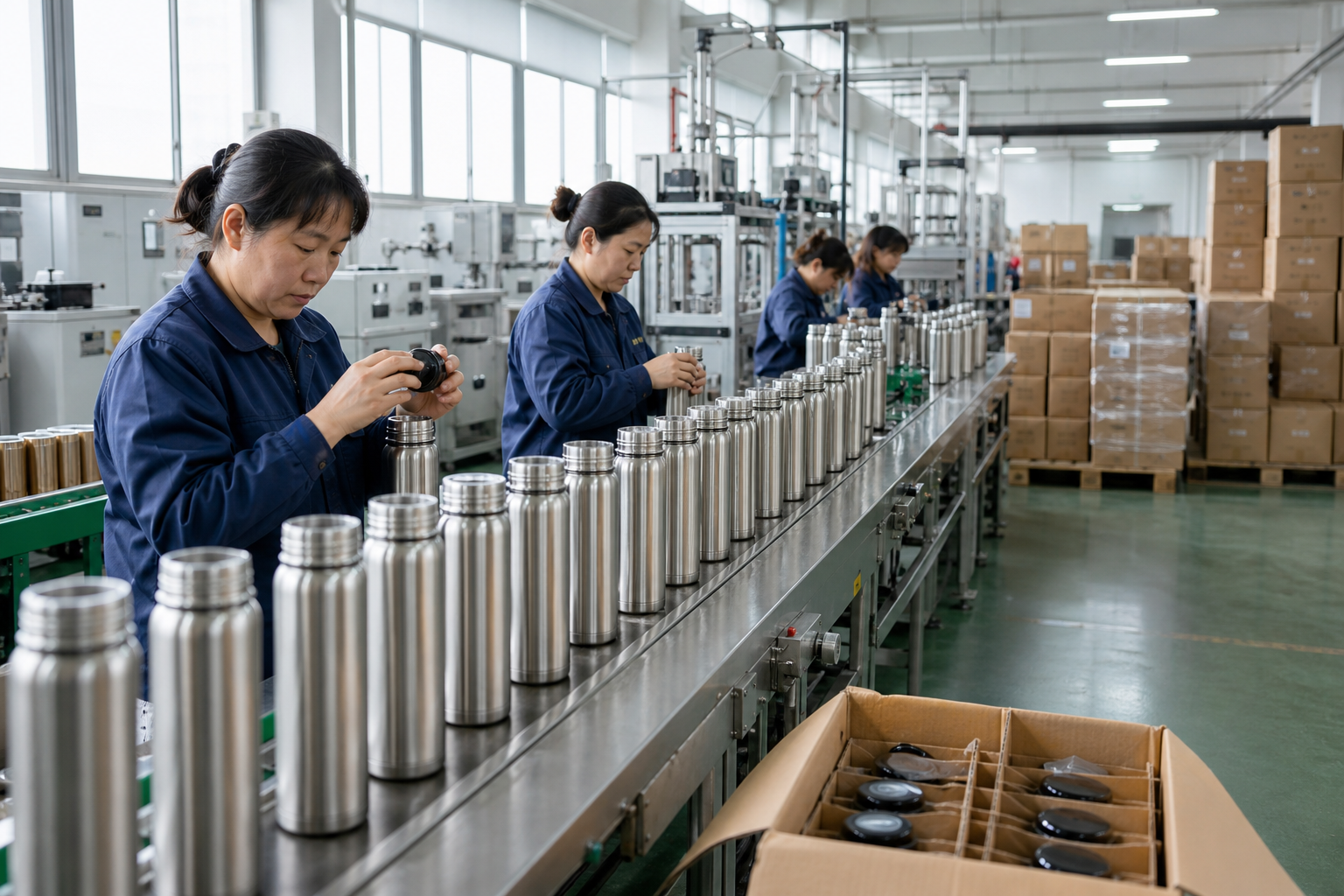
Key Takeaways
- For most programs, 304 stainless steel and a leak-proof lid are the baseline; 316 usually adds 5% to 15% to cost.
- Stock shapes often start at 500 to 1,000 pcs MOQ, while fully customized molds usually need 3,000 pcs or more.
- A disciplined canteen factory should quote 20 to 35 days after sample approval and explain AQL 2.5 / 4.0 inspection.
- Laser engraving lasts longer than basic screen print, but powder-coated bodies need a decoration test on the actual finish.
If you are sourcing the best custom thermal bottle, the hard part is not finding a supplier. It is telling a good-looking sample from a bottle that still holds 58°C after 8 hours, survives a 1.2 m drop test, and keeps the lid from leaking after 500 uses. We run this check on the line every week. In B2B, the deal lives or dies on steel grade, lid seal, coating adhesion, and whether the factory can hold the same spec across 3,000 pieces without drifting.
For buyers in Europe and North America, the right answer depends on your channel. A canteen distributor wants low defect rates, clean carton packing, and no barcode mix-up; a brand owner pushes for logo durability and shelf-ready presentation. This is the wrong question to ask if you only look at photos. If you are buying from Zhejiang or wider China, ask for real lead times, MOQ, and compliance files, not sales talk. QC pulled the sample once because a PO typo changed the bottle height from 260 mm to 240 mm, and the buyer flagged it before shipment.
What makes a bottle truly best
The best custom thermal bottle is not the thickest one or the cheapest one. It is the bottle that fits the job. Start with capacity, mouth style, and the heat-retention target. For office shelves and retail sets, 500 to 750 ml moves fastest. For outdoor packs or premium gifting, 1 L and up works, but freight jumps fast. We had a buyer push back on 1.2 L once; the carton math killed the margin.
Ask for real performance data: 6 hours, 12 hours, and 24 hours, all measured from the same starting temperature. A serious canteen factory will tell you if the claim comes from ASTM-style lab testing or an internal method, and that difference matters. Thin walls save cost on paper, but they dent. A 0.5 mm to 0.6 mm inner wall in 304 stainless steel is a common mid-market spec; 18/8 stainless is the safer baseline when corrosion risk is the issue. QC pulled a sample with a 0.48 mm wall last month, and it failed the tap test.
Do not treat cap design as a side item. A leak-proof lid, silicone gasket, and clean thread pitch drive returns more than the body shape. If you are building a canteen customizable line, confirm carton drop resistance and check whether the finish is matte powder, glossy spray, or raw steel. Buyers often ask for a custom canteen because the profile looks new, but the real question is whether it still holds up in a bag, a truck cab, or a warehouse break room. We run those checks every week, and that is where a custom drinkware program wins or gets cut.
Materials and insulation specs
Material choice decides how the bottle performs after 6 months in distribution. For most custom drinkware programs, 304 stainless steel is the default because it balances cost, formability, and compliance. We run this material on a lot of OEM orders. If a buyer plans acidic liquids, salty use, or a premium shelf position, 316 deserves a separate line item. That is the right call when the spec is tight.
Insulation is where canteen suppliers oversell. What matters is a proper vacuum gap, a clean weld, and steady sealing. Double-wall vacuum construction should be standard. On the line, we check the gap with a gauge before final assembly. If the factory offers copper plating, ask what it actually changes; it can improve thermal retention, but only when the bottle body and lid are built right. A bad lid kills the result.
- 304 stainless steel: best value for mass-market canteen custom orders.
- 316 stainless steel: better corrosion resistance for premium or food-contact-sensitive programs.
- Powder coat: better grip and scratch hiding than simple spray paint.
- Silicone ring: essential for leak resistance and repeat closure cycles.
If you are sourcing a custom growler or a wide-mouth customizable growler, carbonation pressure is a separate question. A thermal bottle lid is not automatically fit for beer or fizzy drinks. We had a buyer flag a PO typo once because the lid was listed as “spillproof” instead of “pressure relief”; the math does not work. Ask the canteen manufacturer for pressure tolerance, seal material, and whether the product is meant only for still liquids. In China, some factories can make both general custom drinkware and niche canteen promotional items, but the spec has to be locked before tooling starts.
Decoration that survives use
Logo choice is not cosmetic; it changes scrap rate. For distributor drinkware and retail canteen customized programs, screen printing works for one or two spot colors, but it wears faster in abrasive bags and after dishwashing. Laser engraving stays clean for premium pieces and almost never flakes. UV print can hold fine detail, yet it depends on a solid base coat and the right cure time on the oven rail.
If you want a canteen promotional item with a short sales cycle, keep the decoration simple. One logo, one Pantone color, one side. That is the job. If you want a branded SKU for a canteen distributor, ask for a decoration test on the actual production finish, not a sample body from another line. We have seen rough powder coat kill ink adhesion, and the buyer flagged it after the first rub test.
Artwork control also affects speed. A factory in Zhejiang that runs 120,000 units per month can still slip if your vector file is messy or your logo has gradients that need manual cleanup on the workstation. Send AI, EPS, or editable PDF files. Put the print position in millimeters, not “centered nicely.” If you need custom logo matching across a full customizable canteen range, ask for a first-article approval sample before mass production. That one sample catches more mistakes than a long email thread and a typo on the PO.
For distributor canteen programs, I usually push two decoration routes only: laser for premium wholesale accounts, or one-color screen print for volume promotions. Anything more complex slows the line and raises rejection risk at inspection. The math does not work when QC pulled the sample and found three weak points on the same job.
MOQ, lead time, and pricing
Pricing on the best custom thermal bottle comes down to four items: steel grade, lid structure, surface finish, and decoration. A 500 ml 304 bottle with a one-color logo and a standard gift box prices lower than a wide-mouth insulated bottle with two lids and a molded sleeve. On the line, we saw a sleeve add 38 g to one sample and cut carton loading by 12%. Do not look at EXW only. Carton size, inner pack, and freight volume can still move landed cost by 10% to 25%.
For a typical canteen factory in China, MOQ usually starts at 500 to 1,000 pcs per color for stock shapes, and 3,000 pcs or more for full custom molds. Lead time is usually 20 to 35 days after sample approval, and peak season or a packaging swap will stretch that. A solid canteen supplier should tell you if the line can hold 50,000 to 120,000 units per month without slipping on inspection. We run that check against the injection schedule, not a sales promise.
When you compare canteen suppliers or canteen vendors, ask for a quote split by bottle body, lid, decoration, packaging, testing, and carton dimensions. That is the fastest way to see whether a distributor canteen program is real or just cheap on paper. If you need FOB China pricing, confirm the port, trade terms, and whether the price covers export cartons and standard master carton marks. The buyer flagged one PO last month because the carton width was written as 1.5 mm off, and the math did not work.
If you are building a repeat order for a canteen distributor, keep the spec stable. A lid color change, a box size change, or a coating shade change is how a clean order turns into a costly one. We have seen this go sideways over a 2 mm lid gasket tweak. The buyer wants speed, but the line wants a fixed spec.
Compliance and quality control
Compliance is where first-time buyers lose time fast. For Europe, ask for REACH files on coatings and seals, plus food-contact proof for your target market. In Germany and the wider EU retail channel, LFGB-type requirements come up all the time even when the factory only says “food grade.” For North America, buyers usually want FDA food-contact declarations and migration test reports from an accredited lab. We had one buyer flag a PO typo on the seal material, and the paperwork had to be reissued before we could ship the 8,000 pcs order.
QC should be written into the PO, line by line. AQL 2.5 for major defects and 4.0 for minor defects is a normal starting point for custom drinkware, but channel matters. A corporate buyer will reject a matte black bottle for a 1 mm scuff that a distributor might pass. That is the wrong question to ask if you only look at unit price.
Ask the canteen manufacturer how they check vacuum loss, leak testing, coating adhesion, and drop performance. Good answers sound like a work order: 100% leak test, random vacuum check, 1% carton drop test, and a gauge number, not sales talk. If they cannot say what fixture they use or how many pieces they pull from each batch, they are not running a disciplined line. We run into this on custom canteen, custom growler, and customized drinkware sets with lids and sleeves. The right factory in China shows documents before samples. QC pulled the sample, saw a 0.3 mm coating pinhole, and we held the lot.
Ask for a pre-shipment inspection plan too. If the supplier in Zhejiang already has a BSCI audit and stable export history, that cuts friction, but it does not replace your own QA checklist. We have seen this go sideways when a buyer relied on the audit and skipped the carton drop test on a 24-piece pack.
Pick the right channel fit
The best custom thermal bottle depends on who is buying it. For a corporate program, we ship a slim 500 ml bottle with one-color branding and neutral colors; it moves faster than a flashy shape. For outdoor retail, a larger double-wall bottle with a handle lid and a powder coat that takes a scratch test after 300 rubs makes more sense. For beverage distributors, a customizable canteen or custom growler works if you need a wider mouth and a stronger carry handle, but the lid spec has to fit the drink category. We had a buyer flag a PO typo on the lid code once, and the whole lot sat on the line for 4 days.
Use this rule: if the buyer handles the bottle every day, put durability and lid cycle life first. If the bottle is a gift or promo item, put print clarity, gift box quality, and replenishment speed first. If you need a line for a canteen distributor network, standardize on 2 to 3 bodies and 4 lid colors instead of chasing endless custom parts. That keeps inventory simple and lets the factory in Zhejiang or elsewhere in China repeat the same canteen customizable format without surprises. The math doesn't work any other way.
One clean SKU that ships on time is better than three clever concepts that miss the season.
That is the practical way to build a canteen custom or customized canteen program: choose the right body, lock the lid, approve the decoration, then scale. If you need a distributor drinkware line, keep the spec narrow and the replenishment steady. We run this with 500 to 1,000 pcs MOQ steps, because a wide catalog ties up cash, pallets, and shelf space fast.
Request a spec sheet and sample quote
Send your target capacity, logo file, and market. We will quote the right build, MOQ, and lead time for China production.
Frequently asked questions
What MOQ should I expect for a custom thermal bottle?
For stock shapes, many factories in China will quote 500 to 1,000 pcs per color if your decoration is simple. If you want a new mold, custom lid, or unique body profile, 3,000 pcs is a more realistic starting point. A good canteen factory should also tell you whether the MOQ changes by capacity, because 350 ml and 1 L often run on different lines. For a distributor canteen program, ask for MOQ by color and by carton assortment so you can avoid dead stock.
Is 304 or 316 stainless steel better for my order?
304 is the normal baseline for most custom drinkware because it keeps cost under control and performs well for water, tea, and coffee. 316 is the better choice if you want higher corrosion resistance, a more premium spec, or you expect harsher cleaning cycles. In practical terms, 316 often adds 5% to 15% to the bottle cost. For a canteen distributor selling volume, 304 usually wins. For a premium custom canteen or custom growler line, 316 can be worth the margin.
How long should a thermal bottle actually hold temperature?
Do not trust a single headline claim. Ask for 6 hour, 12 hour, and 24 hour test data with the test method explained. In real use, fill temperature, ambient temperature, lid quality, and how often the bottle is opened all matter. A bottle that claims 24 hours may still feel disappointing if the seal is weak or the lid has too much headspace. For a customized drinkware program, ask the canteen manufacturer for lab data and use-case notes before you approve the sample.
Which logo method lasts the longest?
Laser engraving usually lasts the longest because it changes the metal surface instead of sitting on top of it. It is a strong choice for premium distributor drinkware and office gifts. Screen print is fine for one- or two-color artwork, but it can wear faster if the bottle is tossed in bags or washed aggressively. UV print can look sharp, but it needs the right coating and curing. If you are ordering canteen promotional stock, test the decoration on the actual powder coat finish, not on a different sample body.
What compliance documents should I request from a China supplier?
For Europe, ask for REACH-related documents and food-contact support that matches your target market. For retail into Germany or the wider EU, LFGB-style testing is often requested. For North America, many buyers want FDA-related food-contact declarations and migration testing from a recognized lab. Also ask for the factory audit status, such as BSCI, and a written QC plan with AQL levels. A good canteen supplier in Zhejiang should be able to send these before you place a repeat order.