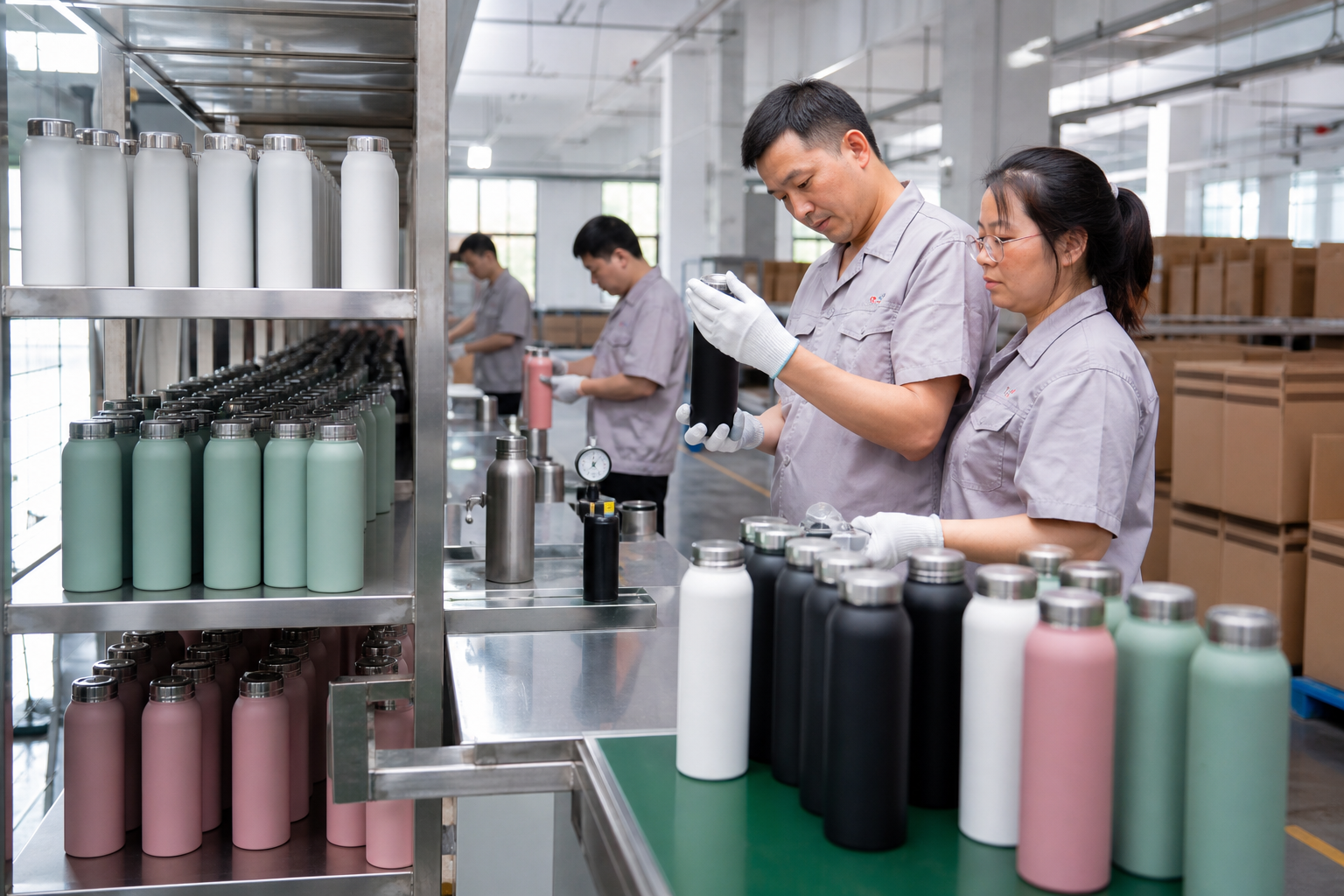
Key Takeaways
- A usable custom thermos usually starts at 304 stainless steel, 0.4-0.5 mm wall thickness, and 1,000 pcs MOQ.
- For most bulk thermos orders, expect FOB China pricing from about USD 4.20-9.80 depending on capacity, coating, and lid.
- A reliable factory should quote 25-35 days lead time for standard customized thermos orders and provide AQL 2.5 inspection.
- For outdoor retail, leakproof lids and 12-24 hour insulation matter more than a large logo area.
If you are buying the best custom thermos bottle for outdoor retail or promotions, the first mistake usually starts with the sample. We have seen buyers approve a shiny cup, then the line fails on leak tests, coating rubs off in 300 cycles, or the heat hold drops after 6 hours. QC pulled the sample on a 24-hour inversion test. That tells you more than a polished photo ever will.
The right way is plain: define the use case, then match the body, insulation spec, and decoration method to it. A factory in China should give you hard numbers, not sales talk: 304 or 316 stainless steel, 0.4-0.5 mm inner wall thickness, 18-24 hour heat retention depending on construction, MOQ from 1,000 pcs, and lead time around 25-35 days for standard custom runs. The buyer flagged a PO typo on cap color once, and that small miss cost 4 days. That is the difference between a real factory thermos program and a cheap promotional thermos that looks fine on first order and turns into a headache on reorder.
Start with the use case
A hiking retailer and a trade show buyer are not buying the same custom thermos bottle. Outdoor customers care about grip, weight, one-hand drinking, and insulation that still holds after a cold morning on the trail. Promo buyers watch unit cost, print area, and whether the lid survives 3,000 open-close cycles. We run those two jobs on different lines for a reason. If you treat them the same, you pay for features the buyer will never use.
For retail, I usually start at 500 ml to 750 ml, with double-wall vacuum insulation and an outer diameter around 70 mm to 75 mm so it still slips into a backpack pocket or cup holder. For promotions, 350 ml to 500 ml is the cleaner call because the unit cost drops and the cartons ship tighter. On the shop floor, we check the neck finish with a caliper before we quote, because a 1 mm miss can break the lid fit. Ask where the bottle will live before you ask for a price. A serious thermos manufacturer in China will tell you straight whether the job wants a straight-wall bottle, a mug-style lid, or a wide-mouth carry model.
Do not let the supplier force one shell into every market. A promotional thermos for a marathon event can run with a basic PP lid and pad print. A retail-ready customizable thermos for an outdoor chain needs a tougher coating, cleaner welds, and packaging that passes drop tests. Last month QC flagged a scuffed seam on a 24-pack before it left the shrink-wrap station, and that saved a return. If the factory cannot explain that split clearly, this is the wrong question to ask. They are not selling a manufacturing solution. They are moving boxes.
Steel grade and insulation
I’m rewriting the section to keep the HTML intact while stripping the generic phrasing and adding the kind of production detail a buyer would hear from a factory, not a brochure.Most buyers ask for “stainless steel” and stop there. That is too vague. For a proper factory thermos, the inner liner should be 304 stainless steel at minimum. If you are selling into premium outdoor or food-contact-sensitive channels, 316 stainless is the better call for corrosion resistance, but it lifts cost by about 8-15%. The outer shell can also be 304, or 201 on low-cost promotional thermos programs, but 201 needs caution because rust shows up faster in humid storage or coastal distribution. This is the wrong question to ask. On the line, we start by checking the material stamp before the sample goes to QC.
Wall thickness matters more than many marketers admit. A common spec is 0.4 mm inner wall and 0.5 mm outer wall. Go too thin and the bottle dents during freight and retail handling. Go too thick and you add weight without real performance gain. For insulation, a good thermos factory should provide test data: 6 hours hot above 65°C, 12 hours above 55°C, or 24 hours above 45°C depending on capacity, ambient temperature, and lid type. These numbers should tie to a standard test condition, not a vague promise. We've seen this go sideways when a buyer tried to save 0.05 mm and then the carton crushed the necks in transit.
Ask for the test method in writing. If the supplier’s thermos team cannot tell you the initial fill temperature, ambient room temperature, and pass/fail threshold, the retention number is just marketing.
For premium outdoor retail, nitrogen flushing and cleaner vacuum sealing help consistency. A real manufacturer thermos line in Zhejiang will usually run vacuum leakage checks and bottle neck torque tests before packing. We run both on every batch, and QC pulled the sample again when the buyer flagged a cap torque issue on a PO. The math does not work if you skip those checks.
Lids, seals, and real leakage control
Most leaks start at the lid, not the stainless shell. You can run a strong body and still ship a bad customized thermos if the gasket is cheap or the lid thread is off by 0.2 mm. For bulk thermos orders, ask what the sealing system is: silicone gasket, food-grade TPE, or a dual-seal build. A single soft gasket works for low-cost promo runs. For outdoor retail, we ship better with dual sealing or a threaded cap that has a removable silicone ring for cleaning. QC pulled the sample on a Tuesday, and the buyer flagged a faint drip after an upside-down shake test.
If the bottle is for hot tea, coffee, or soup, the mouth opening needs to fit ice cubes and a brush, but it cannot be so wide that heat loss jumps. A 42-55 mm mouth is a common middle ground. For travel models, a push-button or one-touch lid sells well, but it adds parts and the defect rate goes up. Every hinge, spring, and latch adds one more failure point on the line. We have seen this go sideways after 20,000 cycles.
- Leak test: upside-down 24 hours at room temperature
- Torque test: lid tightening consistency across the run
- Drop test: 1 meter, 3 sides, with filled bottle
- Dishwasher note: only if the coating and lid components support it
When a thermos supplier says “fully leakproof,” ask for the exact test. Real thermos suppliers in China will show the method, the fixture, and the pass/fail point. If they dodge that question, the math does not work. We once caught a PO typo on a lid spec—28 mm written as 82 mm—and that kind of mistake turns into a return claim fast.
Decoration that survives use
The decoration method changes price and wear. For a promo thermos, screen print is the cheap route. One or two spot colors, clean logo, low setup cost. We run this on the line every week. Laser engraving costs more, but it holds up because it cuts through the coating and leaves the steel showing. On powder-coated bottles, the contrast is strong if the coat is dark enough. UV print works for full-color graphics, but QC needs to check scratch resistance and curing. We have seen a buyer flag a UV logo after a carton rub test with a 3 kg load for 12 minutes.
As a rough FOB China guide for a 500 ml stainless custom thermos, pricing may start around USD 4.20-5.60 for basic coating and one-color print, USD 5.80-7.50 for better lids and matte powder coat, and USD 7.80-9.80 for premium builds with laser engraving or more complex packaging. Steel cost, lid parts, and carton spec move the number. A 0.3 mm lid gasket change can add more than a pretty mockup ever shows. Zhejiang factories quote faster when you send AI or PDF artwork with Pantone references and logo size in mm. If the PO says “PMS red” with no code, we stop and ask.
For a brand owner, the right question is not which decoration looks best on a render. It is which one still looks right after freight rub, cup-holder use, and shelf handling. A gift-channel distributor may take a printed logo. An outdoor retailer usually asks for a finish that survives a 6-month carry test in a pack, truck cab, or office desk. We’ve seen this go sideways when the buyer chose the cheapest print and then wanted 100% no-scratch claims. The math doesn’t work.
MOQ, pricing, and lead time
MOQ is where first-time buyers burn time. For a standard thermos bulk run in Zhejiang, 1,000 pcs per color or model is the number we run without slowing the line. Once you add three body colors, two lids, and two logo versions, the order turns into a 3,000-5,000 pcs program fast. We have seen buyers push for 500 pcs, then complain when the unit price climbs 12-25%. The math does not work.
A factory thermos quote should show more than one unit price. Ask for the sample fee, the tooling fee if the lid is custom, export carton count, and whether the price is FOB Ningbo or FOB Shanghai. Check if inner box, master carton, and drop-test packaging are included. We had one PO with “packging” typed wrong, and the buyer flagged it because the quote left out inserts, barcode labels, and the freight damage allowance. That kind of cheap thermos custom quote stops being cheap fast.
Lead time for standard production is usually 25-35 days after sample approval and deposit. If a thermos factory says 12 days for a full custom run, they are probably pulling from in-stock shells or cutting QC checks. We have seen that go sideways. For seasonal promotions, add 7-10 days for artwork approval, carton proofing, and pre-production sample sign-off. QC pulled the sample with a caliper at 0.2 mm tolerance, and that is the pace you want from a China supplier who wants the order, not just the deposit.
Quality checks that matter
Good quality control is not fancy. It is repetitive, measurable, and done with a gauge on the line. For stainless drinkware, I expect incoming steel verification, vacuum integrity testing, coating adhesion checks, lid torque checks, and final packing inspection. A buyer should ask for AQL 2.5 for major defects and AQL 4.0 for minor defects on a production order. If the factory refuses to state AQL, you are buying hope, not production. We have seen a 0.3 mm lid gap turn into a full complaint batch because QC let it pass on the first hour sample.
For export to Europe and North America, check REACH, LFGB if food-contact compliance is relevant to your market, and paperwork that supports FDA expectations for materials and coatings. If your channel is Amazon or a major distributor, ask the thermos manufacturer to print cartons correctly, apply FNSKU if required, and use polybags or paper sleeves that do not scuff the bottle in transit. The buyer flagged a one-letter typo on a PO before, and that small mistake cost two days at the packing table. The wrong question is whether the carton looks fine from five meters away; ask whether the label matches the SKU and lot code.
In Zhejiang, the stronger factories run line checks every 2-4 hours and keep rework separate from good stock. That sounds basic because it is basic. A 6 mm test ring, a torque driver, and a marked reject bin tell you more than a polished sales deck. Yet a lot of thermos manufacturers still mix borderline pieces into final packing, which is why buyers receive loose lids or slight color shifts. You want a supplier who records defects by station, not one who says the shipment “looked okay.” We ship by data, not by guesswork.
How to choose the right factory partner
Choosing a thermos supplier means choosing how much control you want on the line. If you only need a quick promo run, a trading team can work. If you need repeat orders, tighter price control, and color that matches from sample to sample, go direct to a thermos factory or a manufacturer thermos team that runs molding, vacuum sealing, and packing in-house. A real factory in Zhejiang should show monthly capacity, sample turnaround, and who owns each step, not just talk big.
At BottleForge Industrial in Hangzhou, our stainless thermos line supports 300,000 units per month across multiple bottle families, with standard custom sampling in 5-7 days and normal bulk lead time of 25-35 days. That matters when you are locking a retail launch or a promotional thermos order with fixed ship dates. The line also needs to hold the same customized thermos spec six months later, or the buyer will flag it and we all waste time.
Look at response quality, not just unit price. A strong thermos vendor should come back with steel grade, lid structure, test method, MOQ, and packing spec in the first reply. If the thermos distributor sends only a polished photo and one line price, keep moving. We had one PO with a lid code typo, and QC pulled the sample because the gasket size was 1 mm off. The best custom thermos bottle is not the cheapest bottle; it is the one that stays consistent when reordered, inspected, and shipped across two continents.
Before you approve production, ask for a signed sample, a packaging proof, and a short defect checklist. Good thermos suppliers in China do not treat that as a burden. They know it protects both sides, and it saves a lot of noise when the carton drops on the fork truck or the buyer pushes back on print alignment.
Request your custom thermos quote today
Send capacity, logo file, target market, and quantity. We will quote the right factory thermos spec, not a generic bottle.
Frequently asked questions
What is the best custom thermos bottle for outdoor retail?
For outdoor retail, the safest spec is 304 stainless steel inside and out, 500-750 ml capacity, 0.4-0.5 mm wall thickness, and a leakproof lid with a removable silicone gasket. Expect 12-24 hour insulation depending on size and lid design. A matte powder coat with laser logo usually holds up better than cheap pad print. For a serious custom thermos order, MOQ is often 1,000 pcs and FOB China pricing is commonly USD 5.80-9.80 per unit depending on build. Ask for drop-test and vacuum-leak data before you confirm.
How much does a bulk thermos order cost from China?
A basic thermos bulk program from China can start around USD 4.20-5.60 FOB for a simple 500 ml bottle with one-color print. Better lids, thicker coating, and more premium packing usually push it to USD 5.80-7.50. If you want laser engraving, upgraded seals, or a more complex lid, USD 7.80-9.80 is normal. The final price depends on steel grade, MOQ, carton spec, and whether you need custom packaging. Zhejiang factories usually quote faster when you provide artwork and target market up front.
What MOQ should I expect from a thermos manufacturer?
For a standard stainless custom thermos, 1,000 pcs per model or color is a realistic MOQ from a real thermos manufacturer. Some suppliers will accept 500 pcs, but the unit price often rises 12-25% and the decoration options narrow. If you want multiple colors, multiple logos, or custom lids, the order may need 3,000 pcs or more. A factory in Zhejiang with decent capacity should tell you the MOQ clearly and explain what changes the number, instead of hiding it until after sampling.
Which logo method lasts longest on a customized thermos?
Laser engraving usually lasts the longest because it removes the coating and exposes the metal, so it will not peel. It works especially well on powder-coated stainless bottles. Screen print is cheaper and fine for promotional thermos orders, but it can scratch if the bottle is handled hard or packed loosely. UV print is useful for color graphics, but you need to check abrasion resistance. For outdoor retail, I would pick laser or a very durable print system and ask for a rub test before mass production.
What quality checks should I request before shipment?
Ask for AQL 2.5 on major defects and AQL 4.0 on minor defects, plus a written leak test, lid torque check, and vacuum retention test. For export, also confirm REACH-related material compliance and proper carton labeling for your market. If you sell through Amazon or a distributor channel, ask for FNSKU application if needed and protective inner packing to avoid scratches. A good thermos supplier in China should provide photos from final inspection and pack-out counts before balance payment.