Key Takeaways
- A practical custom stainless thermos usually starts at 500 pcs MOQ, with FOB China pricing from USD 3.20 to USD 8.90 depending on capacity and finish.
- Double-wall vacuum construction with 304 stainless steel is standard; 316 inner liners add corrosion resistance and typically raise cost by 8% to 15%.
- For bulk thermos orders, laser engraving is durable, while 1-color silkscreen is cheaper for large promotional thermos runs.
- A Zhejiang thermos factory should show you insulation test data, AQL 2.5 inspection, and a monthly output of at least 300,000 units before you scale.
If you are sourcing the best custom thermos flask for outdoor retail or a promo run, the easy part is picking a shape. The hard part is the spec sheet: 18/8 stainless steel, 0.4 mm or 0.5 mm wall thickness, 304 or 316 liner, 12-hour heat retention, and artwork that still looks clean after 200 hand washes. We had a buyer send a glossy mockup last month, then QC pulled the sample and found the silk print already scuffing at the shoulder seam. That is the wrong question to ask first.
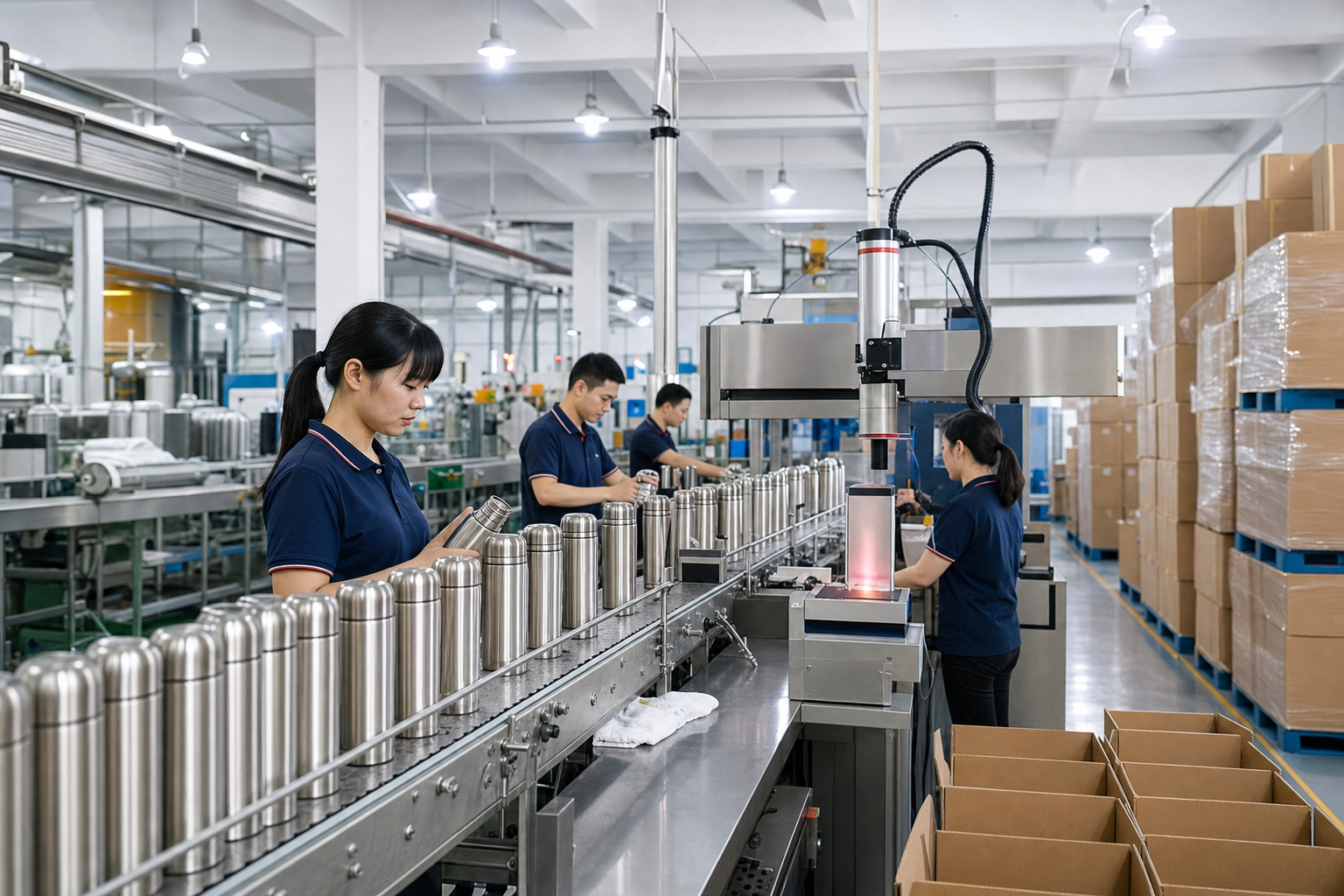
At BottleForge in Hangzhou, Zhejiang, we see this every week from distributors, brand owners, and thermos suppliers who need a factory thermos with a real MOQ, not a guess. We run the line with laser welders and a vacuum checker, and the buyer flags usually show up early: a PO typo on capacity, a wrong lid code, or a decoration method that cannot hold up on 5,000 pcs. If you want a custom thermos that sells in bulk, think like procurement, not like the design desk. China can make a strong customized thermos product, but only when the spec, the print method, and the test standard are locked before mass production starts.
What makes a thermos worth buying
The best custom thermos flask is not the one with the flashiest render. It is the one that holds temperature, survives shipping, and still looks acceptable after 3 months in a backpack or car cup holder. For outdoor retailers, that usually means a 350 ml to 750 ml stainless thermos with double-wall vacuum insulation and a leak-proof lid. For promotional brands, the same bottle has to take logo printing, fast lead times, and a hard target price. We run 500 ml samples through a 1.2 m drop test, and the lid is usually where the buyer flags problems first.
Start with the body. A quality stainless thermos normally uses 18/8 stainless steel for both inner and outer walls, with a wall thickness around 0.4-0.5 mm. If the supplier says the cup feels light, ask for the gauge and the actual net weight. A 500 ml bottle should often land around 270-350 g depending on cap style. Anything much lighter usually means trimmed material. We saw one PO where the buyer typed 304 as 340, and QC pulled the sample before it left the line. That is the difference between a real factory thermos and a reseller with a glossy catalog.
Temperature claims should be specific. Good vacuum bottles commonly hold water above 60°C for 6-8 hours and above 45°C for 12 hours, assuming room temperature around 20-25°C. Cold retention is often stronger. If your thermos supplier cannot share a test method, ask whether they use ISO-based internal testing or a documented ASTM-style procedure. You are not buying a slogan; you are buying performance data. On our bench, the probe reads every 30 minutes, and that number matters more than a nice sales slide.
Choose the right stainless steel spec
Material choice is where buyers overpay or under-spec. The wrong question is price first; we run the line to the use case first. For most custom thermos programs, 304 stainless steel is the right default. It gives solid corrosion resistance, is accepted for food contact, and keeps the quote stable. If the buyer is putting coffee, sports drinks, or salty soup through it, a 316 inner liner is the safer call. QC pulled a sample with a pH 3.2 drink and the 316 held up cleaner after the wipe test. In Zhejiang, we quote 316 as a premium upgrade, because it adds cost and the buyer often flags it before they see the test report.
The lid is where orders go sideways. A stainless body with a cheap PP cap will lose the buyer faster than a weak logo print. Use BPA-free PP, a silicone seal, and a threaded closure that survives leak testing at 45 degrees for 30 seconds and inverted storage for 24 hours. On our bench, we check cap torque with a small gauge, and the seal has to sit flat or the line stops. If you are sourcing bulk thermos units for outdoor retail, ask for a gasket replacement life of at least 500 cycles. We have seen the wrong gasket turn a clean PO into service claims in one season.
- 304 inner liner: best value for most thermos bulk programs; the standard we ship for most coffee bottles
- 316 inner liner: better corrosion resistance, higher cost; use it when acidic drinks or coastal use are in the brief
- 0.4 mm wall: lighter, more promotional-friendly; easier on unit cost and carton weight
- 0.5 mm wall: sturdier, better for premium retail positioning; the safer pick when the buyer wants a heavier hand feel
If you want a thermos manufacturer to quote accurately, send the exact capacity, finish, lid type, and target retail price. A PO that says "high quality stainless flask" forces guesswork, and the math does not work. We once had a buyer flag a typo on the finish line item, and that single word changed the quote by 6%. Give us the spec set and we can run a clean quote.
Decoration methods that actually last
Logo decoration decides whether a thermos custom job looks like a retail product or a rushed sample. Buyers usually compare silkscreen, laser engraving, UV print, and heat transfer. The right choice depends on how the flask will be used on the line, not on a sales sample under soft light.
Laser engraving is the most durable option. Our 60W fiber laser cuts through the coating and leaves the steel itself exposed, so it stands up well to abrasion. For a distributor thermos program or an outdoor retail line, laser is usually the safest call. It costs more than a one-color print, but the failure rate is lower. Silkscreen printing is cheaper and works well for 1-color promotional thermos orders at volume, especially on powder-coated bottles. UV print fits full-color branding, but if the bottle lives in gear bags every day, the math does not work.
From the factory side, we usually tell clients to keep logo coverage under 30% of the visible area if they want a cleaner retail look. On a 500 pcs run, full-wrap graphics can sell, but alignment becomes a real issue and QC will flag it during AQL inspection. We once caught a PO that called for sand black on the art file and matte black in the body spec. That kind of typo turns into rework fast. If you are comparing thermos suppliers, ask for photo proof on the exact coating. A “similar item” sample is not a spec.
Practical rule: for long-term resale, laser engraving beats cheap print. For short-run promotions, silkscreen keeps unit cost under control.
MOQ pricing and lead time realities
Most buyers ask for the best custom thermos flask, then ask for 3,000 units the next minute. Fair enough, but the line runs on numbers, not wishful thinking. For a standard stainless thermos from a Zhejiang thermos factory, MOQ usually starts at 500 pcs per SKU for existing molds and finishes. If you want a new shape, special lid, or a custom Pantone match, MOQ often moves to 1,000-3,000 pcs depending on tooling complexity. QC pulled the sample, checked the lid torque, and found the buyer’s first PO had the size written as 550 ml instead of 500 ml. That kind of typo costs a day.
FOB China pricing for a 500 ml custom thermos commonly falls between USD 3.20 and USD 8.90. The low end is basic powder coating, one-color print, and standard packaging. The high end covers a 316 liner upgrade, gift box, or multi-color branding. If a thermos supplier quotes far below that range, ask what got cut: coating thickness, lid quality, vacuum integrity, or carton strength. The math doesn't work otherwise. We’ve seen a 0.35 mm steel wall come back in inspection when the buyer pushed for a price that was too sharp.
Lead time matters just as much. A capable thermos factory in Zhejiang should quote 15-25 days for standard repeats and 30-40 days for new development after sample approval. If the project needs custom retail packaging, add 7-10 days. Our monthly output in Hangzhou can reach 300,000+ units, but that only helps if the forecast is real and the artwork is final. We ship faster when the buyer stays locked on spec. Change the logo after pre-production samples are approved, and the schedule slips. We've seen that go sideways more than once.
How to vet a China thermos factory
Buyers in Europe and North America do not need a sales story about a thermos factory. They need proof. A solid manufacturer thermos operation in China should show factory audit files, material certificates, and test data without excuses. If you source from Zhejiang, ask for BSCI or an equivalent social compliance report when your channel requires it, plus food-contact declarations for stainless steel, silicone, PP, and coatings. For the EU, REACH usually comes up; for the U.S., ask for food-contact compliance and packaging traceability based on your import route.
The inspection system matters. A real factory should work to AQL 2.5 for major defects and keep a written process for leak testing, drop testing, and insulation checks. Ask whether they do sampling before packing, not after. We had one buyer flag a missing 18 mm carton print mark, and QC pulled the sample before it left the line. You should also ask how they handle barcode labels, FNSKU placement, carton drop tests, and palletization if you ship to Amazon or a 3PL. A thermos distributor who skips packaging usually pays for it later in damage claims. The math does not work.
Here is the shortlist I recommend:
- Ask for material certificates for 304 or 316 steel
- Request photo or video proof of production lines and vacuum sealing machines
- Confirm monthly capacity and whether your order is split across 2 lines
- Check whether the supplier can support custom carton, barcode, and insert card work
In Zhejiang, the best suppliers are not the ones promising everything. They are the ones telling you where the bottlenecks are before production starts. We run into this on the line all the time: one missed 0.5 mm lid tolerance or a typo on the PO can stop shipment for a week.
Best use cases for bulk thermos orders
Different channels need different thermos custom specs. Outdoor retailers usually ask for a tougher coating, tighter lid threads, and a finish that hides scuffs after 200 cartons move through the warehouse. Promotional brands want unit cost control, a clean logo panel, and a schedule that lines up with campaign dates. Distributor buyers sit in the middle: they need something that looks premium on shelf, but the landed cost still has to pass the spreadsheet.
For outdoor retail, a 500-750 ml bottle with powder coating, laser logo, and a screw-cap cup lid is a solid commercial pick. We ran a 500 ml sample last month, and the buyer flagged the lid because the inner cup sat 1.5 mm off center, so we reworked the mold insert. For promo use, a 350-500 ml bottle with one-color print and a simple gift box usually gives the best margin. If you are selling through distributors, pick a neutral body color like black, navy, or stainless silver. That keeps the SKU moving across regions without a new setup on the line.
Below is the practical buying logic:
- Retail premium line: heavier wall, laser logo, better carton
- Promo campaign line: lower unit cost, simpler lid, print decoration
- Distributor program: neutral styling, flexible packaging, repeatable SKU
Do not try to make one thermos do every job. We have seen that go sideways. A thermos supplier can build a bottle for retail, but if you ask it to act like a premium gift item at promo pricing, the math does not work.
Packaging and compliance details buyers skip
Packaging is treated like a final checkbox, but it changes claims, breakage, and whether the buyer keeps the product. On bulk thermos runs, we run a master carton with no more than 10-15 mm of empty space on each side. If the bottle has a glossy shell, we add molded pulp or EPE inserts. A plain polybag can pass for factory thermos exports, but retail and e-commerce want cleaner presentation and better drop resistance. We have seen a 1.2 m drop test turn into dented lids because the carton had 18 mm of play, so this is not theory.
If the channel is Amazon or a similar platform, the pack has to be right down to the barcode, label position, and case pack count. Ask your thermos manufacturer to confirm case pack quantity, gross weight, and carton size before you sign off freight. A 500 ml stainless thermos packed at 24 pcs per carton looks efficient on paper, but if the carton goes past 12 kg or gets too tall for the pallet, the warehouse flags it and damage starts. One PO we saw had a label typo on the outer carton, and the buyer rejected the whole lot at intake.
For compliance, do not stop at the steel body. The lid material and coating matter just as much. Stainless steel is only part of the file. Silicone, PP, and paint systems should be documented, especially for Europe. A solid thermos supplier should know how to answer REACH, LFGB, and the usual market checks. If they dodge the question, we would not trust the line. QC pulled the sample, checked the lid seal, and found the coating spec missing from the paperwork, which is the kind of gap that causes delays at customs.
Good packaging is not decoration. It is a cost-control tool and a claims-reduction tool, especially when thermos distributors move cartons through 3 warehouses and a last-mile carrier. The math is simple: a 2% damage rate on a 20,000-piece order costs more than a better carton spec and a 3 mm insert. We ship this way for a reason.
Send your thermos spec and get a factory quote
Share capacity, logo method, target price, and market. We will quote a custom thermos program from Zhejiang with honest MOQ and lead time.
Frequently asked questions
What is the MOQ for a custom stainless thermos order?
For a standard custom thermos with existing tooling, MOQ is usually 500 pcs per SKU. If you need a new mold, special lid, or custom color, expect 1,000-3,000 pcs. For very simple promotional thermos runs, some suppliers can flex lower, but your unit price often rises by 12% to 25%. A real thermos factory in Zhejiang should state MOQ clearly before sampling, not after. If the quote feels vague, ask whether the number is per color, per logo, or total order quantity.
How much does a bulk thermos cost FOB China?
A typical bulk thermos FOB China price for a 500 ml stainless model ranges from USD 3.20 to USD 8.90. Basic powder coat and one-color print sit at the lower end. A 316 liner, premium lid, gift box, or multi-color decoration can push the price higher. If you are comparing suppliers thermos quotes, ask what steel grade, coating, and packaging are included. A low quote without these details usually means a weaker spec, not a better deal.
Which decoration method lasts longest on a thermos?
Laser engraving is the most durable for a customized thermos because it marks the surface itself and resists abrasion. For promotional thermos orders, silkscreen is cheaper and works well for 1-color logos, but it can wear over time if the bottle is handled hard. UV print gives more color flexibility, yet it is more vulnerable to scratching. For outdoor retail, I usually recommend laser if the budget allows. For short-run campaigns, silkscreen keeps the program profitable.
What insulation performance should I ask for?
For a good stainless thermos, ask for at least 6-8 hours above 60°C and around 12 hours above 45°C, tested from hot fill at room temperature. Cold retention is often longer, especially with a proper vacuum seal. Ask the thermos manufacturer for the test method, starting water temperature, ambient temperature, and whether the bottle was preheated. Without those numbers, the claim is marketing, not data.
How do I know a China thermos factory is reliable?
Request factory audit documents, material certificates, and inspection records. A reliable thermos factory should work to AQL 2.5, provide leak test and drop test data, and show production capacity around 300,000 units per month or more if you need scale. For Europe, ask about REACH or LFGB-related documentation. For North America, confirm food-contact compliance and packaging traceability. If the supplier cannot answer these basics quickly, they are probably a trading layer, not a manufacturer.