Key Takeaways
- 304 stainless steel is the default for a reliable bulk thermos; 316 costs about 15-25% more and only makes sense for premium use cases.
- A practical MOQ from a Zhejiang factory is often 1,000 pcs per color per model, with 30-45 days for production after sample approval.
- For vacuum performance, a 500 ml flask should hold hot water above 60°C after 6-8 hours if the insulation is properly made.
- Decoration choice changes unit cost fast: one-color silk screen may add USD 0.15-0.35, while laser engraving usually adds USD 0.30-0.60.
If you are buying the best custom vacuum flask for outdoor retail or a promo run, the hard part is not finding a bottle. It is sorting a decent-looking custom thermos from one that survives daily use, prints cleanly, and still fits your margin. A flask can look fine in a catalog and still fail on coating adhesion, lid sealing, or drop resistance after the first 500 pcs.
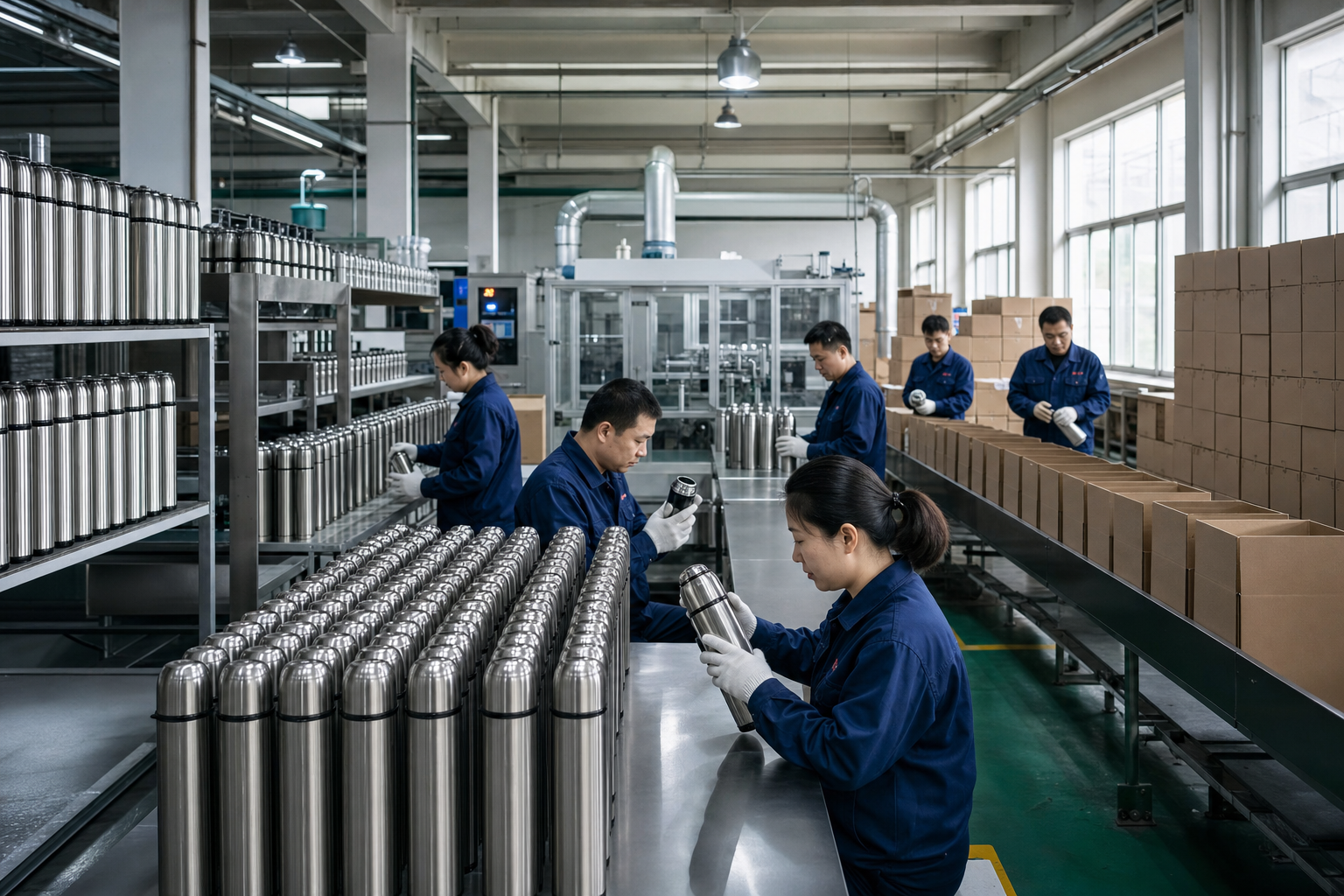
At BottleForge in Hangzhou, Zhejiang, we see this every week from distributors and brand owners who want a manufacturer thermos spec that works on the line, not on a mood board. The usual build is a 304 stainless body, 0.4-0.5 mm inner wall gauge, food-grade PP or Tritan lid parts, and a finish matched to the channel. QC pulled the sample on a 1 m drop test last week and the buyer flagged a lid twist issue, so this is the wrong question to ask: "Can you make it look premium?" Ask whether the custom vacuum flask will hold heat, print cleanly, and ship on the MOQ you need. For outdoor retail, retention and dent resistance matter. For promotions, MOQ, decoration cost, and on-time delivery from a thermos factory in China matter more, and the math does not work if the factory cannot ship what it promised.
What makes a flask worth buying
The best custom vacuum flask is not the shiny sample on the table. It is the bottle that holds spec, price, and print quality together without creating scrap. We run into this all the time on the line: a buyer approves the mockup, then QC pulls the sample after the first drop test or lid cycle test. For outdoor retail, the flask has to take abrasion, repeated opening, and hot-cold swings. For promo jobs, the math has to work at scale, or the logo ends up looking cheap after 3 months.
Start with the body material. A true stainless thermos should use 304 stainless steel for both inner and outer shells in most retail and promo programs. For food contact and corrosion resistance, 304 is the practical standard in China and Europe. 316 has better chloride resistance, but unless you are selling to marine buyers or a premium medical-adjacent channel, you are paying for a spec the market will not reward. On a 500 ml thermos custom order, 316 can add USD 0.40-0.90 per unit depending on finish and volume. We had one buyer push for 316 on a campus giveaway, then dropped it after the sample cost sheet came back.
The next point is wall construction. A common commercial spec is a 0.4-0.5 mm inner wall with a clean vacuum seam. Too thin and the factory thermos dents in transit. Too thick and you lose margin and add weight for no real gain. A 500 ml insulated flask usually lands around 260-340 g depending on lid type and shape. If a supplier quotes far below that range without stating the wall gauge, ask for the cross-section drawing or the press sample record. We have seen this go sideways on PO notes, too—one buyer typed “340g” when they meant “340 ml,” and the carton spec had to be fixed before packing.
- Best starting spec: 304 stainless, double-wall vacuum, 500 ml, powder coat or matte paint
- Retail-ready lid: PP or Tritan, silicone seal, leak-tested to 100% inline
- Promo-ready spec: single-color decoration, standard carton, 1,000-3,000 pcs MOQ
Materials and insulation that matter
Most buyers fixate on capacity and miss the parts that set the actual performance. That is the wrong question to ask. A customizable thermos only performs as well as the steel grade, vacuum level, and the seal around the neck. If the vacuum gap is off by even 0.2 mm or the neck weld is weak, the curve drops fast. On our line, we fill at 95°C and check retention at 6 hours, 12 hours, and 24 hours. For a solid 500 ml flask, you want to see roughly 60-65°C after 6 hours, 45-55°C after 12 hours, and 30-40°C after 24 hours depending on lid style and ambient conditions.
Do not let a thermos manufacturer hide behind vague language like “excellent insulation.” Ask for the measured report. We ship enough samples to know this goes sideways when the seller talks around the data. Serious thermos manufacturers in Zhejiang will hand over a retention test, a leak test, and a coating adhesion test from the sample stage. QC pulled the sample lid on one 500 ml run and found a faint plastic note from cheap PP, which kills retail acceptance fast. Hikers notice it in one sip. So do commuters.
For certifications, a China-based thermos supplier serving Europe and North America should know the basics: REACH for materials compliance, food-contact declarations, and where needed, migration testing under local market expectations. If you sell through Amazon or big-box channels, ask for carton marks, barcodes, and if necessary FNSKU labeling. We have seen PO files come through with one typo on the carton count, and that is enough to hold a pallet at inbound. A good thermos distributor program runs on boring compliance, not clever sales talk.
Reality check: a polished sample with no test data is just a sales object. A real bulk thermos must prove insulation, sealing, and coating durability before you commit purchase orders.
Decoration options that protect margin
Decoration is where a custom thermos can burn margin without helping sell-through. Pick the method by channel, not by ego. For a promo order, silk screen stays the cheapest route for a clean one-color logo. On a retail bottle, laser engraving or UV print can earn its keep because the cup still looks sharp after 50+ wash cycles. We run this every week on the line, and the buyer who wants every bottle “premium” usually has the wrong question.
On a standard 500 ml thermos custom order, silk screen usually adds USD 0.15-0.35 per piece at medium volume. Laser engraving can add USD 0.30-0.60, while full-color UV print goes higher once the curve and coverage area grow. For a distributor thermos program with 4 or 5 SKUs, keep the decoration plan tight. The math does not work when each extra color creates a new setup, a new proof, and another chance for mismatch. QC pulled the sample once because the logo sat 2 mm off center. That kind of miss turns into rework fast.
Finish matters too. Powder coating gives better scratch resistance than basic spray paint, but it can add a day to lead time and push the price up. A matte powder coat is the safer commercial choice for an outdoor brand because it hides fingerprints and looks clean in photos. Gloss finishes show dust, dents, and small pinholes faster. If the buyer flags a thermos promotional product for shelf display and daily carry, matte usually wins.
- Silk screen: best for one-color logos and promotional volume
- Laser engraving: durable, sharp, good for retail and corporate gifts
- UV print: works for complex art, but check abrasion resistance
MOQ, pricing, and lead times
Buyers ask for the best custom vacuum flask, but the real question is the buying structure. A clean order fits your season and cash flow. In Zhejiang, a normal MOQ for a stainless thermos is often 1,000 pcs per color per model. We had a buyer try to split 3 colors into one 1,500 pcs PO, and the math did not work. If you push for 500 pcs as a trial, unit cost usually climbs 10-20%, and carton choices get tight fast.
For stock-shaped models, FOB China pricing usually starts around USD 2.20-3.80 for a basic 500 ml stainless vacuum flask at volume, depending on coating, lid, and print method. With better insulation, custom lids, and premium finishes, the range moves to USD 4.20-6.50. QC pulled a sample on a 0.35 mm body once and found a thin-wall spot near the base seam, so when someone quotes far below that range, we look at steel gauge, vacuum performance, and carton spec first. That low price usually has a catch.
Lead time is usually 30-45 days after sample confirmation for standard production in a capable thermos factory. Peak season and special packaging can push that to 50-60 days. If you need a fast promo drop, ask whether the supplier can hold stock bodies and only change the decoration. We ship that way on some orders. It cuts risk without reopening the mold file or redoing the line.
From our Hangzhou, Zhejiang facility, we run 300,000 units per month across bottle categories, which lets us handle layered programs for thermos distributors without losing QC control. Scale matters only when the factory keeps AQL discipline and color matching. We once caught a Pantone typo on a PO, and the buyer flagged it before production; one wrong code can waste a whole batch.
Quality control before you place PO
You do not need to be a factory engineer to avoid a bad PO. A simple QC plan does the job, and a supplier who answers straight questions. Ask for a pre-production sample, then a golden sample signed off against the final artwork and packaging. After that, lock the inspection standard before mass production starts. For most retail drinkware, an AQL 2.5 major / 4.0 minor inspection level is a solid baseline. We have seen buyers push for looser limits on low-price promo runs, and the math usually does not work.
Check leak testing, vacuum retention, lid torque, coating adhesion, and print registration. If the bottle uses a flip lid or straw lid, the seal needs repeated-cycle testing, not a one-time hand press. We usually run a basic drop test from 1.0 meter onto concrete or a steel plate, filled and empty. A 304 stainless bottle can dent and still seal; that is two different failures. QC pulled the sample, and the lid still clicked open after the third drop. That is the kind of thing you want to catch before the line runs 20,000 pieces.
Ask your thermos partner to confirm packaging compression strength too. A custom thermos can pass product QC and still land damaged if the carton is weak. For Europe and North America, double-wall cartons with dividers, drop-tested master cartons, and clear outer marks are standard. We ship plenty of orders where the buyer flagged a crushed corner on the PO because the carton spec was missing one line. Good thermos manufacturers in China already run this check. The bad ones call it extra work.
Questions worth asking your factory
- What is the steel grade and wall thickness?
- What is the measured temperature after 6 hours?
- What is the MOQ per color and per logo process?
- Which carton spec do you use for export?
How to match bottle to channel
The same stainless flask should not go out through every channel with the same spec sheet. Outdoor retailers usually ask for a tougher finish, fewer color moves, and a story that supports margin. Promo buyers want lower cost, faster turn, and enough visual punch to carry the campaign. So the thermos custom brief has to change by channel, even if the bottle body stays the same.
For outdoor retail, a 500 ml or 750 ml bottle with powder coating, laser logo, and tighter QC is usually the safest route. We run a 60-mesh coating check on that line, and the buyer often flags scratch marks before shipment. For commuter or gift programs, a clean matte bottle with one-color print is often the better balance. For seasonal promotions, a lighter SKU with a standard lid and plain carton can cut landed cost by 8-15% versus a fully customized pack-out. If your customer is a distributor, do not stack too many variants into one PO. We’ve seen 6 lid options on one program kill the margin fast.
As a thermos supplier in China, we see the same mistake again and again: buyers try to force a retail-grade spec into a promo budget, or push a promo spec into retail. The math doesn’t work. A good thermos distributor plan starts with one channel target, one decoration method, and one backup pack option. Keep the core bottle stable, then change only what the market will pay for. On a recent PO, the word matte was typed as matt, and that tiny typo delayed artwork sign-off by 2 days.
For a stable program in Zhejiang production, the sequence is sample approval, artwork proof, pilot run, then bulk order. QC pulled the sample, checked the lid torque at 1.8 N·m, and then we moved. That is how you get a customizable thermos line that repeats without surprises and still protects your margin.
Request a factory quote for your flask
Send your target capacity, logo method, and order volume. We will map the right thermos custom spec for retail or promo use from Zhejiang, China.
Frequently asked questions
What is the best material for a custom vacuum flask?
For most buyers, 304 stainless steel is the best balance of cost and performance. It resists corrosion well, handles food contact properly, and keeps FOB pricing competitive. For a 500 ml custom vacuum flask, 304 is usually enough unless you have a premium marine or chemical exposure case, where 316 may justify a 15-25% price increase. Ask the thermos manufacturer for steel certificates and confirm the inner wall gauge, ideally 0.4-0.5 mm.
How much does a bulk thermos usually cost from China?
For standard 500 ml models, FOB China pricing often starts around USD 2.20-3.80 per piece at volume, depending on coating, lid type, and logo process. Better finishes or premium lids can move the price to USD 4.20-6.50. If a thermos supplier quotes much lower, check the wall thickness, vacuum quality, and carton spec before you approve the order.
What MOQ should I expect from a thermos factory?
A practical MOQ from a Zhejiang thermos factory is often 1,000 pcs per color per model. Some suppliers will accept 500 pcs for a trial order, but the unit price usually rises 10-20% and packaging choices are more limited. If you need multiple colors, calculate MOQ by color, not just by total order quantity.
How long does production take for custom thermos orders?
Standard lead time is usually 30-45 days after sample approval. If you need custom packaging, special lids, or peak-season production, allow 50-60 days. A manufacturer with around 300,000 units per month can still get delayed if you change artwork late, so lock the golden sample and carton spec before mass production.
Which decoration method is best for a promotional thermos?
For a promotional thermos, one-color silk screen is usually the cheapest and fastest option, typically adding USD 0.15-0.35 per unit. If you want durability and a cleaner premium look, laser engraving is better, usually adding USD 0.30-0.60. For complex artwork, UV print works, but you should test abrasion resistance before you commit to a bulk thermos order.