Key Takeaways
- A 500 ml bottle with 0.5-0.7 mm stainless steel walls is often the safest mid-market spec.
- For custom drinkware, MOQ usually starts around 1,000-3,000 units and lead time runs 25-45 days.
- Laser engraving, silkscreen, and UV print each fit different channels, budgets, and wash requirements.
- A China or Zhejiang factory with 300,000+ units/month gives you better scheduling and color consistency.
When you buy the best custom water bottle for a retail program, giveaway, or private label launch, you are buying margin control and shelf presence. It also has to survive freight, filling, 3 months in a warehouse, and daily use without spikes in claims or returns. We have seen a matte powder coat look fine on the sample and turn into a write-off after 5,000 units land, because the line used the wrong cure time and QC pulled the sample late.
The real question is not which bottle looks best. It is which custom drinkware spec fits your channel, your customer, and your target price. A Zhejiang factory can run a different wall thickness, lid system, and decoration path than a generic canteen supplier in China. If you want canteen customized the right way, compare capacity, wall thickness, lid type, and compliance first, then talk print. The buyer's typo on the PO is often the warning sign: 750 ml on paper, 700 ml in hand, and the math does not work.
Start With The Use Case
The best custom water bottle matches the way the buyer will actually use it. A sports program, corporate gift, Amazon listing, and distributor bundle each call for a different build. If you start with the decoration, you usually end up with the wrong bottle. Start with the use case, then choose size, material, lid, and packaging.
For retail, shoppers want a clean silhouette, leak resistance, and strong shelf value. For events, cost and turnaround matter more than a premium finish. For a canteen distributor or distributor drinkware program, consistency and repeat-order stability matter because the same SKU may get reordered across 3 regions. In China, we can quote the same bottle in several body materials, but the math changes fast once you move from 18/8 stainless steel to Tritan, glass, or aluminum. QC pulled the sample on one job because the lid torque drifted after 2,000 cycles.
Practical starting points
- 500 ml to 750 ml for general retail and office use.
- 350 ml to 500 ml for kids, travel, and smaller packs.
- 800 ml to 1,000 ml for gym, outdoor, and custom growler-style applications.
- Single-wall bottles for light promotional budgets; double-wall vacuum for premium channels.
If you need canteen promotional pricing, a simple body with one-color print may be enough. If you are building a branded program for a canteen vendor or canteen vendors network, the spec has to survive repeat orders and customer complaints. We’ve seen this go sideways when a buyer approved a 0.6 mm wall, then came back asking why the bottle felt thin in hand. The bottle should be chosen for the channel first, and decorated second.
Pick The Right Material
Material sets the cost, weight, insulation, and compliance risk. That is the first filter. We see buyers lock artwork first, then the sample comes back wrong because the body material was never settled. A canteen custom brief that skips this step usually turns into an approval headache later.
Stainless steel is the line we run for most customized drinkware. Use 304 for normal interior contact, and move to 316 only when the use case pays for it. On a vacuum bottle, 0.5-0.7 mm inner wall is standard in many factories; we have seen buyers push for 0.4 mm to save pennies, and the math does not work once dent claims start coming in. Tritan fits lightweight, clear SKUs where drop resistance matters more than heat retention. Glass gives a clean-taste story, but it is a poor match for rough distributor canteen programs. Aluminum stays light and low cost, yet the liner and coating need tight control, or QC pulls the sample.
Material also changes decoration yield. Laser engraving stays stable on stainless steel. Silkscreen works on coated surfaces only if curing and abrasion resistance are under control. UV print looks sharp on flat areas, but the substrate has to be consistent across the run. If you want a customizable canteen that can be reordered in Q1 and Q3 without artwork drift, choose a finish the factory can repeat with low variation.
For price-sensitive channels, a simpler body with better tooling beats a fancy shape with thin margins.
For any canteen manufacturer in Zhejiang or elsewhere in China, ask for material certificates, food-contact declarations, and test reports. We ship these with the sample pack because buyers do flag missing paperwork. That gives you a cleaner path through REACH expectations in Europe and basic buyer audits in North America.
Compare Lids And Leak Risk
The cap is where a lot of custom canteen projects go sideways. A clean bottle with a weak lid turns into a service headache the first time it hits a backpack or a parcel line. We run lids against the use case, the filling method, and how the end customer actually washes it.
For commuter and retail bottles, a screw cap with a silicone seal is the baseline. For sports or active-use bottles, a flip-top or straw lid gives faster drinking, but it adds parts and more leak points. If you are sourcing custom canteen products for a distributor canteen catalog, ask about spare lids from day one. We had a buyer flag a PO typo on lid color once, and that small mistake became a week of back-and-forth because the lid could not be shipped separately.
- Simple screw caps: lower risk, lower cost, easier to clean.
- Straw lids: better for quick drinking, but more cleaning steps and more parts.
- Flip lids: good for sports, but they need hinge testing and tougher cycle counts.
- Bamboo or decorative tops: better for gifting, not a safe pick for high-volume daily use.
Test the lid as part of the full bottle, not as a standalone part. Ask for leak testing under pressure, drop testing from at least 1 meter, and closure cycle data; QC pulled the sample at 3,000 opens on one recent run and the hinge started to loosen. A serious canteen factory in China should be able to state the seal material, torque range, and gasket replacement plan. If the supplier cannot talk in numbers, the math does not work for volume.
Decoration Changes Margin
Decoration is where custom drinkware turns from plain stock into branded inventory. The right method depends on order size, artwork, and how the bottle will be used. A corporate canteen program, a growler run, and a retail gift line are not the same job, so asking for one universal print spec is the wrong question. On our line, we check the artwork file first, then the sleeve or fixture, then the bottle body diameter in mm before we quote.
Silkscreen is still the workhorse for simple logos, especially on cylindrical bodies with one or two colors. Laser engraving works well on stainless steel and gives a mark that does not rub off. UV printing fits full-color graphics and tight brand systems, but it costs more and usually needs a coated surface. Pad printing works for small logos or curved panels, though we avoid it for large art because QC pulled a sample last week and the edge registration drifted by 1.2 mm.
If you are comparing canteen customizable and canteen customized quotes, ask for decoration cost per position, not only the bottle price. A low-cost blank with a heavy print charge will eat margin fast. We have seen this go sideways on a 5,000-piece PO with one typo on the print position line and three rounds of samples. A cleaner structure is a slightly higher bottle cost, lower scrap risk, and repeatable output across 2 or 3 sales cycles.
For Amazon or omnichannel retail, print durability matters more than the first sample photo. For distributor drinkware and custom growler projects, the logo has to hold up to handling, washing, and warehouse abrasion. If you expect reorders, choose the process the factory runs every day, not the one it treats like a special request. That is how we ship on time and keep the line steady.
Check MOQ And Lead Time
MOQ is not a line item you ignore on a quote. It tells you how the line runs, how much color matching risk sits on the table, and whether your order fits the factory schedule. In our Zhejiang plant, a 15-color spray rack can handle mix-and-match work, but a 500-piece order with three lid colors will slow the line. That is the wrong question to ask if you only chase the lowest price.
For most custom drinkware jobs, MOQ lands around 1,000 to 3,000 units per SKU. For a custom canteen with a more complex lid or multi-step decoration, the floor can climb. Standard lead time is often 25 to 45 days after sample approval and deposit, and we have seen that stretch when QC pulled the sample for a cap torque issue. Add another 7 to 20 days for ocean freight if the goods ship to Europe or North America.
Ask the supplier about actual monthly capacity. A Zhejiang canteen manufacturer turning out 300,000 units per month usually keeps repeat orders and color consistency tighter than an ad hoc trader. Capacity does not guarantee quality, but it does keep the schedule honest. If a canteen supplier cannot tell you how many units each line ships per day, you are taking avoidable risk.
For distributor canteen programs, ask whether the factory can hold finished goods or reserved components. That matters when you want staggered releases, regional packing, or mixed-language cartons. We once caught a PO typo on carton marks and had to reprint 2,000 outer boxes, so this is not theory. A good canteen vendor setup is less about the lowest unit price and more about whether the factory can support your reorder pattern without resetting the whole job.
Demand Proof, Not Promises
Smart buyers ask for proof. The best custom water bottle is not the one with the prettiest studio shot; it is the one that clears the checks you set. If a factory is serious, it should hand over test data, inspection flow, and compliance files without drama. We run into buyers who were burned by a nice-looking sample that failed at the seam.
For Europe, ask for REACH-related material control and food-contact declarations. For North America, request FDA food-contact statements where applicable, plus clear details on inks, coatings, and packaging parts. If your sales channel needs retail compliance, ask for ASTM-style drop or performance testing where it fits your spec. AQL inspection is still the cleanest way to set the bar: we see a lot of buyers use AQL 2.5 for major defects and 4.0 for minor defects on finished goods. One PO typo can tell you a lot too—the buyer flagged “3040” instead of 304 stainless, and QC caught it before the line packed 8,000 pcs.
- Check weld seams and vacuum retention on insulated bottles.
- Verify logo placement, color tolerance, and surface finish.
- Inspect lid fit, gasket position, and smell on first open.
- Review carton strength, drop risk, and barcode accuracy.
Good factories in China are blunt about what they can document and what they cannot. That helps. If a canteen factory in Zhejiang sends a stable QC checklist, the same 5-piece sampling plan, and photo reports with batch numbers, you can control the order with less back-and-forth. We’ve seen this go sideways when a buyer accepted “looks fine” and skipped the gauge check; the caliper showed a 1.2 mm lid gap. You are buying repeatable output, not a promise.
Choose A Factory Partner
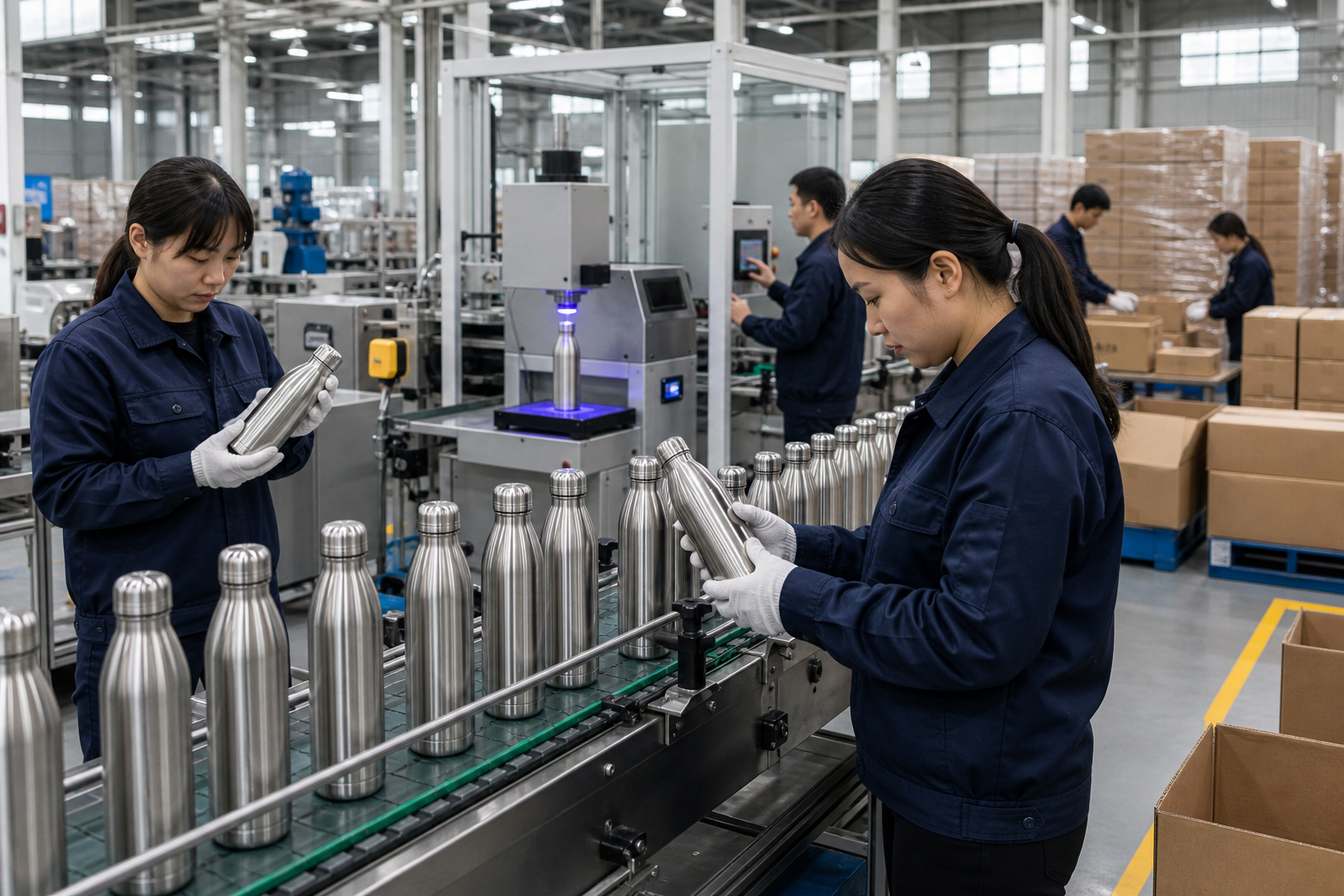
A factory partner is not the same as a quote broker. We run the line every day, and the difference shows up fast: tooling, decoration, packing, and export papers all sit in one flow, not four different inboxes. If a supplier cannot walk you through the production steps line by line, they are not ready for custom drinkware at scale.
Check three things. One, can they quote the build in detail: body material, wall thickness, lid material, seal type, carton pack count. Two, can they repeat the same bottle on a reorder without changing the mold finish or the shoulder height. Three, do they work like a Zhejiang export team, with sampling, documents, and ship dates tied together. Last month a buyer flagged a PO typo on the pack count, and QC pulled the sample before it left the line. That saved a mess.
If you buy for a canteen distributor or a wider drinkware range, SKU control matters. Clean item names, artwork proofs with the right Pantone callout, and packing specs that stay fixed from batch to batch. We have seen this go sideways when a buyer asked for “same bottle, cheaper,” and the math did not work. A solid canteen manufacturer will say that plainly.
For promotional runs, one good production lot may be enough. For retail, private label, or custom growler programs, you need a partner that can scale without chaos. A factory that keeps defect rate low on the first 3,000 units is often the one that saves you more on the next 30,000. On one 18-day order, we held the carton drop test at 60 cm and cut breakage before shipment.
Get a factory quote with real specs
Send your target volume, material, and logo file. We will quote MOQ, lead time, and packaging from our Zhejiang factory.
Frequently asked questions
What is the best custom water bottle material for retail buyers?
For most retail programs, 18/8 stainless steel is the safest default because it balances durability, insulation, and perceived value. A 500 ml or 750 ml double-wall bottle with 0.5-0.7 mm walls usually sits in the right price band for B2B orders. If you need a lighter or clearer product, Tritan is practical, but it will not match vacuum performance. For Europe and North America, make sure the factory can support food-contact declarations, REACH-oriented material control, and a clear QC process. If the bottle is for a canteen distributor program, keep the structure simple so the same SKU can be reordered without tooling changes.
What MOQ should I expect from a canteen factory in China?
For a standard custom drinkware order, MOQ often starts at 1,000 to 3,000 units per SKU. If you want multiple colors, special lids, or custom packaging, the effective MOQ can rise because the factory must set up separate materials and decoration runs. A larger Zhejiang canteen manufacturer may be more flexible on mixed orders because it has stronger line planning and higher monthly output, sometimes 300,000 units or more. Ask whether the MOQ is per color, per logo, or per carton configuration. That detail changes your cost structure more than the headline number.
Which logo method lasts longest on a customized canteen?
Laser engraving is usually the most durable on stainless steel because the mark is physically etched into the surface. It does not peel, and it handles washing well. Silkscreen is fine for lower-cost canteen promotional projects, but it depends on the ink system, curing, and abrasion exposure. UV print gives you more color freedom, yet it is not always the best choice for rough handling. If you are building a canteen customized product for repeat distributors, ask the factory for abrasion and wash test references, not just a photo of the first sample.
How do I avoid leak problems in custom canteen orders?
Start with the lid design and sealing system, not the bottle body. Ask the supplier what gasket material they use, what torque range the cap is designed for, and whether the bottle passes leak testing after drop and vibration simulation. A good benchmark is to test closure cycles, drop from at least 1 meter, and ship samples through real packing. If the product is for distributor canteen sales or retail, insist on a spare-parts plan for lids and seals. That prevents a small defect from becoming a full replacement program.
Can I source both custom growler and water bottle SKUs from one supplier?
Yes, if the supplier is a true canteen manufacturer or broader drinkware factory with multiple product lines. A good partner can often handle custom growler, customizable growler, and custom water bottle programs from the same production base, but the construction details will differ. Growlers usually need thicker walls, stronger handles, and stricter seal control. Water bottles are usually lighter and easier to decorate. If you want one supplier for both, ask about separate tooling, monthly capacity, and how they manage quality across different shapes. One factory can cover both, but only if the process control is real.