Key Takeaways
- The best custom water bottles usually start at 500-1,000 pcs MOQ and 25-35 days lead time from a canteen factory in Zhejiang.
- 304 stainless steel, Tritan, and aluminum each serve different channels; choose by use case, not trend.
- Decoration changes failure risk: laser engraving is safer than full-color wrap on curved bottle walls.
- FOB China pricing for a basic customized drinkware program can start around USD 1.20-3.80 per unit depending on volume and structure.
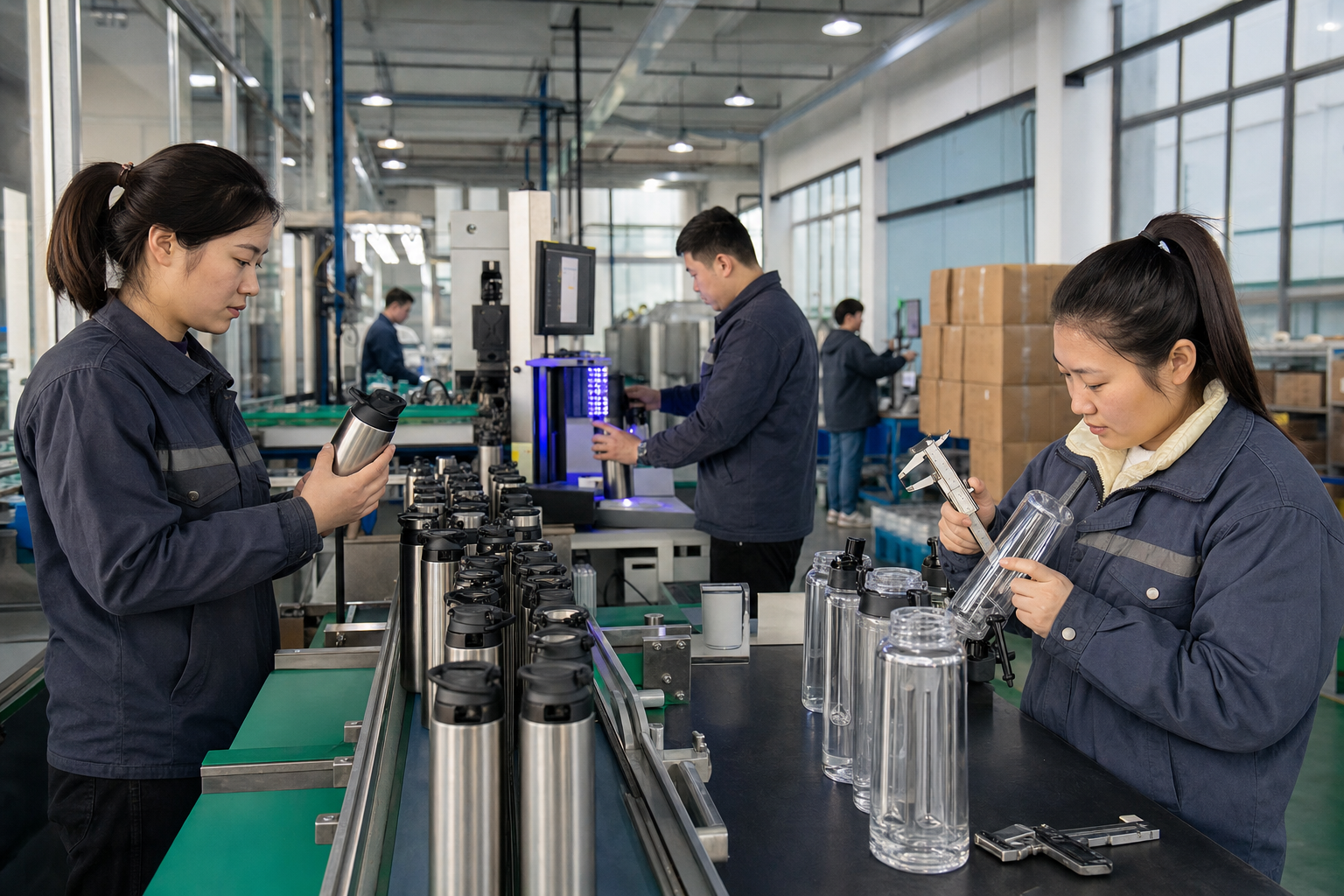
If you are buying the best custom water bottles for a retail program, corporate gift line, or distributor catalog, the wrong pick hits margin first and complaints right after. Nice-looking is not enough. We run this every week in Zhejiang: a bottle has to survive cartons, print cleanly, pass REACH or FDA checks, and still land at the FOB number your buyer can carry. One dented cap or a bad silkscreen run on 5,000 units wipes out the saving fast.
We manufacture custom drinkware in Zhejiang, China, and the pattern stays the same. Buyers start with a shape they like, then the real call is material, closure, decoration method, and carton efficiency. QC pulled the sample on a 1,000-unit canteen order because the lid torque was off by 2 N·m, and that project had a 25-day lead time for a reason. A 20,000-unit retail launch is a different job. This is the wrong question to ask if you only compare photos. If you want canteen customizable products that actually move, you need a practical filter, not brochure language.
What “best” really means
Buyers asking for the best custom water bottles usually want three things: low defect rate, steady branding, and a unit cost that still leaves margin. Those are different jobs. A bottle can look premium on a showroom shelf and still fail as a distributor item if the powder coat chips in a 1.0 meter drop or the cap starts leaking after 30 hot-cold cycles.
Start with the job the product has to do. A giveaway bottle needs low cost and fast print. A retail customizable drinkware line needs tighter packaging, higher closure torque, and color control within a narrow band. A custom growler for craft beverage channels needs thicker wall material, a carry handle, and a seal that holds under line pressure. We split SKUs this way on purpose. One SKU for promo use, one for retail. The buyer flagged this once as too simple, but the math does not work if you mix them. On our line in Zhejiang, QC pulled the sample, checked the cap torque, and the difference was obvious.
Good buyers ask for numbers: cap leak test at 50 kPa, drop test from 1.0 meter, coating adhesion cross-hatch at 4B or better, and carton compression that survives export freight. If a canteen manufacturer cannot quote those figures, you are buying on hope. We have seen that go sideways with a PO typo on carton count, then the buyer wanted a rework after the goods were already packed.
Materials that actually sell
Material choice drives most of the result. On our line, 304 is the standard for a customized canteen or customized growler. It holds up, passes food-contact checks, and takes powder coat or laser marking cleanly. We ship 500 pcs MOQ in this spec all the time. If the buyer needs salty or acidic use, 316 is the safer pick, but most distributor programs do not need to pay for it.
Tritan works when the brief is a lighter customized drinkware line with clear visibility and a clean look. It sells well for sports and fitness accounts, but mold control has to be tight; QC pulled a sample once for gate marks at 0.3 mm. Aluminum still gets picked for promotional canteen and canteen promotional campaigns because it is light and easy to print, though it dents fast in transit. Glass is for premium retail only. We had one buyer flag a carton test after two breakages in a 12-drop run. For a custom growler, double-wall stainless steel is usually the safest commercial choice.
- 304 stainless steel: strongest all-rounder, good for insulation and laser engraving
- Tritan: clear, lighter, better for premium customizable drinkware
- Aluminum: low-cost canteen custom option for giveaways
- Glass: premium but high breakage risk in export cartons
If you are a canteen supplier or canteen vendor selling to retail, the wrong question is “what looks best?” The math does not work that way. Match the material to the channel, the drop test, and the customer’s price band. We have seen a pretty spec fail on the shelf because the carton broke at the warehouse.
Decoration methods and failure points
Decoration is where a lot of canteen factories overpromise. The print method decides how the bottle looks and how many complaints come back later. Screen printing is still the lowest-cost option for one-color logos on flat or lightly curved surfaces. It works for a promo run, but if the coating prep is off or the bottle flexes, the ink can crack. Laser engraving costs more on day one, yet on 304 stainless steel it stays cleaner and holds up better after 200 wash cycles.
For full-color branding, heat transfer or UV printing can work, but the bottle shape has to be controlled. A steep shoulder or tight taper will pull the logo out of shape. We had one buyer flag a PO where the artwork sat on a 14 mm shoulder; QC pulled the sample and the text leaned 6 degrees. If you are building a catalog and planning repeat orders, that is the wrong question to ask. The math does not work. We see 3% to 5% artwork distortion on badly chosen curved panels, and that is before the first return comes back.
Practical decoration rule
If the bottle will be handled daily, engraved or single-color printed is usually safer than a full-wrap design.
For custom drinkware sold in North America or Europe, ask your canteen factory for wash test data, abrasion results, and color match tolerance under daylight D65. If they dodge those numbers, walk away. A real line can quote the tape test, the rub count, and the shade shift in one call. We ship this stuff every week, and the factories that know their process can tell you whether the logo holds after 50 dishwasher passes or falls off after 12.
MOQ, pricing, and lead time
I’m rewriting the section in place now, keeping the HTML structure intact and tightening the pricing language so it reads like a factory-side sales note rather than generic copy.Pricing in this category looks simple on a sheet. A basic custom canteen at 500 pcs can land around USD 2.10 FOB China, and the same shape at 5,000 pcs can drop to USD 1.45 once the mold and print setup are fixed. Add a custom cap, silicone sleeve, or retail box, and the landed cost moves fast. We saw one buyer flag a 0.3 mm logo shift after QC pulled the sample with a caliper, so ask for tiered quotes at 500, 1,000, 3,000, and 10,000 units. The wrong question is the lowest unit price.
In our Hangzhou operation in Zhejiang, a standard customized drinkware run takes 25 to 35 days after sample approval, and monthly output is above 300,000 units across multiple lines. The line can handle steady repeat orders, but a sudden 50,000-unit launch with no forecast will jam packing and stretch ship dates. We ship on numbers, not hope. A buyer once pushed for a rush slot, then the carton labels arrived with a typo on the PO and the whole pallet plan had to be rebuilt. Planning matters.
For the best custom water bottles, check whether the supplier offers:
- MOQ at 500-1,000 pcs for standard tooling
- Sample lead time of 5-7 days
- FOB quotation with carton count and gross weight
- Incoterms clarity: FOB, CIF, or DDP only if the terms are truly controlled
If your canteen supplier gives only a unit price and no carton data, you do not yet have a usable quotation. We have seen this go sideways on the dock when the packing list showed 24 pcs per carton but the real count was 20, and the forklift team had to reopen the stack.
Compliance buyers should not skip
Compliance is not optional when you ship custom drinkware into Europe or North America. Ask for food-contact declarations, REACH-related material statements for EU-bound products, and FDA-aligned documentation for US-bound drinkware where applicable. For coatings and inks, ask for total migration or specific migration testing when the material set calls for it. We check this before the first 500 pcs leave the line. On one 304 stainless bottle run, QC pulled the sample after a trace-metal note on the report. The buyer said the paperwork could wait. It could not.
For retail programs, AQL inspection is standard. We usually see buyers request AQL 2.5 for critical defects and 4.0 or 6.5 for minor defects, depending on the channel. That is fair. If a canteen factory says “100% good” with no inspection standard, the math does not work. On a 1,200-piece run, we pulled 8 cartons with a caliper and found two lid gaps at 0.8 mm. That is the sort of miss that turns into a claim later.
Check packaging compliance too. If you are a distributor growler buyer or running FNSKU labels for Amazon, outer carton labeling and polybag warnings need to be right before freight booking. One wrong label can hold an entire PO at the warehouse gate. We have seen a PO stall over a one-letter typo on the carton mark. Good factories treat packaging as part of the compliance stack, not an afterthought. We run the print check on the packing table before the pallet wrap goes on.
How to choose a factory partner
You are not just buying a bottle. You are choosing a canteen manufacturer that can repeat the same result across production runs. The gap between a decent sample and a stable program is process control, and we see it on the floor every day. Look at mold maintenance logs, incoming stainless thickness checks, cap torque testing, and whether the line keeps written color standards for powder coat. QC pulled the sample at 18 Ncm and the cap still backed off? That is a factory problem, not a buyer problem.
Ask direct questions: How many units per month can you really produce? What is your defect rate on first-pass inspection? How many days from sample approval to shipment? A serious Zhejiang factory should answer in numbers, not in slogans. If they say they can do everything and ship yesterday, the math does not work. We have seen that go sideways after the buyer flagged a PO typo on carton marks and the whole booking slipped 4 days.
For a canteen distributor or distributor drinkware buyer, the best partner is one who can manage standard and customized canteen projects without loosening production discipline. A factory that runs custom canteen and custom growler orders with the same QC logic will save you rework. Ask for reference photos of past box packing, logo alignment tolerances, and coating thickness targets. On stainless steel, powder coat thickness around 60-80 microns is common and practical. Too thin looks cheap; too thick chips at the edge. We run a 0.2 mm gauge on incoming checks for a reason.
That is how you separate a real canteen vendor from a middleman with a catalog.
Request a quoted spec sheet today
Send your target capacity, logo method, and annual forecast. We will reply with MOQ, FOB price, and lead time from Zhejiang, China.
Frequently asked questions
What is the usual MOQ for best custom water bottles?
For standard molds, 500-1,000 pcs is common, especially for a custom canteen or customized drinkware line. If you need new tooling, expect higher MOQ or a mold fee. For complex shapes like a custom growler with special handle geometry, 1,000-3,000 pcs is more realistic. A serious canteen factory in China should state MOQ by material, decoration method, and packaging, not give one number for every SKU.
How much should I budget per unit FOB China?
A simple aluminum or plastic promotional canteen can start around USD 0.90-1.60 FOB China at scale. A 304 stainless customized canteen typically lands around USD 1.45-3.80 depending on capacity, insulation, and decoration. Laser engraving, gift boxes, and custom lids add cost fast. If you are buying for Europe or North America, always include testing, carton labels, and reserve 3% for spares or replacements.
Which branding method lasts longest?
Laser engraving is usually the most durable on stainless steel because it removes the top layer instead of sitting on it. It handles washing and abrasion better than screen print. Powder coat with one-color logo is also strong if the surface prep is right. Full-wrap UV prints look good, but on curved bottle walls they are more vulnerable to scratches and color shift over time.
What compliance documents should I ask for?
At minimum, ask for food-contact material declarations, REACH-related statements for EU shipments, and FDA-aligned support for US-bound custom drinkware where applicable. If coatings or inks are used, request migration test references. For retail or Amazon programs, also ask for carton markings, barcode placement, and AQL inspection records. Do not ship on a sample approval alone; get the document set before PO release.
How do I compare canteen suppliers fairly?
Compare on the same sheet: MOQ, unit price at 1,000 and 5,000 pcs, sample lead time, production lead time, carton count, gross weight, and defect standard. Ask each canteen supplier for the same artwork format and the same inspection level, such as AQL 2.5 critical and 4.0 major. If one canteen vendor refuses to quote by spec, you cannot judge value. You are comparing guesswork to data.