Key Takeaways
- For most campaigns, a 500 ml or 750 ml bottle with 1-color print and a simple cap gives the best cost-to-impact ratio.
- A reliable China factory should quote MOQ from 500 pcs and standard lead time from 15 to 25 days, not vague promises.
- For Europe, ask for LFGB and REACH; for the US, ask for FDA contact compliance and packaging drop-test proof.
- Laser engraving lasts longest on stainless steel, while screen print is cheaper but needs tighter artwork control.
The best promotional drink bottle is not the cheapest bottle with a logo on it. If you buy for retail, events, or distributor channels, the wrong spec costs you twice: first in complaints, then in reorders. We have seen a bottle pass on price and fail after two weeks because the cap gasket leaked and the print scuffed in the carton. That is not a small miss; it hurts the brand.
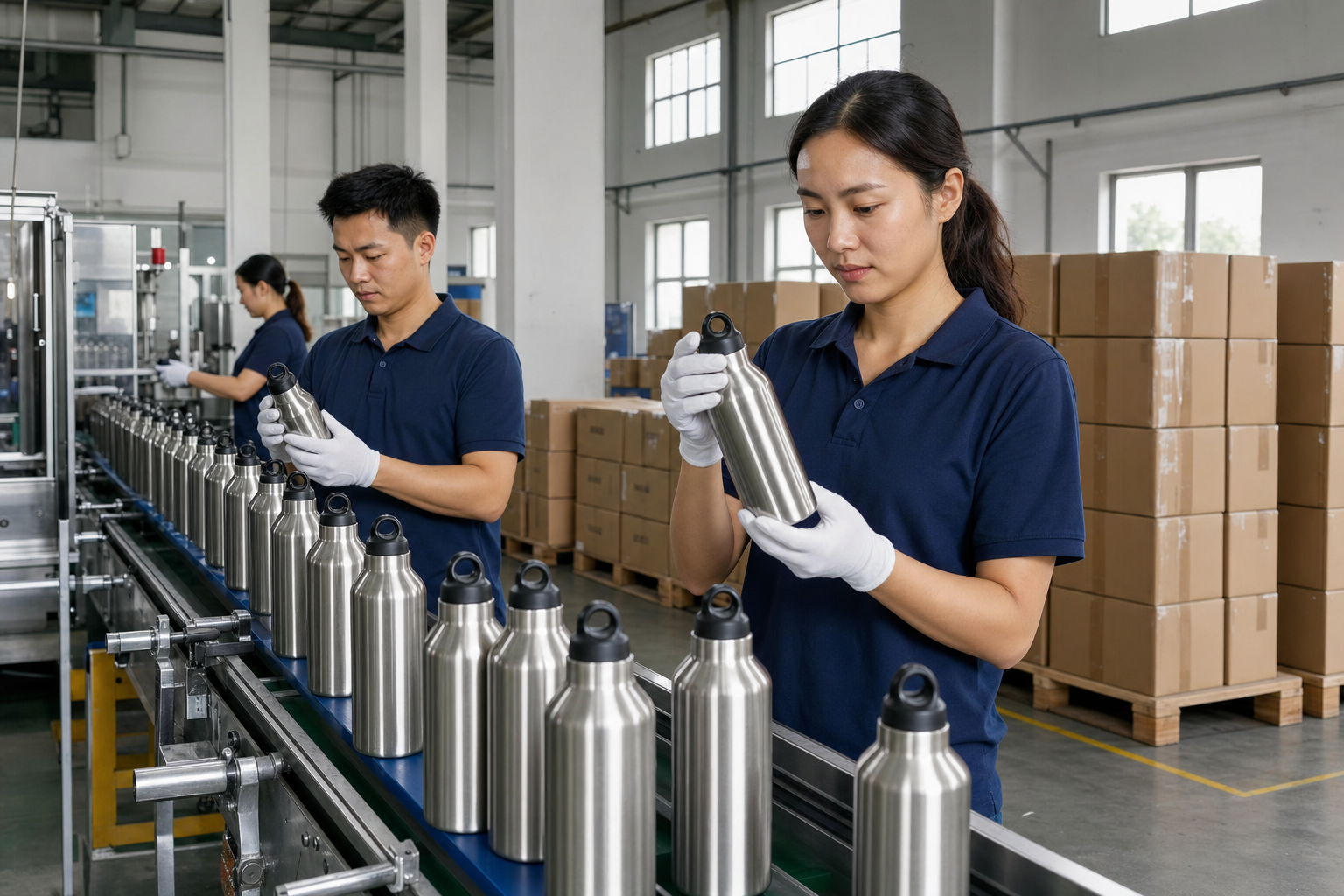
You need a buying filter that works on the line. Pick the body material, cap, decoration method, and factory setup before you talk price. A serious canteen manufacturer in Zhejiang, China should show MOQ, lead time, test reports, and monthly output. For standard custom drinkware, 500 to 1,000 pcs is a normal starting point, and 15 to 25 days is realistic when artwork and packaging are clear. QC pulled the sample at the torque station before we shipped it. The math does not work if you price first and spec later.
Start With the Use Case
The first mistake buyers make is asking for the best promotional drink bottle before they pin down where it will be used. A bottle for a 3-day trade show is not the same spec as one for a gym chain, outdoor retail, or a distributor program. If the user carries it every day, we run a leak test, check cup-holder fit, and pick a finish that does not show scuffs after 20 round trips in a backpack. If the bottle is for a short campaign, price and print speed win. That is the math.
For most B2B promotions, 500 ml or 750 ml with a straight body and a wide decoration panel is the safe call. That gives space for a logo, website, and QR code without forcing a new mold. On the line, we see buyers push back on complicated shapes because the MOQ jumps and carton packing gets messy. A canteen distributor usually wants the simple format for that reason. Judge the sample by four points: hand feel, leak rate, logo visibility, and carton efficiency.
Ask the factory to quote the actual use case, not a generic bottle. A cheap sports bottle can work for an event giveaway, but a client gift often needs a heavier wall, matte coating, and a tighter closure. QC pulled one sample last month because the lid sat 1.5 mm off center, and the buyer flagged it before shipping. When you say custom drinkware, the spec should change with the channel. That is the gap between a canteen supplier that sells blanks and a canteen factory that understands end use.
Choose Materials That Fit Price
Material choice decides whether your product feels like a real branded item or a giveaway. For the low to mid price band, stainless steel 304 is still the safest pick for the best promotional drink bottle. It gives solid corrosion resistance, broad compliance options, and better shelf appeal than plain aluminum. We run 304 with a 0.6 mm outer shell on the line for most corporate orders; QC pulled the sample, and the buyer still asked for a flatter seam. For cold drinks, that usually means 6 to 12 hours of temperature retention, depending on the lid and how the bottle is filled.
If you need a lighter bottle, Tritan or PP can work, but treat it as a different product, not a cheaper stainless substitute. A custom canteen for hiking or campus use often sells better in Tritan because it weighs less and takes molded shapes cleanly. For a premium corporate gift, stainless still sends the right signal. One PO we checked had a 380 ml Tritan bottle listed as stainless, and the buyer flagged it after sampling. In Zhejiang, China, plenty of factories can run both lines, but the finish on the cap ring and shoulder edge is where the weak ones show up.
Do not skip wall thickness. Thin metal feels cold and cheap, and it dents fast in transit. We had a carton test drop a batch with 0.35 mm walls, and the math did not work. A practical spec sheet should state the material grade, the thickness, the cap material, and the seal type. If a canteen vendor cannot tell you whether the gasket is silicone or TPE, move on.
Use Decoration That Lasts
Decoration is where a lot of promotional bottles die on the shelf. A logo that looks sharp on a render can wash off after 3 or 4 cycles if the process does not match the substrate. For stainless steel, laser engraving is the one we ship when the buyer wants the mark to stay put; it does not peel, and it gives a clean one-color brand line. On one run, QC pulled the sample after 24-hour detergent soak and the engraved mark was still crisp. For a lower-cost campaign, screen printing still has a place, especially if you need 1 to 3 spot colors and a bigger imprint area. UV print can carry complex art, but the line needs tight surface prep and curing control, and the math falls apart if the client expects photo detail on a curved body.
If you are comparing a cantenne customizable order with a standard bottle, decoration matters even more because the shape is already doing some of the selling. A customizable canteen with a matte powder coat and a deep laser mark usually beats a glossy body with a weak printed logo. We had a buyer flag a PO where the logo was typed 5 mm too low on the art file, and that small mistake would have made the neck area look crowded. Buyers sometimes ask for a canteen customized effect when they really want a premium look without paying for new tooling. This is the wrong question to ask. On our line, better finish and better print do the job faster than opening a mold for the same body.
What to confirm before production
- Logo artwork in vector format
- Print size and exact Pantone reference
- Engraving depth or print thickness
- Rub test and dishwasher resistance target
If your channel includes gift sets or distributor canteen programs, ask the factory for a print sample and a blank sample before mass production. We run this check on a stainless tumbler line with a steel ruler and a caliper, and it catches problems early. That step is cheap compared with reworking 5,000 pcs after the logo shifts 2 mm off-center, and we have seen that go sideways more than once.
Push For Real MOQ And Lead Times
Price without MOQ is noise. For standard custom drinkware from China, a real offer usually starts around 500 pcs for existing shapes and 3,000 pcs or more for heavier customization. If a supplier says any number is possible, the math does not work; they are hiding the loss somewhere else. On a Zhejiang export line, QC pulled the first 12 pcs with calipers before we locked the carton size, and that is the level of discipline you should expect from a factory that can move 180,000 units per month across multiple bottle lines.
For a simple promotional order, sample time is often 5 to 10 days, mass production 15 to 25 days, and carton-ready export packing another few days if you need inserts or retail sleeves. The wrong question is, "Can you do it faster?" Ask which step is adding days. Last week the buyer flagged a typo on the PO for sleeve height, and that cost us 2 days before the line could start packing. If you want special colors, soft-touch coating, or custom lids, add time. A custom growler or large-volume bottle may need extra testing because the closure and handle carry more stress. The same is true for a customized growler used in brewery channels; the lid seal matters more than the art. We run a 1.5 N·m torque check on the cap before sample release.
On the price side, the spread is wide. A single-wall promotional bottle can land under USD 2 FOB at scale, while a double-wall insulated model with a better finish may sit between USD 3.50 and USD 6.50, depending on volume and decoration. Ask for the quote to separate product cost, print cost, and packaging cost. QC found a 0.3 mm print drift on one sleeve run, and that is exactly why we split the numbers on the worksheet. That is how a canteen supplier keeps hidden charges off your PI, and it is how a professional canteen distributor keeps margin from getting eaten by an extra insert or inner box.
Demand The Right Quality Proof
Quality checks belong in the purchase order, not in a handshake promise. For drinkware, the minimum set is leakage testing, coating adhesion, print adhesion, and carton drop testing. On our line, QC pulls samples before packing starts, because once 5,000 units are boxed, small defects get expensive fast. If the order is going to Europe, ask for LFGB and REACH support. If it is going to the US, ask for FDA food contact compliance and, when relevant, California Proposition 65 awareness. ISO 9001 and BSCI are useful signals for factory management, but they do not replace product-level testing.
A clean inspection plan uses AQL 2.5 for major defects and AQL 4.0 for minor defects. That keeps the discussion on defect rates, not vague claims about "good quality." We run a 1.5 m drop test on packed cartons, especially for Amazon FBA or distributor warehouses. The wrong question is whether the bottle looks fine on the sample table. If the carton fails, the shipment fails. We have seen a buyer miss a PO typo on the carton label and lose a week while the reprint was rushed.
Ask for pre-production samples, in-line photos, and a final inspection report before balance payment. That is normal, not aggressive. QC pulled the sample on our last 8,000-piece run, and the buyer still had one print shade question.
For a custom drinkware program, the safest path is to approve one golden sample and one packed-carton sample. If the factory cannot hold those references, you do not control the run. The lid torque should not drift after the first 2,000 pieces. We have seen that go sideways. That is true whether you buy from a canteen vendor in Zhejiang or a larger China exporter with multiple production lines.
When Canteens And Growlers Win
Sometimes the best promotional drink bottle is not a bottle at all. For outdoor clubs, school programs, travel sets, and branded retail, a canteen custom spec can beat a round bottle on shelf presence and pack-out. A flat body sits closer to the body, stacks cleaner in a carton, and gives us a wider print panel. On one 1200-piece order, the buyer wanted a 60 mm logo panel, and that extra face made the sample easier to sell. A canteen customizable program also lets you swap straps, lids, and finishes without cutting a new mold every time.
This is where the language matters. A customized canteen is usually the cleaner call for hiking stores and sports programs, while a custom canteen for corporate gifting needs better gift boxing and a nicer first look. If you are working with a canteen factory or a canteen supplier that knows export work, ask how the same platform supports distributor canteen, distributor drinkware, and distributor growler jobs. That is the real test. If they only talk about print, they are not set up for channel work. We once caught a PO typo on a strap length, 980 mm instead of 900 mm, and QC pulled the sample before the line ran it.
Growlers follow the same logic. A custom growler works for breweries, specialty beverage shops, and gift packs, but the closure, neck finish, and drop performance need more care than a basic promo bottle. For a customizable growler, the right move may be a heavier glass body or a 316 stainless upgrade, depending on the fill and transport plan. We ship both from Zhejiang, and the math does not work if the buyer wants a low-cost look with zero breakage risk. A 750 ml glass growler that fails one drop test at 1.2 m will cost more in claims than the upgrade ever did. The right partner will tell you when a simple canteen is enough and when a tougher platform will save you complaints later.
Source Your Next Promo Bottle With Less Risk
Send your target price, capacity, and decoration method. We will quote MOQ, sample timing, and compliance documents from our China team.
Frequently asked questions
What MOQ should I expect for a custom promotional bottle?
For standard shapes, 500 pcs is a common MOQ from a real China factory, and 1,000 pcs is safer if you want custom colors or mixed packaging. If you need a new mold, plan for 3,000 pcs or more. The exact number depends on material, decoration, and whether the lid is standard or custom. A Zhejiang canteen manufacturer with export volume should quote the MOQ clearly, not hide it in a sample price. If they cannot separate blank, print, and packaging cost, the real minimum is usually higher than they admit.
Which material is best for the best promotional drink bottle?
For most B2B uses, 304 stainless steel is the best balance of cost, compliance, and perceived value. If you need insulation, a double-wall vacuum bottle with 0.6 to 0.8 mm wall thickness is a solid spec. For lightweight campaigns, Tritan or PP works better, especially for a custom canteen used in sports or campus programs. If the bottle is for Europe, confirm LFGB and REACH; if it is for the US, request FDA food-contact support. The best material is the one that fits your channel, not the one with the lowest unit price.
Is laser engraving better than screen printing?
Laser engraving is better when you want durability and a premium look, especially on stainless steel. It will not peel, and it handles daily washing well. Screen printing is better when you need low setup cost and 1 to 3 colors on a larger area. For a giveaway with a tight budget, screen print can be the right choice. For a higher-end distributor drinkware program, laser usually wins because the logo stays visible longer. If the art has fine lines, ask the factory for a print sample before mass production, because line thickness can disappear fast on curved surfaces.
What quality documents should I request from a China supplier?
At minimum, ask for material declaration, LFGB or FDA support where relevant, REACH if you sell into Europe, and a recent inspection report. For factory qualification, ISO 9001 and BSCI are useful, but they do not replace product testing. You should also ask for leakage test data, print adhesion checks, and carton drop-test evidence. A good canteen supplier in Zhejiang should be able to provide a golden sample, a packed sample, and batch inspection photos. If your buyer needs Amazon FBA compliance, ask for carton labeling, barcode placement, and drop-resistance requirements before production starts.
When should I choose a custom canteen or growler instead of a bottle?
Choose a custom canteen when the product needs a flatter profile, a bigger print face, or a more outdoor-friendly look. That works well for hiking, school, and lifestyle retail. Choose a custom growler when the channel is beer, cold brew, or premium beverage gifting, because capacity and seal performance matter more. A customizable growler often needs a stronger closure and more testing than a normal promo bottle. If your distributor canteen order is going into mixed retail and promotion, ask the factory to compare both options with the same artwork and price target. The better platform usually becomes obvious once you compare leakage risk and unit cost.