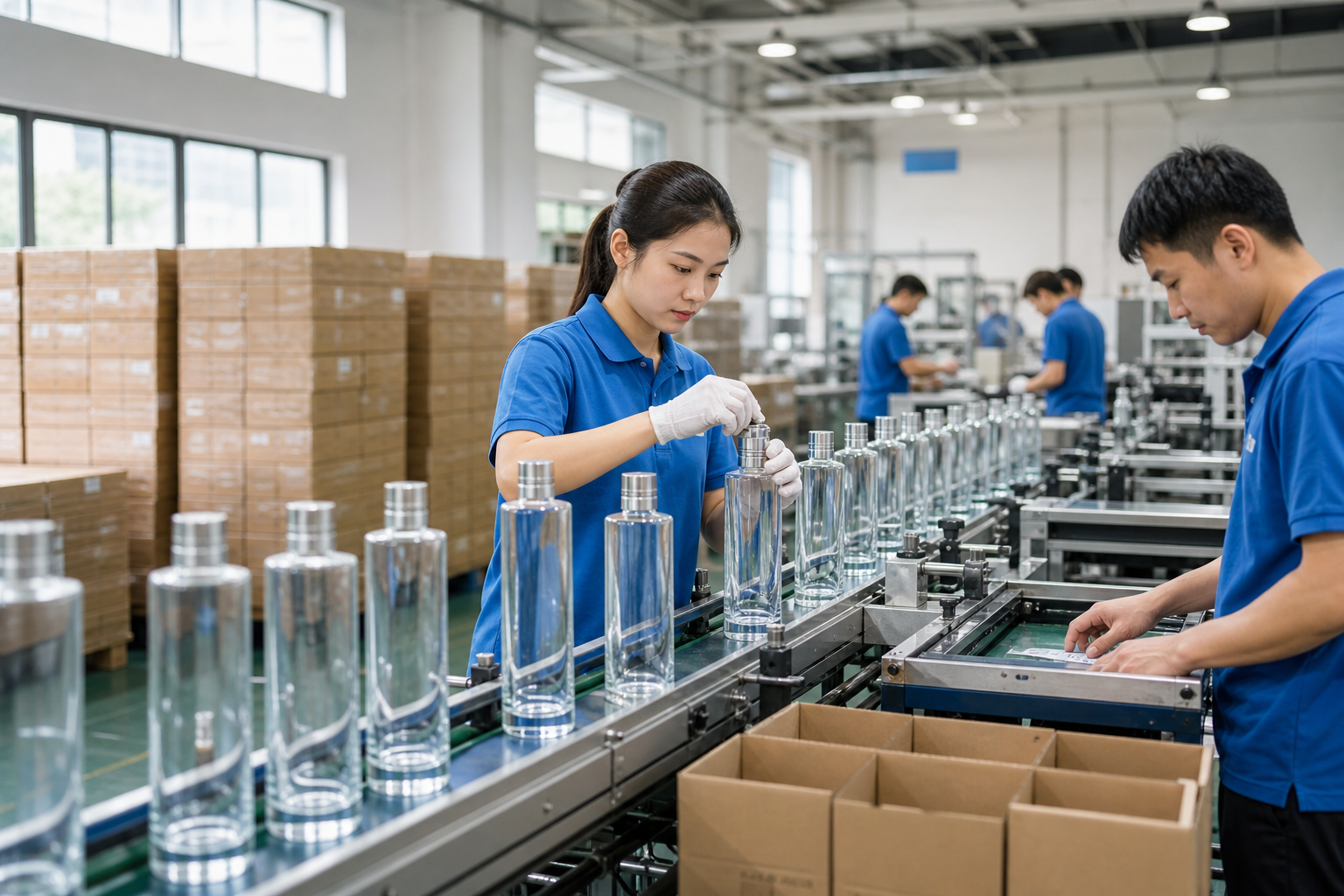
Key Takeaways
- A practical promotional glass bottle usually starts at 330 ml, 500 ml, or 750 ml, with 500 ml as the safest all-around choice.
- Typical MOQ is 3,000 pcs per design, with sample lead time of 7 to 10 days and mass production of 25 to 35 days.
- For Europe and North America, ask for REACH, LFGB, and food-contact documentation on the lid, gasket, and print system.
- A factory in Zhejiang, China with 800,000 units per month can keep your lead time stable only if artwork, carton spec, and closure are finalized early.
The best promotional glass bottle is not the prettiest sample. It is the one your distributors can ship without breakage, your brand team can print clearly, and your customer can use without leaks. We had a buyer flag a cap issue on a 20-cycle test, and the line stopped for a new gasket spec. Pretty does not pay claims.
In Zhejiang, China, we build glass drinkware for buyers who need real numbers, not guesses: MOQ, print yield, carton strength, and lead time. For custom drinkware, the usual fit sits at 330 ml to 750 ml, 3,000 pcs MOQ, and a decoration method that survives the 1.2 m drop test on the carton line before it leaves China for Europe or North America.
What Makes A Bottle Sell
The best promotional glass bottle is the one that holds up in a real program. If your team needs 5,000 to 50,000 units for stores, events, or distributor kits, the bottle has to balance shelf presence, breakage risk, and print area. We once saw a buyer love a sample, then QC pulled two chipped pieces after a 1.2 m drop test. That sample did not sell the job.
Start with the use case. A bottle for a café chain is a different animal from a bottle for a distributor canteen program, a custom growler campaign, or a customized drinkware bundle. The café order needs fast replenishment and a clean print panel. The growler side usually wants a wider mouth, a tougher lid, and cartons that survive warehouse handling; a buyer flagged a pallet shift issue on a 24-bottle case, and the math was off.
When we quote a canteen customized or canteen promotional order in Zhejiang, China, we ask for four facts before price: capacity, closure type, decoration, and carton spec. That is the filter we run at the line.
- Capacity: 330 ml, 500 ml, or 750 ml are the safe volumes.
- Closure: bamboo, stainless, aluminum, or PP with a food-grade gasket.
- Decoration: one-color print for volume, etch or decal for premium retail.
- Packaging: inner protection matters as much as the bottle itself, and 3 mm dividers beat loose packing every time.
If you also buy custom canteen, customizable canteen, or custom growler programs, use the same lens. The bottle has to fit the channel, not just the mood board. A canteen distributor or distributor drinkware buyer should ask one question first: will this reorder cleanly in six months, in the same spec, from the same canteen manufacturer or canteen supplier? We have seen this go sideways when the PO had a 500 ml spec typed as 550 ml.
Choose The Right Glass Format
For most promo runs, soda-lime glass is the default. It keeps unit cost down and the clarity is good. Borosilicate fits when the buyer wants better thermal shock resistance, but the quote usually jumps 25 to 40 percent. We ran that comparison on a 500 ml sample pack last month, and the math did not work for a simple giveaway. Pick the glass for the drink, not the pitch deck.
A 500 ml clear bottle with 2.2 to 2.8 mm wall thickness sits in the sweet spot. QC pulled the sample, the caliper read 2.5 mm, and the carton test passed clean. 330 ml bottles are better for tastings and event kits. If you move up to 750 ml or 1 L, you are closer to a custom growler or distributor growler program, which makes sense when the buyer wants shelf impact and fewer refills. Same logic on a canteen factory line: match the container to the channel.
Neck finish and closure matter more than most buyers think. A 28 mm neck is easy to source and prints cleanly. A wider opening speeds filling, but if the gasket is weak, leak margin drops fast. We had a buyer flag a PO typo on the closure spec once, and the line caught it before we packed 3,000 pcs. For hospitality or retail, I want a cap that survives repeated torque checks without deformation.
If you need one bottle that can move across promotions, retail, and distributor samples, start with 500 ml. It gives the safest mix of cost, handling, and perceived value.
- 330 ml: low-cost giveaway, event sampler, easy carton density.
- 500 ml: the best all-around promotional size.
- 750 ml to 1 L: premium beverage, bulk display, or custom growler use.
For buyers working with canteen manufacturers, canteen distributors, or canteen vendors, the sourcing logic is the same. The format has to make shipping, filling, and reordering simple. If it creates extra breakage or awkward MOQ planning, it is the wrong bottle.
Decoration That Holds Up
Decoration is where a lot of promotions go wrong. A print can look clean on the proof and still fail after 14 days in a warehouse at 35°C. For the best promotional glass bottle, judge decoration by wear first and appearance second. If you need a simple logo and tight cost control, silkscreen is still the workhorse. If you want a more premium finish, frosting, acid etching, or a fired decal holds better than a fast surface print. On one run, QC pulled the sample after a 48-hour rub test and the edge of the logo started to haze. That is the wrong place to save money.
For one-color logos, silkscreen on clear or frosted glass is efficient and easy to repeat. For complex artwork, a decal gives more detail, but it adds cost and usually 5 to 8 days of lead time. Laser engraving works on metal caps or sleeves, not always on the glass body unless the buyer wants a stripped-down look. If you are buying customized drinkware for retail, ask for print placement drawings with exact height and wrap dimensions before you approve sampling. We have seen a PO typo move a logo 12 mm off center. The buyer flagged it, and the line had to stop.
Two checks matter more than the render: rub resistance and dishwasher resistance. A practical in-house test is 50 dishwasher cycles or a 48-hour soak and rub check with neutral detergent. If the logo shifts color, flakes, or blurs, the decoration system does not fit the channel. We run this test on the bench, not on a sales pitch.
- Silkscreen: best for volume and one to three Pantone colors.
- Fired decal: better for multi-color graphics and wash resistance.
- Frosting or etching: best for premium tactile branding.
- Laser: useful for caps, not always the best answer for glass.
If your buyer asks for canteen custom, customizable canteen, or canteen customized packaging, the same rule applies. Keep the artwork clean and the print count low, and a canteen manufacturer in China has a much easier time holding color from the first order to the repeat order. We ship fewer surprises that way.
MOQ, Pricing, And Lead Times
Pricing on promotional glass moves with tooling, decoration, and packaging, and the quote changes fast once you touch the line. A stock 500 ml clear bottle with a one-color print and kraft box often lands around USD 0.68 to 1.25 FOB China at 3,000 pcs. Add a frosted finish, embossed mold work, or a magnetic gift box and you can push into the USD 1.40 to 2.80 range without much effort. We have seen the buyer flag a carton typo on the PO and hold the whole booking for a day.
Lead time matters just as much. A normal sample takes 7 to 10 days. Production after sample approval is usually 25 to 35 days. If the plant is in Zhejiang, China, and the line is running well, that schedule is realistic. A canteen factory with 800,000 units per month can take a tighter schedule than a small trading desk, but only when your artwork is final and the carton spec is locked. QC pulled the sample on a caliper at 0.8 mm, and that is the kind of check that keeps the date honest.
Do not compare only on unit price. Compare on the full landed cost: inner packaging, master cartons, palletization, breakage allowance, export documents, and inland trucking to the port. This is the wrong question to ask if you only look at FOB and ignore the rest. A distributor drinkware buyer who skips those numbers usually finds the problem after the goods reach the warehouse, when the math does not work. If you need a canteen supplier, canteen suppliers, or canteen vendor comparison, use the same spreadsheet.
- Tooling: new molds can add USD 1,200 to 4,000.
- Printing: one color is cheap; four color wrap is not.
- Packaging: individual boxes can add USD 0.12 to 0.45 each.
For a custom canteen or customized growler style project, the price gap is usually not the bottle alone. It is the finish, the closure, and how tightly the cartons pack on the pallet. We ship these jobs every week, and the direct factory quote from China is cleaner than a broker number that changes after the first sample run.
Quality Checks Buyers Should Demand
Glass QC is not optional. We ask for AQL 2.5 on major defects, AQL 4.0 on minor defects, and zero tolerance on cracks, sharp edges, or seal failure. On the line, the first checks are clarity, neck finish accuracy, leak testing, and print adhesion. Then we look at shipping protection: carton strength, divider layout, and pallet stability. A 38 mm neck that passes on paper but leaks after capping is a bad bottle.
For Europe, ask for REACH declarations and, where needed, LFGB documents for the lid and gasket. For North America, the food-contact material file should be clean and easy to read. If the lid is bamboo or stainless steel, the sealing part still needs its own test. A BSCI-audited supplier helps, but audit status does not replace product testing. We’ve seen buyers skip this and pay for it later.
We run a pre-production sample, an inline check during printing, and a pre-shipment inspection before final payment. If your order goes to Amazon FBA, add FNSKU labeling, carton mark instructions, and a master carton spec that keeps each case under the warehouse limit. One buyer once sent a PO with the wrong carton height by 30 mm, and the warehouse refused the load. A dropped carton should not turn a promo campaign into a breakage claim.
Good buyers do not ask only whether the bottle is safe. They ask whether the bottle still meets spec after printing, packing, palletizing, and export handling.
- Leak test: 100 percent for the first run.
- Drop test: verify from 70 cm to 100 cm depending on packaging.
- Print test: rub and wash checks before mass production.
- Traceability: lot code on carton or label, not just on paperwork.
If you are sourcing from a canteen manufacturer or canteen vendor in China, insist on the same discipline. The supplier should show the test method, the tolerance, and the lot record, not just a brochure. QC pulled the sample, checked the lot code, and that told us more than any sales deck.
How To Source Without Mistakes
The cleanest way to source from China is to run it like a spec job. That applies whether you are buying a customized canteen, customizable canteen, customized drinkware, or the best promotional glass bottle for a beverage launch. Start with a written brief: 500 ml or 750 ml, closure type, print file, target market, annual forecast, carton count, and whether the product goes to retail, events, or distributor kits. We had one buyer skip the carton spec and the PO came through with a typo on the sleeve count; the line caught it before we packed, but that mistake cost three days.
Then make the quotes match. Ask each canteen distributor, canteen suppliers, or canteen vendor you contact to price the same bottle, same decoration, same packaging, and the same Incoterm. If one quote lands 18% lower, the supplier has usually cut something you did not ask to cut. The missing item is often a thicker carton, a weak gasket, or a loose inspection standard. The math does not work otherwise.
- Send a simple RFQ with size, artwork, and target FOB price.
- Approve a sample with the real lid, gasket, and carton.
- Confirm compliance files and label requirements before production.
- Book a pre-shipment inspection and lock the shipping mark.
A serious buyer also asks for factory video, not only photos. In Zhejiang, China, the better glass plants can show melting, forming, printing, packing, and loading in one sequence. We run the lehr, the cap torque test, and the drop check on camera when a buyer asks, because that is the fastest way to separate a real plant from a reseller. If the factory cannot show repeatability, the order is still not ready.
For distributor drinkware programs, repeatability matters more than novelty. One clean bottle. One stable print. One lead time that holds at 12 days instead of slipping to 18 days. That is how you keep reorders moving without changing the whole line, and it is the right question to ask when the buyer flags cost pressure.
Request Your Custom Glass Bottle Quote Today
Send your capacity, artwork, and target market. We will return pricing, sample timing, and a practical production plan within 24 hours.
Frequently asked questions
What MOQ should I expect for a promotional glass bottle?
For a standard promotional glass bottle, a realistic MOQ is 3,000 pcs per design or color. If you need embossing, a special lid, or mixed packaging, 5,000 pcs is more common. Stock bottles with logo-only decoration can sometimes start at 1,000 to 2,000 pcs if the factory already holds inventory. Sampling is usually 1 to 2 pcs, and sample fees often sit around USD 30 to 80 depending on printing and freight. If you are comparing canteen manufacturers or canteen suppliers, make sure the MOQ includes the actual closure and carton spec, not just the bottle body.
Is glass safe for both hot and cold drinks?
Yes, but the material choice matters. Soda-lime glass is good for cold drinks, room temperature water, juices, and shelf display. If you want hot and cold cycling, borosilicate is the safer option because it handles thermal shock better. For practical sourcing, I usually recommend keeping soda-lime bottles in the 0 to 60 C range and borosilicate for hotter fills. The closure matters too: the lid, gasket, and venting must match the temperature range. A good supplier in China will state the recommended use temperature and test method instead of leaving you to guess.
Which decoration method lasts the longest on glass?
For long-term durability, fired decal and acid etching are usually stronger than a simple surface print. Silkscreen is still the best value when you want one to three colors and a clean logo, but it should be tested for rub resistance and washing. If the bottle will be handled daily or washed often, ask for a 50-cycle dishwasher test or an equivalent internal wash test. Laser engraving is better suited to metal caps or sleeves than to the glass body itself. For canteen custom or custom drinkware programs, choose the print method based on how the item will actually be used.
Can you ship promotional glass bottles to Amazon FBA?
Yes, but you need to plan the packaging from the beginning. Each unit should be protected with a sleeve, carton divider, or individual box so glass does not touch glass. Add FNSKU labels before dispatch, and keep the master carton within the warehouse weight limit, usually under 50 lb for US fulfillment. A five-layer corrugated carton is common for glass, and palletization should be specified before production. Ask the supplier for carton dimensions, gross weight, and pallet height in writing. If you skip those details, you may save a little on FOB China and lose much more on receiving and repacking.
How do I choose between a glass bottle, custom growler, or canteen?
Choose glass when you want a premium look, neutral taste, and strong branding on shelves or at events. Choose a custom growler or customized growler when the format needs larger volume and reuse, usually 650 ml to 1 L or more. Choose a canteen custom or customizable canteen program when insulation and drop resistance matter more than clarity. For distributor drinkware programs, the best answer is often one hero glass bottle for premium channels and one tougher canteen-style item for value channels. If your buyer base includes both retail and hospitality, split the line instead of forcing one product to do everything.