Key Takeaways
- A practical promotional thermal bottle program usually starts at 500 ml or 17 oz, with 18/8 stainless steel and 6-12 hour heat retention.
- For China sourcing, a realistic MOQ is often 1,000-3,000 units per SKU, with 35-50 days lead time after sample approval.
- Laser engraving, one-color silkscreen, and 4-color UV print each fit different canteen customized budgets and retail expectations.
- A supplier in Zhejiang with 200,000+ units/month capacity can support distributor drinkware programs, but only if QC and packaging are controlled.
Buy the wrong promotional thermal bottle and it shows up fast: weak heat retention, pad print that flakes off after 3 washes, or a lid that starts leaking on the second week. We see it on the line. The right pick is not about chasing the lowest unit price; it is about matching the bottle to how your customer actually carries, opens, and refills it.
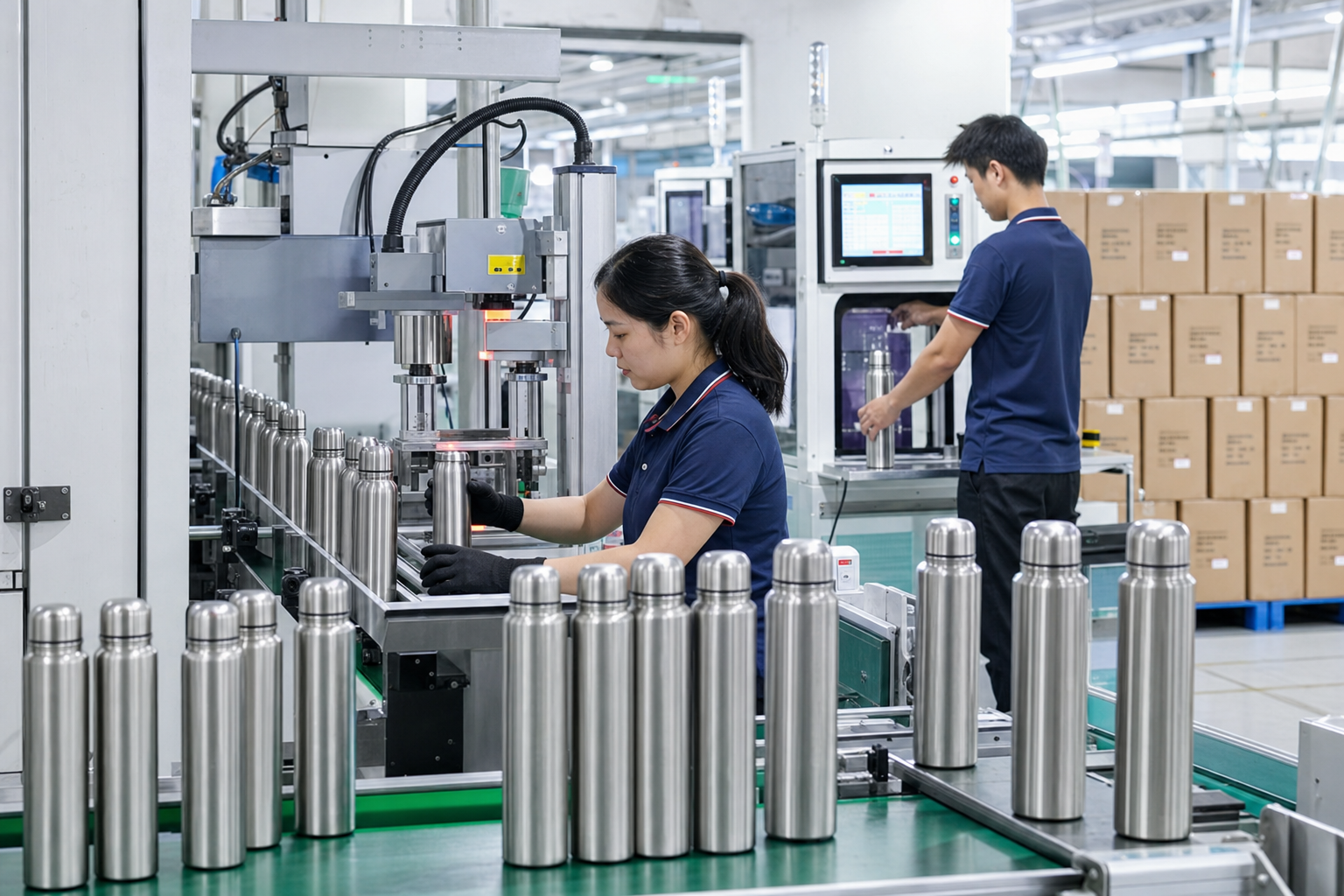
Here in Zhejiang, a good canteen manufacturer asks about your channel first, then builds the spec from there—capacity, steel grade, coating, carton count. That order matters. We had one buyer push for a glossy sample at 500 ml, then the PO typo showed 550 ml, and QC pulled the sample because the outer box size no longer matched the master carton. A bottle that looks good in photos but fails REACH, AQL, or drop testing is dead stock, not custom drinkware.
Start With The Selling Channel
The best promotional thermal bottle is not a generic bottle with a logo on it. Start with the channel. A corporate giveaway, a sports event, and a retail-ready distributor program all need a different body spec, decoration method, and carton pack. We run this every week. If you skip that step, you end up with a canteen built for the factory floor and sold to a premium office buyer, and the fit is wrong from day one.
For low-risk promo programs, 500 ml and 750 ml are the safest capacities. They ship well, carry well, and fit most cup holders or backpacks. On one North America order, the buyer pushed back on a 3-color logo and switched to a matte powder coat with a single-color print; the sample passed faster, and the PO had one typo in the carton mark that QC caught before loading. For Europe, buyers usually want a cleaner look and the paperwork to match, including REACH and food-contact declarations.
Use the channel to set the spec, not the other way around. A distributor selling to gyms may ask for a rugged wide-mouth body with a 55 mm opening. A brand owner running ecommerce may need a lighter profile and a cleaner unboxing. This is the wrong question to ask if the factory starts from its own standard bottle and tries to force it onto every buyer. A canteen supplier in China should explain these differences without guessing; if they cannot, you are not talking to a useful partner.
Pick Specs That Hold Up
Thermal performance is where promo programs get exposed. A bottle that looks good on the sample table can still fall apart after 60 minutes on the road. For a factory spec that holds up, we run 18/8 stainless steel on both walls, keep the vacuum gap even from neck to base, and test the lid seal after repeated opening. Double-wall construction is standard. The real difference is whether the line controls welding, vacuuming, and final closure without leaks.
Ask for numbers, not slogans. A solid promotional thermal bottle should keep hot drinks 6-12 hours and cold drinks 12-24 hours, depending on volume and lid style. We usually see wall thickness at 0.4-0.6 mm on mainstream SKUs; one buyer once pushed back on 0.35 mm, and the math did not work for their target price. If a supplier claims extreme performance but will not show the test method, that is a sales pitch, not a spec.
- Ask for food-contact declarations for the body, lid, and seals.
- Confirm BPA-free status for any plastic parts.
- Request salt-spray data or coating abrasion results if the finish matters to your channel.
- Check whether the lid was tested for 5,000 to 10,000 open-close cycles.
These numbers matter because distributors do not buy stories. They buy repeatable product that survives packing, transit, and end-user use. QC pulled the sample on a 2 mm lid gap before shipment, and that kind of miss is exactly why we check this twice.
Decoration Changes The Margin
I’m rewriting the section to sound like a sales engineer on the factory side: tighter claims, concrete numbers, and sample/test language that matches how we quote and inspect drinkware.Decoration is where many canteen manufacturers either protect your margin or burn it. A one-color silkscreen logo usually wins on price when the artwork is flat and the order clears 1,000 units, especially for a simple promo bottle. We run that on a 120-mesh screen, and if the logo is clean, the math works. Laser engraving costs more in setup than in material, but it gives a tighter finish and avoids the fade risk that comes with some coatings. UV print gives sharper color or a full wrap, but it has to match the body finish and the abrasion spec.
If you are building a customized growler or a larger customizable canteen for outdoor retail, decoration should be treated as part of the build, not as afterthought branding. Matte, gloss, and rubberized finishes react differently to heat, solvent wipe, and carton rub. On the line, we check the same sample after 24 hours and again after a tape test, because a pretty print on the wrong shell is useless. A canteen vendor in Zhejiang should show printed samples on the exact body finish you plan to buy, not a demo unit that hides the real result. The buyer flagged a 0.2 mm color shift before, and we had to rework the file.
If the print cannot survive a basic rub test and a realistic carton drop, it is not ready for distributor drinkware.
For high-volume programs, ask your canteen supplier to quote blank and decorated pricing side by side. That makes the margin impact obvious. A PO typo once changed “laser” to “layer,” and QC pulled it before we started the line. This is the wrong question to ask if you only look at unit price. It also helps you decide whether the bottle should go out as customizable drinkware for a campaign or as a retail-grade customized canteen with a higher ticket price.
Know The MOQ And Lead Time
MOQ is not a factory whim. It comes from setup cost, decoration complexity, and the packing line. For a common canteen custom project, 1,000-3,000 units per SKU is a normal starting point in China. If the shape is tricky, the lid has extra parts, or you want prints in two positions, the number climbs. If someone offers 200 units with deep customization and a low price, ask which step they are skipping. We have seen that math fail on the line.
Lead time is usually 35-50 days after sample approval and deposit for a standard line. Add another 7-12 days if you need new tooling, special cartons, or multi-step decoration. A real canteen factory in Zhejiang should be able to walk you through the flow: body forming, vacuuming, coating, curing, printing, packing, final QC. Last week QC pulled a sample with a 0.8 mm print shift and held the lot. That breakdown matters more than a vague fast-delivery promise.
One clean way to judge a supplier is monthly capacity. A factory running 200,000+ units per month has the scale to support canteen distributors and distributor growler programs, but only if the QC system stays tight. Scale without control just makes the scrap pile bigger. You want a vendor that can repeat the same result on a replenishment order, not just on the first shipment. We ship plenty of orders where the buyer flags a PO typo on carton marks, and that is where the real test starts.
Check Quality Before You Scale
Quality control is where a promo bottle order turns into a reorder. Do not sign off on a nice-looking sample and call it done. We run a pre-production sample, a gold sample, then a production approval sample once the order crosses 5,000 pcs; on one 18,000-piece run, the buyer flagged a 1.2 mm lid gap and we caught it before the line moved. A workable inspection plan is AQL 2.5 for major defects and 4.0 for minor defects, though retail and ecommerce often need tighter limits.
For Europe and North America, paperwork carries the same weight as appearance. Ask for REACH-related declarations, food-contact confirmation, and test reports for the coating, lid, and 304 stainless. We had a PO with the FNSKU printed in the wrong spot by 8 mm, and that typo would have stalled receiving at Amazon. A good canteen manufacturer handles carton labels, barcode placement, and FNSKU handling as part of the order.
- Check logo alignment and color consistency on the first 20 cartons, the middle stack, and the last 20 cartons.
- Run leak resistance after hot and cold cycling, then flip the bottle for 12 hours.
- Confirm that spare parts, such as lids or seals, are available on repeat orders of 1,000 pcs or more.
- Test the bottle with your actual packing inserts, not only the factory carton; we’ve seen a 2 mm insert change crush a sleeve.
If you are sourcing customized drinkware at scale, ask for a written QC checklist. This is the right question to ask. It cuts down on shipment arguments and keeps the program stable when QC pulled the sample and found a loose cap torque at 18 N·cm.
Match The Product To Your Market
Different markets pay for different details. In Europe, buyers usually want matte finishes, recycled carton claims, and a clean compliance file with the test reports ready. In North America, the same bottle often needs bolder contrast, a larger logo panel, and plain language on insulation and drop resistance. Same bottle. Different pitch.
That is why a canteen distributor has to look past the bottle body. We run the line with the decoration method, inner carton, shipper strength, compliance files, and the reorder plan all in view. A custom growler for a brewery promo is not the same job as a customized canteen for an employee onboarding kit. One needs shelf pull. The other needs 500-piece repeat shipments without drama. Both can come from the same China supply base, but the brief cannot be the same. We’ve seen that go sideways when the buyer assumed a standard gift box would hold up in transit; one 1.2 mm dent on the carton corner was enough to trigger claims.
When you talk to a supplier in Zhejiang, give the market, channel, and target price on day one. A factory can suggest the right build once it knows whether you are aiming at USD 3-5 FOB or a bottle in the USD 7-12 FOB range. Those are planning bands, not quotes. If the PO says “canteen promo item” and nothing else, QC pulled the sample, found the print area off by 8 mm, and the whole job slipped a week. The math does not work if freight, AQL 2.5, and replacements were never in the brief.
Source your next thermal bottle with clarity
Send your target price, capacity, and artwork. We will map the right canteen customized spec for your channel and timeline.
Frequently asked questions
What capacity sells best for a promotional thermal bottle?
For most B2B programs, 500 ml is the safest default because it balances price, portability, and perceived value. If your audience is office buyers or commuters, 350-500 ml works well. For outdoor or sports campaigns, 750 ml often performs better because it feels more substantial and gives you a larger logo area. In China sourcing, the same mold can sometimes support multiple lid options, but each change can affect MOQ and lead time. If you want the bottle to feel premium without driving freight too high, 500 ml with 18/8 stainless steel and a matte finish is usually the most efficient starting point.
What MOQ should I expect from a canteen manufacturer in China?
For a standard canteen custom order with one body color and one logo, 1,000-3,000 units per SKU is a realistic expectation. If you add multiple colors, special packaging, or custom lids, the MOQ can rise to 5,000 units or more. Smaller orders are possible, but the unit price usually jumps enough to erase the benefit. A serious canteen factory in Zhejiang should tell you exactly which cost drivers are affecting the MOQ: coating setup, print setup, packing materials, or extra inspection. That level of clarity is more useful than a vague yes.
Which decoration method is best for custom drinkware?
It depends on the job. Laser engraving is the most durable and usually the cleanest for premium distributor drinkware. Silkscreen is the lowest-cost choice when you need a simple logo and a larger run. UV print is better when you need color detail or a more retail-facing look. For canteen promotional programs, the best option is often one-color print because it keeps cost down and improves production stability. If your logo has gradients or small text, ask for a proof on the exact finish you want, because matte and gloss surfaces do not behave the same.
How do I check quality before placing a large order?
Start with samples and documentation, then move to production controls. Ask for a pre-production sample, a gold sample, and if the order is large enough, an in-line or pre-shipment inspection using AQL 2.5 for major defects. Check leak testing, logo placement, coating adhesion, and carton strength. For Europe and North America, also request food-contact declarations and REACH-related paperwork where applicable. If your order is going into ecommerce, test the bottle in the actual shipper you will use. That catches problems the factory carton will hide.
What lead time is normal for a customized canteen order?
For a standard order from a canteen supplier in China, 35-50 days after sample approval and deposit is normal. If you need new tooling, special packaging, or multiple decoration steps, plan for 50-65 days. Air freight can shorten transit, but it does not fix production bottlenecks. A factory with 200,000+ units per month can usually handle volume, but only if you approve artwork and samples quickly. If the project is time-sensitive, ask for a written schedule that breaks out production, QC, packing, and shipping separately.