Key Takeaways
- 304 stainless steel with 0.5-0.6 mm inner wall is the safest baseline for most promotional thermos programs.
- For bulk thermos orders, expect FOB China pricing around USD 4.20-8.90 depending on capacity, lid type, and decoration.
- A 24-hour heat retention claim should be verified with test conditions, not just catalog wording.
- MOQ of 1,000 pcs and 20-35 day lead time is realistic for a custom thermos factory in Zhejiang.
If you are buying the best promotional thermos bottle for an outdoor retailer, a brand giveaway, or a distributor program, the hard part is not finding a bottle. It is finding one that ships without dents, prints cleanly, passes REACH and FDA checks, and still leaves room in the margin. We see this every week in Zhejiang. Two bottles can look the same on a screen and behave nothing alike once they hit the line or the carton test.
A good custom thermos is judged by steel grade, wall construction, lid seal, vacuum hold, coating adhesion, carton strength, and whether the thermos factory can keep dimensions steady across 5,000 or 50,000 units. QC pulled the sample on our 0.02 mm gauge last Friday and found one lid thread drifting by 0.3 mm; the buyer flagged it before we ran the order. At BottleForge Industrial in Hangzhou, our stainless lines run 120,000 units per month, MOQ is 1,000 pieces per SKU, and standard lead time is 20-35 days after sample approval. That is the difference between a promo item that sells through and one that comes back.
What makes a thermos promotional
The best promotional thermos bottle does one job well: it holds temperature and gives you a clean, durable branding surface. If the bottle leaks, dents, or prints badly, the campaign loses value fast. Outdoor retailers look at shelf appeal and drop-test results. Promotional buyers look at imprint area, color match, and a unit cost that still works after freight, duty, and local decoration.
For a custom thermos program that ships without drama, start with the body structure. A 304 stainless steel inner and outer wall is the usual baseline. If the buyer asks for better corrosion resistance, 316 stainless can be specified, but the price usually rises by 12-20%. Wall thickness matters too: 0.5 mm is common for cost-sensitive bulk thermos orders, while 0.6 mm gives a firmer hand feel and better dent resistance. We ran one order at 0.5 mm, and QC pulled the sample after a 1.2 m drop test left a visible flat spot.
Then look at the lid. A screw lid with silicone gasket is the safer promotional thermos choice because it takes carton pressure better than push-button mechanisms. For distributor thermos programs, simpler means fewer claims. If you need a premium custom logo finish, powder coating plus laser engraving gives a cleaner result than low-grade pad print. We ship a lot of factory thermos pieces from Hangzhou, and the buyer often flags the print after the first carton open if the logo edge looks fuzzy. This is the wrong question to ask if you are only chasing the lowest MOQ.
- 304 steel: the usual balance of price and performance
- 316 steel: better corrosion resistance, 12-20% higher cost
- 0.5-0.6 mm wall: practical for promotional use
- Screw lid with gasket: fewer claims in transit
Sizes buyers actually move
Our thermos catalogs usually list 350 ml, 500 ml, 750 ml, and 1,000 ml, but the line does not move them evenly. For outdoor retail, 500 ml and 750 ml are the steady sellers because they fit a backpack side pocket and most car cup holders. For corporate giveaways, 450 ml to 550 ml is the range buyers keep coming back to. Go much larger and the bottle stops being a daily carry item.
When you compare thermos custom options, check the finished size, not just the volume. A 500 ml bottle with a wide shoulder can look solid on paper, then miss a 78 mm cup holder by 2 mm. A slim 350 ml bottle works for lunch kits, but the print panel is small and the logo gets squeezed. We ship a lot through Amazon and retail cartons, so case count matters. One extra centimeter in carton length can wipe out a cheap FOB price.
Typical FOB pricing from a thermos manufacturer in China for stainless promotional bottles is around USD 4.20-5.30 for basic 350-500 ml models, USD 5.60-7.20 for mid-range vacuum bottles with powder coating, and USD 7.50-8.90 for premium double-wall designs with advanced lids or gift packaging. Those are factory thermos references for Zhejiang production, not retail prices. If a thermos supplier comes in well below that, the question is not "why so cheap" but "what got cut." We have seen 304 claimed on the PO, then QC pulled the sample and the steel wall was 0.35 mm thinner than spec.
Ask for a dimension sheet with diameter, height, weight, and carton pack count. A bottle that is 2 mm wider can cost more in freight than a 10 cent unit price difference.
Insulation claims you can verify
Thermal claims get fuzzy fast. We do not accept “keeps hot for 12 hours” unless the sheet shows the fill temperature, ambient temperature, starting volume, lid type, and the exact run on the line. Our own check usually starts with 95°C water in a 20-25°C room, then readings at 6, 12, and 24 hours. QC pulled a sample last week with a missing test note, and the buyer flagged it immediately. If you are comparing manufacturers thermos samples, use one test method for every piece. The math does not work any other way.
For the best promotional thermos bottle, 6-8 hours of usable hot retention and 12-18 hours of cold retention is enough for most campaigns. We ship plenty of these for trade shows and team gifts. Premium vacuum bottles can do better, but if your audience is outdoors, the cap seal and spill resistance matter as much as the temperature curve. A custom thermos with a weak lid loses heat faster than a well-made bottle with average steel, and we have seen that go sideways in 2 mm cap gaskets more than once.
Ask the factory thermos team for vacuum leak testing, usually 100% visual or spot-tested under internal pressure methods, plus drop testing from 76 cm or 1 meter depending on your spec. REACH compliance and food-contact declarations are normal requests for Europe and North America. If your program is going into retail, request test reports for LFGB, FDA, and ASTM-style thermal claims where relevant. The buyer once caught a PO typo on the carton count, and the same kind of slip can ruin a compliance file. A supplier thermos team in Zhejiang should handle these documents cleanly, no drama.
Practical rule: a promotional thermos should pass leak-free inversion for 24 hours, retain hot water above drinking temperature for at least 6 hours, and survive carton compression without lid distortion.
Decoration that survives handling
Your decoration choice decides whether the bottle still looks premium after 1 week or after a full season in the field. Screen print is cheap and works for a plain logo, but once the bottle knocks against a steel lunchbox or hard plastic crate, we’ve seen edges scuff off. Laser engraving is the safest pick for a customized thermos when the buyer wants a clean mark that holds up. UV print handles multi-color graphics, but the line needs cleaner surface prep and a steady coating thickness, or the buyer flags it after the first carton sample.
For distributor thermos and thermos distributor campaigns, we run three decoration routes. One is laser engraving on bare steel or coated surface for durability. One is 1-3 color silk screen for budget promotions. One is full-wrap heat transfer or water transfer for a more decorative look. On a thermos customizable program, once the print covers more area, adhesion and abrasion resistance stop being a side issue. This is the wrong question to ask if someone only talks about artwork; the math is in the wear test, not the mockup.
We normally recommend a logo zone of at least 40 x 40 mm for small caps and 60 x 80 mm on the body if you want the brand to stay readable from 1-2 meters away. If the target is outdoor retailers, darker powder coating with a matte finish hides fingerprints and scratches better than gloss. On our Hangzhou line, we check surface pretreatment, spray curing, and a tape adhesion test before packing. Last month QC pulled the sample when the crosshatch left flaky edges, and the buyer had typed the PO size as 60 x 60 mm by mistake.
- Laser engraving: most durable, premium look
- Silk screen: lowest cost for simple logos
- UV print: better for color graphics, tighter QC required
- Powder coat: better scratch resistance than basic paint
MOQ, lead time, and pricing
Bulk thermos buyers should treat MOQ and lead time as production variables, not sales talk. We run the line that way. A thermos factory in China can quote 500 pcs, but that only works when the body is already tooled and the decoration stays simple. For a real custom thermos with a new color, logo, and packaging, 1,000 pcs per SKU is the practical start. If you need two artwork versions, split the quantity early or your unit cost climbs fast.
For BottleForge Industrial in Hangzhou, the standard MOQ is 1,000 pcs, and normal lead time is 20-35 days after sample approval and deposit. QC pulled the sample at 2 mm print tolerance, and that is the level buyers expect. That schedule is solid for Zhejiang manufacturing if you want stable QC and export paperwork. If you need urgent stock, ask whether the thermos supplier has semi-finished bodies or common lids in inventory. A vendor that promises 500 pieces in 7 days usually cuts corners or only has stock colors with no real custom work. We've seen that go sideways.
Pricing should be read with freight and packaging, not just FOB. A thermos bulk order at USD 5.10 FOB can turn into USD 7.40 landed after cartons, inland trucking, ocean freight, and import handling. The math doesn't work if you ignore those lines. If your sales plan depends on a fixed margin, request a full landed-cost estimate. For distributors thermos orders, ask about case pack count, master carton strength, and palletization. A 12 kg carton that crushes in transit costs more than a clean quote saves.
Buyer note: a reliable thermos manufacturer will quote from capacity, steel grade, lid complexity, print colors, and packaging spec. If the quote only says “stainless bottle,” you are not comparing real numbers. One PO typo on lid color or carton count can change the whole order.
Quality checks before you commit
Good buyers do not wait for a container to find defects. We run a pre-production sample, a sealed golden sample, and a written inspection standard before the line starts. On stainless thermos orders, the usual trouble spots are leaks, coating chips, loose lid fit, off-center logos, and vacuum loss after carton pressure. We saw a 1.2 mm logo shift kill one promotional run last year. That is not a small issue when you are shipping thousands of units into retail or giveaway programs.
Use AQL 2.5 for major defects and AQL 4.0 for minor defects as a starting point for bulk thermos inspection. If the bottle is for a trade show or a retailer launch, tighten the appearance spec. A solid thermos supplier should cover incoming material checks, in-process inspection, and final random inspection. Ask for photo records, dimension checks, and, if they have the setup, a vacuum retention report from production. QC pulled one sample at 24 hours and caught a pressure drop before we packed the lot.
Check the packaging too. A customized thermos can pass inspection and still arrive dented if the inner box is thin or the master carton is packed too heavy. We have seen a 12 kg carton fail a drop test where a 9.5 kg version held up. For export to Europe and North America, you need clear carton marks, inserts that survive drop testing, and compliance papers ready for customs. A China factory that ships every week will know this. Zhejiang OEM plants keep these files in order because importers ask for them on every shipment.
When you compare suppliers thermos options, do not chase the lowest quote. Compare defect rate, reply speed, sample lead time, and whether the factory can remake the same bottle six months later without color drift. One buyer flagged a PO typo on the Pantone code and the whole batch came out wrong. The math does not work if the first run is cheap and the rework eats the margin. That consistency is what keeps a distributor thermos program profitable.
How to choose the right partner
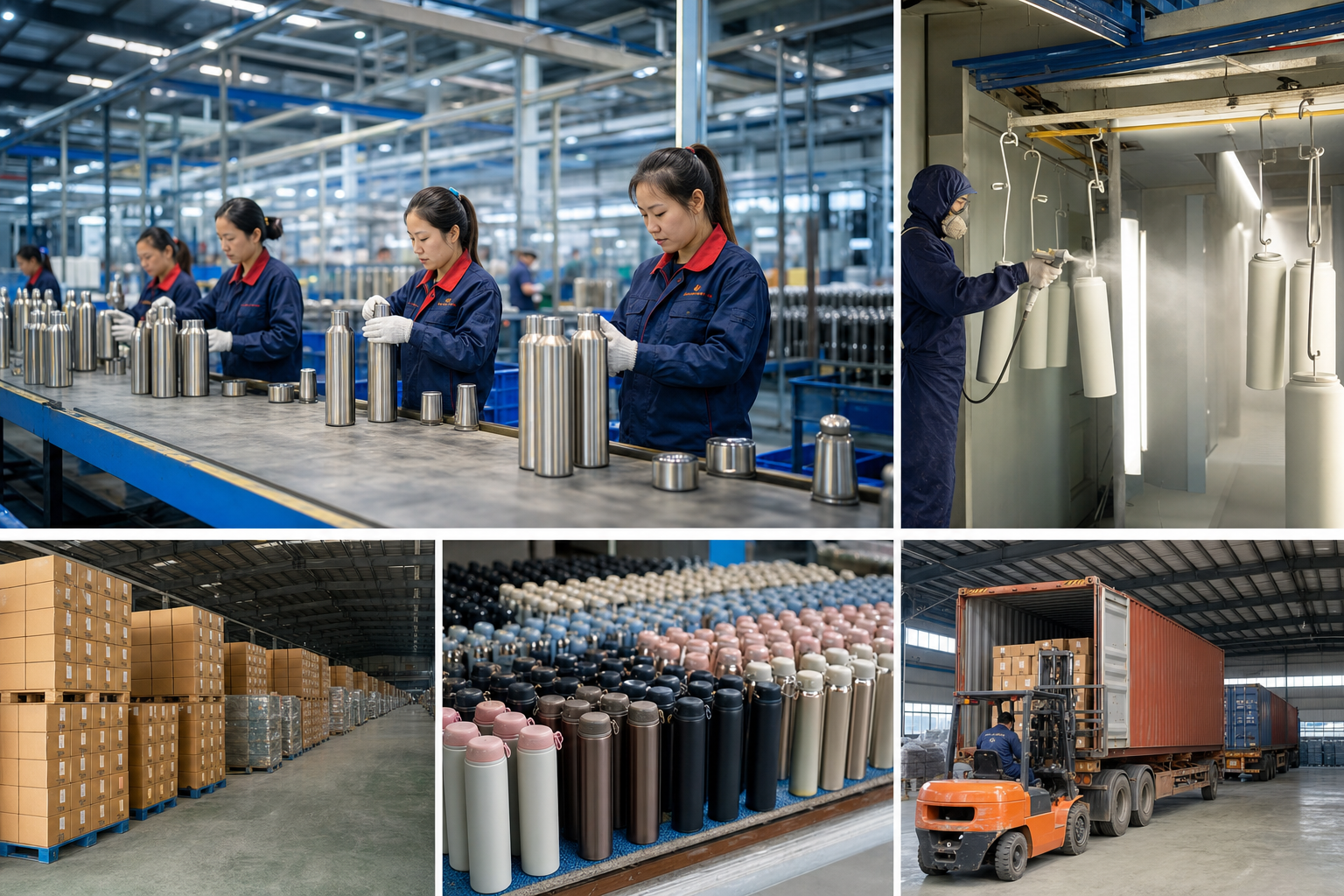
The best promotional thermos bottle is only as good as the thermos factory behind it. If the same plant does steel forming, vacuum welding, coating, printing, and export packing, the handoffs stay tight. We run it that way for a reason. Once a plant outsources half the job, one loose seam at 0.3 mm or one late coating slot can throw the schedule and make QC a headache.
Ask direct questions. How many units per month can you actually make, and what is the real number on your busiest line? Which steel grades do you stock today? What is your normal defect rate? Can you send BSCI, ISO 9001, REACH, and food-contact documents without a chase? Do you support FOB Ningbo or FOB Shanghai, and how fast can you air-ship samples? A solid supplier answers in numbers. A weak one hides behind catalog talk, then misses a PO typo on the carton mark.
For outdoor retailers and promotional brands, I would put three things first: stable vacuum performance, decoration durability, and export discipline. Price only is the wrong question to ask. We have seen that go sideways on a 12-day sample and an 18-day rework. China has plenty of thermos manufacturers, but only a smaller group can keep output steady at volume. In Zhejiang, the stronger plants keep the tooling room, powder coat booth, and dispatch desk on the same page. That balance is what you buy.
Short checklist: sample in 7-10 days, mass lead time 20-35 days, MOQ 1,000 pcs, and clear QC photos before balance payment. If the plant cannot send leak-test shots and carton labels before you pay the balance, walk.
Request your custom thermos quote today
Send your target size, logo, and quantity. We will return a clear FOB price, sample schedule, and QC spec within one working day.
Frequently asked questions
What is the best promotional thermos bottle size for giveaways?
For most giveaways, 450 ml to 550 ml is the safest range. It is small enough to carry daily and large enough to feel useful. In bulk thermos programs, that size also gives you a good balance of print area, carton efficiency, and factory pricing. A 500 ml stainless model usually lands in the USD 4.20-7.20 FOB range depending on lid and finish. If your audience is outdoors, a wider 500 ml bottle with a screw lid is often better than a tall slim bottle because it packs well and resists tipping.
How much does a custom thermos cost from China?
A realistic China factory price for a custom thermos starts around USD 4.20-5.30 for simple 350-500 ml stainless vacuum bottles. Mid-range powder-coated models usually sit at USD 5.60-7.20, and premium versions with upgraded lids or gift boxes can reach USD 7.50-8.90 FOB. Final cost depends on steel grade, print colors, packaging, and order quantity. In Zhejiang, a thermos manufacturer will usually require 1,000 pcs MOQ for true customization. Freight, duty, and local warehouse fees can add 20-40% to the landed price.
What certifications should I ask a thermos supplier for?
For Europe and North America, ask for REACH, food-contact declarations, and if needed LFGB or FDA-related compliance documentation. If you are buying for a retailer program, also request ISO 9001 and BSCI if social compliance matters to your customer. A good thermos factory should provide a material declaration for 304 or 316 stainless steel, silicone gasket details, and test reports for insulation or leak resistance. For promotional thermos orders, ask for a signed golden sample plus QC photos before mass production starts.
What is a normal MOQ for bulk thermos orders?
A practical MOQ is 1,000 pcs per SKU for a custom thermos with logo, color, or packaging changes. Some thermos suppliers will offer 500 pcs if the design is already tooled and they are using stock colors, but you usually lose flexibility on branding and finish. For distributors thermos programs, 1,000-3,000 pcs is a better planning range because it gives you a workable unit price and enough stock for reorder continuity. If a vendor claims 200 pcs for full customization, expect higher prices and slower production.
How do I avoid leaks and heat-loss complaints?
Start with the lid. A screw lid with a quality silicone gasket is far safer than a complex button cap for shipping and daily use. Then require vacuum testing, leak inversion testing for 24 hours, and drop testing from at least 76 cm. For thermal performance, ask the manufacturer to test at 95°C fill water in a 20-25°C room and provide readings at 6, 12, and 24 hours. In a promotional thermos program, a stable lid seal is usually more important than chasing an extra 1-2 hours on the headline heat-retention claim.