Key Takeaways
- For most promo programs, 500-750 ml is the safest size range, with 6-12 hour hot retention and a leakproof lid.
- 304 stainless steel is the default for value; 316 makes sense when you need higher corrosion resistance and a better retail story.
- A China factory MOQ is often 1,000 pcs per SKU, with 25-35 days lead time after sample approval.
- Expect FOB pricing around USD 2.80-6.50 depending on finish, capacity, lid complexity, and packaging.
If you are buying the best promotional thermos flask for outdoor retail or a brand campaign, price only gets you into trouble. A custom stainless thermos has to hold heat, survive freight, keep the logo clean after 200 uses, and pass the checks your buyer actually cares about. That is a different job from a souvenir cup. We had one PO with “304 sstl” typed three ways, and QC still had to stop the line.
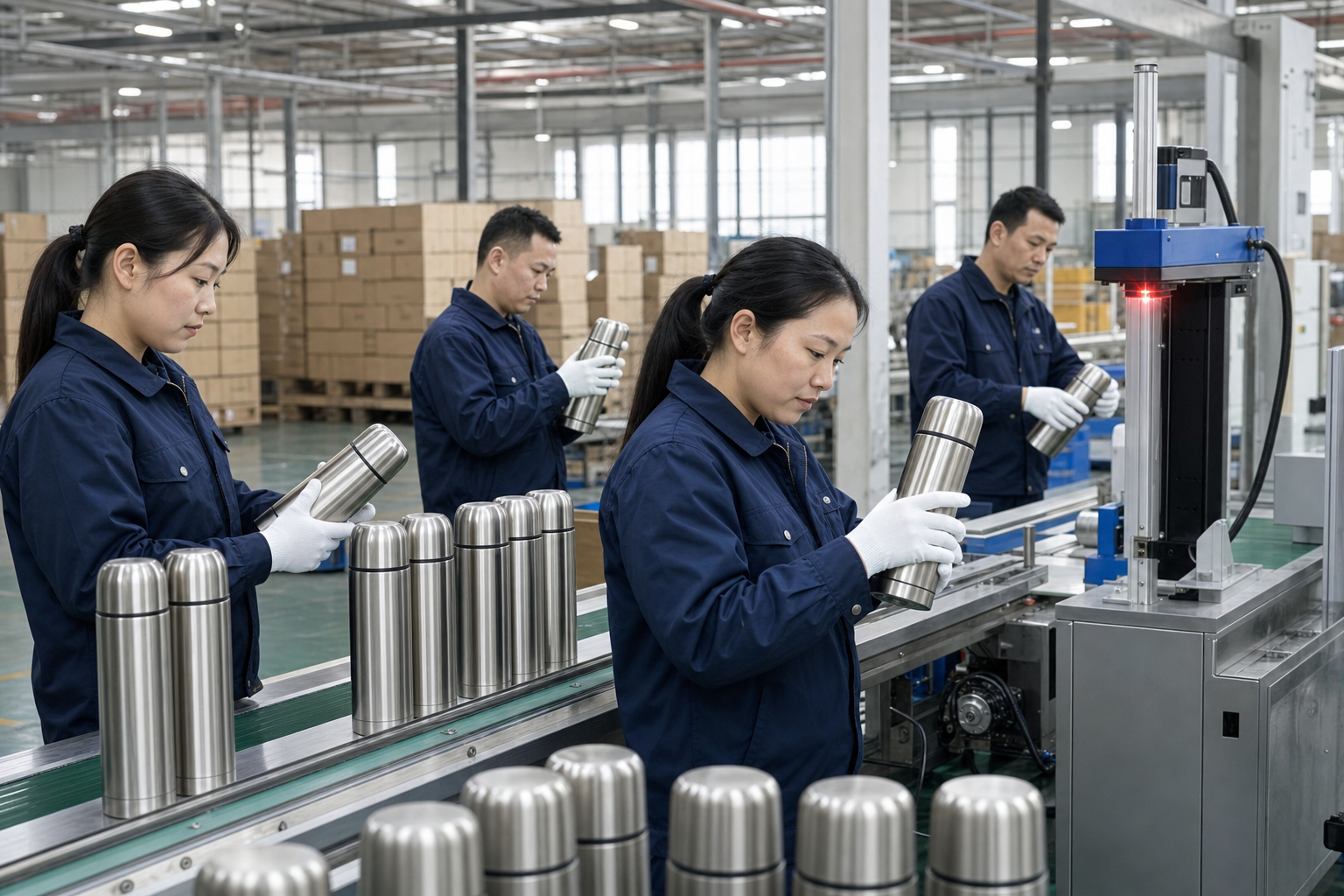
At BottleForge in Zhejiang, China, we treat a promotional thermos as a working product, not a handout. The right spec depends on your channel, carton plan, and margin target. If you want a bulk thermos that a distributor can reorder without complaints, settle steel grade, lid style, insulation target, decoration method, and test standard before you ask for a quote. The math does not work any other way, and we ship that lesson every week.
Start With the Use Case
The best promotional thermos flask is the one that matches how your buyer will actually use it. Outdoor retailers need a bottle that survives trail bags, cold mornings, and repeated opening with one hand. Corporate promo programs care about cost control and logo visibility. Distributors want a thermos they can reorder with the same color, the same carton count, and no surprise defect spike. That is three different jobs, not one product brief. We had a buyer flag a PO because the carton count changed from 24 pcs to 20 pcs without notice, and the math did not work.
Start with capacity. For commuter and gift programs, 350-500 ml works well. For hiking, driving, and field use, 600-750 ml is the practical sweet spot. One liter sounds attractive, but it adds weight, carton size, and freight cost. On the line, a 1000 ml sample in 304 stainless steel ran 0.42 kg empty, and the buyer dropped it after QC pulled the sample and checked the tote load. A 500 ml custom thermos is often the better fit for a thermos promotional campaign because it carries easily and still feels like a real product. That is the right question to ask.
Retention claims need to be realistic. A decent vacuum bottle should hold hot liquid for 6-12 hours and cold liquid for 12-24 hours under normal use. If a supplier says 24-hour heat retention on a low-cost model, ask for the test method and the starting water temperature. We run that test with a thermometer and a 95°C fill, and the result tells the story fast. A serious thermos supplier gives you a clear benchmark instead of a brochure line. For outdoor retail, that kind of honesty matters more than glossy art.
- 500-750 ml: strongest all-around range
- 6-12 hours hot retention: credible for bulk thermos orders
- Leakproof lid: non-negotiable for distributor thermos programs
Pick the Right Stainless Build
Stainless steel is where a thermos feels like a proper promotion piece or a cheap giveaway. For most orders, 304 stainless steel is the default. It gives solid corrosion resistance, steady forming, and a clean cost base for a factory run. If the buyer wants a stronger retail story, we move to 316 stainless steel. It costs more, and it holds up better in salt air, marine use, and higher-end outdoor channels.
Wall construction matters too. A good vacuum thermos uses double-wall stainless with the vacuum gap sealed after drawing. The inner wall should come out smooth, with no weld marks or sharp edges. On our line, the inner wall thickness usually sits at 0.35-0.5 mm, depending on the shape and the target price. Go too thin and dent resistance drops fast. We had one PO where the buyer asked for a lighter cup to save freight, then QC pulled the sample and the mouth edge failed a drop check.
Ask your manufacturer thermos partner about surface finish. Matte powder coating hides fingerprints and gives better grip. Brushed metal looks more technical, but it scratches faster on retail shelves. For outdoor accounts, powder coat usually wins because the product survives real handling. If you want a customized thermos that looks premium without blowing up the cost, we run 304 steel, a soft-touch powder coat, and a base ring that cuts table noise. That’s the right stack. Not the fancy one.
Do not ignore food-contact compliance. For Europe, ask for REACH documents and, where needed, LFGB testing through the supply chain. On the factory side, ask if the thermos manufacturer runs ISO 9001 checks on incoming steel and welding. A real thermos factory should show material traceability and batch records, not just a sample photo. We once caught a PO typo on alloy grade and fixed it before steel cutting started; that saved 12 days versus a full remake.
Lids, Logos, and Decoration
The lid decides whether a promotional thermos gets daily carry or lands on a shelf. Screw lids are plain and tough. Push-button lids work for drivers and commuters, but the seal has to pass a pressure check. Wide-mouth lids make ice loading and cleaning easier, while narrow-mouth lids hold heat better. If you supply outdoor retailers, a lid that opens with gloves matters more than a fancy cap detail nobody uses. On our line, we check the gasket groove with a 0.2 mm feeler gauge before we pack the first sample.
For branding, match the decoration method to the channel. Laser engraving gives a permanent mark and holds up on stainless. Screen printing costs less and suits larger color logos, but it wears faster. Heat transfer and wrap decoration carry more artwork, yet they add time at the press. If you want a customizable thermos that keeps its logo after hard use, laser on metal or a good powder-coat print is the safer choice. We have seen buyers push back on this, then come back after the first 500 pieces rubbed in transit.
Look at the full logo zone, not only the imprint. The flat body area, the lid, and even the base ring can work if the artwork allows it. A supplier thermos team can often clean up your file by opening the panel 2-3 mm or moving the logo up so it does not run into the curve. That kind of change beats adding one more color. On one order, a typo on the PO put the logo 5 mm too low, and QC pulled the sample before mass run.
For custom logo work, ask for a print proof on the actual coating, not only on paper. Color on matte steel usually reads darker than the file on screen. That is normal on production, and the thermos vendor should flag it before mass production. We ship better when the proof matches the coating and the buyer signs off on the real sample, not a flat mockup.
MOQ, Lead Time, and Pricing
If you want a custom thermos from China, get the numbers pinned down before you place the order. For a single SKU, 1,000 pcs is a normal MOQ; 3,000 pcs is where the factory starts pushing back if you want a special lid, a new color, or a printed box. We run this on the line in Zhejiang every week, and the gap is usually tooling, not ambition. A 0.2 mm lid gasket change or a new cap insert can move the whole quote.
Lead time is usually 25-35 days after sample approval and deposit. If you need a new mold for a cap or a custom silicone part, add 15-25 days. FOB pricing for a simple 500 ml promotional thermos often lands around USD 2.80-3.80; a powder-coated model with laser logo and a better lid moves toward USD 4.50-6.50. Double-wall 316 or retail packaging pushes it higher. We had one buyer flag a PO because the carton spec was missing, and the quote changed once QC pulled the sample and checked the lid torque. A supplier giving you one flat price without asking about finish, carton count, or logo method is hiding the real cost somewhere.
For distributors, build the quote around reorder stability. Lock the same color code, the same carton count, and the same master carton dimensions on every lot. That keeps the warehouse from getting split pallets and relabeling headaches. If you sell on Amazon or through retail, ask whether the factory can print barcodes, FNSKU labels, and retail-ready cartons. The wrong question is "what is the cheapest unit price?" The better one is how many touches the product takes before it reaches the shelf. We have seen that go sideways when a buyer changed the inner box by 5 mm and the outer carton no longer fit the pallet plan.
When you compare supplier thermos quotes, compare like for like. A 500 ml bottle with a PP lid, a silicone seal, and a simple kraft box is not the same as a 500 ml bottle with a flip lid, gift box, and sleeve. China has enough factories to bury you in similar photos. Pin the exact configuration in writing, or the math does not work. A typo on the PO for "500 ml" instead of "550 ml" can change the whole run, and we have had to stop a line over that before loading.
Quality Checks That Matter
Good QC separates a factory thermos from the cheap lookalike that photographs well and leaks in week one. We run vacuum retention, leakage, coating adhesion, lid torque, and carton drop resistance on the line. Ask for an AQL plan before shipment. For a lot of B2B orders, AQL 2.5 for major defects and AQL 4.0 for minor defects is a sensible starting point, but the acceptance level should follow your channel and return risk.
Leak testing is not optional. Every lid style gets hot water testing and inverted hold testing. For retail programs, a 1-meter drop test on the filled unit catches weak seals and stress cracks in the cap. If the goods go into e-commerce or warehouse distribution, ask for carton compression and distribution testing. We’ve seen buyers push back on this, then the first corner crush tells the story. ASTM D4169 style distribution testing comes up when they want a stronger shipping case for palletized goods.
Documentation matters as much as the physical test. A serious thermos manufacturer should keep production records, incoming inspection logs, and final inspection sheets. If you are buying from China or Zhejiang, ask for photos of the actual inspection table, not a generic QC poster on the wall. QC pulled the sample, and that is the photo you want. If the supplier also has BSCI, ISO 9001, or third-party audit records, fine, but do not confuse audit badges with product quality. The bottle still needs to pass leak and heat tests.
Ask for three numbers in the same file: start temperature, test duration, and ambient room temperature. Without that, a retention claim is just a sales line.
For outdoor retail, a thermos promotional order should also include scratch checks on the coating and a simple assembly audit on the lid components. We inspect the cap with a 0.5 mm feeler gauge, and loose parts show up fast. Loose parts and weak seals are the fastest way to turn a bulk thermos order into a return problem.
Packaging for Retail and Distribution
Packaging is where a lot of buyers leak margin and never see it on the first PO. A promo thermos has to move from the line to the warehouse to shelf with no dead air in the carton. For distributor orders, we usually run 12 pcs or 24 pcs per master carton, depending on bottle diameter and how much crush the outer box can take. For retail, the barcode has to scan first time, and the box faces need to stay aligned; QC pulled one sample last week because the front panel was 2 mm off-center.
For Amazon and mixed-channel programs, send the FNSKU or UPC placement before production starts. We ship e-commerce thermos packs to survive a one-meter drop test, and the lid area is where the buyer flags problems first. A tight paper insert, a snug neck ring, and zero empty headspace matter more than pretty graphics. A gift box that adds 18 percent to carton volume will show up in freight right away. The math does not work.
For distributor thermos programs, keep the pack the same every time. Same inner carton, same tissue or bag, same barcode position, same master carton mark. That cuts warehouse mistakes and makes reorders smoother. We’ve seen this go sideways when one batch used a 1.5 mm thicker insert and the buyer complained about mixed stacks. Fancy print is the wrong question to ask here. Clean arrival, neat stacking, and no damage claims win the job.
China factories can quote mailer boxes, color boxes, kraft sleeves, and window packaging. Pick the pack based on channel cost, not on shelf looks alone. For a bulk thermos campaign, a plain protective box often gives a better landed cost than a decorative box that adds volume and bumps breakage risk. Our freight team checks carton size in mm before booking, because export shipping in and out of China punishes loose packaging fast.
Specify your custom stainless thermos now
Send your target price, capacity, logo file, and carton plan. We will match the right thermos factory spec for your channel.
Frequently asked questions
What is the best promotional thermos flask size for outdoor retail?
For outdoor retail, 500-750 ml is usually the best range. A 500 ml unit is easier to carry, fits most cup holders, and keeps the landed cost controlled. A 750 ml unit works better for hikers, field staff, and long drives, but it raises weight and carton volume. If you want one SKU that moves across both gift and retail channels, 600 ml is often the compromise. Ask your thermos supplier for a hot retention target of 6-12 hours and a leak test on the exact lid you will sell. That keeps the product practical instead of just looking premium.
How much MOQ should I expect from a China thermos factory?
For a standard custom thermos, expect 1,000 pcs per SKU as a realistic starting MOQ, with 3,000 pcs for special colors, new lids, or custom packaging. A thermos factory in Zhejiang may have large monthly output, but small runs still carry setup cost for coating, printing, and carton work. If you want to lower MOQ, simplify the finish, use an existing mold, and keep the logo to one color or laser engraving. Lead time is usually 25-35 days after sample approval, and new tooling can add 15-25 days. Clear spec control saves time and avoids quote surprises.
Should I choose 304 or 316 stainless steel?
Choose 304 stainless steel for most promotional thermos orders. It gives solid corrosion resistance, acceptable cost, and broad supply availability from China manufacturers. Choose 316 when the bottle will face harsher conditions, when you want a more premium retail story, or when the buyer expects better resistance to salt and acidic use. The price difference is real, so do not overspec every bulk thermos order. For many distributor programs, 304 plus a good coating and leakproof lid is the right balance. If your customer is coastal or marine-focused, 316 becomes easier to justify.
How do I know if a customized thermos is really leakproof?
Ask for three tests on the exact production unit: a hot-water inversion test, a lid torque check, and a 1-meter drop test. The lid should stay sealed when filled, inverted, and shaken after the gasket is installed. A real supplier thermos team should also show you the seal material spec, usually silicone, and the assembly record for the cap. For retail or e-commerce, request carton-drop testing too, because many leaks appear after transit stress, not during normal use. If the factory cannot document the test method, the leakproof claim is not reliable enough for a bulk order.
What logo method lasts longest on a promotional thermos?
Laser engraving usually lasts the longest because it removes or marks the surface instead of sitting on top of it. That makes it a strong choice for a promotional thermos that will be washed, handled, and carried every day. If you need full-color branding, screen printing or heat transfer can work, but the logo life is shorter and depends on coating type and use conditions. For a custom thermos used by outdoor retailers, laser on stainless or a high-quality mark on powder coat is the safest route. Always ask for a sample on the actual production finish, not on a generic test panel.