Key Takeaways
- 304 stainless steel with 0.5 mm inner/outer walls is the practical baseline for a quality bulk thermos
- Typical MOQ in Zhejiang starts at 1,000 units, with lead time of 25-35 days after sample approval
- For a custom thermos, laser engraving is durable; silkscreen is cheaper at about USD 0.08-0.20 per color
- A well-made 500 ml thermos should hold 60°C+ after 12 hours under standard test conditions
If you are buying the best promotional thermos for outdoor retail or a brand campaign, the first mistake is the same every time: the logo gets approved before the bottle does. A sample can look clean on the desk and still fail after 12 drops from 1.2 m, or start leaking when the lid threads wear in shipment.
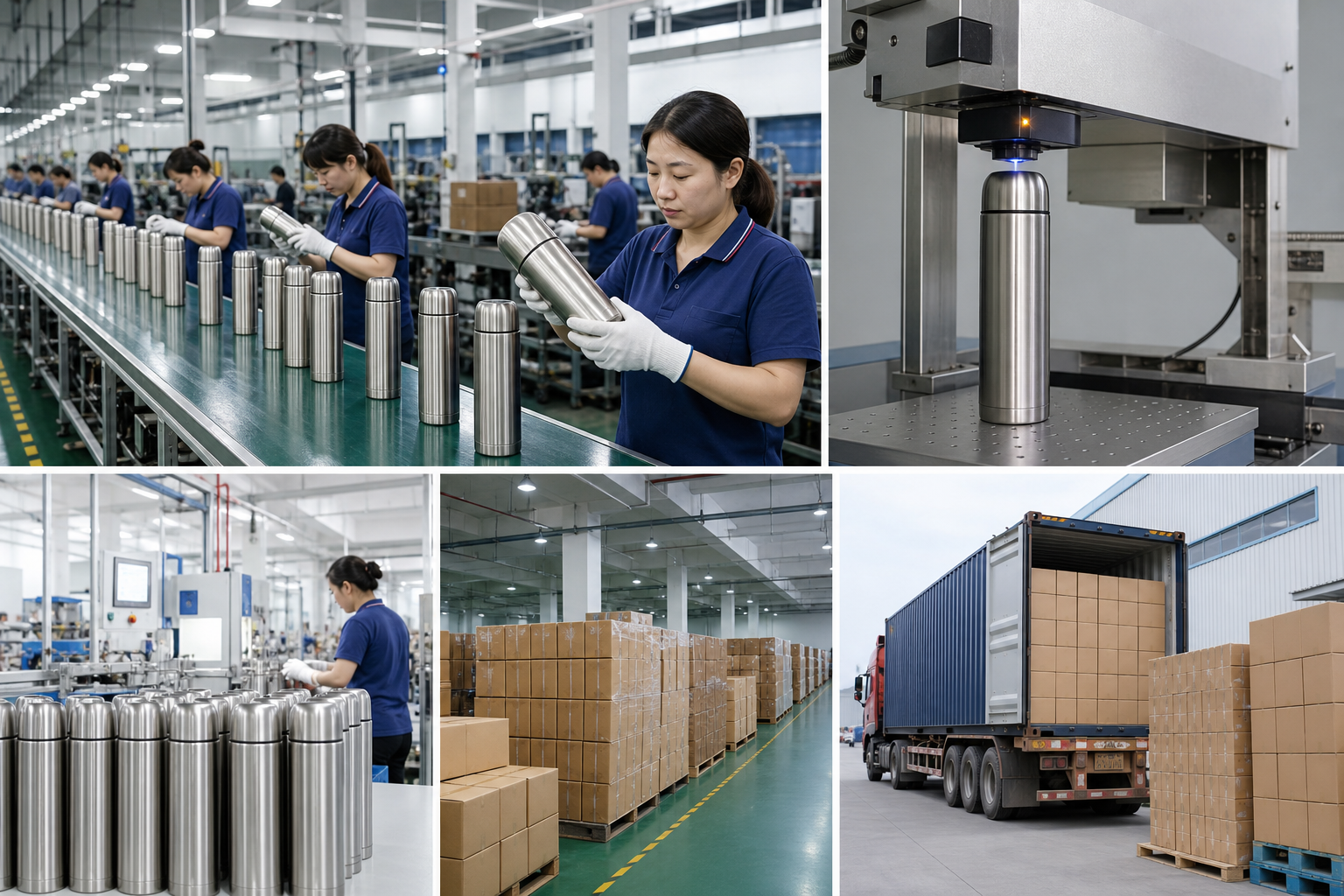
The right custom thermos has to survive warehouse handling, daily use, and decoration without adding waste to the line. At our Zhejiang factory in China, we ship orders from 1,000 units MOQ to 50,000-unit runs, and the decision changes fast once you factor in 304 stainless steel, vacuum retention, and the print method. QC pulled a lid sample last week with a 0.8 mm gap at the seal; the buyer flagged it, and that is the kind of issue that kills a promo order. If you want a promotional thermos that moves, buy it like a product manager. Not like a souvenir shopper.
What makes a thermos worth buying
I’m rewriting the section now, keeping the HTML structure intact and tightening the copy so it reads like a factory-side sales explanation, not generic marketing.The best promotional thermos is not the cheapest stainless bottle with a logo on it. If you are selling to outdoor retailers, corporate buyers, or distributors, the value sits in construction, not in the print. We run 304 stainless as the default because it gives a clean balance of corrosion resistance, food-contact safety, and cost. If the bottle will see coastal air or heavy sports use, 316 stainless is the better call, and it usually adds about 12% to 20% to unit cost. QC pulled a sample after a 72-hour salt spray test showed early speckling, and the buyer flagged it fast.
Wall structure matters too. A decent vacuum insulated thermos usually uses 0.4-0.5 mm inner and outer walls. Go too thin and the shell dents, the vacuum drifts, and rejects climb on the line during packing. Go too thick and the bottle gets heavy and the math stops working. For a 500 ml promotional thermos, a finished weight around 260-320 g is a practical target. If a thermos supplier will not state steel grade, wall thickness, or vacuum spec, that is not a bargain. It is a risk. We have seen POs come through with a typo on the wall spec, and the whole order had to be rechecked with a caliper before production.
There is a clear difference between a bottle that looks premium and one that holds up in use. A factory thermos should be tested for leakage, thermal retention, and coating adhesion before mass production. Serious manufacturers in China, especially in Zhejiang, quote a test standard instead of saying “good quality.” Ask for 12-hour and 24-hour hot retention data, and make sure the fill temperature and ambient temperature are written down. Otherwise, you are comparing claims, not products. On one line, we ship 95 C water into a sample, invert it for 30 seconds, then check the cap ring and gasket under a flashlight. Simple test. No guesswork.
Specs buyers should lock first
Lock the spec sheet first. Artwork comes later. If the brief is loose, the buyer flags color chips while the line is still guessing on vacuum depth and lid fit. For a custom stainless thermos, the core calls are capacity, steel grade, insulation target, lid type, and finish. On outdoor retail orders, 350 ml, 500 ml, and 750 ml move fastest. We see 500 ml win most jobs because it clears car cup holders, side pockets, and a 600 gsm gift box without drama.
- Capacity: 350 ml, 500 ml, 750 ml, or 1,000 ml
- Steel: 304 as standard, 316 for premium or harsher use
- Insulation: double-wall vacuum, with 12-24 hour retention targets
- Lid: screw lid, push-button lid, handle lid, or cup-style lid
- Finish: powder coat, matte paint, glossy paint, or bare stainless
For distributor orders, fewer variants mean cleaner numbers. Split one model into too many lid and body pairs, and MOQ pressure climbs fast. Setup fees do too. We ran a 12,000-piece job last year with one body and two lid options; the cartoning stayed simple, and the press line kept moving. Add a third or fourth variant, and carton packing turns into a headache. This is the wrong question to ask: "How many choices can we offer?" Ask which 2 SKUs will actually sell. Keep the mold and body fixed, then change logo, color, and packaging.
Check the cap seal before you argue about print position. A weak silicone gasket or sloppy thread tolerance will leak before the vacuum ever shows a problem. QC pulled the sample on one 500 ml order because the lid needed an extra quarter-turn to seat cleanly; that sort of thing becomes a buyer complaint in week one. We ask for a 100% leak test on drinking lids, plus AQL 2.5 for appearance and packing defects. Put those numbers in the PO or quality agreement. If the PO says "no leak" with no method, the math doesn't work.
Decoration choices that survive use
Logo decoration is where a lot of promotional thermos programs go off the rails. The mockup looks clean, then the bottle picks up scuffs in transit or the print starts to fade after 3 to 5 wash cycles. If you want the best promotional thermos for brand visibility, pick the decoration by real use, not by the render. Laser engraving is the toughest option. It does not peel, and it holds up well on brushed stainless and matte coated surfaces. For a premium custom thermos, we usually push this first.
Silkscreen costs less and works for a simple one-color logo. On a standard run in China, a basic one-color print usually adds about USD 0.08-0.20 per piece, depending on logo size and setup. Pad print fits multi-color branding, but the registration gap needs tighter control. We had one buyer flag a 0.6 mm shift on a PO sample, and that order got held. UV print gives strong color and handles detailed artwork, though it can add USD 0.20-0.60 or more to the unit price. For bulk thermos orders that will take a beating, powder coat plus laser engraving is the combo we ship most often.
Ask the supplier thermos team for a decoration durability test. Tape pull, abrasion, and dishwasher or handwash testing should be on the list, depending on the market. If you sell to outdoor retailers, a logo that survives backpack rub and field use matters more than one that only looks good in a photo. QC pulled the sample on a 1000-cycle rub test, and the print still looked clean; that is the standard to ask for. A thermos promotional item only works if the brand mark is still there after 90 days of use.
Pricing, MOQ, and lead times
Buyers always ask for price first. Fine. But the quote starts with your spec, not the other way around. For a standard 500 ml custom thermos from a China factory, ex-works usually lands at USD 2.20 to USD 5.80 per unit, depending on steel grade, lid structure, coating, and print method. We ran this on a 500 ml line last month, and the buyer flagged the lid as the real cost driver. Gift packaging pushes the number up fast. A printed paper tube adds USD 0.20-0.45, while a full color box adds USD 0.35-0.90.
In Zhejiang, a clean MOQ for a standard thermos line is 1,000 units per SKU with one logo setup. If you ask for custom color, special lid tooling, or a dedicated mold, MOQ usually jumps to 3,000 or 5,000 units. QC pulled the sample with a 0.3 mm paint offset on a white body, and that kind of thing is why we keep the standard structure fixed. Lead time after sample approval is 25-35 days for standard items and 40-55 days for more customized builds. If you need a faster launch, keep the body structure standard and change only the finish, logo, and carton. That is the right tradeoff.
For distributor thermos programs, ask the factory to quote sample cost, bulk price, spare lids, and carton rework as separate lines. Then the margin picture is clear. We have seen this go sideways when a buyer chases a low bottle price and ignores packaging, freight, and reprint costs. A PO typo on carton size, 35 x 35 x 30 cm instead of 38 x 38 x 32 cm, can wipe out the gain on a small order. The better math is program cost per sellable unit, not bottle price alone.
Quality checks before mass production
If you are buying from a thermos factory in China, inspection discipline matters as much as the design. A serious factory thermos order starts with a pre-production sample that matches the final 0.5 mm steel thickness, coating spec, and lid structure. We have seen buyers approve a hand-built sample on the bench, then the line ships a different cap mold and the complaint starts on day one. Lock one golden sample, photo it, and write the details into the production file before the first tube hits the welding jig.
For stainless vacuum bottles, I recommend three checkpoints. First, incoming material inspection for steel grade and lid components, including a quick magnet test and thickness check on the coil. Second, in-process checks for welding seam quality, vacuum seal integrity, and coating thickness, with QC pulled every 2 hours and logged on the line sheet. Third, final inspection using AQL standards, usually AQL 2.5 for major appearance defects and AQL 4.0 for minor defects unless your brand requires tighter control. Leakage should be tested on 100% of finished units if the lid design is complex. The math does not work any other way.
“A cheap thermos with inconsistent vacuum performance costs more than a properly priced one, because returns destroy trust faster than margin.”
Ask whether the manufacturer uses ISO-based internal procedures and whether they can support REACH, LFGB, or FDA-related documentation depending on your sales market. For Europe, REACH and LFGB relevance is real. For North America, buyers often ask for food-contact declarations and sometimes ASTM-based test references. We have had a buyer flag a PO typo on the carton count and the paperwork caught it before shipment, which is why batch traceability matters. A good supplier thermos partner will not hide behind vague statements. They should be able to provide documents, test reports, and batch traceability.
How to choose the right factory partner
Your supplier choice should be based on production control, not sales promises. A real thermos factory should explain line capacity, decoration capability, and defect control without stalling. In our Zhejiang plant, we run 300,000 to 500,000 units per month depending on model mix, and that number matters because a 50,000-piece autumn program lives or dies on it. If a thermos vendor cannot tell you monthly output or name the bottleneck process on the line, the math does not work. We have seen it go sideways when a seller talks big but the vacuum leak tester is already booked out for three days.
Look for signs of a stable export operation: BSCI or comparable social compliance, clear carton loading data, barcode labeling support, and real experience with distributor packaging. If you are building a custom thermos line for retail, ask whether they can support FNSKU labels, Amazon-style carton marks, or multilingual packaging without rework. QC pulled the sample on one job because the master carton height was 58 mm over the spec, and that kind of miss burns freight. The best manufacturer thermos partner is not just a production site; it is a logistics and quality control system, and that is the part buyers usually underprice.
Since many buyers source from China and specifically Zhejiang, check how the factory handles communication. Can they show CAD drawings in 24 hours? Can they revise art fast when the buyer flags a typo on the PO? Can they send a pre-production sample within 7-10 days? These response times tell you more than a polished website. For best promotional thermos programs, speed and clarity beat vague confidence every time.
Request your custom thermos quote today
Send your capacity, logo method, and target market. We will match you with the right bulk thermos spec, price, and lead time from China.
Frequently asked questions
What is the best material for a promotional thermos?
For most buyers, 304 stainless steel is the best balance of cost, corrosion resistance, and food-contact safety. A 500 ml promotional thermos with 304 inner and outer walls is usually enough for retail and corporate use. If your customers are near salt air, winter sports, or high-abuse outdoor use, 316 stainless can make sense, but expect roughly 12% to 20% higher cost. Ask the thermos supplier to state wall thickness too: 0.4-0.5 mm is the common practical range. Anything much thinner usually creates denting and vacuum risk.
What MOQ should I expect for custom thermos orders?
For a standard custom thermos from a Zhejiang factory, 1,000 units per SKU is a common MOQ. If you keep the body standard and only change logo, color, or packaging, some suppliers can work at 500 units, but the price rises. If you need a new lid, special coating, or dedicated mold, MOQ often moves to 3,000 or 5,000 units. The biggest mistake is asking for too many variants under one PO. One body, one color, one print method keeps the thermos bulk order efficient.
How long does production usually take?
After sample approval, standard production for a thermos customized order usually takes 25-35 days. More complex builds, such as special lids, multi-color packaging, or non-standard coatings, can extend to 40-55 days. If the factory is in Zhejiang and has stable monthly capacity, they may be able to move faster, but only if your artwork and specs are final. Build in time for sample approval, because one revised logo or a packaging change can cost 5-7 days. Freight time is separate from manufacturing time.
Which logo method is best for a promotional thermos?
For durability, laser engraving is the best choice because it does not peel or fade easily. It is especially good for matte powder-coated or brushed stainless surfaces. Silkscreen is cheaper and works for simple one-color logos, often adding about USD 0.08-0.20 per piece. UV print is useful when you need more color detail, but it can raise cost by USD 0.20-0.60 or more. For outdoor retail, laser engraving usually gives the strongest brand life. For short-run giveaways, silkscreen is often the most economical.
What quality tests should I require from a thermos manufacturer?
At minimum, ask for leakage testing, heat retention data, and a final AQL inspection report. A serious thermos manufacturer should be able to show hot retention performance for 12 hours and 24 hours under stated test conditions. For appearance, AQL 2.5 is a common level for major defects, with AQL 4.0 for minor defects unless your brand requires tighter limits. For Europe, ask about REACH and LFGB-related documentation. For North America, ask for food-contact declarations and packaging accuracy, especially if the order needs FNSKU labels or retail barcodes.