Key Takeaways
- A practical promotional vacuum bottle usually starts at 500 ml to 750 ml and 18/8 stainless steel with 0.4-0.5 mm wall thickness.
- For factory thermos orders, MOQ is often 3,000-5,000 units, with lead times of 30-45 days after sample approval.
- A good bulk thermos program should target 6-12 hours hot retention for daily promo use; 24 hours is better for retail.
- Typical FOB China pricing for a decent custom thermos runs about USD 3.20-7.80 depending on lid, coating, and decoration.
If you are buying the best promotional vacuum bottle for outdoor retail or a branded giveaway, the wrong pick gets expensive fast. We have seen a buyer approve a $1.20 lid, then fight with leaked cartons and a failed first run. A weak vacuum, thin paint, or tiny print panel turns a “promotional” item into dead stock, and the math does not work. For a bulk thermos program, the bottle has to look premium, survive transport, and still land at a workable landed cost.
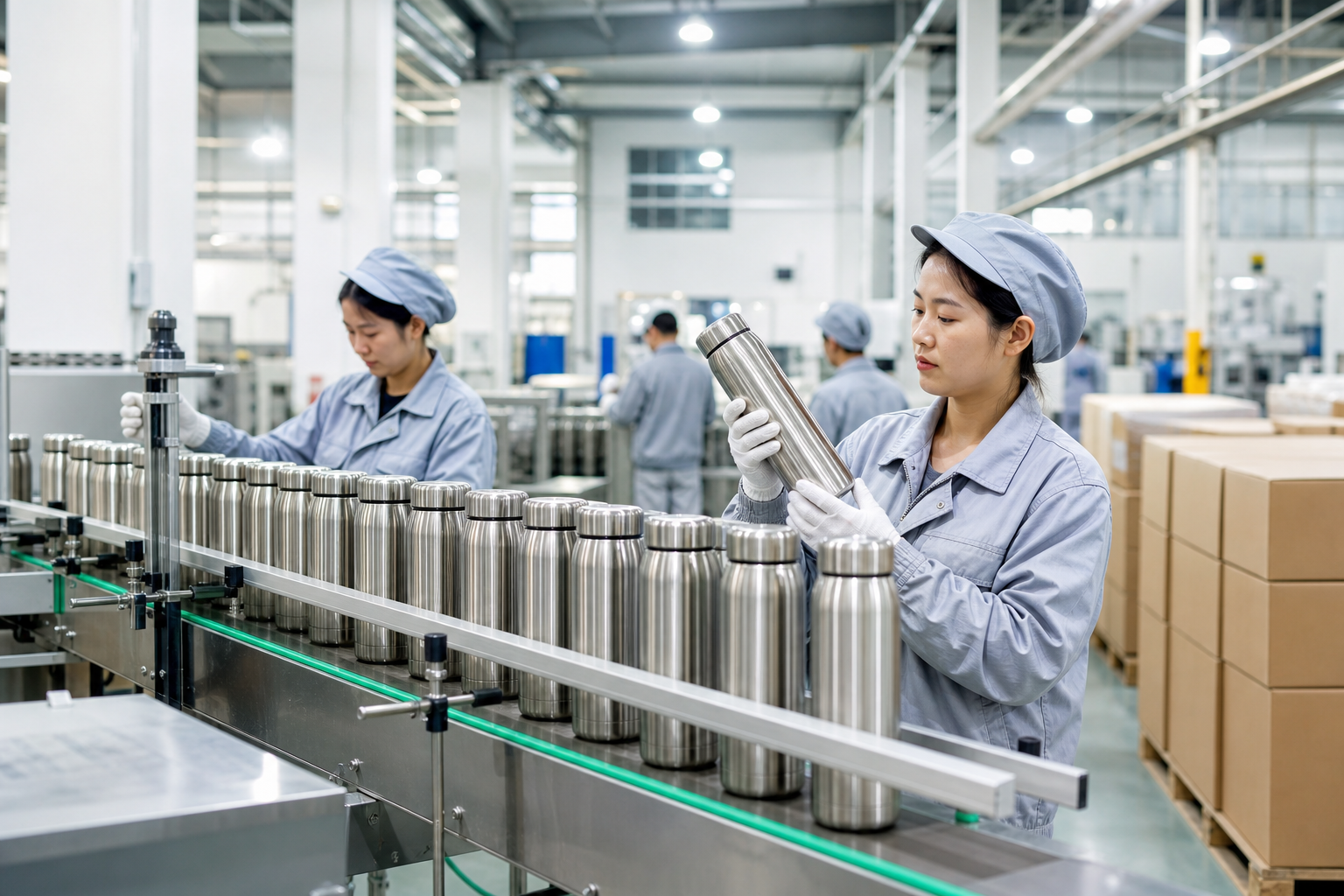
We make and export stainless drinkware from Hangzhou, Zhejiang, and the buyers who do well usually start with one question: what spec can hold up at scale? On our line, we check steel gauge, insulation time, coating, lid style, packing, and carton efficiency before artwork is finalized. Last month QC pulled a sample with a 1.2 mm lid ring that looked fine in photos but failed a 1.5 m drop test. China has plenty of suppliers; Zhejiang has plenty of factories. The real test is whether the manufacturer can ship 30,000 units on time with stable quality, not just send a nice sample.
What makes a bottle sell
The best promotional vacuum bottle is the one buyers keep on the desk, in the car, and in the bag. If it leaks once, the reorder dies. For outdoor retailers, that means a thermos with a steady hand feel, a body that fits standard cup holders where it matters, and a lid that stays sealed after a backpack drop test. For promotional brands, the print area has to take a logo cleanly. If the logo wraps too tight, it looks cheap. We ran a batch with a 38 mm neck and the buyer flagged the first proof because the mark sat too close to the seam.
Start with the core body spec. We recommend 304 stainless steel inside and outside for most custom thermos programs. On a premium line, 316 on the inner wall can make sense, but the cost jumps and the margin math gets tight. A practical insulated bottle uses 0.4-0.5 mm steel wall thickness and a double-wall vacuum structure. That is the split between a giveaway and a retail thermos that feels proper in hand. On the line, QC pulled the sample at 1.8 kg drop height and the cap held; that is the level buyers remember.
Capacity matters more than many first-time buyers think. A 500 ml promotional thermos is easier to ship and cheaper to decorate. A 750 ml customized thermos usually wins in outdoor retail because it carries higher perceived value and gives more print space. If you are handling distributor thermos programs, pick one primary size and one lid style only. Two sizes are manageable. Four sizes turn into carton mix-ups, split inventory, and QC noise. We have seen this go sideways when a PO typo changed 500 ml to 550 ml and the pallet labels no longer matched.
- Best range: 500 ml, 600 ml, or 750 ml
- Steel: 304 inside/outside, 18/8 grade
- Wall thickness: 0.4-0.5 mm
- Retention target: 6-12 hours hot, 12-24 hours cold
Lids, lids, and leakage risk
Most returns on a promotional thermos have nothing to do with the body. They start at the lid. A lid has to seal cleanly, open without a fight, and stay tight after 500 or 1,000 cycles without the hinge or thread going soft. On our line, a 2.4 mm silicone gasket and a controlled 18 N closing force make the difference between a bottle that ships well and one the buyer flags after the first case.
There are three practical lid paths. First, the basic screw lid is the lowest-cost choice and fits volume promo orders, but it gives the end user little convenience. Second, the push-button or one-hand lid makes daily use easier and usually lifts perceived value by 15-25%. Third, a cup-cap lid still fits traditional insulated bottles and works for cold-weather outdoor use. A thermos supplier should show torque test data and leak test results, not a glossy rendering. We run a torque wrench and a vacuum leak fixture for a reason. The math does not lie.
Ask for a 1-meter drop test, a 45-degree tilt leak test, and at least 1,000 opening cycles on the closure. For Amazon-style retail, the pack copy and use instructions need to be clear because one slow leak can turn into a bad review fast. If you are using a thermos factory in China, insist on lid sampling with your actual artwork approval. QC pulled one sample last month because the final resin color shifted the cap fit by 0.3 mm. White resin looked fine. The production color did not.
“If the lid is weak, the whole bottle is weak. Buyers forgive a plain body; they do not forgive leaks.”
For outdoor retailers, a wide-mouth opening of 45-55 mm is usually the safest choice. It cleans faster, takes ice cubes, and gives you more room for a logo on the shoulder or body. We often spec a 50 mm mouth on this type of order because it passes the ice test and still leaves a usable print zone. This is where a manufacturer thermos program starts to beat a generic catalog item.
Decoration that survives handling
A custom thermos has to look good on day one and still pass the eye test after six months in a glove box or backpack. We choose the decoration method by use case, not by the cheapest quote. For a promotional vacuum bottle, the finish has to survive abrasion, condensation, and the scuffing you get in shipping trays.
Silkscreen is the low-cost choice for simple one- or two-color logos. It runs fast, but the edge detail does not hold up like laser engraving. Laser engraving gives a cleaner premium look and works well when the logo is monochrome or the buyer wants a permanent mark. For an outdoor retail customized thermos, powder coating plus laser engraving usually gives the best mix of appearance and wear resistance. On the line, we have also done gradient paint, matte texture, and soft-touch coating for a thermos customizable program, but each one raises reject risk and unit cost. QC pulled one matte batch last month because the touch-up marks showed under side light.
The pricing is easy to read. A plain brushed body may add almost nothing. Matte color coating often adds USD 0.25-0.60 per unit. Laser engraving can add USD 0.15-0.45 depending on logo size and setup. Full-color wrap or complex UV print can add more and usually pushes MOQ higher. In Zhejiang, plenty of factories can quote decoration in an hour; far fewer can keep the registration clean across 20,000 units. The math does not work if the logo drifts.
If you are a distributor thermos buyer, ask for a print tolerance sample, not just a blank bottle. A logo shifted by 2 mm can look fine on a PDF and still look sloppy on shelf. We usually run one hero finish, one logo method, and one carton spec. That keeps the thermos distributors program stable and easier to reorder. We had one PO where the buyer flagged a typo in the carton mark, and we caught it before the line started.
Pricing, MOQ, and lead times
A thermos bulk order is a tradeoff. Simple as that. If you want the best promotional vacuum bottle at a price that still leaves room for freight and margin, you need to know where each dollar lands. Stainless steel, lid structure, surface finish, and packaging all move the FOB China quote.
For a standard 500 ml custom thermos with 304 stainless steel, matte coating, and one-color logo, we usually see FOB USD 3.20-4.80 at MOQ 3,000 units. Change to a push-button lid, two-color print, and gift box packaging, and the number often moves to USD 4.90-7.80. Add retail-ready packaging with premium carton, barcode label, individual polybag, and insert, and you're looking at another USD 0.20-0.60 per piece. That looks small on paper. At 20,000 units, the math gets loud fast. We had one buyer flag a PO typo on the packaging line—barcode label instead of barcode sticker—and the quote changed by the next morning.
MOQ is not just a sales line. It sets the steel buy, the coating line slot, and the carton print run. In our Hangzhou, Zhejiang factory, the normal MOQ for this category is 3,000 units, and we run about 120,000 units a month across stainless drinkware lines. Standard lead time is 30-45 days after sample sign-off and deposit. If artwork changes after production starts, the clock resets in practice. QC pulled the sample, checked the lid torque at 1.8 N·m, and we still had to hold the line for a revised logo file. That's how it goes.
Be careful with ultra-low MOQ offers. A thermos vendor willing to do 300 or 500 units usually charges much more per piece, and the carton mix gets messy. If a buyer needs speed, stock body plus custom logo is the better play than a fully customized thermos build. We've seen the other route go sideways: a 500-unit order looked cheap until the buyer asked for mixed colors, then the packing labor and carton waste ate the savings. This is the wrong question to ask if you're chasing a promotional thermos run.
- MOQ: 3,000 units typical
- Lead time: 30-45 days after approval
- FOB target: USD 3.20-7.80
- Factory output: about 120,000 units/month across stainless drinkware
Testing and compliance basics
If you sell into Europe or North America, compliance is not optional. A thermos that passes the photo test but misses safety rules turns into a warehouse headache, then a customs hold, then a returns pile. For a stainless vacuum bottle, the core checks are food-contact safety, chemical compliance, and basic mechanical strength.
At minimum, ask for REACH documentation for coatings and components sold into Europe, plus food-contact declarations for the steel and lid materials. For North America, buyers often ask for FDA-related materials declarations and, where applicable, California Proposition 65 screening. If the design uses silicone seals, confirm the silicone grade and odor control. We had a 500 ml run where the buyer flagged a faint rubber smell on day 3, and the samples were fine on paper but dead in the market.
QC should be specific. A serious thermos manufacturer will track vacuum leakage, thermal retention, coating adhesion, and carton drop performance with a drop tester set at 76 cm or 90 cm, depending on the spec. We run AQL 2.5 for major defects and 4.0 for minor defects on commercial runs, with pre-shipment inspection on at least 8-10 cartons per lot based on order size. The line also needs three checkpoints: prototype sample, pre-production sample, and golden sample signed off by both sides. QC pulled the sample, and the lid torque was 0.8 N·m off spec; that is the kind of miss that wrecks a shipment.
In China, some suppliers will tell you compliance is “no issue” and send documents later. That is the wrong question to ask. Ask before PO, not after. If your compliance team needs test reports, build that into the schedule. We ship from Zhejiang fast, but only when the paperwork is complete and the approval chain is clean; one PO typo on the carton mark can stall a 12-day booking and turn it into 18 days.
How to choose the right supplier
The right thermos supplier is not the one with the biggest catalog. It is the one that knows your channel. Outdoor retail wants tougher carton drops, tighter finish control, and fewer scratch claims. Promotional brands want clean pricing, repeatable print positions, and no surprises on artwork. Distributors care about lead times that hold and a reorder process that does not stall at week 6.
Ask direct questions. How many stainless bottles do you run each month? What is your in-house coating capacity, in square meters per day? Do you check vacuum retention before packing? Can you handle barcode stickers, master carton marks, and FNSKU labels if the route goes through Amazon or marketplace retail? A real thermos factory in Zhejiang will answer straight. If the reply is fuzzy, the problem is usually hiding in lead time or QC. We have seen a 1.5 mm logo shift turn into a full reprint.
Check whether the factory handles customization and standard production in-house, not just trading. A manufacturer with its own tooling room and decoration line can move faster when you need a cap color fixed or a logo reduced by 2 mm. That matters when the launch date is locked and the buyer flagged the PO typo before we even started the line. We pulled a sample last week and the matte spray held, but the cap insert was 0.3 mm off. Small gap, big headache.
For the next RFQ, keep it tight: size, material, lid, finish, logo method, packing, target market, and compliance needs. The best promotional vacuum bottle is rarely the flashiest one. It is the one the customer keeps using, and the one your team can reorder without drama from China or anywhere else. If the MOQ is 3,000 and the re-order needs 18 days, say that early. The math has to work.
Request your custom thermos quote today
Send your size, logo, and target market. We will quote a realistic FOB price, confirm MOQ, and suggest the right spec for your channel.
Frequently asked questions
What is the best capacity for a promotional vacuum bottle?
For most promotional and outdoor retail programs, 500 ml to 750 ml is the sweet spot. A 500 ml custom thermos ships cheaper and works well for office or travel use. A 750 ml model feels more substantial in retail and gives you more logo space. If you are ordering thermos bulk for giveaways, 500 ml is usually the lowest-risk choice. For a premium custom thermos, 600 ml or 750 ml often looks better on shelf and supports a higher perceived value without blowing up freight costs.
What MOQ should I expect from a thermos factory in China?
A realistic MOQ for a stainless promotional vacuum bottle is usually 3,000 units per design. Some suppliers offer 1,000 units, but the unit price rises fast and your packaging cost becomes inefficient. In Zhejiang, a real factory thermos line can usually support 3,000-10,000 units with stable color and print control. If you want multiple colors or multiple lids, treat each variant as a separate SKU and expect higher MOQ or longer lead time.
How do I know if the insulation is good enough?
Ask for a thermal retention test with a clear method: start with near-boiling water, seal the bottle, and measure temperature at 6 hours and 12 hours. For a decent promotional thermos, 6-12 hours hot retention is acceptable. For a better retail-ready bottle, 18-24 hours is stronger. Do not rely only on a brochure claim. A serious thermos manufacturer should give you tested data, not just marketing numbers.
Which logo method is best for a custom thermos?
For simple one-color branding, silkscreen is usually the lowest-cost option. If you want a more durable premium look, laser engraving is better because it does not peel. On powder-coated bottles, laser engraving often gives the best result for a promotional thermos. If your artwork is detailed or multicolor, you may need heat transfer or UV print, but that adds cost and needs tighter inspection. For bulk thermos orders, always ask for a decorated sample before mass production.
What compliance documents should I request?
For Europe, ask for REACH-related documentation and food-contact declarations for the body, lid, and seals. For North America, many buyers ask for FDA-related material declarations and, if needed, Prop 65 screening. If your custom thermos uses silicone parts or a painted finish, request separate material reports for those components. A good supplier thermos partner in China should provide these before production, not after shipment.