Key Takeaways
- A 500 ml double-wall 304 bottle is the safest default for most promotional thermos programs.
- For China factory orders, 500 pcs MOQ and 25-35 days lead time are normal on standard molds.
- Laser engraving is the most durable decoration for a custom stainless thermos, while screen print is cheaper for simple logos.
- Ask for REACH, LFGB, and AQL 2.5 checks before you approve a thermos bulk shipment.
The best promotional vacuum flask is not the prettiest sample on the table. It is the one that holds temperature, survives handling, and still prints cleanly after 5,000 units. We run into this on the line all the time: a cup can look sharp at 300 mm away, then the logo flakes after 200 dishwasher cycles. For outdoor retailers and promo brands, a custom stainless thermos has to perform as a product, not just carry a logo.
In Zhejiang, China, we see the same mistake every season: buyers chase the lowest bulk thermos price and then lose margin to bad lids, weak coating, or late freight. The math does not work. Before artwork, you need the steel grade, insulation spec, MOQ, and decoration method locked down; QC pulled a sample last week with a 1.2 mm lid gap, and the buyer flagged it before we shipped 5,000 pcs.
What Buyers Mean By Promotional
The best promotional vacuum flask is the one your buyer can resell or hand out without excuses. We run QC on this every day. It needs stable insulation, a lid that still seals after 3 cold cycles, and decoration that stays clean after shipping from China to Europe or North America. A promotional thermos should not feel like a cheap giveaway with a logo slapped on.
For outdoor retailers, the brief is different. You need a custom thermos that reads like a real product line, not a printed shell. A 500 ml stainless bottle is usually the safest start: easy to carry, enough room for a logo, and sized well for standard cartons. The buyer flagged a 12 mm bigger cap on one PO, and the math did not work for the carton pack. If you want the best promotional vacuum flask, judge it on four points: heat retention, lid reliability, branding area, and landed cost. The rest is noise.
- 500 ml fits most campaigns.
- Double-wall 304 stainless is the default baseline.
- Powder coat gives better grip than bare steel.
- A leak test matters more than a pretty render.
Choose The Steel, Not Just The Look
Steel choice decides whether you are buying a factory thermos or a future complaint. For beverage contact, 18/8 stainless, usually called SUS304, is the practical standard. It handles coffee and tea well, resists corrosion, and keeps cost under control. If the buyer says the bottle will see lemon water or other acidic drinks every day, SUS316 for the inner wall is the safer call, and the price goes up about 8-15 percent. We had one PO typo last quarter where “304” was printed as “340”; QC pulled the sample before packing, and that saved us a reprint fight.
The shell thickness matters too. A usable promotional flask normally sits around 0.4-0.6 mm per wall. Too thin and the bottle dents in transit; too thick and the weight jumps with no thermal gain. A 0.5 mm shell on the line is easier to hold to spec than a random 0.35 mm roll, and the buyer will notice the feel in hand. A good manufacturer thermos also needs a proper vacuum gap, laser weld consistency, and a finish that does not flake when the carton is shaken. We run about 300,000 units per month in Zhejiang, with MOQ 500 pcs on standard molds and 25-35 days after sample approval. This is the wrong question to ask if someone only talks about color cards and ignores the steel.
Do not buy on capacity alone. A 500 ml bottle with poor welds loses the sale faster than a 480 ml bottle with better insulation.
Insulation Specs That Actually Matter
Insulation claims mean nothing unless the test method is real. For a promotional thermos, ask for a temperature curve, not a slogan. If a supplier will not show the curve, the math does not work. On our bench, QC pulled the sample after a 95C fill and logged it at 6, 12, and 24 hours; a decent 500 ml vacuum flask usually keeps hot water above 60C for 8-12 hours and above 45C past 12 hours, though lid design and fill level move the result. Cold retention is simpler. 24 hours is common when ice stays in the bottle and the cap seals well. Preheat or precool before testing, or the numbers lie.
The lid decides most of the user experience. A wide-mouth lid is easier for coffee and cleaning, but it can leak if the thread pitch is weak or the silicone ring is cheap. On the line, a 0.2 mm thread mismatch was enough to trigger a buyer flag on a PO, so we do not treat that as a minor issue. If you are sourcing thermos bulk for retail, check three points: screw engagement, gasket hardness, and one-minute inversion leak test. A good supplier thermos will also define the test setup: 95C water, room temperature at 20C, filled to 90 percent, measured at 6, 12, and 24 hours. Without that, the numbers are decorative.
What to confirm before approval
- Leak test at 1 minute and 30 minutes.
- Drop test from 1.2 m onto carton corners.
- AQL 2.5 for appearance and 4.0 for carton damage.
- Food-contact silicone for the seal.
Decoration That Survives Transit
I’ve got the structure and constraints. I’m rewriting the three paragraphs to sound like a factory-side sales engineer, with specific process details and no filler phrasing.Decoration is where a promotional thermos looks premium or looks cheap. On stainless steel, a 60W fiber laser gives the cleanest mark, and it will not rub off after a 200-cycle abrasion test. Screen printing works when the logo stays simple, one-color or two-color, and the buyer wants lower unit cost on a 5,000-piece run. UV print can carry finer detail, but it needs a stable coated surface and tighter abrasion control on the line. The wrong question is which method sounds fancier; the bottle finish decides it, not the artwork file.
If you want a custom thermos for outdoor retail, powder coating is usually the best blank. A 60 to 80 micron coat gives better grip, hides small forming marks from the press, and gives laser or silk screen a steadier surface. For a 1,000-piece order, decoration often sits around USD 0.20-0.60 per piece, with laser near the low end and multi-color print at the top. We have seen buyers push for a full-color logo on a rough camp bottle, and the math does not work. We would ship a sharp one-color mark on a solid cup before we chase a busy print on a weak surface.
For distributor thermos programs, ask for a decoration proof on the exact cup, not a mock-up on generic art. You want the logo on the real curve, then after rub testing and carton compression at 15 kg. QC pulled the sample once because a 2 mm shift near the seam only showed up after packing. I would rather catch that in the sample room than after 10,000 pieces leave the warehouse. That is basic risk control, not perfectionism.
MOQ, Lead Time, And Freight
MOQ and lead time drive most bulk thermos mistakes. Buyers often ask for custom colors, special lids, gift boxes, and a tight ship date on the same PO. That can be done, but the math changes. A standard custom thermos order usually starts at 500 pcs per style and per color. If you change the cap mold, add a carry loop, or request a special finish, MOQ can move to 1,000-3,000 pcs. Sample lead time is usually 7-10 days. Mass production is often 25-35 days in China after sample sign-off, and we have seen it stretch to 45 days in peak season when the line is booked and the buyer flags one more revision.
Shipping math matters as much as product math. A 40HQ container can often hold 18,000-22,000 pieces of 500 ml flasks, depending on box size and inner packing. If you are a thermos distributor, that carton count decides your margin. Ask for FOB Ningbo or FOB Shanghai quotes, then compare landed cost, not just factory price. We once caught a PO typo on carton size, 48 pcs written instead of 24 pcs, and the buyer’s freight target broke before the goods even left QC. A cheap bottle with weak packing can turn into damage claims and rework. We ship those costs back to the buyer sooner or later.
When a China supplier says yes to everything, be careful. A serious manufacturer will tell you where the trade-offs are: better insulation usually means higher weight, richer packaging usually means lower container load, and fast turnaround usually means fewer decoration choices. That is normal. One sample test here showed a 304 stainless flask holding temperature 2 hours longer only after we added 0.2 mm wall thickness, and the carton count dropped right away. You are buying production capacity, not wishful thinking.
Compliance And Packaging For Export
Compliance protects the whole promo thermos order. For Europe, ask for REACH files and food-contact declarations for the steel, coating, and silicone parts. If the flask goes into retail, LFGB reports save time with distributors; we have seen a buyer stall a PO for 11 days over a missing silicone declaration. For North America, the bottle needs FDA food-contact support, and any BPA-free lid claim should match the resin spec sheet. If the order includes gift boxes or transit cartons, check BSCI status and ask for a recent inspection report, not an old PDF from last season.
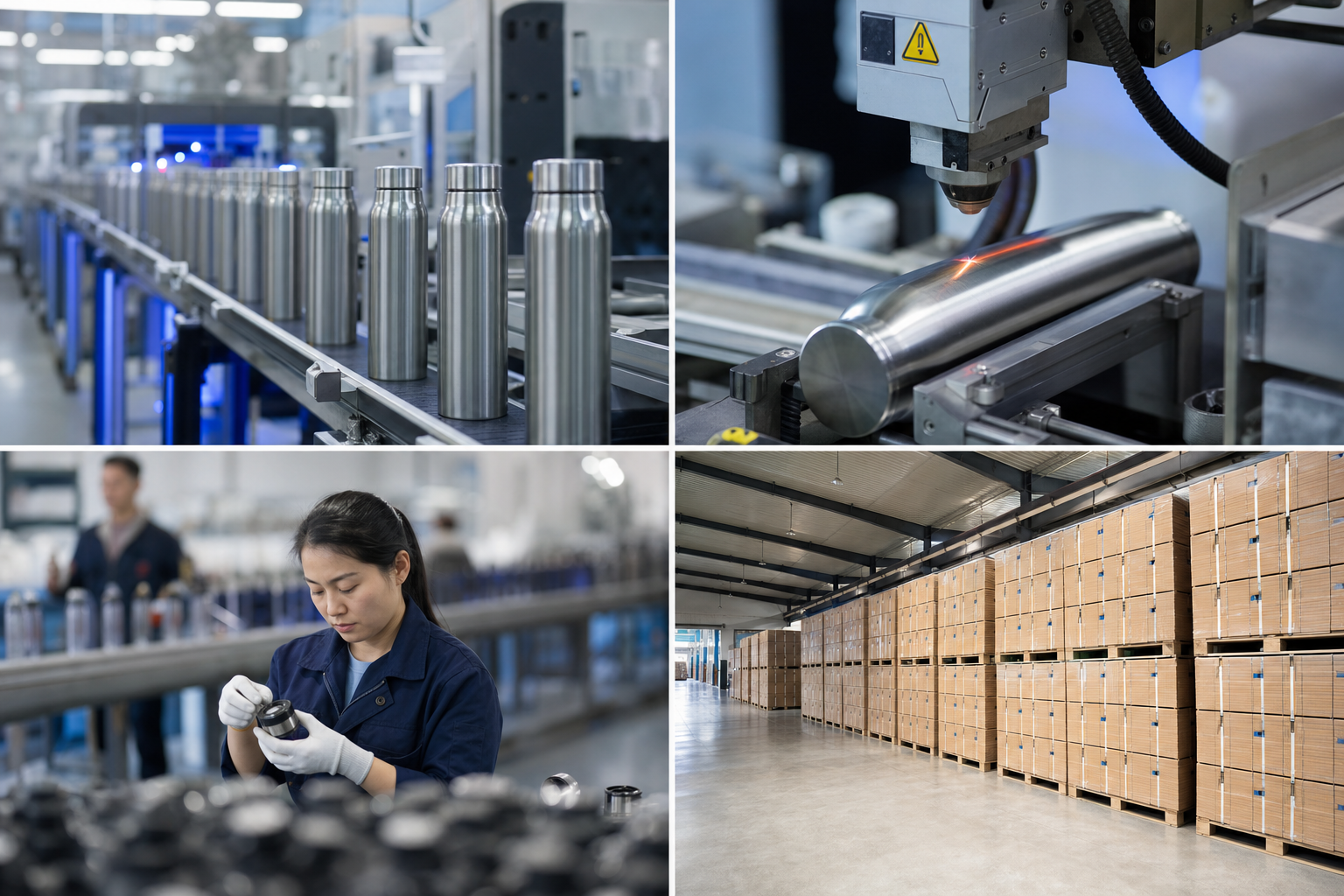
QC should be on paper and on the line. A real factory check covers incoming material review, in-process vacuum inspection, 100 percent leak testing on lids, and final AQL sampling before shipment. Ask the thermos factory for the inspection method, not just a promise; QC pulled a sample with a 0.3 mm lip defect once, and the buyer flagged it before loading. For retail shelves, request outer carton drop testing and barcode verification on the master carton. For a campaign, confirm whether you need individual boxes, belly bands, or a polybag. Packaging changes freight, damage rate, and the unboxing feel.
The best promotional vacuum flask is not the fanciest one. It passes compliance, lands on schedule, and still looks deliberate after transit. That is the standard we run on export jobs, and it beats chasing a spec sheet with no packing plan.
Get a quote for your custom thermos program
Send your target price, logo file, lid style, and carton spec. We will match the right promotional thermos to your channel, MOQ, and delivery window.
Frequently asked questions
What capacity is best for a promotional vacuum flask?
For most campaigns, 500 ml is the safest size. It gives enough room for a logo, fits cup holders better than a 750 ml bottle, and loads efficiently in cartons. A 350 ml flask works for commuter gifts and tight budgets, but the branding area is small. A 750 ml bottle makes sense for outdoor retail, but freight cost rises because cartons get larger and heavier. On a China FOB quote, a 500 ml promotional thermos often lands in the most efficient cost band. If you want the best promotional vacuum flask for broad distribution, 500 ml usually wins on utility, margin, and packaging.
What is the MOQ for a custom stainless thermos?
For a standard custom thermos using an existing mold, 500 pcs per style and color is common. If you ask for a new lid, a special finish, or a unique carry handle, the MOQ can move to 1,000-3,000 pcs. Sample production usually takes 7-10 days, then 25-35 days for mass production after approval. In Zhejiang and other manufacturing hubs in China, the real MOQ question is whether the cap and body are shared across colors. If the structure stays the same, a factory can often split one order across several colors without punishing the unit price too hard.
Which decoration method lasts longest on a promotional thermos?
Laser engraving is the most durable choice on stainless steel because it marks the surface instead of sitting on top of it. It will not peel or rub off during transit or daily use. Screen printing is cheaper for simple logos, but it is better for one or two colors and larger runs. UV print can carry more detail, but you need a stable coated surface and decent abrasion resistance. For a powder-coated bottle, laser on the coated surface usually gives the cleanest premium look. If your logo is simple, laser is usually the best value. If you need color, silk screen is still practical on large thermos bulk orders.
How do I check compliance for Europe and North America?
Ask for REACH test reports for the coating, steel, and silicone parts if you are shipping into Europe. LFGB is worth requesting if the bottle will sit on retail shelves or go through stricter distributor review. For North America, ask for food-contact documentation that references FDA expectations, and verify that any BPA-free claim is backed by the lid material spec. A real thermos supplier should also show AQL inspection records, leak-test results, and batch traceability. Do not accept screenshots alone. For bulk thermos programs, third-party reports from SGS, Intertek, or a similar lab are more useful than a verbal promise from a sales rep.
Can you support Amazon FBA or distributor packing?
Yes, but it needs to be set up correctly. For Amazon FBA, the carton label, FNSKU, and case-pack count must be correct before the goods leave the factory. For distributor thermos shipments, ask for individual boxes, master carton marks, and pallet dimensions in writing. A common retail case pack is 12 pcs per carton, but it depends on bottle size and box thickness. If you need pre-applied barcodes, confirm whether the print is on the retail box or on the bottle itself. For a large promotional thermos order, packaging details can change container load by 8-15 percent, so they should be approved before production starts.