Key Takeaways
- Most promotional bottle programs land at MOQ 1,000-3,000 pcs; small runs usually push unit cost up 18-35%.
- For retail and corporate gifting, 304 stainless steel and Tritan are the safest bets; glass only works when breakage risk is controlled.
- FOB China pricing for a basic 500 ml printed bottle often starts around USD 2.10-4.80 depending on material and decoration.
- A reliable canteen manufacturer should give you AQL 2.5/4.0 inspection, leak testing, and a confirmed 30-45 day production lead time.
If you are buying the best promotional water bottles for a brand launch, distributor program, or retail giveaway, the bottle is the easy part. The hard part is picking one that prints cleanly, survives carton drops, and still looks presentable after 50,000 cycles of handling, pallet moves, and resale pressure. We have seen a 0.5 mm wall difference turn a nice sample into a cracked shipment. That kills margin fast.
From our Hangzhou, Zhejiang factory, we see the same mistake every season: buyers start with logo ideas, then the line gets dragged into leak tests, carton crush checks, and compliance paperwork. Last month, QC pulled the sample because the PO had the closure code wrong by one digit. A promo bottle is a commercial item first. If you want custom drinkware that holds margin, think like procurement, not a gift table. Check material, wall thickness, closure style, MOQ, and real lead time before you place the order.
Start with the use case
Before you compare samples, pin down where the bottle will be sold or handed out. A 32 oz bottle for a trade show is a different job from a line item for an outdoor retailer, a gym chain, or an Amazon FBA launch. A giveaway piece can live with thin margins; distributor drinkware gets judged on repeated handling, shelf presence, and the complaints that come back after week 3. We see that split on the line all the time.
For most B2B programs, we sort the market into three working buckets: low-cost PET or single-wall aluminum for high-volume promotions; 304 stainless steel or Tritan for mid-market retail; and insulated double-wall stainless for premium campaigns. If you are sourcing from a canteen factory in China or Zhejiang, tell the supplier the channel first, then the logo. That is the right order. A 500 ml single-wall steel bottle might land at USD 1.35-2.10 FOB at 3,000 pcs, while a 500 ml vacuum tumbler can reach USD 4.20-7.80 FOB depending on the coating and lid spec. QC pulled the sample, checked the wall thickness with calipers, and the buyer flagged it when the finish did not match the shelf target.
- Trade show giveaway: light, low-cost, fast print
- Corporate gifting: better finish, stronger box presentation
- Retail or distributor program: stable specs and repeatable quality
If you are buying a canteen promotional item for a distributor network, ask for the exact target shelf price first. That single number keeps the spec honest. We have seen this go sideways when a PO said 12.00 but the margin math only worked at 8.50.
Pick the right material
Material choice decides more than looks. It affects drop rate, ink adhesion, odor control, and freight cost. For custom drinkware, we usually start with 304 stainless because it is the safest all-around pick for food-contact bottles. On the line, we check 0.4-0.6 mm wall thickness for single-wall builds and 0.35-0.5 mm shell thickness for vacuum bottles, using a caliper and a weight check, because thin walls can turn a good bottle into a dented complaint. If the buyer wants a light custom canteen for outdoor promotion, aluminum can work, but coating quality is the real issue. We have seen a PO say "matte silver" and the buyer later flag the scratch rate after 500 pcs. That is the wrong place to save money.
Tritan and other copolyesters fit jobs that need a clear body and low weight. They sell well for school, gym, and wellness programs because the bottle looks clean and takes pad print or silk-screen well. Glass gives a premium feel, but it is not a low-effort choice. You need thicker carton corrugation, a 1.2 m drop test, and a realistic scrap allowance, or the breakage math goes sideways fast. For a custom growler used in beer or beverage retail, stainless still wins when the buyer wants fewer claims and simpler shipping. QC pulled a sample last month with a chipped shoulder after a single corner drop, and that was enough to stop the line.
Ask every canteen supplier for the material declaration, food contact compliance, and migration test reports where they apply. If you are shipping into Europe, REACH and LFGB come up early. For North America, buyers often ask for FDA food-contact support, and you need to confirm the coating, ink, and lid gasket, not just the bottle shell. A supplier who only talks about the body material is not doing the full job. We run into this all the time when a buyer approves the bottle but misses the lid spec, then the gasket arrives with the wrong compound and the first inspection fails.
Logo methods that survive shipping
Decoration decides whether a bottle looks like a retail item or a cheap giveaway. For the best promotional water bottles, the logo method has to match the body material and the sales channel. Silk screen is still the lowest-cost choice for flat graphics on stainless, aluminum, and some Tritan bodies. At 1-2 colors, the line moves fast and the print stays clean. Laser engraving gives a permanent mark on stainless and works well on premium canteen customized orders, but it does not suit every coating. On dark matte finishes, the mark can disappear unless we plan the contrast from day one.
When buyers ask for a canteen customizable program with 8-12 SKUs, we usually lay out a print matrix:
- Silk screen: best for 1-4 colors, lower cost, MOQ often 1,000 pcs
- Laser engraving: premium, durable, no ink wear, best on metal
- UV print: better for detailed branding and gradients, but check abrasion resistance
- Heat transfer: useful for full-wrap graphics, but only if your QC standards are strict
If you sell through a canteen distributor network, one scuffed logo can trigger a return claim on the full batch. We run a 1,000-cycle rub test on sample units before mass production, and QC pulled the sample if the ink started to lift at the edges. That test will not prove retail durability, but it tells you fast if the ink was under-cured or the coating pre-treatment was weak. One buyer once sent a PO with the logo size written as 35 mm on one page and 3.5 cm on another; the math does not work, and the line will catch it before production. In Zhejiang, plenty of factories can print. Fewer can hold the same color and adhesion on repeat orders.
MOQ, price, and margin math
Procurement teams ask for the lowest MOQ all the time, but that is the wrong question. The better question is what MOQ keeps margin clean after setup, print plates, and carton work. We run this math every week on the line. A bottle factory in China may quote 500 pcs, yet that level can land 20-40% above a 3,000 pcs order because the filler, sleeve packing, and decoration time do not drop in the same way. For a basic 500 ml custom drinkware order, common FOB China pricing looks like this: single-wall stainless USD 1.35-2.10, Tritan USD 1.60-2.90, vacuum insulated stainless USD 4.20-7.80, depending on lid type, finish, and print coverage.
Ask for carton quantities, outer carton drop-test assumptions, and whether spare lids are in the box. QC pulled one sample last month and found a 3 mm gap in the lid fit after the buyer changed from white to black, which turned into a PO dispute. A good canteen factory in Hangzhou or elsewhere in Zhejiang will tell you if the order can be mixed by color or only by size. For distributor drinkware programs, mixed-color batches help with channel flexibility, but they also split stock fast. If you plan a customized drinkware launch, start with one body and two lid colors, then add more variants after the first re-order.
Watch the price bands, not just unit price. A bottle that looks 12% cheaper can end up 8% more expensive after freight, packaging upgrade, and rework.
For corporate buyers, a first order usually sits at 2,000-5,000 pcs. That covers tooling and setup cost without choking cash. We’ve seen 1,000 pcs go sideways when the buyer pushed for five print positions; the math did not work.
Quality checks that matter
Quality is not a slogan. It is a checklist with numbers. If you are sourcing canteen manufacturers in China, ask for the inspection plan before the line starts. We run raw material verification on the first 200 pcs, in-process QC during forming or welding, final leakage testing, and carton-drop testing. For most promotional bottle programs, AQL 2.5 for critical defects and AQL 4.0 for major defects is the standard baseline, unless your retail buyer wants tighter limits.
For vacuum bottles, write the insulation test method into the PO. A common spec is 6 hours hot at 60°C+ retention and 12 hours cold at 10°C- performance, but the buyer flagged it when the target was left vague. For a custom canteen, check thread smoothness, lid seal compression, and gasket material; we have seen leaks come from a weak lid, not the body. One factory-floor detail: QC pulled the sample and checked the cap torque with a torque meter at 0.35-0.45 N·m.
Ask for these before you confirm mass production:
- Food-contact compliance documents
- Leak test standard and sampling rate
- Exterior coating adhesion data
- Carton compression or drop test result
- Production photos with batch traceability
If your canteen supplier will not document the inspection process, the price is not low. The math does not work. You pay later in chargebacks, replacements, and customer service time. We have seen a PO typo turn into a 5,000-unit reprint because the carton spec was written as 12 pcs instead of 24 pcs. That lesson is the same in China and anywhere else.
Compliance for EU and North America
If your bottles go to Europe or North America, compliance is not paperwork on the side. It is part of the bottle. A serious canteen distributor or brand owner needs to say whether the order is for retail, e-commerce, or promo resale, because the file set changes. For Europe, REACH checks cover coatings, inks, and cap parts. For food contact, we still see buyers ask for LFGB on the same 500 ml bottle if the channel is retail. In North America, FDA food-contact questions come first, and California Prop 65 is next when coatings, pigments, or accessory parts trigger review. This is the wrong question to ask after mass production starts. On our line, QC pulled the sample with a swab test tag and the buyer flagged a missing ink declaration in the first round.
For custom growler or insulated drinkware programs, the lid and gasket matter as much as the body. Silicone needs to be food-grade, with the test basis named in writing. If a vendor says “compliant” and stops there, push back. Ask for the report number, test lab, and the exact material split. A canteen vendor should also be able to provide carton marks, country of origin, HS code support, and factory audit files like BSCI when your retail customer asks for them. We have seen this go sideways on a 2 mm gasket spec because the buyer assumed the cap was covered by the cup report.
Shipping is part of the same job. If the cartons go to Amazon or a 3PL, carton labels, FNSKU placement, and master carton dimensions should be locked before production. A good customized canteen program avoids relabeling at the end. Relabeling in a bonded warehouse burns time, adds cost, and increases damage risk. We run this every week, and the math does not work when a PO typo sends 24 cartons to the wrong carton code. Zhejiang factories that export regularly know this, but you still need to spell it out on the PO.
Order structure and lead time
A clean order structure saves more cash than hard bargaining ever does. For the best promotional water bottles, the factory needs one clear spec sheet: material, size, logo method, finish, lid style, packaging, compliance target, and destination country. If you keep changing the lid after sampling, you pay twice. If you keep adding colors, the line slows down and lead time stretches. We have seen a buyer flag a missing carton mark on a PO and the whole batch sat for 3 days.
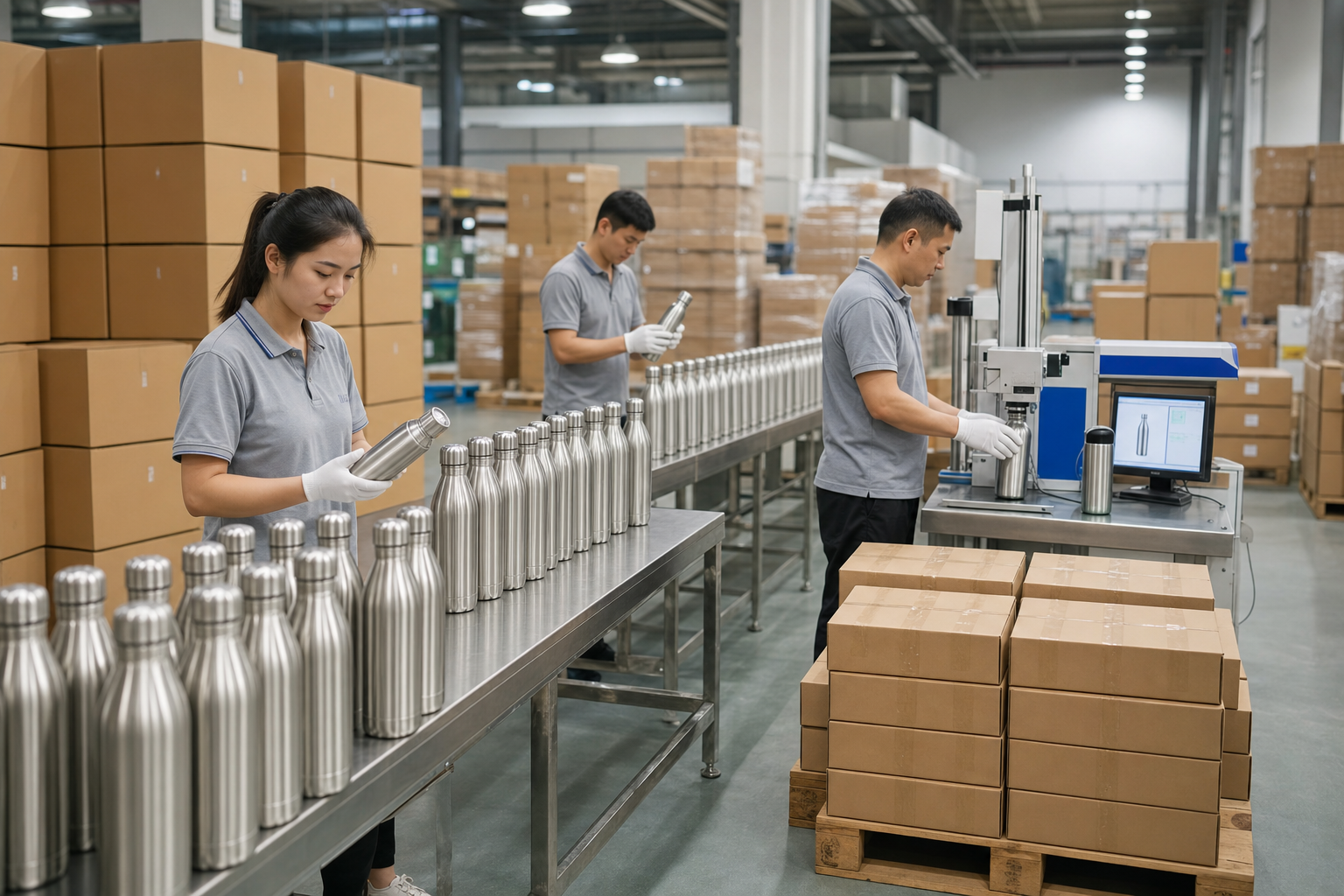
At our Hangzhou, Zhejiang operation, a standard promotional bottle line can run 120,000 units per month across multiple SKUs, with typical production lead times of 30-45 days after sample approval and deposit. That is a real shop-floor benchmark, not a sales line. QC pulled the sample, checked the logo against a 0.2 mm tolerance, and still we had to rework one lid mold because the first shot did not close cleanly. Rush orders can work, but they squeeze inspection time and raise scrap. For reusable customized growler projects or premium double-wall canteen promotional campaigns, plan 45-60 days if decoration is complex or the packaging needs retail-grade inserts.
Use a simple order sequence:
- Confirm drawings and logo placement
- Approve pre-production sample
- Lock packaging artwork and carton marks
- Authorize mass production
- Approve shipment inspection before balance payment
If you are a canteen distributor or distributor canteen buyer managing multiple channels, a tight production schedule protects your seasonal inventory better than a discount ever will. We ship on the schedule we lock, not the one someone hopes for later.
Get a quote for your next bottle program
Send your target price, quantity, and market. We will match the right material, print method, and packaging for China or Europe shipments.
Frequently asked questions
What is the usual MOQ for best promotional water bottles?
For standard custom drinkware, MOQ is usually 1,000 pcs for silk screen or laser engraving and 3,000 pcs for better pricing on mixed colors. Some canteen suppliers will accept 500 pcs, but the unit cost can jump 20-40%. If you want a retail box, custom insert, or multi-color print, plan for 2,000-5,000 pcs. That is the range where a canteen factory in China can keep setup cost under control and still give you consistent quality.
Which material is best for a canteen custom order?
For most buyers, 304 stainless steel is the safest default because it balances durability, food-contact confidence, and decent margins. Tritan works well when you need a lighter customizable canteen with clear walls and good visibility. Aluminum is cheaper but more sensitive to coating quality. Glass is premium but fragile. If you are selling through distributor drinkware channels, stainless usually creates fewer claims and fewer returns than glass or low-grade plastic.
How much do promotional bottles cost FOB China?
A basic 500 ml single-wall stainless bottle can start around USD 1.35-2.10 FOB China at 3,000 pcs. Tritan models often sit around USD 1.60-2.90. Vacuum insulated bottles usually land around USD 4.20-7.80 depending on coating, lid, and print coverage. Add USD 0.10-0.45 for simple packaging and more for retail boxes. Prices from Zhejiang factories are usually more stable when you commit to a repeat order schedule.
What quality checks should I ask for from a canteen manufacturer?
Ask for raw material confirmation, leak testing, lid seal checks, and final AQL inspection. For many orders, AQL 2.5 for critical defects and 4.0 for major defects is a practical standard. Also request carton drop-test results, print adhesion checks, and compliance documents for your market. If the order is going into Europe or North America, include REACH, FDA food-contact support, and any retail-specific documentation before production starts.
How long does production take for customized drinkware?
Typical lead time is 30-45 days after sample approval and deposit for standard custom drinkware. Complex canteen customized orders with special lids, retail boxes, or full-wrap decoration can take 45-60 days. If you need rush production, say so early; otherwise the factory will build a normal schedule. A canteen vendor in Zhejiang with stable monthly capacity should give you a clear timeline and update it if any artwork or packaging changes are made.