Key Takeaways
- For standard stainless steel drinkware, 1,000 pcs MOQ is common; custom colors often move to 3,000 pcs.
- A reliable Zhejiang factory should quote 25-35 days lead time and show real output around 600,000 units/month.
- REACH, LFGB, FDA, ISO 9001, and AQL 2.5/4.0 checks matter more than the lowest FOB price.
- The right SKU depends on use case: bulk canteen, beer growler wholesale, beer tumbler wholesale, or best wholesale drink bottle.
Procurement teams lose money on drinkware the same way every time: they chase a low unit price, then eat rework, late trucks, and compliance fixes after the PO is signed. If you are sourcing wholesale drinkware for retail, promotions, foodservice, or Amazon FBA, the supplier has to hold the mouth rim, keep decoration clean, and ship on schedule. That is the test for the best wholesale drinkware. A glossy sample shot means nothing if the carton arrives with scuffs or the print rubs off in QC.
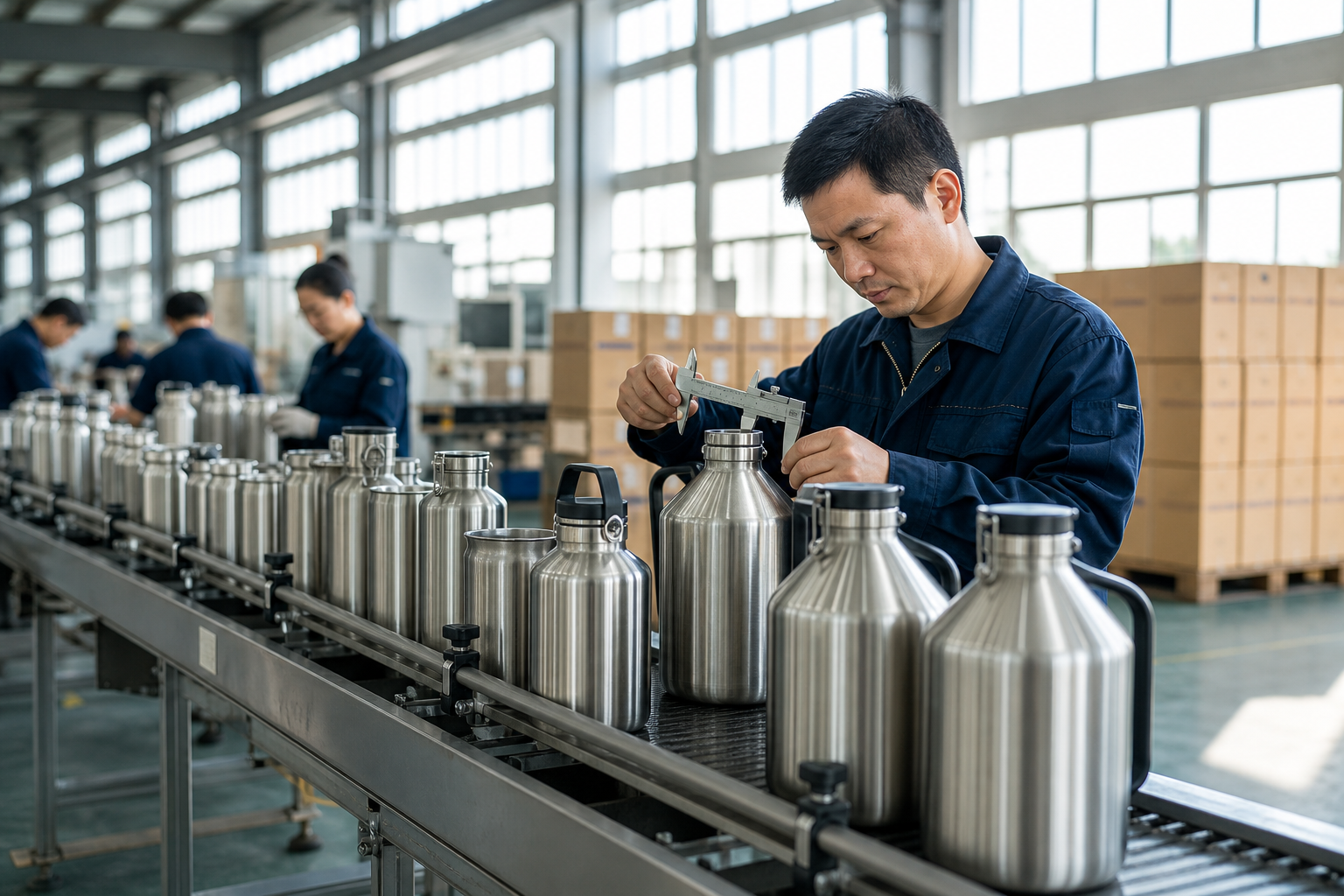
In Zhejiang, we run lines for almost every bulk format you will see, from 5,000-piece canteen orders to wholesale growler runs and alcohol flask wholesale bulk programs. The gap between a solid factory and a cheap quote shows up fast: MOQ, lead time, audit status, and whether the sales desk can explain the material spec without guessing. We had a buyer flag a PO typo on “3048 stainless” once; the math did not work, and the line would have stopped for a wrong material callout. If they cannot answer that in the first round, move on.
Start With the Buying Use Case
If you start with the bottle shape before the channel, you usually end up with the wrong SKU. We see it on the line all the time. A promo program wants low decoration cost and packing that holds up after 12 days in transit. A retail program needs shelf presence and a margin that still works after freight, duty, and one round of rework. An FBA program needs carton control, scannable labels, and fewer returns. The best wholesale drinkware is the one that fits the route to market, not the one with the lowest ex-factory quote.
For outdoor retail, a canteen wholesale program often starts with 500 ml or 750 ml single-wall or insulated bottles. For a hiking chain, we usually keep the cap simple and open the mouth to 42 mm so ice drops in without a fight. Taproom buyers and beverage brands tend to buy wholesale growler and beer growler bulk programs around 32 oz and 64 oz, because those sizes move cleanly through shelves and tasting rooms. For gifting, alcohol flask wholesale and alcohol flask in bulk orders need tighter cosmetic control than gear built only for use; QC pulled the sample once and flagged a tiny logo shift that would have been fine on a camp bottle.
- Retail: better decoration, tighter color control, less overpacking.
- Foodservice: stackability, dent resistance, and easy cleaning.
- Amazon or e-commerce: carton strength, FNSKU placement, and low defect rates.
Do not force one bottle to serve every use case. We have seen that go sideways. The math does not work. The best wholesale drink bottle for a DTC brand is often not the same bottle you should put into wholesale drinkware wholesale distribution.
Materials and Compliance First
Material choice drives performance and compliance risk. For stainless steel bottles, 18/8 or 304 steel is the standard starting point. If the drink is acidic, 316 stainless gives us better corrosion resistance, and the buyer pays for it. For plastic lids or clear bodies, BPA-free Tritan is the common call. For glass drinkware, borosilicate handles thermal shock better than soda-lime glass, and we ship fewer breakage complaints from it.
Wall thickness matters more than a lot of buyers think. A 0.5 mm wall can look fine on a hand sample, then feel flimsy on the line after polishing. For a premium insulated tumbler, 0.6-0.8 mm outer wall is a more honest target. Ask for vacuum retention in hours, not soft wording. If the claim is 12 hours cold and 6 hours hot, ask the test ambient and whether QC pulled the sample from mass production or a hand-finished piece. The math doesn't work if the data is vague.
For Europe, ask for REACH and LFGB support where relevant. For the US, ask for food-contact declarations and any needed FDA-facing test reports. If the supplier has ISO 9001 and BSCI audit coverage, that helps, but only when the paperwork is current and matches the PO. We have seen buyers get burned by a typo on a packing list that swapped 304 for 201. In China, a factory that cannot show traceability for steel coils, lids, and coatings is not ready for serious wholesale drinkware programs.
Practical rule: if the supplier cannot explain steel grade, coating system, and lid gasket material in one email, the sample is better than the factory.
Price, MOQ, and Lead Time
Buyers often ask for price before they define the product, which is backwards. A plain stainless tumbler with no print has a different cost base from a custom powder-coated growler with a laser logo and retail carton. On our line, a 12 oz tumbler and a 40 oz bottle do not share the same tooling, and the quote changes fast once the lid or finish changes. For a standard stainless steel bottle or tumbler, a real MOQ is usually 1,000 pcs per SKU. If you want custom color, special packaging, or a new lid, 3,000 pcs is more realistic. For a new mold or unusual geometry, 5,000 pcs is common. The wrong question is "what is your lowest price?" The better one is "what exactly are we building?"
Our Zhejiang line runs about 600,000 units per month across multiple drinkware formats, so capacity is usually not the problem. QC pulled the sample at the drop-test bench, and the real bottleneck was artwork approval, test approval, and carton specs. For a normal bulk drinkware order, 25-35 days after sample sign-off is a sensible lead time. Add 7-10 days if you need fresh compliance testing or export documentation. FOB Ningbo or FOB Shanghai is standard for most China shipments, and you should compare on landed cost, not just factory price. We ship faster when the PO is clean; one typo on a carton mark can hold the line for a full day.
- Sample cost: often USD 20-80 depending on decoration and tooling.
- Standard unit price: roughly USD 1.20-3.80 for simple tumblers, higher for growler wholesale formats.
- Extra decoration: laser engraving or one-color print may add USD 0.08-0.25 per piece.
If the quote is unusually low, check what is missing: carton test, vacuum test, compliance docs, or proper spare parts. We have seen this go sideways when a buyer chased the cheapest number and then found an 8% rework rate after the first shipment. Cheap drinkware wholesale pricing is not cheap if it creates 8% rework.
Customization Without Delays
I’m rewriting the section to sound like a working sales engineer, keeping the same HTML structure while tightening the claims and removing the AI-style phrasing. I’m also adding a few concrete production details so it reads like someone who has actually run these orders.Decoration is where orders slip. A logo that looks simple on screen can turn into a headache on the line, and a 2-color mark is enough to push a 500 ml run off schedule if the file is messy. For most wholesale drinkware programs, one-color silk screen, laser engraving, pad print, and a simple full-wrap are enough. On powder-coated stainless steel, laser marking stays cleaner than ink. For clear bottles and glass, adhesion and cure time decide the result, not the artwork file.
Do not stack changes on the first PO. The wrong question is whether we can do every upgrade at once. Start with one structural change and one decoration change. One buyer sent us a PO with a new lid, a new finish, a custom carton, and a logo revision on the same line, and the order slipped 12 days while we reset the tooling and rechecked the master carton size. If you need FBA prep, ask for FNSKU labeling, carton labeling, and master carton dimensions before sampling starts. A typo on the PO is enough to send the warehouse the wrong pack plan.
For beer tumbler wholesale or beer tumbler bulk programs, a clean 1-color logo usually sells better than a crowded full-wrap print. On one 8,000-unit run, QC pulled the sample because the art looked busy from 2 meters away, and the buyer cut the design back the same day. For alcohol flask wholesale bulk, small logo placement and a solid closure matter more than flashy graphics. If the artwork is too fine for the method, a good supplier in China should say so. We’ve seen that go sideways on a 0.2 mm stroke, and the math does not work.
- Laser engraving: durable, clean, no ink mismatch, and no chip risk on coated steel.
- Silkscreen: best for flat color logos and repeat volume on 5,000 pcs and up.
- UV or wrap print: stronger shelf impact, but the line needs tighter cure control and registration.
Quality Control You Can Verify
Quality control is where sourcing gets real. Ask for an inspection plan, not a promise. For bulk drinkware, a solid factory should walk you through incoming material checks, in-process leak testing, and final inspection to AQL 2.5 for major defects and 4.0 for minor defects. If a supplier cannot explain AQL, you are not talking to a production partner.
For insulated stainless products, we run three checks on the line: vacuum integrity, lid fit, and drop resistance on the packed carton. A 24-hour inverted hold test is standard for leaks. A 1 meter carton drop during pre-shipment review catches more bad units than a polished video ever will. Ask for batch photos, lot numbers, and a sample from the actual production run, not just the approved pre-production sample. QC pulled the sample after the buyer flagged a loose lid on a 30 oz tumbler, and that saved a return.
Documents matter too. For China export, you usually need a commercial invoice, packing list, and sometimes a certificate of origin. For Europe, REACH or LFGB-supporting reports may be required depending on the materials. For larger buyers, BSCI audit status and ISO 9001 are useful filters, but only if they tie back to real process discipline. The point is not to collect papers. The point is to stop a bad bulk canteen or wholesale growler shipment before it leaves the factory floor. We have seen a PO typo on carton count turn into a 12-day delay.
Good factories show you defects by category, not by excuse.
Choose the Right Product Family
Once the technical baseline is set, pick the SKU family that fits the channel. A best wholesale drink bottle for outdoor retail is not the same as a corporate gift tumbler. We once saw a buyer try to mix both in one PO, and the math did not work. If you want assortment depth, keep the line tight and make the differences count. One 500 ml insulated bottle, one 750 ml sports bottle, one 32 oz growler, and one stainless canteen usually cover more orders than 10 loose SKUs.
- Bulk canteen: best for outdoor, military-style, hiking, and utility programs.
- Canteen wholesale: works when you need wide-mouth filling, simple lids, and durable packaging; our wide-mouth spec runs 53 mm, which helps on the filling line.
- Wholesale growler: best for taprooms, beverage brands, and refill campaigns.
- Beer growler wholesale bulk: useful when you need consistent branding across multiple locations; QC pulled the sample after the first logo print was 1.5 mm off-center.
- Beer tumbler wholesale: strong option for hospitality, bars, and merch programs.
- Alcohol flask wholesale bulk: keep the decoration restrained and the closure tested; we ship a torque check on the cap, not a guess.
Drinkware bulk buying rewards discipline. The buyer who holds SKU count usually gets better pricing, cleaner cartons, and faster replenishment. I have seen a 12-day lead time beat an 18-day one just because the order stayed on two models instead of five. If you need one category to anchor the range, start with insulated stainless, since it sells in Europe and North America without much hand-holding. Add glass or Tritan only when the channel asks for it. China can supply all of it, but your margin gets better when you buy less, not more.
Source the right drinkware before you place volume
Send your target SKU, decoration method, and destination market. You will get MOQ, FOB pricing, and lead time that fit a real production run.
Frequently asked questions
What MOQ should I expect for wholesale drinkware?
For standard stainless tumblers, bottles, and canteens, 1,000 pcs per SKU is a normal starting point. If you want custom color, new packaging, or a different lid, expect 3,000 pcs. New molds or unusual shapes often start at 5,000 pcs. A serious China supplier should tell you where the MOQ comes from: decoration setup, carton allocation, or tooling. If the factory offers 100 pcs on a fully custom item, check the real cost, because someone is hiding the setup somewhere else.
How long should production take in China?
For a clean reorder, 25-35 days after sample approval is reasonable for most wholesale drinkware. Add 7-10 days if you need fresh lab testing, a new carton spec, or a revised logo method. If a supplier promises 10 days on a complex stainless tumbler with custom packaging, the risk is usually rushed assembly or weak QC. Zhejiang factories with stable lines can hit faster timelines on repeat jobs, but you should still protect yourself with clear artwork approval, pre-production samples, and written packing specs.
What materials are best for bulk canteen and growler orders?
For stainless steel bulk canteen and wholesale growler programs, 304 or 18/8 steel is the practical standard. If you need stronger corrosion resistance, 316 is better, especially for acidic drinks, but it costs more. For plastic components, BPA-free Tritan is common. For glass, borosilicate is safer for thermal shock. In real sourcing, wall thickness matters as much as the material grade: 0.6-0.8 mm for a premium insulated body is more dependable than a thin sample that dents easily.
Which compliance documents should I ask for?
For Europe, ask for REACH and, where relevant, LFGB support. For the US, ask for food-contact declarations and any needed FDA-facing test reports. Good factories can also provide ISO 9001, BSCI audit status, and product test reports from a third-party lab such as SGS or Intertek. If you are selling into Amazon or retail, ask for carton dimensions, barcode placement, and traceability by batch or lot number. A supplier in China that cannot provide basic documentation is not ready for serious wholesale drinkware volume.
How do I keep customization from slowing the order down?
Keep the first order simple. One decoration method, one color system, and one carton specification is far safer than changing everything at once. Laser engraving is often the fastest for stainless steel. One-color silkscreen is also efficient if your logo is not too fine. If you need FNSKU labels, master carton marks, or retail hangtags, lock those details before production starts. For alcohol flask wholesale bulk and beer tumbler wholesale programs, the fewer variables you change, the more likely you are to ship on time and stay within budget.