Key Takeaways
- Target MOQ is usually 1,000-3,000 pcs per SKU, with custom colors adding 7-10 days
- A decent wholesale sport bottle often lands at USD 1.10-3.80 FOB depending on material, lid, and print
- Ask for AQL 2.5/4.0 inspection, REACH documentation, and leak testing before you approve production
- A Zhejiang factory with 300,000+ units/month is far safer for repeat wholesale drinkware programs than a small trading setup
If you are sourcing the best wholesale sport bottle, you are not buying a “bottle.” You are buying a repeatable margin machine that has to survive transit, retail handling, and customer abuse. We run this every week. Think in units, not samples: 5,000 pcs, 10,000 pcs, or a 1,000 pcs trial if you want to check the design before you commit. A buyer once sent a PO with “5000” in the note and “5,000 pcs” in the header; the line caught it before we cut tooling. In Zhejiang, that is normal. The real trade-off sits between price, lead time, compliance, and factory discipline.
The wrong question is, “Who gave the lowest FOB?” The math does not work if the closure fails, the wall thickness is off by 0.3 mm, or the print rubs after 50 wash cycles. A $1.20 bottle that leaks or fails REACH gets expensive fast. On a solid drinkware wholesale program from Hangzhou, we ship in 25-35 days after approval, and monthly output can pass 300,000 units when the line is stable. QC pulled the sample last week and flagged a cap torque issue at 1.8 N·m, which is the kind of detail that saves a buyer from a headache later. You need a supplier that can run bulk drinkware, not just make pretty samples.
What Buyers Mean by Best
“Best wholesale sport bottle” is not the fanciest bottle on the shelf. It is the one that protects margin, keeps defect rate low, ships cleanly, and reorders without drama. For a procurement manager, that usually means a bottle that survives a 1.2-meter drop test, passes a 24-hour leak check, and keeps decoration intact after 30-50 dishwasher cycles if you sell into premium channels. For a brand owner, the cap has to match the body. We had one buyer flag a matte lid on a glossy bottle, and the whole line looked off.
Start with the use case. A gym bottle, a commuter bottle, and a school bottle are different jobs. A 500-750 ml tritan sports bottle works for North America; a 650 ml stainless option often sells better in Europe, where buyers care more about durability and heat retention. If you want wholesale drinkware that moves, keep the build tight: one body, two lid options, one print method. Every extra variable creates another approval loop. The math does not work.
- Volume range: 500 ml, 650 ml, 750 ml are the practical sizes we ship most often
- MOQ: 1,000 pcs for stock-based customization; 3,000 pcs for new molds or special lids
- Target FOB: USD 1.10-3.80 depending on material and branding
Choose the Right Bottle Material
Material choice moves the cost stack more than printing or labels. Tritan is the standard pick when the buyer needs a clear, light bottle that takes drops and does not hold smell. Stainless steel suits a buyer asking for a more premium hand feel or insulated use, but the extra welds and assembly raise cost. Aluminum can work for light canteen runs, yet coating quality and dent control decide whether the line ships cleanly. Glass stays niche in sport sales because breakage is a real claim risk, though it still sells for office and wellness packs. On our line, QC pulled one dropped sample from cavity 2 and the body stayed intact; that is the kind of result buyers pay for.
For wholesale canteen and wholesale drinkware programs, keep the spec tight. If the customer wants fewer returns, run Tritan or 304 stainless. Tritan body wall thickness is usually 2.5-3.0 mm. For stainless, ask for 0.4 mm or 0.5 mm gauge on 304 inner walls, not vague “food grade stainless” language. If you are buying beer growler bulk or growler wholesale for hospitality promotions, 18/8 stainless with a secure lid and powder coating beats thin-wall aluminum every time. We had one PO where the buyer flagged “0.5 mm” as “0.05 mm” by mistake; the math did not work, and that is the kind of typo that wastes a week. In Zhejiang factories, the real control point is tooling and assembly, not sales copy.
- Tritan: light, clear, impact-resistant, typically USD 0.90-1.80 FOB for basic models
- 304 stainless: durable, premium, usually USD 2.20-5.50 FOB depending on insulation
- Aluminum: economical but needs better coating and dent control
Check Lid and Leak Performance
Most wholesale sport bottle programs fail at the lid, not the body. We have seen a 0.6 mm gasket mismatch turn a good bottle into scrap. A strong bottle with a weak cap is still a bad product. Match the closure to the channel. A flip-top with a silicone gasket works for gym and school orders. A screw cap with a carry loop fits outdoor and promo use better. A vacuum-insulated sports cap sells in premium retail, but it adds USD 0.40-1.20 per unit, and the math has to work before you run the line.
Ask for leak testing under shipping conditions, not a quick upside-down demo at the desk. On one 5,000-piece order, QC pulled the sample and found seepage after a 1.2 m carton drop, even though the cap passed hand testing. We test 10 samples per lot at room temperature, then another set after thermal cycling if it is stainless. For canteen wholesale orders, ask whether the gasket is food-grade silicone and whether it comes out for cleaning. If you are sourcing alcohol flask bulk or alcohol flask wholesale bulk for a gift channel, closure fit and seam quality matter even more because buyers inspect the cap line, the weld, and the print. The same applies to beer tumbler bulk or beer tumbler wholesale items: lid feel, thread smoothness, and seal consistency decide your complaint rate.
Do not approve a lid only because it looks good. Ask for assembly torque, gasket material spec, and a 24-hour inverted leak test report. If the supplier cannot show those three items, the buyer flagged the right problem.
Price the Program Correctly
Buyers ask for a unit price before the program is pinned down. That is the wrong order. We run it as spec first, then decoration, then packaging, then freight terms. A basic wholesale sport bottle in China can start near USD 0.95 FOB for simple single-wall plastic with one-color print at 5,000 pcs. A better Tritan bottle with a custom lid may land at USD 1.40-2.20 FOB. A double-wall stainless version with laser logo and color box can be USD 3.20-6.00 FOB. The die-cut insert, lid tooling, and carton size all move the number.
If you are comparing drinkware bulk options, split product cost from landed cost. A bottle that looks cheaper by USD 0.18 can end up costing more after heavier cartons, higher breakage, or slower packing speed. We had one PO where the buyer flagged a 2 mm carton change, and the math showed the freight delta wiped out the savings. A factory can shave USD 0.05 on the body and lose USD 0.12 in assembly time. Ask for a full quote sheet: unit price, inner box, master carton, testing charge, sample fee policy. For bulk growler or wholesale growler projects, a heavier container can push freight up enough to erase the apparent product savings. This is why smart buyers treat freight and packaging as part of sourcing, not an afterthought.
- Low-complexity plastic bottle: USD 0.95-1.60 FOB
- Mid-range Tritan bottle: USD 1.40-2.20 FOB
- Premium insulated stainless: USD 3.20-6.00 FOB
Verify Factory Capability
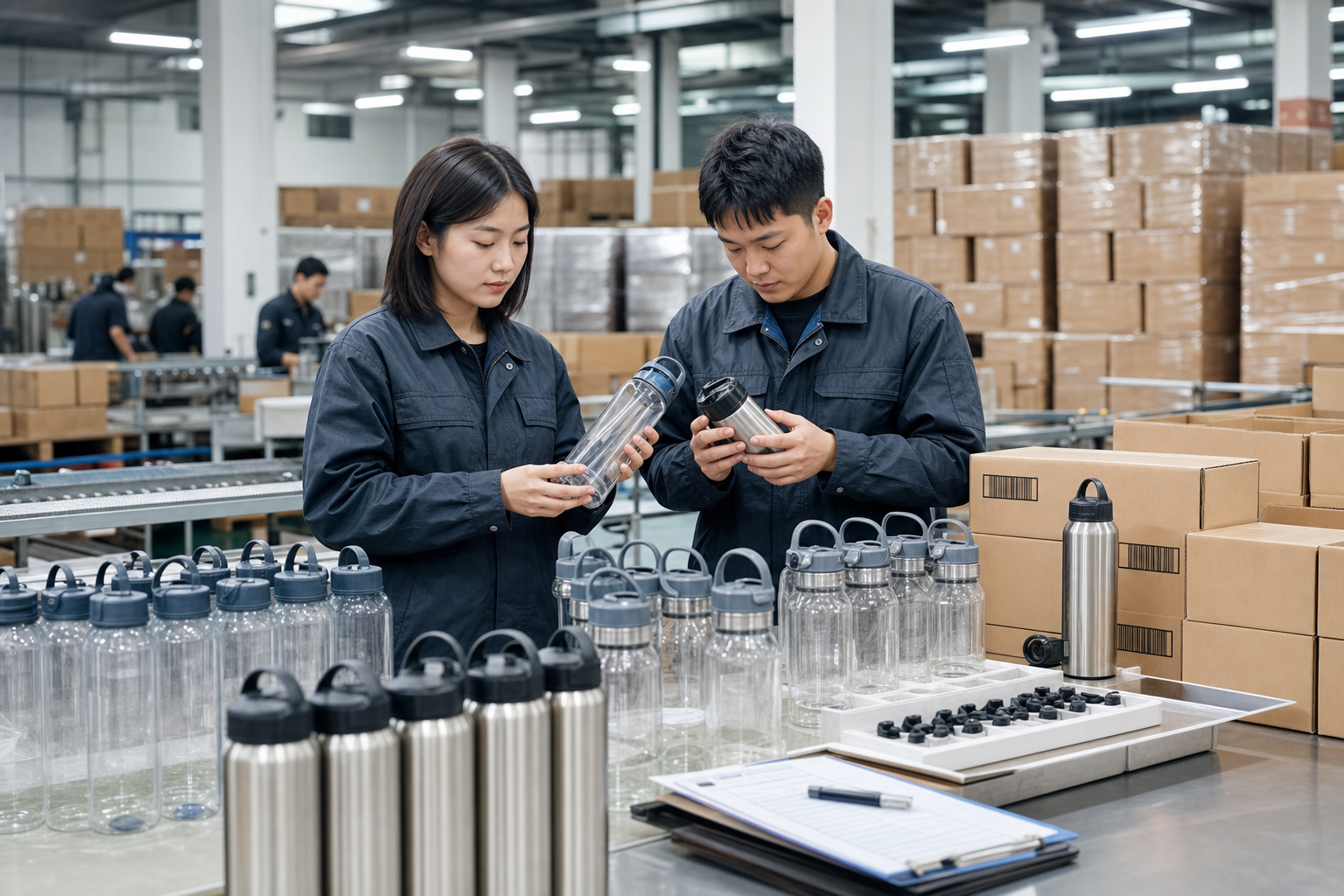
Do not buy wholesale canteen or wholesale drinkware from a factory that cannot prove its production rhythm. Ask for monthly output, line count, and whether they mold key parts in-house or buy them out. We run 8 injection machines, 4 welding lines, and 2 assembly lines here in Hangzhou, and that is the kind of setup a buyer can audit. BottleForge’s working benchmark is 300,000+ units/month across mixed drinkware lines, with a standard 25-35 day lead time after sample approval. I have seen orders go sideways when the supplier talked big but could only ship 40,000 units and kept blaming “busy season.”
Check compliance at the same time. For Europe, ask for REACH and, where relevant, LFGB for contact materials. For North America, ask for FDA food-contact declaration, plus CPSIA if the bottle is for kids. If you are sourcing bulk drinkware for Amazon or retail, carton labeling, FNSKU placement, and barcode verification all need to be clear before we cut packing materials. QC pulled one sample last month because the carton barcode was 2 mm off center; the buyer flagged it, and that one mistake would have held the whole shipment. This is the wrong question to ask if a factory “sounds compliant” — ask what they actually put on the carton and who checks it.
- Factory signal: 300,000+ units/month is a healthy benchmark
- Lead time: 25-35 days after approval, plus 7-10 days for complex decoration
- Compliance: REACH, FDA, LFGB, AQL 2.5/4.0, and carton barcode control
Order Smarter in Bulk
When you place a drinkware wholesale order, the job is not to chase every color and cap style. It is to cut risk. One body shape, one lid family, and a tight color set usually move faster than a catalog packed with mixed SKUs. For bulk drinkware programs, we ask buyers to lock in 2 or 3 core colors and let decoration handle channel differences. That keeps the mold running cleaner, cuts wear on the tooling, and makes replenishment easier to plan. On the line, a 2-cavity cap mold will tell you fast if the spec is too loose.
If you are building a promotional range, you may need related items like a bulk canteen, beer tumbler wholesale, or wholesale growler line for different end customers. Fine. Keep the sourcing logic tight. A beer growler wholesale bulk order should not be treated the same as a school sports bottle order, because the packaging, cap style, and freight density are different. The same goes for alcohol flask in bulk or alcohol flask wholesale orders: metallic finish quality and seam control matter more than capacity. We’ve seen buyers push for one mixed PO, then QC pulled the sample and found the matte coat passed on one item and failed on the next. In Zhejiang, the better suppliers are the ones who split the plan instead of forcing everything into one quote. The math does not work any other way.
Use this buying rule: if a feature does not improve sell-through or cut returns, remove it. That discipline saves money faster than arguing over USD 0.03 on unit price. Last month a buyer flagged a PO typo on lid color code, and the whole shipment would have gone out wrong if we had not caught it at packing.
Request a factory quote built for your channel
Send your target price, MOQ, and artwork. We will quote the right sport bottle, not the cheapest guess, from our Hangzhou line.
Frequently asked questions
What is the typical MOQ for the best wholesale sport bottle?
For standard customization, 1,000-3,000 pcs per SKU is normal. If you want new molds, special lids, or complex color matching, expect 3,000-5,000 pcs. A serious Zhejiang factory should give you a clear MOQ split for stock body, custom logo, and full private-label packaging. If the supplier cannot explain why the MOQ changes, they are guessing.
How much should I budget per bottle FOB?
A simple plastic sports bottle may start around USD 0.95-1.60 FOB. Mid-range Tritan bottles usually sit at USD 1.40-2.20 FOB. Stainless insulated bottles often land at USD 3.20-6.00 FOB. Add USD 0.06-0.25 for basic print, more for laser engraving or multi-color decoration. Packaging can add another USD 0.08-0.40 depending on box quality.
What testing should I require before shipment?
At minimum, ask for leak testing, drop testing, and AQL inspection. For Europe, request REACH documentation; for North America, ask for FDA food-contact declarations. If the bottle has insulation or a child-safe design, add thermal retention tests and CPSIA where relevant. AQL 2.5 for critical defects and 4.0 for major defects is a common baseline, but you should define it in the PO.
Can I source beer growler bulk or alcohol flask wholesale bulk from the same factory?
Yes, if the factory has metal forming, welding, and coating capability. But do not assume one production line can handle everything equally well. Beer growler wholesale bulk usually needs thicker gauge, better seam control, and stronger packaging. Alcohol flask bulk and alcohol flask wholesale often need tighter cosmetic standards and smaller packaging units. Ask for separate quotes and separate QC plans.
How do I reduce risk when ordering drinkware wholesale from China?
Start with a sample approval process, then lock the BOM in writing. Specify material grade, wall thickness, cap type, print method, carton spec, and acceptable color tolerance. Use a pre-production sample, then an in-line inspection, then a final AQL check before balance payment. If possible, work with a Zhejiang supplier that can show stable monthly output and a documented QC process rather than a trading-only model.