Key Takeaways
- A practical MOQ for custom wholesale thermal bottles is usually 500-1,000 units per SKU, with 25-35 day lead time from approved sample.
- For most wholesale drink bottle programs, 18/8 stainless steel with 0.5-0.6 mm wall thickness gives the best balance of cost and durability.
- For EU and North America, ask for REACH or LFGB where needed, plus ISO 9001, BSCI, and AQL 2.5/4.0 inspection records.
- A Zhejiang factory with 200,000+ units/month can support bulk drinkware, canteen wholesale, and growler bulk without stretching production.
If you are buying the best wholesale thermal bottle, the first mistake is treating every insulated bottle as the same. They are not. A 500 ml commuter bottle, a 1 L canteen, and a wide-mouth growler use different wall gauges, lids, gasket shapes, and carton layouts. On the line, we have seen a 0.8 mm wall pass sample stage and then dent in transit, or a lid that looks fine until QC pulled the sample and found a slow leak after a 12-hour tilt test. The math does not work if you ignore those details.
Good sourcing starts with the use case, not the catalog. You need a bottle that fits your channel, your margin, and your compliance target in Europe or North America. A serious factory in Zhejiang, China should quote the right structure, show drop and heat-retention data, and explain why one model beats another for wholesale drinkware. If the buyer flags a PO typo on capacity or coating code, we stop and fix it before production. If they cannot talk that way, keep looking.
Start With The Use Case
The best wholesale thermal bottle is the one that fits the buyer’s job. A retailer selling office gear usually wants a slim 500 ml bottle that slides into cup holders and laptop bags. We ship those all the time. A distributor serving outdoor channels may need a 750 ml or 1 L bottle with a wider mouth, a thicker base, and a cap that survives repeated drops. If the order is for a bulk canteen or wholesale canteen program, the brief changes again: bigger capacity, easier cleaning, fewer decorative parts.
Start with a simple spec sheet. Lock the capacity, target temperature retention, lid style, and finish before you ask for price. A 6-hour hot hold or 12-hour cold hold target is not enough on its own. Define the test condition: 95 C fill temperature, 25 C ambient, and a 24-hour reading. QC pulled the sample at 24 hours on our bench last week, and the buyer flagged it because the claim did not match the test setup. That is the wrong question to ask if the numbers are loose. Compare drinkware wholesale quotes only after the test method is fixed.
Shape matters too. Straight-wall bottles are cheaper, and the line runs faster on them. Curved or tapered bodies cost more to form and pick up dents in transit; we have seen that go sideways in a carton drop test. For a best wholesale drink bottle program, that geometry choice changes carton count, pallet fit, and shipping cost per unit. One PO typo on a 48 mm lid once turned into a reprint and a 12-day delay.
Choose The Right Construction
Material choice is where a lot of bulk drinkware orders go off the rails. We usually start with 18/8 stainless steel, which means 304 stainless for the inner and outer shells. That is still the safest default for wholesale drinkware because it holds up against corrosion, we can source it fast in Zhejiang, and it takes pad print or laser marking cleanly. If the buyer wants stronger resistance for salty water or acidic juice, 316 stainless is the upgrade, but the math does not work for most mainstream thermal bottle programs. On a 5,000 pcs order, the price jump shows up fast.
Wall thickness matters more than most buyers think. A 0.5 mm shell is standard for mid-market runs. Go to 0.6 mm if the bottle will live in travel retail, outdoor, or club channels. We have seen 0.45 mm spec sheets get rejected after one dent test on the line. You save metal below that, then lose rigidity and dent resistance. Ask for the vacuum gap spec, the mouth finish, and the gasket material. Food-grade silicone is normal. Cheap TPE gaskets look fine on paper, then QC pulled the sample after hot-water cycling and the buyer flagged the smell.
What to verify on the sample:
- Inner and outer steel grade certification
- Vacuum seal integrity after drop testing
- Lid thread alignment and gasket fit
- Odor neutrality after hot-water cycling
For niche shapes such as beer growler wholesale, beer growler in bulk, or growler bulk programs, the same rules apply, but the lid and shoulder geometry matter more because the neck takes the load. We once found a 1.2 mm mismatch on the cap thread, and that small typo on the PO turned into a full rework. This is the wrong question to ask: not “can we make it look right,” but “will it survive 12 days in transit and a rough handoff at delivery?”
MOQ, Price, And Lead Time
Price only makes sense after you map the order. A standard 500 ml stainless thermal bottle with a basic powder coat usually lands at FOB USD 4.20 to USD 6.30 at 1,000 units. Add laser engraving, a premium flip lid, or a two-tone finish, and the number moves to USD 6.80 to USD 8.90. A 1 L bottle costs more, plain and simple, because the steel usage goes up and the inner carton needs a larger die-cut; we once caught a PO typo that changed 1 L to 0.75 L, and the buyer flagged it before we cut the line.
MOQ is driven by tooling, decoration, and packaging. A stock shape with custom logo can start at 500 units, while a fully custom bottle usually sits at 1,000 to 3,000 units per color. If a supplier says 100 units for a custom project, ask what they are hiding. The math does not work. On our side, a line that runs 200,000 units per month can keep your repeat orders moving without stealing capacity from other jobs, and that matters when the buyer asks for the same bottle again in 45 days.
Lead time for a normal order is 25 to 35 days after sample approval and deposit. That assumes no new tooling delay. For a retail launch or Amazon order, add carton testing, labeling, and pallet layout to the schedule. We ship beer tumbler bulk, beer tumbler in bulk, and alcohol flask in bulk jobs under similar timing, but the packing rules change fast; QC pulled the sample last week because the ink on the warning label sat 2 mm off-center, and that cost us a day.
Test The Compliance Path
Compliance is a buyer risk filter, not a checkbox. For Europe, ask for REACH coverage and LFGB food-contact testing where the market needs it. For North America, ask for FDA food-contact declarations and, if the buyer pushes, migration data from a recognized lab. “Safe material” is noise. We ask for the test report, the sample reference, and the issue date. If the report belongs to a different resin, lid, or print ink, it does not protect your order. On the line, we have seen a 500 ml bottle pass with one cap and fail with a swapped gasket.
Quality control needs a written inspection plan. A factory with ISO 9001 procedures and a BSCI audit is easier to manage when social compliance is in scope. For production inspection, AQL 2.5 is common for major defects, while AQL 4.0 can work for minor appearance issues depending on the program. The checks are straightforward: vacuum leak testing, 1 meter drop testing, insulation performance, and carton compression or drop tests for export. QC pulled the sample on a 350 ml thermo bottle last month and found a 1.8 mm cap gap, which would have turned into a leak claim later.
Ask for wash-cycle validation too. A practical benchmark is 50 dishwasher cycles for printed bottles, and the ink or coating will decide how close the result gets. If the buyer sells through retail or e-commerce, this paper trail cuts returns and gives you something solid when the buyer flags a print fade or a lid mark. We ship at scale, so this is the wrong question to ask after the PO is signed. One typo on a PO can also change the spec, and we have seen a lid code mismatch quietly kill the test result.
Decoration Changes The Offer
Decoration changes cost, lead time, and the usable print area. On our line, silkscreen is still the cheapest choice for one or two colors on a straight wall. Laser engraving costs more per unit, but it stays clean on brushed steel and holds up after 20 or 30 wash cycles, which is why buyers keep it in premium wholesale thermal bottle programs. Powder coat gives a tougher retail look and hides scuffs better. UV print is the pick when the artwork needs more color and a sharper brand story.
The right decoration depends on the channel. For a private-label Amazon launch, we usually run a simple logo, one color, and a matte body color that photographs well. For club channels or event merch, a larger logo and stronger contrast can win the sale. For alcohol flask wholesale or alcohol flask wholesale bulk programs, the bottle shape is smaller and the logo zone is tighter, so the decoration choice matters fast. The same goes for a compact beer tumbler wholesale line. The buyer flagged it on a 42 mm print area before, and we had to redesign the art.
Be precise about Pantone references, logo size in millimeters, and placement. Ask for a decoration strike-off or pre-production sample. That is the only way to see if the logo bends over a curve, if the ink density stays even, and if the cap or base cuts into the mark. QC pulled the sample on one order because the PO typo moved the logo 8 mm too high. A good supplier will tell you when the design needs to be simplified. A weak one will say yes and let the problem show up after shipment.
Vet The Supplier Properly
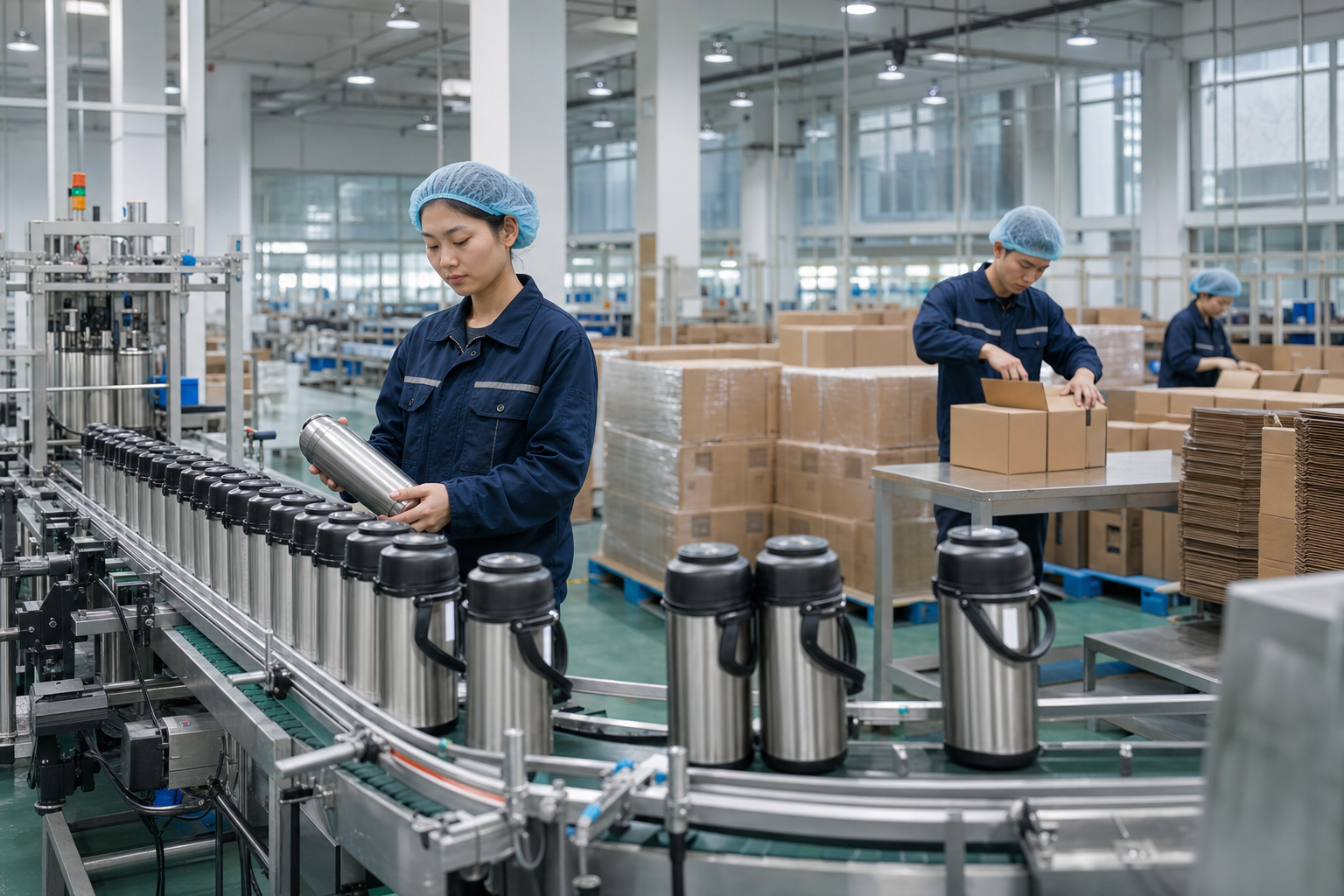
Check whether the supplier can repeat quality at scale. Start with the line, not the sales pitch. Ask how many assembly lines they run, the monthly output in pcs, and whether they make bottles, lids, and cartons in-house or push them to outside shops. A factory in Zhejiang with metal forming, polishing, coating, and packing under one roof usually gives steadier lead times than a trader juggling three subcontractors. We’ve seen that save a refill program when the buyer wanted the second PO in 18 days, not 28.
Request the sample plan before you pay. Get the exact count: 2 samples, 3 samples, or a full pre-production set. Ask whether the samples are hand-built or pulled from the production line, and what sign-off comes before mass production starts. Then check carton markings, barcode placement, and whether they can print FNSKU labels for Amazon. One typo on a PO can turn into 500 wrong cartons at the warehouse, and QC pulled the sample for that exact mistake on a 500 ml bottle run.
Use this supplier checklist:
- Factory audit or recent BSCI report
- Current ISO 9001 certificate
- Material and migration test files
- Written AQL inspection standard
- Clear Incoterm, usually FOB or EXW
If the factory cannot explain reject rate, rework policy, and sample retention, walk away. This is the wrong question to avoid. Ask for the numbers. The best wholesale thermal bottle supplier will show records, give you the defect rate, and tell you how they hold samples for 12 months before the next order ships.
Get a spec-matched thermal bottle quote
Send your capacity, lid style, and target market. We will quote the right wholesale drinkware build, MOQ, and packaging for your channel.
Frequently asked questions
What material should I choose for a wholesale thermal bottle?
For most programs, 18/8 stainless steel is the right default. It gives you good corrosion resistance, stable forming, and predictable cost. A typical build uses 0.5 mm wall thickness for standard retail or 0.6 mm if the bottle is going into travel, outdoor, or high-return channels. If your customer needs stronger chemical resistance, 316 stainless is an option, but it increases cost and is usually unnecessary for ordinary wholesale drinkware. Ask the supplier for steel grade proof, gasket material details, and vacuum performance data. A solid factory should also tell you whether the lid uses PP, Tritan, or stainless components and how that affects heat retention and leak risk.
What MOQ should I expect for custom logo bottles?
A realistic MOQ for custom logo thermal bottles is 500 to 1,000 units per SKU for a stock shape, and 1,000 to 3,000 units if you want color changes, packaging changes, or a custom mold. If someone offers 100 units for a fully custom project, they are usually quoting a stock item with a simple logo, not a true private-label build. For buyers in Europe or North America, the better way to think about MOQ is by total launch risk, not just unit count. A slightly higher MOQ often gets you cleaner packaging, better QC, and a lower defect rate, which matters more than a few cents on unit price.
How do I compare prices from China suppliers fairly?
Compare the full landed structure, not only FOB price. A bottle quoted at USD 4.50 may become expensive if it uses thin steel, weak lids, or oversized cartons. When comparing suppliers from China, check material grade, wall thickness, print method, lid quality, packing count per carton, and whether the price includes export cartons or only inner boxes. You should also confirm whether the quote assumes 500, 1,000, or 5,000 units, because price drops fast as the order volume rises. The best comparison method is a spec-matched sheet with identical capacity, finish, and decoration, then add freight, duties, and warehousing to find the true cost.
Do I need REACH or LFGB for Europe?
It depends on the market and customer requirements, but for most EU-bound drinkware, you should expect the supplier to support REACH-related compliance and, when food-contact evidence is needed, LFGB testing or equivalent migration data. Do not rely on a generic “food safe” statement. Ask for reports tied to the actual bottle body, lid, gasket, and ink set you are buying. If the factory uses a different coating or print system on another order, the old report does not transfer automatically. A good supplier will know how to prepare the material declaration, test sample references, and batch traceability records so your customs or retail team can review them without delays.
Can one factory handle growler bulk and alcohol flask projects too?
Yes, if the factory has the right forming and sealing equipment. A capable plant can produce growler bulk, beer growler wholesale bulk, and alcohol flask wholesale bulk items alongside standard thermal bottles, but you should not assume the same tooling, lid systems, or decoration rules apply. A growler usually needs a wider mouth and stronger closure, while a flask-style product has a smaller capacity and tighter print zone. Ask the supplier whether they already make similar shapes, what their leak test standard is, and whether the packaging has been validated for export drops. If they only make one bottle shape, they may still be usable, but the risk on a new format is higher.