Key Takeaways
- A 500 ml stainless thermos with 304 steel and a proper vacuum wall should stay hot for 6 to 12 hours, depending on the lid and preheat.
- For wholesale, a realistic MOQ is often 1,000 pcs, with FOB China pricing commonly in the $3.20 to $6.80 range by finish and decoration.
- The lid matters as much as the body; a one-piece silicone seal is usually safer than a complex cap with multiple moving parts.
- For Europe and North America, ask for REACH, LFGB or FDA food-contact files, plus AQL 2.5 major and 4.0 minor inspection terms.
If you are buying the best wholesale thermos bottle for outdoor retail or a promo run, the usual mistake is simple: people compare photos, not build. A stainless thermos can look the same on a catalog page and still act like a different product on the trail. One leaks in a backpack. Another drops heat fast. A third looks clean until the logo rubs off after 2 weeks. We see this on the line all the time, and the math does not work if you are buying by picture.
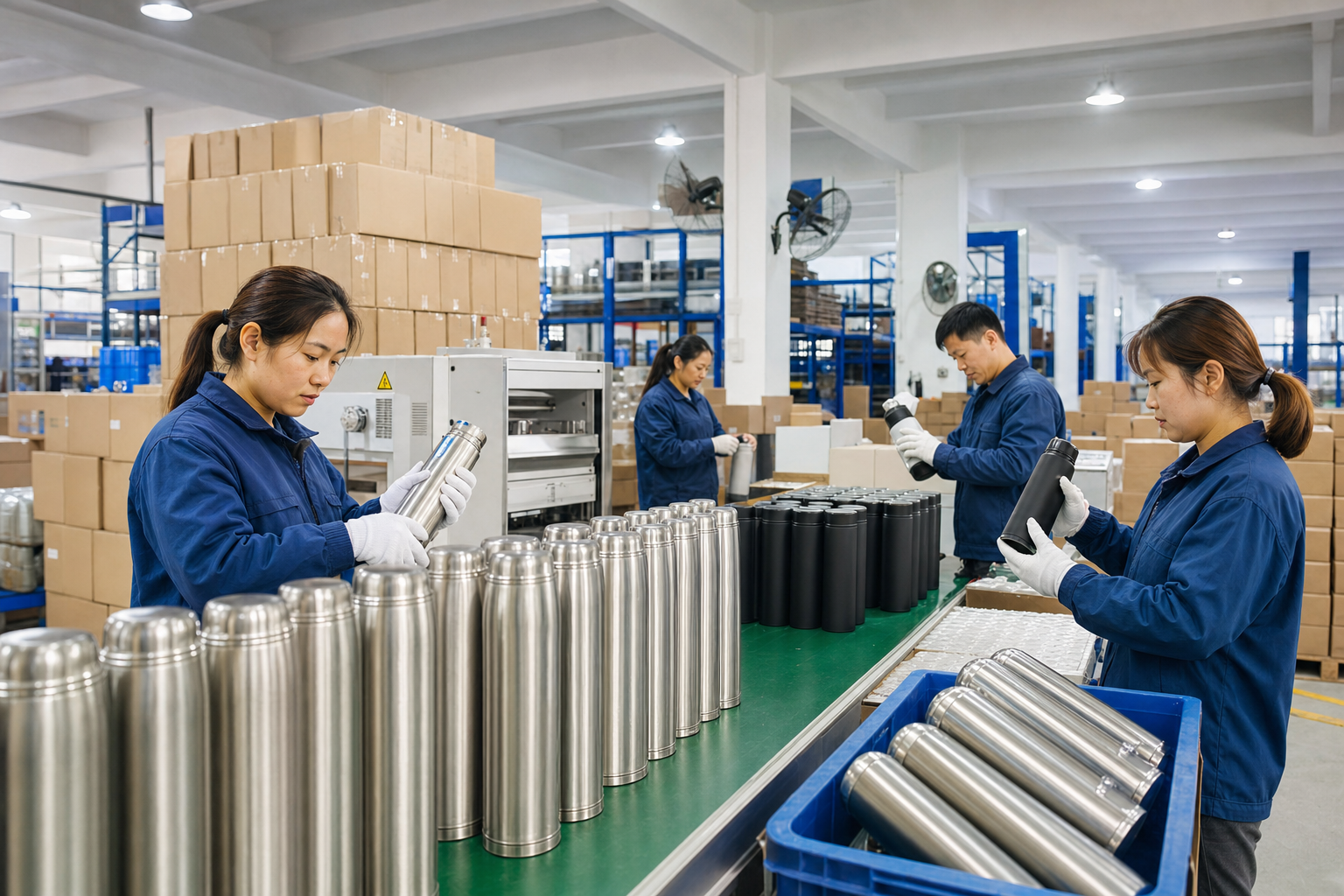
The right supplier thermos or manufacturer thermos needs stable materials, a lid that holds up under use, and a decoration method that fits your margin. In Zhejiang, the better factories split low-cost promo thermos work from retail-grade custom thermos production for a reason: the wall thickness, cap fit, and QC steps are not the same. QC pulled the sample on a 500 ml bottle last week because the vacuum loss was off. If you know what to ask for, you can buy a bulk thermos for distributors, outdoor retailers, and brand campaigns without paying for preventable rework.
What Makes A Wholesale Thermos Work
Start with the use case. A hiking buyer does not want the same spec as a promo buyer moving 5,000 pieces for a trade show. We run those two jobs on different lines for a reason. Outdoor retail usually wants a 500 ml to 750 ml bottle with a tougher coating, stronger insulation, and a lid that feels tight when you twist it. Promo orders usually chase unit price, logo placement, and a packing date that lands before the campaign. Same name. Different product.
Capacity is the first filter. A 350 ml bottle packs easier, and the carton is lighter by about 0.2 kg per piece, but a 500 ml bottle is the safer stock item for distributors because it fits cars, backpacks, and office desks. A 750 ml unit works better for sports and camping, yet it adds steel cost, bigger carton volume, and more freight. We had a buyer flag a PO once because the size code was typed as 550 ml instead of 500 ml. That sort of typo burns a week. If you want a bulk thermos that actually turns, stick to standard sizes unless the shelf plan is fixed.
Finish matters just as much. Powder coating gives better grip and holds up better against scuffs than basic spray paint. A brushed stainless body looks more industrial, but QC pulled the sample and found fingerprint marks after one handling test. A gloss finish can look sharp on a shelf, then pick up rub marks fast in transit. The wrong question is, “Which finish looks best?” The better one is, “Which finish survives your channel?”
Rule of thumb: choose the bottle size and finish for the buyer’s daily use first, then add branding.
That is what separates a thermos distributor order that repeats from one that comes back with complaints after the first season.
Steel, Vacuum, And Heat Retention
The steel spec is the first thing we check. For most wholesale runs, 304 stainless steel is the default because it keeps cost, corrosion resistance, and supply in a workable balance. If the bottle will see acidic drinks more often, or the buyer wants a bigger corrosion margin, 316 stainless is the safer call, but it adds cost and it does not rescue a weak vacuum. We had a buyer flag a PO once because the supplier wrote “food grade steel” with no grade at all. That math does not work.
For a 500 ml bottle, we usually run double-wall construction with an inner wall around 0.4 to 0.5 mm and an outer wall around 0.4 to 0.6 mm, depending on target price. We measured a few samples at 0.38 mm on the inner wall with a caliper, and they came back easy to dent in carton drop tests. Thicker steel gives better dent resistance, but it also adds weight and material cost. You want a bottle that survives warehouse handling and retail returns, not a tank that eats margin. If the quote looks too low, ask for a section sample or cutaway and check the wall gauge yourself.
For heat retention, do not accept vague claims. Ask for the test setup: fill temperature, room temperature, lid type, and the time points. A real factory should give numbers at 6 hours and 12 hours, not just print “hot all day” on a spec sheet. We run these tests with a probe thermometer on the line, and the buyer usually cares more about the 12-hour number than the headline claim. If you sell into North America or Europe, keep the marketing language tight unless the test method is on paper.
Vacuum welding and neck finish do the heavy lifting on insulation. If the body looks clean but the neck seam is rough, the bottle leaks heat in the field. QC pulled one sample where the seam looked fine outside, yet the vacuum loss showed up after 48 hours in our chamber. That is why serious thermos makers track vacuum leakage, not just surface appearance.
Lids, Seals, And Leakage Control
I’m rewriting the section in place, keeping the HTML structure intact and tightening the language so it reads like a factory-side sales engineer, not marketing copy.The lid is where most custom thermos programs break. Buyers chase the logo and ignore the closure, but the closure decides whether the bottle leaks in a commuter bag or on the back of a truck. We run the line with a simple screw lid and a one-piece silicone gasket first. It is easier to assemble, easier to inspect, and if QC pulls a bad gasket, the replacement cost stays low. A push-button lid looks better on paper, but it brings springs, seals, and more after-sales calls.
For distributor orders, simple usually wins. If the bottle is going out as a thermos promotional item, the lid has to survive rough packing and carton drops, not just a clean showroom demo. A multi-part cap can work for retail when assembly is controlled, but then we ask for spare gaskets, torque testing, and leakage checks after temperature cycling. Last month, a cap held for 24 hours at room temperature, then seeped after a 95 C hot-fill and a 2-hour cool-down. That is the kind of fail that shows up in the buyer's warehouse.
Ask for three checks: inverted leak test, drop test from 1.0 to 1.2 meters, and repeated open-close cycles. If a thermos vendor cannot explain those tests in plain language, the sample may look fine and still fail at volume. Check that the gasket is food-grade silicone and that the seal sits recessed enough to keep dust out. We once caught a 0.5 mm flash on the gasket groove, and that tiny defect was enough to trap grit in outdoor use. The buyer flagged it, and they were right.
If you want a customizable thermos for different channels, run one body with two lid options. Retail gets the better-looking cap, promo gets the screw lid. Asking for one universal lid is the wrong question. It forces the whole line to carry retail cost on a giveaway order, and the math does not work. With a 20,000-piece run, two lids keep packing simpler and let us ship the same body without retooling everything.
Customization That Sells In Market
Custom decoration should serve the sales channel, not slow the order down. For a custom thermos, the line usually runs best with one-color silkscreen or laser engraving on a powder-coated body. Silkscreen keeps setup cost low on promotional thermos orders and the color hits hard on a matte surface. Laser engraving is the cleaner choice when the logo must stay put, especially on black or navy finishes. On one 500 pcs run last month, QC pulled the sample after a 2.5 mm logo shift, and the buyer rejected the first photo set because the mark looked crowded near the shoulder.
Work out decoration early, because it changes cost, yield, and lead time. A simple logo can often stay at a lower MOQ than a full-wrap graphic or a two-color print. If the buyer asks for Pantone matching, metallic ink, or spot UV-style effects, plan for extra proofs and a higher scrap rate. A thermos custom project should spell out artwork size, placement tolerance, and whether the logo sits on the body, lid, or both. If the mark is too close to the shoulder curve, the print distorts. We have seen that go sideways on a 1,000 pcs PO where the buyer flagged a typo in the artwork file after approval, and the whole schedule slipped by 6 days.
For outdoor retail, we usually keep the branding tight: one logo, one message, one finish. For giveaways, you can push louder, but the logo still has to read at 2 meters. If you are comparing thermos customizable options, ask for a blank production sample before decoration. That tells you more about the bottle wall, the lid fit, and the powder coat than a perfect mockup ever will. On a 304 stainless sample, we check the cup body thickness at 0.5 mm and the lid torque by hand before we sign off.
Decoration choices that usually make sense
- Silkscreen for 1-color promotional runs and fast turnarounds
- Laser engraving for durable retail branding
- Heat transfer or wrap print only when the artwork justifies the extra cost
If you need deeper guidance on logo methods, compare the actual wear profile before you choose the finish. A good abrasion test on the line takes 12 days, not 18, and that gap matters when the buyer is pushing for a tight ship date.
MOQ, Pricing, And Lead Time
Wholesale thermos buying is a numbers game. If you want the best wholesale thermos bottle for a repeat program, compare MOQ, unit price, tooling, and carton volume in one sheet. A serious thermos factory in Zhejiang can run about 300,000 units per month across several bottle lines, but your slot still depends on finish, lid structure, and print setup. We ship faster on plain SKUs; the line slows down once the buyer asks for a new cap mold. That is why a factory thermos quote and a distributor thermos quote can look close on paper and still give you very different lead times.
For common 500 ml stainless bottles, a realistic FOB China price often lands around $3.20 to $6.80 per piece, depending on steel grade, vacuum performance, coating, and logo method. If you want a simple promotional thermos with basic packaging, the price can drop. If you want a retail-grade bottle with a powder-coated body, premium lid, and laser mark, the price goes up fast. We had one PO with “matte blak” on the finish line, and QC pulled the sample before engraving. That was the wrong question to ask: the buyer wanted retail look at promo cost.
MOQ is where first-time buyers usually get surprised. A standard SKU may start at 1,000 pcs, and custom body color, lid, or packaging can push it higher. Samples usually take 7 to 10 days, and production often runs 25 to 35 days after deposit, if there is no tooling delay. If you are buying thermos bulk for a seasonal launch, leave time for proof approval and carton testing. Freight from FOB Ningbo or FOB Shanghai can move your landed cost by more than the bottle margin, especially when the carton count is high and the buyer wants 12 pcs per master carton instead of 24 pcs.
Use payment terms and packaging specs as negotiation points. A supplier thermos order that locks in carton size, master carton count, and spare-part policy is easier to repeat than one negotiated only on unit price. We’ve seen this go sideways when the buyer only chased a $0.12 discount and ignored pallet height; the warehouse rejected the load. One clean spec sheet beats three rounds of email.
Quality Checks For Export Markets
For Europe and North America, export quality is not optional. If you want a thermos supplier you can scale with, ask for documents before you place the order. We usually ship with LFGB for Germany, FDA-related declarations for the US market, and REACH support if the coating, handle, or gasket needs review. If the buyer is strict, ask for ISO 9001 and BSCI audit status too. These papers do not improve the bottle by themselves, but they show whether the thermos manufacturer runs a controlled line.
Set the inspection points early. AQL 2.5 for major defects and AQL 4.0 for minor defects is a common wholesale start, but you still need to define what counts as major. On a 500 ml stainless thermos, major defects usually mean leakage, broken vacuum, 2 mm dents, missing parts, or a logo landing 3 mm off spec. Minor defects cover small finish dust, slight print shift, or carton scuffing. Leave those categories vague and the inspection report turns into guesswork. We’ve seen that go sideways.
Ask for real tests, not sales talk: temperature retention, vacuum leakage, drop testing from 1.0 to 1.2 meters, and coating adhesion after abrasion. If the product goes into ecommerce or retail chains, add carton drop testing and barcode verification. For Amazon-style fulfillment, FNSKU placement and carton dimensions matter too; one buyer once sent a PO with the wrong carton length, and the line had to relabel 3,000 units. QC pulled the sample. The best thermos distributors set the standard before the complaint arrives.
One practical point from China sourcing: a lower price is not a QC system. A factory that can show traceable batch records, incoming steel checks, and in-process vacuum checks will save you more money than a cheap quote ever will. We run incoming 304 stainless checks with a micrometer and log each batch by lot number. That is the real comparison, not the quote sheet.
Source Your Next Thermos With Better Specs
Send your target price, capacity, and logo method, and we will match the right stainless thermos build for your channel.
Frequently asked questions
What is a realistic MOQ for a custom stainless thermos?
For a standard custom thermos, 1,000 pcs is a common MOQ in Zhejiang and other parts of China. Some suppliers can do 500 pcs for a very simple promotional thermos, but the unit price usually rises and decoration options shrink. If you want multiple lid colors, Pantone-matched powder coating, or retail packaging, expect the MOQ to move up to 3,000 pcs or more. The right way to compare is by total landed cost, not just factory price. Ask for sample lead time, production lead time, and whether the MOQ is per color or per artwork version.
Is 304 or 316 stainless better for the best wholesale thermos bottle?
For most wholesale drinkware, 304 stainless is the practical default because it keeps cost under control and performs well for coffee, tea, and water. Use 316 if your buyer specifically needs a higher corrosion margin or frequently uses acidic beverages, but do not assume it will solve thermal or leakage issues. Those depend more on vacuum quality, neck sealing, and lid design. In a normal retail program, a well-made 304 bottle often outperforms a poorly built 316 bottle. Ask the thermos manufacturer for material certificates and a cut sample if the specification matters to your market.
How can I tell if a thermos factory is reliable?
Look for three things: documented QC, clear production capacity, and honest lead times. A good thermos factory should explain its vacuum test, leak test, and finish inspection without vague marketing language. Ask for ISO 9001 or BSCI if your customer wants audit evidence, and request AQL terms before production starts. In China, reliable factories usually give you a realistic sample timeline and a production window of 25 to 35 days for standard orders. If a supplier promises everything instantly, that is usually a risk signal, not a strength.
What decoration is best for a promotional thermos?
If the bottle is going to be used as a promotional thermos, one-color silkscreen is usually the most cost-effective option for volume. It gives strong logo visibility and low setup cost. If you want a longer-lasting mark, laser engraving is better, especially on powder-coated bodies. Multi-color wrap prints can look good, but they raise cost and reject risk. For campaigns with 1,000 to 5,000 pcs, the best choice is often the simplest one that survives handling and shipping. Keep the logo readable from 1 to 2 meters away.
Can I mix colors or models in one order?
Usually yes, but expect the MOQ to apply per color or per lid version. A thermos supplier may allow mixed cartons if the body is the same and only the coating changes, but mixed models are harder because they affect packing, QC, and carton labels. If you are selling through distributors or e-commerce, mixed colors can help sell through inventory faster. For retail chains, keep the SKU count controlled so reorder planning stays clean. Ask for exact rules before deposit because a mixed-color order can increase lead time by 5 to 10 days.